
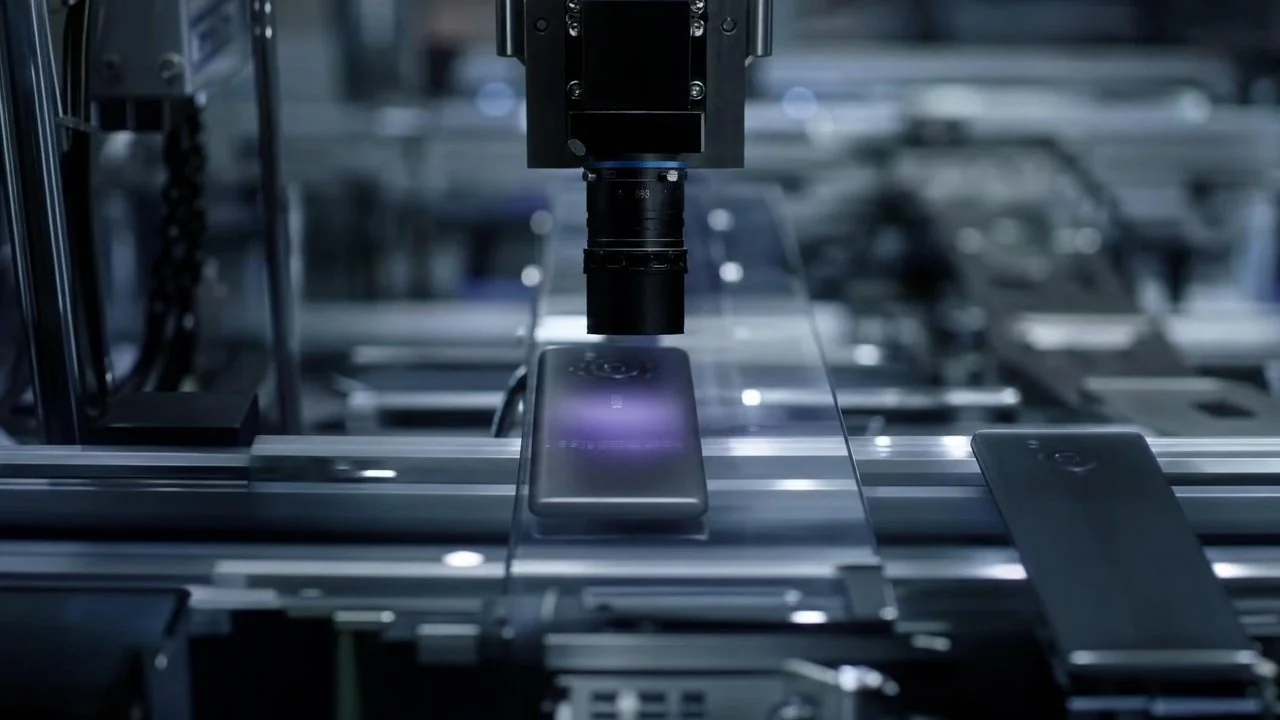
In the consumer product manufacturing sector, product appearance, especially the quality of brand logos and critical silk-screen prints, directly influences consumer perception and purchasing decisions. DaoAI 2D ACI equipment (high-resolution 2D imaging + deep learning secondary judgment, targeting surface/print/character OCR/assembly omissions and other planar defects, high-speed inline full inspection, micron-level, semantic false positive filtering) leverages its advanced vision inspection technology and local private deployment capability to reduce the leak detection rate for body logo silk-screen defects from a typical 1.5% in traditional manual inspection and rule-based AOI to below 0.3%, ensuring an immaculate brand image. This not only boosts the product's ex-factory qualification rate but also, in an era of increasing data security concerns, builds an impregnable data defense for enterprises.
Pain Points: Why This Hurdle Is Difficult to Overcome
Quality inspection of consumer product body logo silk-screens faces multiple challenges. Firstly, defect types are diverse and subtle, including ink spots, broken lines, uneven color, misalignment, blurry characters, and scratches. These defects are often at the micron level, making manual inspection highly prone to fatigue and missed detections, especially on high-throughput production lines, where the leak detection rate often exceeds 1.5%. Secondly, traditional rule-based AOI struggles to adapt to the complexity and variability of logo designs. New products or minor design adjustments require significant time for rule library updates and parameter tuning, leading to long changeover downtime, averaging 2-4 hours per changeover. Furthermore, for companies highly sensitive to brand reputation and intellectual property, the potential for data leakage and compliance concerns arises if production image and defect data are uploaded to the cloud for processing. This is particularly critical in industries like automotive manufacturing, which demand extremely high data security, requiring data to remain on-premises. Finally, traditional solutions suffer from high false positive rates, potentially reaching 5%-10%, leading to numerous good products being misidentified as defective, increasing manual re-inspection workload by 70% and unnecessary rework costs, impacting overall production efficiency and cost control.
The root cause of these difficulties lies in the inherent complexity of the silk-screen printing process and the limitations of traditional vision inspection technologies in handling unstructured defects and adapting to varied scenarios. Factors such as ink fluidity, substrate surface properties, printing pressure, and environmental temperature and humidity all affect the final result, leading to diverse and random defect morphologies. Simultaneously, consumer aesthetic demands for product appearance are continuously rising, where even minor blemishes can impact brand image. Traditional rule-based AOI relies on engineers' pre-set fixed thresholds and geometric rules, making it ineffective in identifying 'semantic-level' defects that lack clear boundaries or irregular shapes, and it cannot generalize learning like the human brain. WeLinkirt deeply understands these challenges and is committed to providing breakthrough solutions through its 2D ACI equipment.
Technical Principles
The core of WeLinkirt's DaoAI 2D ACI equipment lies in the synergistic combination of its high-resolution 2D imaging system and deep learning secondary judgment engine. First, the equipment employs industrial-grade high-resolution cameras and customized lighting to capture micron-level details of product body logo silk-screens, ensuring that even the most subtle defects are clearly imaged. This image data is then fed into DaoAI's powerful deep learning vision models for analysis. Unlike traditional rule-based AOI, which relies on manually set thresholds, WeLinkirt utilizes deep learning models, such as Convolutional Neural Networks (CNNs), trained on vast image datasets. These models can autonomously learn features from abundant good and defective samples, identifying texture, color, and morphological anomalies that are imperceptible to the human eye.
Its key advantages include 'semantic false positive filtering' and 'positive/few-shot learning' capabilities. Traditional rule-based AOI often misidentifies normal process variations or background textures as defects, leading to high false positive rates. WeLinkirt's DaoAI deep learning models, through extensive real-world data learning, can understand 'what constitutes a defect' and 'what is normal,' thereby effectively distinguishing true defects from background noise, reducing the false positive rate by 75%. Furthermore, with APDT positive/few-shot learning technology, only 1–20 good sample images are needed to complete model training and changeover for new products or logos within 5 minutes, significantly shortening the traditional solution's changeover cycle of several hours or even days. This technological architecture of WeLinkirt's DaoAI 2D ACI equipment demonstrates exceptional adaptability and accuracy, achieving a defect detection rate of 99.4% in complex and varied consumer product appearance inspection scenarios.
Typical Application Scenarios
- **Logo Print Integrity and Clarity Detection:** Detects whether logo edges are clear and free of burrs, and if characters are broken, blurry, or missing. The challenge lies in reflections and texture differences on various material surfaces, as well as the inherent complexity of logo designs. DaoAI addresses this effectively through multi-angle lighting and deep learning generalization capabilities.
- **Silk-Screen Color Consistency and Uniformity Detection:** Evaluates whether logo colors meet standards and if there are color deviations, uneven ink, or missing prints. The difficulty is that human eyes have limited sensitivity to subtle color differences, and different ink batches may have slight variations. DaoAI 2D ACI can perform precise color quantitative analysis to ensure consistency.
- **Character OCR and Content Verification:** Conducts optical character recognition (OCR) on silk-screened characters such as serial numbers, batch numbers, and model numbers, then cross-references them with a database to ensure accuracy. Challenges include character deformation, smudges, or poor printing leading to recognition errors. WeLinkirt supports recognition of various fonts and complex backgrounds, with a detection rate up to 99.8%.
- **Surface Foreign Object and Scratch Detection:** In addition to printing itself, the equipment can detect foreign objects like dust, fibers, oil stains, and mechanical damage such as scratches or dents in the logo area. These defects are often tiny and easily confused with logo details, making them difficult for traditional methods to distinguish, but DaoAI 2D ACI performs high-precision identification.
- **Assembly Omission and Misalignment Detection:** Checks whether the logo silk-screen is accurately positioned on the product, if there is any offset or tilt, or if its relative position to other components is correct. This is crucial for ensuring overall product aesthetics and functionality, and WeLinkirt achieves high-precision detection through accurate geometric positioning algorithms.
Case Study
A leading manufacturer specializing in high-end smart home products considered the quality of their product body logo silk-screens critical to their brand image. Previously, the manufacturer relied on manual inspection and an outdated rule-based AOI system for quality control. However, as product lines expanded and designs grew in complexity, the shortcomings of traditional solutions became increasingly apparent: the leak detection rate was as high as 1.2%, leading to hundreds of defective products entering the market each month and triggering consumer complaints. Simultaneously, the rule-based AOI had an 8% false positive rate, sending a large volume of good products to manual re-inspection, consuming 70% of the work time of a nearly 20-person QC team. What concerned them more was that to improve system performance, the vendor suggested uploading some data to the cloud for model optimization, which conflicted with the company's strict data security policies.
After implementing WeLinkirt's DaoAI 2D ACI equipment, the situation changed significantly. The manufacturer chose WeLinkirt's 100% local private deployment solution, ensuring all inspection images and model training were completed on internal enterprise servers. This guaranteed absolute security for core data, fully meeting their strict data-on-premises requirement. During commissioning, WeLinkirt engineers completed equipment integration and initial model training in just one week. With APDT few-shot learning, changeover time for new product models was reduced from the original 3 hours to 8min. Now, the leak detection rate for logo silk-screen defects on this production line is consistently below 0.2%, the false positive rate has decreased by 75%, and manual re-inspection volume has been drastically reduced. The QC team is now freed from repetitive tasks to focus on higher-value work. The successful implementation of WeLinkirt's DaoAI 2D ACI equipment not only resolved the manufacturer's quality inspection pain points but also built a robust data security barrier.
WeLinkirt DaoAI 2D ACI's local private deployment is not just a technological breakthrough, but a firm defense of enterprise data sovereignty.
WeLinkirt Solutions and Products
WeLinkirt's DaoAI 2D ACI equipment provides an end-to-end solution for consumer product body logo silk-screen defect detection. Its core strength lies in the DaoAI ACI OS, which features a built-in visual foundation model with powerful feature recognition capabilities. It supports 'one good sample, 5 minutes, 0-code automatic programming,' significantly lowering the barrier to model deployment and maintenance. For new products or design modifications, APDT positive/few-shot learning (requiring only 1–20 good samples) enables rapid model iteration, ensuring efficient production line operation. Furthermore, DaoAI's semantic false positive filtering effectively addresses the high false positive rates of traditional AOI, significantly reducing the manual re-inspection workload. For deployment, WeLinkirt offers SDK / API / Docker multiple integration methods, supporting 100% local private deployment to ensure all sensitive data remains on-premises, meeting stringent customer data security and compliance requirements. Through the unified foundation of the DaoAI World Model, the system gains semantic understanding, cross-scenario generalization, and continuous learning from production line feedback, further enhancing the intelligence and adaptability of detection. WeLinkirt is committed to building an intelligent quality inspection platform for customers that is both efficient, precise, and secure.
By deploying WeLinkirt's DaoAI 2D ACI equipment, the client achieved significant business value. The leak detection rate decreased from 1.2% to <0.2%, effectively preventing brand image damage and consumer complaints. The false positive rate was reduced by 75%, substantially cutting down manual re-inspection workload and costs, freeing up valuable human resources. New product changeover time was shortened from an average of 3 hours to 8min, significantly improving production line flexibility and efficiency. More importantly, 100% local private deployment eliminated data security risks, enhancing the client's control over core intellectual property and production data, establishing a unique competitive advantage in a fiercely competitive market. The introduction of WeLinkirt's DaoAI 2D ACI equipment achieved intelligent upgrading of the quality inspection process, bringing long-term and stable economic and brand benefits to the enterprise.
FAQ
What is local private deployment for WeLinkirt's DaoAI 2D ACI equipment?
Local private deployment for WeLinkirt's DaoAI 2D ACI equipment means that all hardware, software, data storage, and processing systems are deployed entirely within the customer's internal network environment, without relying on any external cloud services. This implies that all image data, defect information, and trained models generated during the inspection process are stored and run exclusively on the customer's own servers, ensuring that data never leaves the facility, thereby maximizing data security, privacy, and compliance.
Does local private deployment affect the performance or update iterations of DaoAI 2D ACI equipment?
Local private deployment does not affect the detection performance of DaoAI 2D ACI equipment. Our AI models are optimized to run efficiently locally. Regarding updates and iterations, WeLinkirt regularly releases software update packages and model optimization recommendations. Customers can choose to update within their internal network according to their specific needs and security policies, ensuring the system remains up-to-date while data remains fully under customer control. Performance and security are parallel considerations.
What is the approximate budget required to deploy WeLinkirt's DaoAI 2D ACI equipment?
The budget for WeLinkirt's DaoAI 2D ACI equipment primarily depends on several factors, including the required inspection throughput, precision requirements, product complexity, deployment scale (number of production lines), whether customized integration is needed, and the chosen hardware configuration. Local private deployment typically involves a one-time hardware investment. We encourage customers to schedule an expert consultation, where we can provide a detailed, customized solution and precise quotation based on your specific production environment and needs to ensure maximum return on your investment.
Full solution for this scenario: the full inspection solution for Consumer / general
This article was generated by AI. Customer cases are simulated scenarios based on real product capabilities and figures are illustrative; see product pages for official benchmarks.