
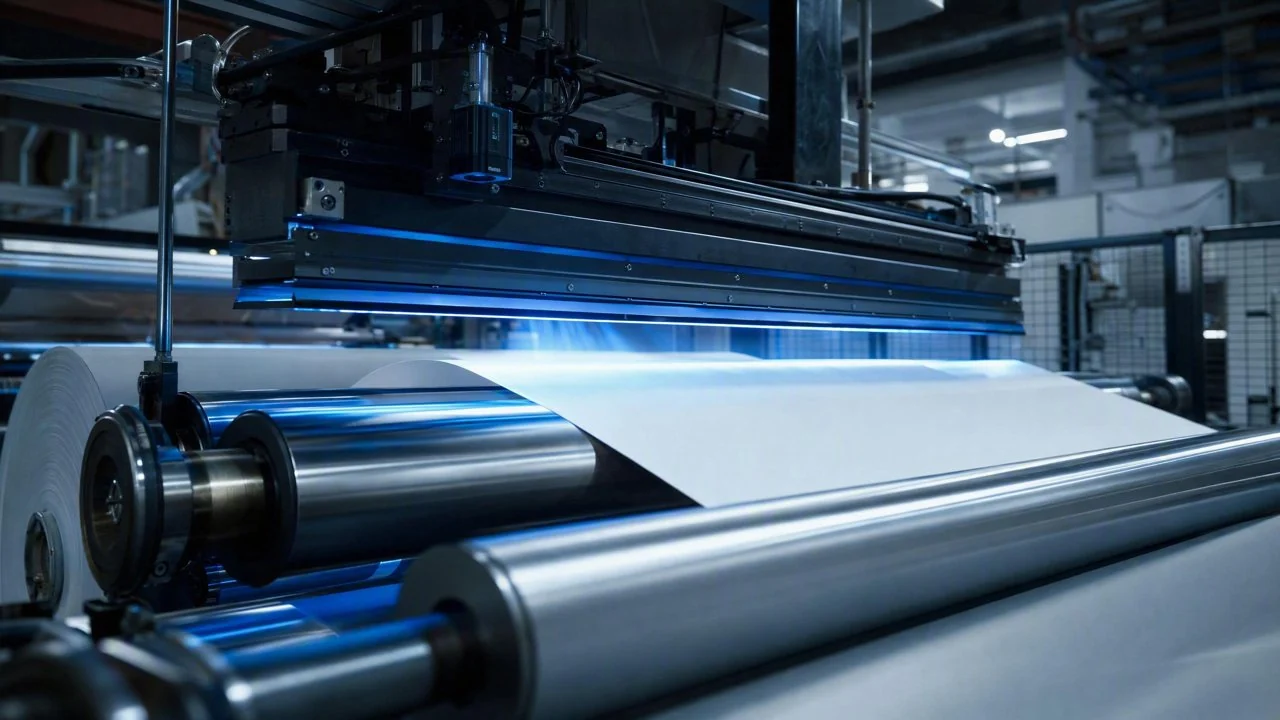
DaoAI's 2D ACI equipment (high-resolution 2D imaging + deep learning secondary judgment, targeting planar defects such as surface/printing/OCR/assembly omissions, high-speed online full inspection, micron-level, semantic false positive filtering) achieved precise identification and classification of micron-level surface defects on chemical/material industry paper production lines, successfully reducing the missed detection rate from a common 2.5%+ for traditional manual inspection and rule-based AOI to <0.3%, significantly improving product qualification rates and optimizing production costs.
The chemical and material industry, especially in paper manufacturing, demands extremely high product quality. As a basic industrial material, the surface quality of paper directly impacts subsequent processing and final applications. From high-grade packaging paper to special functional papers, any subtle surface defect, such as black spots, fiber clumps, pinholes, creases, uneven coating, or foreign material inclusions, can lead to product downgrading or even scrap. On high-speed production lines, achieving online, full-width, high-precision inspection of these micron-level, diverse, and randomly distributed defects, while effectively suppressing missed detection rates, is a long-standing challenge for the industry. DaoAI's 2D ACI equipment is designed precisely for this purpose, integrating advanced optical imaging technology with powerful deep learning judgment capabilities to provide reliable quality assurance for paper production lines, particularly excelling in reducing missed detection rates.
Pain Points: Why This Hurdle Is So Difficult to Overcome
Surface defect detection in paper production faces multiple challenges. Firstly, there's an extremely high demand for detection speed; modern paper machines typically operate at line speeds exceeding 1000 meters/minute, meaning the inspection system must complete image acquisition and analysis in a very short time. Secondly, defects are diverse and complex, ranging from tens of microns to several millimeters in size, with irregular shapes, low contrast against the background, and subtle variations across different batches or production conditions. This makes it difficult for traditional rule-based AOI systems to establish a universal set of discrimination standards. Thirdly, there's a contradiction between high false positive rates and missed detection rates. Traditional rule-based AOI systems often set looser thresholds to ensure detection, leading to a large number of normal textures or slight fluctuations being misidentified as defects, resulting in a false positive rate of over −15%, increasing the workload for manual re-inspection. If thresholds are tightened, the missed detection rate significantly increases, commonly exceeding 2.5%, posing risks to product quality. Furthermore, traditional solutions are highly dependent on sensor calibration in physical AI vision systems; any slight deviation in illumination, angle, or focus can lead to unstable detection results, further exacerbating the dilemma of false positives and missed detections.
Fundamentally, these difficulties stem from the optical properties of paper material itself and the high-speed production environment. Paper surfaces exhibit a certain degree of scattering, leading to uneven light reflection, coupled with subtle vibrations that may occur during production, all of which interfere with high-precision image acquisition. Traditional vision algorithms struggle to effectively distinguish between genuine defects and normal paper textures, watermarks, or slight irregularities in fiber distribution. Manual inspection is not only inefficient but also highly dependent on operator experience and fatigue, often resulting in high missed detection and false positive rates in high-speed, repetitive inspection tasks, failing to meet modern industrial quality standards. DaoAI's 2D ACI equipment addresses these traditional challenges by introducing the powerful feature extraction and pattern recognition capabilities of deep learning.
Technical Principles
The core of DaoAI's 2D ACI equipment lies in the tight integration of its high-resolution 2D imaging system and deep learning secondary judgment. On the imaging side, we employ industrial-grade high-speed line scan cameras combined with customized multi-angle, multi-spectral light sources to achieve full-width, high-contrast, and blind-spot-free image acquisition of paper, ensuring that even micron-level subtle defects are clearly captured. Special polarized light and dark-field illumination techniques effectively suppress surface scattering and reflections on paper, enhancing the contrast between defects and the background. At the data processing level, the DaoAI engine is equipped with advanced Convolutional Neural Network (CNN) models. These models are pre-trained on vast amounts of industrial defect data, possessing powerful feature extraction capabilities. When image data enters the system, traditional image processing algorithms first perform preliminary defect region localization, and then these potential defect regions and their contextual information are fed into the deep learning model for secondary judgment.
Compared to traditional rule-based AOI, the advantage of DaoAI's 2D ACI lies in its “semantic false positive filtering” capability and strong generalization. Traditional rule-based AOI relies on engineers manually writing complex rule sets, which are difficult to exhaust and prone to misjudgments when facing variable environments and defect types. In contrast, DaoAI's deep learning model can learn the “semantic” features of defects, meaning their essential manifestations, rather than merely pixel-level brightness or shape changes. For example, it can distinguish between normal fiber clumping and harmful foreign particles, or between harmless slight texture fluctuations and structural damage. Through APDT positive/few-shot learning (requiring only 1–20 good samples), the system can quickly adapt to new paper types or defect patterns, shortening model training time from days to hours, significantly enhancing production line flexibility. In practical applications, DaoAI's 2D ACI consistently reduces the missed detection rate to <0.3% while lowering the false positive rate by over 70%, far exceeding the performance of traditional solutions.
Typical Application Scenarios
- **Paper Surface Black Spots and Foreign Objects:** Tiny carbon particles, fiber bundles, or foreign impurities may be mixed in during pulp preparation or coating, forming visible black spots or foreign objects. DaoAI's 2D ACI, through high-resolution imaging, can capture these micron-level foreign objects and use deep learning models to precisely identify their characteristics as distinct from paper fibers, avoiding confusion with normal fiber clumps.
- **Fiber Clumps and Uneven Coating:** During paper manufacturing, uneven fiber distribution or insufficient spreading of coating liquid can lead to localized thickness variations and abnormal textures on the paper surface. Traditional methods struggle to differentiate between good products and defects, while DaoAI can learn and identify these subtle texture differences, effectively detecting potential quality issues.
- **Micro Pinholes and Creases:** On high-speed paper machine lines, the paper web may develop tiny pinholes or creases due to mechanical stress or uneven tension. These defects might be only tens of microns in size and difficult to capture at high speeds. DaoAI's high-speed imaging capability ensures image integrity, while deep learning models precisely identify these subtle structural damages.
- **Printing Surface Defects:** For paper products with printed patterns, such as packaging paper or specialty paper, DaoAI's 2D ACI can also detect defects like ink dots, missing print, misregistration, blurred patterns, ensuring print quality meets standards, and even perform OCR for batch numbers, dates, and other information.
Implementation Case Study
A leading domestic specialty paper manufacturer, whose products are widely used in high-end packaging and electronic materials, has extremely stringent requirements for paper surface quality. Previously, the manufacturer relied on manual inspection combined with an outdated rule-based AOI system for quality control. However, due to high line speeds, diverse product types, and complex defect categories, manual inspection was inefficient with a missed detection rate typically around 2.8%, leading to frequent customer complaints. The rule-based AOI system, with a false positive rate as high as 18%, resulted in many good products being misidentified, increasing re-inspection costs and resource waste. Facing increasing production capacity and strict quality demands, the manufacturer decided to introduce DaoAI's 2D ACI equipment. Before deployment, we worked closely with the client's team to collect and label data for typical defects and good samples across different product batches. The DaoAI team utilized the APDT few-shot learning function, completing initial model training and optimization within hours, using only a small number of defect samples and 15 good images. After two weeks of on-site debugging and trial operation, DaoAI's 2D ACI system was successfully integrated into the existing production line, achieving high-speed online full inspection.
By introducing DaoAI's 2D ACI equipment, this specialty paper manufacturer's missed detection rate for paper surface defects decreased from 2.8% to <0.3%, production efficiency improved by 15%, and millions of RMB in returns due to quality issues are saved annually.
DaoAI Solutions and Products
DaoAI's 2D ACI equipment provides an end-to-end intelligent inspection solution for the chemical and material industry, particularly in paper production. This equipment integrates our independently developed high-resolution industrial cameras, highly stable light source modules, and high-performance edge computing units. At the software level, the core is the DaoAI ACI OS, whose visual foundation model possesses powerful feature recognition capabilities, supporting "one good sample, 5 minutes, 0-code automatic programming," greatly simplifying the configuration process for new products or defect types. For the complexity of paper defects, we fully leverage APDT positive/few-shot learning technology, requiring only 1–20 good images to quickly train high-precision detection models, significantly reducing changeover downtime, shortening previous hours of preparation to 5min. The system also includes a "semantic false positive filtering" mechanism, based on deep learning to understand defects at a deeper level, effectively distinguishing true quality issues from harmless paper textures, keeping the false positive rate at an extremely low level.
This solution supports 100% on-premise private deployment, with all inspection data processed within the customer's factory, ensuring data security and production confidentiality. Through integration with existing MES/SCADA systems, DaoAI's 2D ACI can output real-time inspection results and provide detailed defect reports and trend analysis, offering data support for production process optimization. In terms of quantitative results, the system successfully reduced the missed detection rate for paper surface defects from the traditional solution's 2.8% to <0.3%, while also lowering the false positive rate by 70%, greatly reducing the workload of manual re-inspection. This not only significantly improved product qualification rates and reduced rework and scrap costs but also enhanced the client's market competitiveness and brand reputation. DaoAI's continuously learning World Model unified foundation ensures that the system constantly optimizes from production line feedback, achieving cross-scenario generalization and providing customers with future-proof intelligent manufacturing capabilities.
FAQ
How does DaoAI's 2D ACI equipment ensure the detection rate for micron-level paper defects?
DaoAI's 2D ACI equipment achieves precise imaging of paper surfaces by combining high-resolution line scan cameras with customized multi-spectral light sources. The core DaoAI deep learning model, trained on extensive defect data, can recognize and learn subtle features of micron-level defects. Through semantic false positive filtering, it distinguishes true defects from normal textures, consistently keeping the missed detection rate extremely low and ensuring a high detection rate.
Compared to traditional rule-based AOI or manual inspection, what are the core advantages of DaoAI's 2D ACI in paper inspection?
The core advantages of DaoAI's 2D ACI lie in its intelligent learning and generalization capabilities. Traditional rule-based AOI struggles with diverse and complex defect types, leading to high false positives or missed detections; manual inspection is inefficient and prone to fatigue. DaoAI, through deep learning, achieves high-precision recognition, semantic false positive filtering, and supports rapid few-shot training, significantly reducing false positive and missed detection rates while boosting inspection efficiency and stability for micron-level online full inspection.
What is the approximate budget for deploying DaoAI's 2D ACI equipment? What factors influence the quotation?
The budget for DaoAI's 2D ACI equipment is influenced by various factors, including line speed, inspection width, required precision, integration complexity, and whether custom features are needed. We offer flexible configuration options to match different customer requirements and budgets. For the most accurate quotation and detailed proposal, we recommend contacting our sales engineers directly for a needs assessment and customized consultation.
Full solution for this scenario: the full inspection solution for Chemical / materials
This article was generated by AI. Customer cases are simulated scenarios based on real product capabilities and figures are illustrative; see product pages for official benchmarks.