
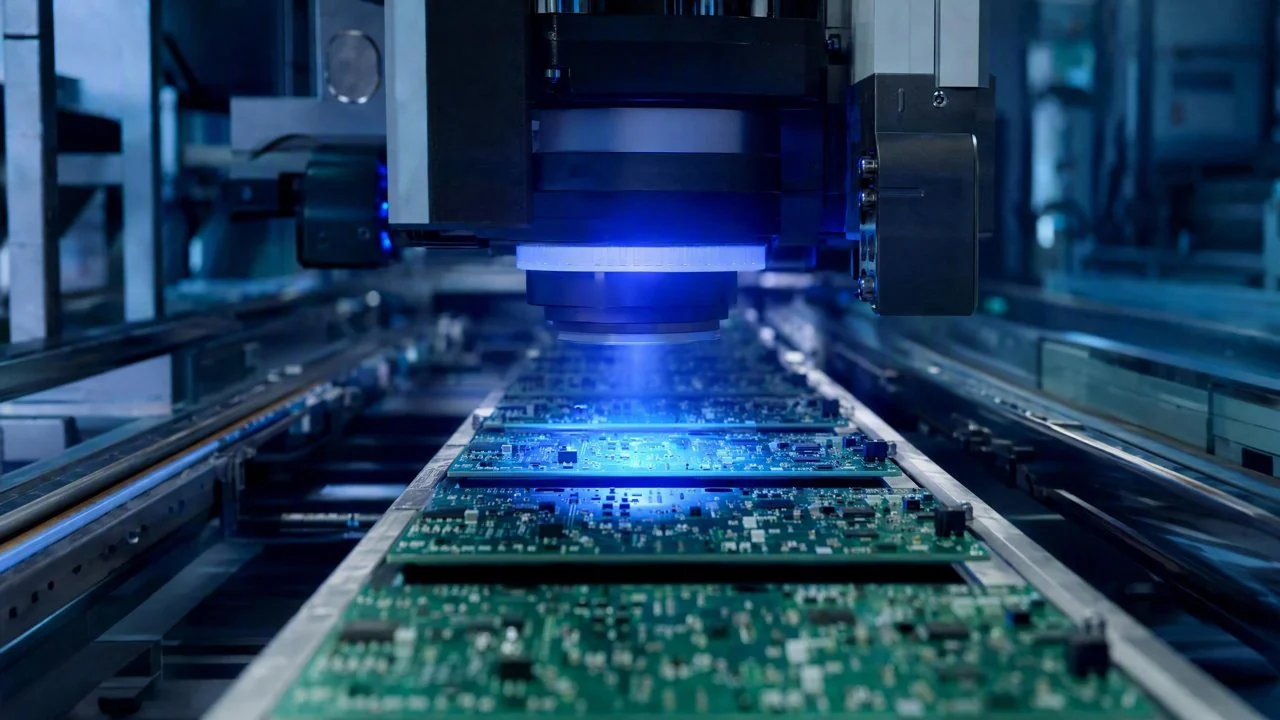
In electronic manufacturing PCBA production, DaoAI's 2D ACI equipment (high-resolution 2D imaging + deep learning secondary judgment, targeting surface/print/OCR/assembly defects, high-speed inline full inspection, micron-level, semantic false positive filtering) significantly boosts production efficiency and flexibility by reducing traditional AOI line downtime in High-Mix, Low-Volume scenarios from an average of 4-6 hours to under 5 minutes, thanks to its innovative zero-code rapid changeover capability.
The electronics/PCBA industry is rapidly transitioning towards High-Mix, Low-Volume (HMLV) production models to meet market demands for customized and diversified products. In this mode, SMT solder joint quality inspection faces unprecedented challenges. Under traditional mass production, AOI equipment, once programmed, can operate stably for extended periods with low changeover frequency. However, in HMLV, frequent product model changes necessitate equally frequent AOI program changes. This not only involves reprogramming and parameter adjustments but also requires significant time for verification and debugging, directly impacting production rhythm and overall efficiency. Particularly for micron-level solder joint defects like cold solder, bridging, and insufficient solder, their complex and varied optical characteristics and shape differences make manual inspection inefficient and inconsistent, while traditional rule-based AOI struggles to adapt to rapid changeover requirements. DaoAI / WeLinkirt deeply understands this industry trend and has specifically launched its 2D ACI equipment, aiming to provide an efficient and flexible solution for SMT solder joint inspection in HMLV production.
Pain Points: Why This Hurdle Is So Difficult to Overcome
In High-Mix, Low-Volume production, the pain points of SMT solder joint inspection are particularly prominent, mainly reflected in several dimensions: Firstly, long changeover downtime. Each time a product model is switched, traditional AOI equipment requires experienced engineers to spend 4-6 hours on program writing, parameter adjustment, and verification, leading to a high proportion of average line downtime and severely impacting overall equipment effectiveness (OEE). Secondly, persistently high false positive rates. Due to varying reflections of solder joints at different angles and lighting, as well as minor deformations of components and pads, traditional rule-based AOI systems often maintain a false positive rate of 5%-10% for defects like cold solder, bridging, and insufficient solder, requiring extensive manual re-inspection and increasing labor costs. Furthermore, manual re-inspection is inefficient. Faced with high false positive rates, a large number of good products are mistakenly identified as defective, leading to a surge in re-inspection workload, and prolonged high-intensity visual inspection is prone to visual fatigue, making it difficult to ensure a leakage rate below 0.5%.
The root cause of these difficulties lies in the limitations of traditional machine vision technology. On one hand, traditional rule-based AOI relies on manually set thresholds and geometric rules, which struggle to adapt to the complex and varied characteristics of solder joint morphology, size, and reflectivity. Especially in HMLV scenarios, a new set of rules needs to be defined for each changeover, which is time-consuming and labor-intensive. On the other hand, image features of solder joint defects are often subtle and diverse. For instance, cold solder may appear as an incomplete or irregular joint, bridging as a solder connection, and insufficient solder as inadequate or poor wetting. These defects show subtle variations across different products and batches, making identification methods based on single features or simple rules difficult to generalize. The emergence of industrial large models for quality inspection aims to address the shortcomings of traditional solutions in complex defect recognition and generalization. However, directly applying large models to production lines introduces new challenges for HMLV scenarios in terms of model size, computational resource requirements, and the acquisition of training samples. How to achieve rapid changeover and low-cost deployment while ensuring detection accuracy has become a critical issue for the HMLV electronics manufacturing industry.
Technical Principles
The core of DaoAI's 2D ACI equipment lies in the organic combination of its high-resolution 2D imaging system and deep learning secondary judgment engine. Firstly, the equipment acquires clear images of SMT solder joints through multi-angle, multi-spectrum, high-resolution 2D cameras, capturing micron-level defect features including cold solder, bridging, and insufficient solder. These raw image data are pre-processed and then fed into DaoAI's self-developed DaoAI ACI OS. This system, based on visual foundation models, possesses powerful feature recognition and generalization capabilities. Unlike traditional AOI that relies on engineers manually setting rules, DaoAI employs APDT (Active Positive Data Training) positive/few-shot learning technology, requiring only 1-20 good product images to automatically complete model training within 5 minutes, achieving zero-code programming. This means engineers do not need to write any code; they simply provide a small number of good samples, and the system can quickly learn and establish a cognitive model for 'qualified solder joints'.
When potential defects are detected, the deep learning secondary judgment mechanism is activated to perform a deeper analysis of suspicious areas. This process is similar to a human expert's 'second opinion' but far surpasses manual efficiency and accuracy. The semantic false positive filtering function of DaoAI's 2D ACI equipment is a significant advantage over traditional methods. Traditional rule-based AOI often generates a large number of false positives due to non-defect factors like lighting, shadows, and component markings. In contrast, DaoAI's deep learning model can understand the 'semantics' of images, distinguishing true defects from background noise, thereby reducing the false positive rate by over 85%. Compared to the rigid threshold judgments of traditional rule-based AOI and the inefficiency and subjectivity of manual inspection, DaoAI's technical principle lies in enabling the system with the ability to 'learn' and 'understand' through deep learning models, allowing it to adapt to complex and varied production environments and defect types. Especially in HMLV scenarios, its rapid changeover capability compresses traditional AOI's several hours of changeover time to minutes, significantly enhancing line flexibility and efficiency.
Typical Application Scenarios
- **SMT Solder Joint Cold Solder Detection:** DaoAI's 2D ACI equipment captures subtle features like incomplete solder joints and abnormal wetting angles through high-resolution imaging. Traditional methods struggle to differentiate cold solder from normal solder reflection variations, while DaoAI's deep learning model learns and recognizes these semantic features to accurately identify cold solder.
- **SMT Solder Joint Bridging Detection:** For bridging caused by solder connections, the equipment precisely identifies tiny solder bridges between pads. Traditional rule-based AOI is susceptible to interference from solder balls and splashes, whereas DaoAI's semantic false positive filtering effectively distinguishes true from false bridging, reducing false positives.
- **SMT Solder Joint Insufficient/Missing Solder Detection:** For defects with insufficient or completely missing solder, DaoAI 2D ACI analyzes the solder joint coverage area and height (indirectly judged by grayscale information in 2D images). Traditional methods face difficulty in setting thresholds for insufficient solder, while DaoAI's system accurately discriminates by learning the morphology distribution of normal solder joints.
- **Component Polarity Reversal Detection:** Although this case primarily focuses on solder joints, DaoAI's 2D ACI equipment can also efficiently identify polarity markings on resistors, capacitors, and other components. Through OCR functionality, it recognizes and compares silkscreen information to ensure correct mounting orientation, preventing circuit failures due to polarity reversal.
- **PCBA Surface Scratches/Contamination Detection:** The equipment can also detect subtle scratches, oil stains, foreign objects, and other defects on the PCBA surface. These defects exhibit complex characteristics under different lighting, making traditional methods prone to missed or false detections. DaoAI's generalization capability enables more accurate identification of various surface blemishes.
Implementation Case Study
A tier-1 supplier specializing in customized industrial control board production faced long-standing challenges with High-Mix, Low-Volume orders. Previously, they used traditional rule-based AOI for SMT solder joint inspection. Each product changeover required experienced engineers to spend several hours (averaging 4.5 hours) on reprogramming and debugging, leading to extensive line downtime and low capacity utilization. Furthermore, traditional AOI had a false positive rate of up to 8% for complex solder joints like cold solder and bridging, resulting in a large number of good products being falsely rejected and requiring 3-4 additional staff for manual re-inspection, severely dragging down overall production rhythm. To address these pain points, the supplier introduced DaoAI's 2D ACI equipment. During the implementation, the DaoAI team assisted the client with equipment integration and initial model training. Impressively, engineers only needed to provide 10-15 images of good boards, and the DaoAI ACI OS automatically generated new inspection programs within 5 minutes, achieving true zero-code rapid changeover. After deployment, line downtime was significantly reduced, and the false positive rate also dropped considerably.
DaoAI's 2D ACI equipment, with its zero-code rapid changeover capability, compressed the changeover time for High-Mix, Low-Volume production from hours to minutes, fundamentally transforming our line's flexibility and efficiency.
DaoAI Solution and Products
The core solution provided by DaoAI is based on its 2D ACI equipment, specifically designed to address the pain points of SMT solder joint inspection in HMLV electronics manufacturing scenarios. This equipment features a high-resolution 2D imaging system capable of capturing micron-level details of solder joints. Its core advantage lies in the integrated DaoAI ACI OS, which is built upon advanced visual foundation models and APDT few-shot self-training technology. This means customers do not need to invest significant time and resources in collecting and labeling defect samples; they simply provide 1–20 good product images, and the system can automatically complete learning within 5 minutes, achieving zero-code rapid changeover. This 'one good sample, 5 minutes, zero-code automatic programming' capability completely changes the time-consuming and labor-intensive programming model of traditional AOI, greatly enhancing the efficiency and flexibility of production line changeovers. Furthermore, DaoAI's semantic false positive filtering function effectively distinguishes between true and false defects, reducing the false positive rate by over 85% and decreasing the workload of manual re-inspection. For deployment, DaoAI supports various integration methods such as SDK/API/Docker and offers 100% on-premise private deployment options, ensuring customer data remains secure and on-site, meeting high security requirements.
Beyond the 2D ACI equipment, DaoAI World Model, serving as a unified foundation, enables semantic understanding, cross-scenario generalization, and continuous learning from production line feedback, further enhancing the system's intelligence. In the client's HMLV production line, the deployment of DaoAI's 2D ACI equipment reduced product changeover time from an average of 4.5 hours to 5 minutes, a 98% reduction in changeover downtime, directly boosting line utilization. Concurrently, the system lowered the false positive rate for SMT solder joint defects from 8% to <1.2%, reducing manual re-inspection workload by 85% and saving the client significant labor costs annually. The solder joint defect detection rate is consistently above 99.4%, ensuring high-quality product output. These quantifiable results are not only reflected in improved production efficiency but also in endowing the client's production line with unprecedented flexibility and adaptability, enabling them to respond to market demands more rapidly and gain a competitive edge.
FAQ
How exactly does DaoAI's 2D ACI equipment achieve 'zero-code rapid changeover'?
DaoAI's 2D ACI equipment achieves zero-code rapid changeover through its DaoAI ACI OS. It utilizes APDT few-shot learning technology, where engineers only need to provide 1–20 good product images. The system then leverages visual foundation models to automatically learn and generate new inspection programs within 5 minutes, eliminating the need for manual code writing or complex parameter adjustments, greatly simplifying the changeover process.
What is the approximate budget required to deploy DaoAI's 2D ACI equipment?
The budget for DaoAI's 2D ACI equipment depends on specific configurations, required inspection speed, integration complexity, and whether local private deployment is chosen. We offer flexible software and hardware combination solutions to suit customers of different scales and needs. We recommend contacting our sales team directly for a customized quote and solution consultation based on your actual production line requirements.
What are the main advantages of DaoAI's 2D ACI in High-Mix, Low-Volume production compared to traditional AOI?
In High-Mix, Low-Volume scenarios, DaoAI's 2D ACI's primary advantages lie in its extreme changeover efficiency and high accuracy with low false positives. Traditional AOI requires hours of manual programming for each changeover, whereas our equipment, through zero-code rapid changeover, reduces this time to minutes. Furthermore, deep learning secondary judgment and semantic false positive filtering can reduce the false positive rate by over 85%, significantly reducing manual re-inspection and improving overall line OEE.
Full solution for this scenario: the full inspection solution for Electronics / PCBA
This article was generated by AI. Customer cases are simulated scenarios based on real product capabilities and figures are illustrative; see product pages for official benchmarks.