
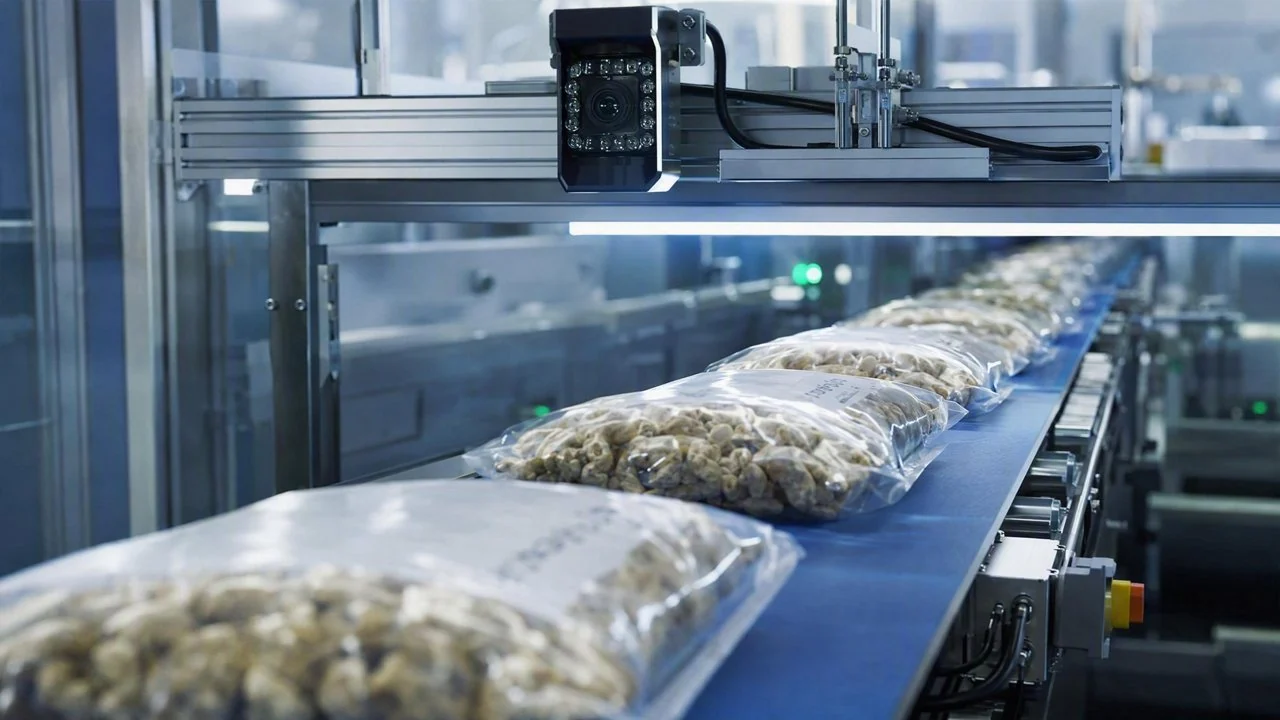
DaoAI 2D ACI equipment (high-resolution 2D imaging + deep learning secondary judgment, targeting planar defects like surface/print/OCR/assembly omissions, high-speed online full inspection, micron-level, semantic false positive filtering) leveraged APDT few-shot self-training to reduce the false positive rate for packaging seal defect detection from 15% to <2% for a leading food manufacturer, ensuring product quality and brand reputation.
In the food and agriculture sector, product packaging quality is the cornerstone of consumer trust. Particularly in dairy products, frozen foods, and snack foods, the integrity of packaging seals, accuracy of labels, and clarity of codes directly relate to food safety and shelf life. Traditional manual inspection or rule-based vision inspection solutions often fall short when confronted with complex and varied packaging materials, minute seal wrinkles, irregular inkjet characters, and high-speed production lines. A major dairy product manufacturer, whose products are primarily packaged in flexible plastic pouches, has extremely high demands for seal quality. Any minor heat seal defect, wrinkle, or foreign matter inclusion could lead to product spoilage, posing recall risks. Concurrently, due to the wide variety of products, subtle differences exist in packaging details across different batches and flavors, presenting a significant challenge to the adaptability of inspection systems.
Pain Points: Why This Hurdle Was Difficult to Overcome
This dairy manufacturer faced multiple challenges in the packaging seal inspection process. Firstly, traditional manual inspection suffered from a high rate of missed detections, often around 3%, especially during night shifts or extended work periods due to visual fatigue, directly impacting outbound product quality. Secondly, rule-based traditional AOI systems exhibited persistently high false positive rates, reaching 15% or more. This led to a large number of good products being incorrectly flagged as defective, requiring manual secondary review, which consumed significant labor daily, increased production costs, and severely slowed down the production line tempo. Thirdly, due to frequent product changeovers, each time packaging specifications or flavors changed, the traditional AOI system required several hours for parameter adjustment and reprogramming, resulting in long downtime, averaging 2 hours per changeover, which drastically reduced the overall efficiency of the production line. Furthermore, in the context where nanoscale precision inspection is increasingly becoming an industry trend, traditional solutions struggled to effectively address micron-level defects such as subtle scratches, ink splatter, or blurred character edges on packaging material surfaces. These minor defects, though small, could be perceived as quality flaws, impacting brand image.
The root causes of these difficulties were: dairy packaging materials are often composite plastic films, whose reflective surfaces and uneven textures pose challenges for imaging quality. Seal defects such as tiny air bubbles, uneven heat seals, wrinkles, or foreign matter inclusions are diverse in form and often indistinguishable from normal textures, increasing identification difficulty. Inkjet characters, affected by printer vibration and ink spread, might have blurred or broken edges, making traditional OCR algorithms less robust. High-speed production lines (hundreds of packages per minute) demand inspection systems with extremely high processing speed and stability, while traditional solutions, with their high computational load for complex defect patterns, struggled to balance speed and accuracy. Amidst the broader trend of domestic substitution, there is an urgent need for intelligent inspection systems that can adapt quickly, offer high precision, and low false positive rates, especially to address the pain points of few-shot learning and rapid changeover.
Technical Principles
The DaoAI 2D ACI equipment fundamentally resolves the aforementioned pain points by integrating high-resolution 2D imaging with deep learning secondary judgment technology. Its core lies in utilizing advanced visual foundation models with powerful feature recognition capabilities, enabling it to learn the normal patterns of products from a minimal number of good samples. Specifically, the APDT (Automated Pre-training and Dynamic Tuning) few-shot self-training technology allows users to collect only 1–20 good sample images, and the system can automatically complete model training and deployment within 5 minutes, achieving “0-code changeover.” Compared to traditional rule-based AOI, which requires engineers to manually set numerous parameters and thresholds, DaoAI's deep learning model can automatically extract and understand complex semantic information within images, effectively distinguishing real defects from background noise, thereby significantly reducing the false positive rate. For instance, for subtle wrinkles on packaging seals, traditional methods might misclassify them due to their similarity to normal textures. However, the DaoAI 2D ACI, by learning features from a large number of good seal samples, can identify subtle semantic differences between abnormal wrinkles and normal textures, reducing the false positive rate by over 85%.
Compared to manual inspection, DaoAI 2D ACI equipment eliminates human eye fatigue and inconsistencies caused by subjective judgment, ensuring consistent, high-stability inspection accuracy around the clock. Compared to traditional rule-based AOI, its advantages include no complex programming, extremely rapid changeovers, and stronger generalization capabilities for complex, varied defect patterns. DaoAI's semantic false positive filtering mechanism, through contextual understanding and multi-scale feature fusion, further enhances the system's ability to identify true defects, reducing false positives caused by non-defect interferences (such as reflections, shadows, slight deformations), maintaining a very low missed detection rate of <0.5%. This intelligent judgment logic based on deep learning is unmatched by traditional pixel- or edge-detection algorithms, especially in diverse and defect-sensitive scenarios like food packaging, where it demonstrates significant technical superiority.
Typical Application Scenarios
- **Packaging Seal Integrity Inspection:** Detects whether seals on plastic pouches, cartons, cans, and other packaging types are flat, wrinkle-free, free of foreign matter, and without false or incomplete seals. The DaoAI 2D ACI equipment captures seal details with high-resolution cameras and uses deep learning models to identify micron-level seal defects. The challenge lies in distinguishing normal heat seal textures from abnormal wrinkles or air bubbles.
- **Label Printing Quality Inspection:** Checks if the printed content on product labels is clear and complete, and if there are issues such as ink voids, ink bleeding, misregistration, blurred characters, or damaged barcodes/QR codes. DaoAI's image recognition algorithms can accurately identify various printing defects and perform OCR, with the difficulty being interference from different colors and material backgrounds of labels.
- **Code Content and Position Inspection:** Verifies if production dates, batch numbers, expiration dates, and other coded information are correct, clear, complete, and if the code position meets requirements. The DaoAI 2D ACI equipment utilizes its powerful OCR capabilities for accurate recognition and comparison of codes on high-speed moving products. The challenge arises from potential character deformation due to uneven inkjetting or vibration.
- **Packaging Surface Damage and Contamination Inspection:** Checks for surface defects such as scratches, damage, stains, or deformation on the packaging. DaoAI's deep learning models can learn the characteristics of various surface imperfections to achieve high-precision detection. The challenge is distinguishing between product reflections or inherent packaging material textures and actual defects.
- **Assembly Omission Detection:** For composite packaging containing multiple components (e.g., gift boxes, multi-packs), detects missing, misplaced, or insufficient components. The DaoAI 2D ACI equipment can quickly determine assembly completeness through overall image analysis. The challenge lies in accurately counting and locating multiple components against complex backgrounds.
Implementation Case Study
A leading dairy product manufacturer, with its intelligent factory in South China, faced high-capacity, multi-variety, and high-standard packaging seal inspection challenges. Previously, this production line relied primarily on manual inspection and a traditional rule-based AOI system. However, with the continuous expansion of product lines and increasing market demands for quality, the problems of false positives and changeover efficiency in traditional solutions became increasingly prominent. Manual re-inspection occupied 5-6 workers daily, and each changeover caused the production line to stop for over 2 hours, severely impacting overall capacity. The manufacturer decided to introduce the DaoAI 2D ACI equipment for upgrade and transformation. In the initial phase of the project, the DaoAI team conducted on-site surveys and, for their most representative dairy product packaging, collected only 10 good samples. Utilizing APDT few-shot self-training technology, the model training and deployment were completed within 5 minutes. After a two-week trial run and fine-tuning, the system demonstrated exceptional performance.
Before deployment, manual inspection had a missed detection rate of approximately 3%, and the traditional AOI's false positive rate was as high as 15%. After deployment, the DaoAI 2D ACI equipment consistently reduced the false positive rate to <2% and the missed detection rate to <0.5%. Changeover time was reduced from an average of 2 hours to under 5 minutes.
Specifically, before deployment, the traditional AOI system's high false positive rate led to a large number of packages requiring manual re-inspection daily, accounting for about 15% of the total inspected volume, incurring significant labor costs and time. After the DaoAI 2D ACI equipment was deployed, its powerful semantic false positive filtering capability drastically reduced the false positive rate by over 85%, significantly cutting down the volume of products needing manual re-inspection. Concurrently, the missed detection rate was reduced from 3% with manual inspection to <0.5%. The most significant improvement was in changeover efficiency; previously, engineers spent hours adjusting parameters for each changeover, but now, model loading and deployment for new products can be completed in just 5 minutes, greatly enhancing production line flexibility and efficiency. The manufacturer highly recognized the performance of the DaoAI 2D ACI equipment and plans to extend its use to other production lines.
DaoAI Solution and Products
The core solution provided by DaoAI is based on its 2D ACI equipment, integrating the DaoAI ACI OS. This system's core advantage is its APDT few-shot self-training, enabling customers to quickly complete model training and changeovers with minimal samples (1–20 good samples) and “0 code.” For this dairy manufacturer, DaoAI deployed high-resolution 2D industrial cameras combined with intelligent lighting control to ensure high-quality image data acquisition on high-speed production lines. Subsequently, the DaoAI software system processes these images in real-time, utilizing deep learning models for defect recognition and classification. Its semantic false positive filtering function effectively distinguishes normal reflections and textures of packaging materials from true defects, preventing misjudgments. The entire system supports 100% local private deployment, ensuring customer data security and privacy, in compliance with the stringent data compliance requirements of the food industry. Furthermore, DaoAI offers flexible SDK/API/Docker deployment options, facilitating integration with existing MES/SCADA systems to achieve closed-loop production data management.
Through the deployment of DaoAI 2D ACI equipment, the client achieved significant business value. Firstly, product quality was qualitatively enhanced, with the missed detection rate reduced to <0.5%, ensuring that every outgoing package meets stringent quality standards and effectively preventing brand damage and recall risks due to quality issues. Secondly, production efficiency significantly improved, with the false positive rate reduced by over 85%, eliminating numerous manual re-inspection steps and freeing up human resources. Changeover time was shortened from hours to under 5 minutes, significantly boosting production line flexibility and utilization. This not only reduced operational costs but also enabled the enterprise to respond more quickly to market changes and launch new products, enhancing market competitiveness. DaoAI's solution provides a reliable domestic alternative path for intelligent manufacturing in the food industry, supporting enterprises in achieving high-quality development.
FAQ
How does DaoAI 2D ACI equipment's APDT few-shot self-training technology work specifically?
APDT (Automated Pre-training and Dynamic Tuning) few-shot self-training technology is a core advantage of DaoAI 2D ACI. It leverages pre-trained visual foundation models combined with dynamic tuning mechanisms, enabling the system to automatically learn and deploy defect detection models with just 1-20 good sample images within 5 minutes. This significantly simplifies the cumbersome programming and parameter setup of traditional AOI, achieving “0-code changeover,” especially suitable for multi-variety, small-batch production scenarios.
Compared to traditional rule-based AOI, what are the significant advantages of DaoAI 2D ACI in food packaging inspection?
The advantages of DaoAI 2D ACI equipment primarily lie in three aspects: first, high precision and low false positive rates, leveraging deep learning's semantic understanding to effectively distinguish real defects from background noise, resulting in significantly lower false positive rates than traditional rule-based AOI; second, rapid changeover capability, achieving changeovers within 5 minutes through APDT few-shot self-training, whereas traditional AOI typically requires several hours; third, stronger generalization ability for complex defects, capable of adapting to diverse packaging materials and irregular defect forms that are difficult for traditional rules to cover.
What is the budget required to deploy DaoAI 2D ACI equipment, and how is data security ensured?
The budget for DaoAI 2D ACI equipment varies based on specific configurations (e.g., camera resolution, inspection speed, integration complexity, etc.) and customer requirements. We recommend contacting our sales team for a customized quote. Regarding data security, we support 100% local private deployment, where all data is processed and stored within the customer's factory, without uploading to the cloud, ensuring data remains on-site and fully complies with the strict data compliance requirements of the food industry.
Full solution for this scenario: Food / agriculture industry solutions · Food Foreign-Object Removal & Grading: Robot Vision Cuts False Positives
This article was generated by AI. Customer cases are simulated scenarios based on real product capabilities and figures are illustrative; see product pages for official benchmarks.