
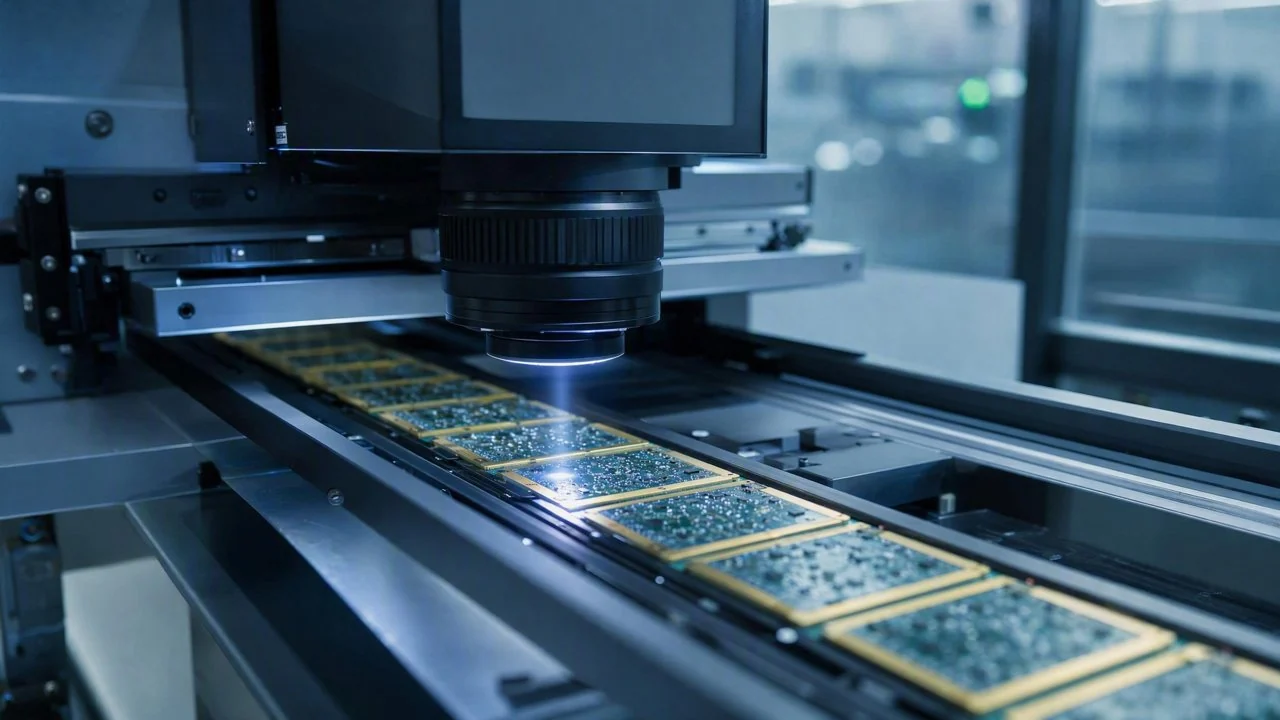
DaoAI 2D ACI equipment (high-resolution 2D imaging + deep learning secondary judgment, targeting surface/print/OCR/assembly defects, high-speed inline full inspection, micron-level, semantic false alarm filtering), through precise identification and semantic false alarm filtering of gold finger scratches and oxidation defects on electronic PCBA, reduces the undetected defect rate from a typical 2.5% of traditional manual inspection and rule-based AOI solutions to <0.3%, while reducing false alarm rates by over 85%, significantly enhancing overall production line inspection efficiency.
In electronic product manufacturing, especially in PCBA (Printed Circuit Board Assembly) production, gold fingers serve as critical contact points for connectors and external interfaces. Their surface quality directly impacts the electrical performance and reliability of the product. Defects such as scratches, oxidation, foreign objects, or contamination, even at micron levels, can lead to poor contact, signal interruption, or even product failure. A leading PCBA manufacturer, facing increasingly stringent product quality requirements and accelerating production cycles, urgently needed an automated inspection solution capable of high detection rates, low undetected defect rates, and intelligent discrimination, to replace traditional manual inspection and rule-based AOI. This was crucial for achieving 'zero-defect' manufacturing of gold fingers, particularly for complex defects like scratches and oxidation that are difficult to standardize.
Pain Points: Why This Hurdle is Difficult to Overcome
Detecting gold finger scratches and oxidation defects presents multiple challenges: Firstly, **defect forms are diverse and subtle**. Scratches can be linear, punctiform, or net-like, while oxidation manifests as uneven changes in color or luster. These defects are often at the micron level, making them difficult for the human eye to consistently identify, and challenging for traditional rule-based AOI due to their varied forms. Secondly, **false alarm rates remain high**. The complex surface features of PCBA, such as pad reflections, character printing deviations, and board material textures, are often misidentified as defects by rule-based AOI, leading to extensive manual re-inspection hours and severely impacting production efficiency. Traditional solutions typically have false alarm rates of 10-15%. Thirdly, **high risk of undetected defects**. Especially for minor scratches or early oxidation, manual inspection is prone to fatigue and subjective judgment, while rule-based AOI may miss defects due to improper threshold settings, allowing defective products to flow into subsequent processes or even the market. Traditional solutions often have undetected defect rates around 2.5%. Finally, **inefficient changeovers**. Traditional AOI requires significant time for parameter adjustments and rule writing when switching between different PCBA models, leading to lengthy production line downtime and making it unsuitable for High-Mix, Low-Volume (HMLV) production modes.
These pain points stem from the complexity and variability of gold finger defects, as well as the limitations of traditional vision technologies in feature extraction and discrimination. The depth, width, direction of scratches, and the thickness and uniformity of oxide layers all impose extremely high demands on imaging and algorithms. Furthermore, the reflective properties of gold finger plating materials and variations in ambient lighting further increase the difficulty of stable imaging and accurate judgment. In the trend of achieving zero-defect manufacturing through AI visual inspection, effectively addressing these challenges is a critical issue that the electronics manufacturing industry urgently needs to resolve.
Technical Principles
DaoAI 2D ACI equipment addresses gold finger scratches and oxidation defects using an advanced technical architecture that combines high-resolution 2D imaging with deep learning secondary judgment. At the imaging level, the equipment is equipped with industrial-grade high-resolution cameras and a precise lighting system, capable of capturing micron-level texture details and color variations on the gold finger surface, ensuring clear presentation of defect features. Unlike traditional rule-based AOI, which relies solely on pixel values or simple geometric features, DaoAI 2D ACI employs deep learning visual foundation models for feature recognition. Through APDT positive sample/few-shot learning technology, only 1–20 good samples are needed to quickly build defect discrimination models, significantly shortening the model training cycle. This model learns and understands the normal surface textures, luster, and other 'good product' features of gold fingers, as well as various complex and variable 'defective product' features, thereby achieving precise identification of defects such as scratches and oxidation.
The core advantage of DaoAI 2D ACI lies in its 'deep learning secondary judgment' capability and 'semantic false alarm filtering' mechanism. When potential defects are initially detected, the system further utilizes deep learning models to perform fine-grained analysis of these areas, distinguishing between true defects and normal but easily misjudged surface features. This secondary judgment greatly enhances the accuracy of discrimination. Simultaneously, its built-in semantic false alarm filtering function can understand contextual information in the image, identifying and excluding false alarms caused by non-defect factors such as background interference, character printing, or slight color differences. Compared to the subjectivity and fatigue of traditional manual inspection, and the rigidity and susceptibility to false alarms of traditional rule-based AOI, DaoAI 2D ACI demonstrates excellent stability and intelligence, reducing the undetected defect rate to <0.3% while lowering the false alarm rate by over 85%, significantly outperforming conventional industry solutions.
Typical Application Scenarios
- **Gold Finger Surface Scratch Detection:** DaoAI 2D ACI, through high-resolution imaging and deep learning models, accurately identifies micron-level scratches and abrasions on the gold finger surface, regardless of their direction, length, or depth. The challenge lies in the randomness and subtlety of scratches, as well as background texture interference. The AI model effectively distinguishes between real scratches and normal surface textures.
- **Gold Finger Oxidation Detection:** The equipment can accurately determine the degree and extent of oxidation by analyzing changes in color, luster, and uniformity on the gold finger surface. The challenge is that color changes are often not obvious in the early stages of oxidation and are susceptible to ambient light. DaoAI 2D ACI's semantic understanding capability effectively filters environmental interference.
- **Gold Finger Foreign Object/Contamination Detection:** For foreign objects such as dust, solder dross, fibers, or stains on the gold finger surface, DaoAI 2D ACI can perform high-precision identification. The challenge is the diverse forms of foreign objects and their potential similarity to background colors. The AI model learns these complex features and accurately detects them.
- **Character OCR and Print Quality Inspection:** DaoAI 2D ACI can also be applied to detect defects such as missing, blurry, misprinted, or ghosted silkscreen characters, barcodes, and other markings near the gold fingers, ensuring information legibility and accuracy. The challenge lies in the variety of character fonts and sizes, and potential slight deformations.
- **Assembly Omissions and Positional Deviations Detection:** In the assembly process of gold fingers with other components, DaoAI 2D ACI can check if gold fingers are correctly installed, if there are any omissions, and if their positions are accurate. The challenge is the mutual occlusion of multiple components and the identification of minute deviations.
Case Study
A Tier-1 supplier specializing in high-end PCBA manufacturing had long faced high undetected defect rates and high false alarm rates in its gold finger inspection process. Traditional rule-based AOI solutions had limited ability to identify gold finger scratches and oxidation defects, with an undetected defect rate of about 2.5%, leading to increased customer complaints and rework costs. At the same time, unable to effectively distinguish between normal textures and defects, the false alarm rate remained around 12%, requiring significant manual re-inspection hours daily and severely slowing down the production pace. To address this challenge, the supplier introduced DaoAI 2D ACI equipment. In the initial deployment phase, the DaoAI team utilized the APDT few-shot self-learning function to complete defect model training for various gold finger models of the client in just one week. During the validation phase, at the supplier's site, the equipment demonstrated exceptional performance, achieving a detection rate of over 99.7% for gold finger scratches and oxidation defects, successfully reducing the undetected defect rate to <0.3%.
After deployment, DaoAI 2D ACI equipment has been operating stably and continuously. Compared to traditional solutions, the equipment's false alarm rate significantly decreased by 85%, from 12% to less than 2%. This means the number of PCBAs requiring manual re-inspection daily has been drastically reduced, freeing up substantial human resources, allowing workers to focus on more valuable tasks. Furthermore, due to the model's self-learning and generalization capabilities, changeover time for new products has been reduced from an average of 4 hours to 5min, greatly enhancing production line flexibility and efficiency. The client highly recognized DaoAI 2D ACI equipment's outstanding contributions to improving inspection quality and reducing operating costs.
DaoAI 2D ACI not only drastically reduced the undetected defect rate of gold finger defects but also, through intelligent false alarm filtering, lowered the manual re-inspection burden by over 85%, truly achieving a dual leap in quality and efficiency.
DaoAI Solutions and Products
DaoAI provides core solutions for the electronic PCBA industry based on its powerful DaoAI ACI OS and 2D ACI equipment. This equipment leverages high-resolution 2D imaging hardware combined with the visual foundation models of the DaoAI ACI OS to achieve micron-level, high-speed inline full inspection of complex planar defects such as gold finger scratches and oxidation. The modeling process is extremely simple: using APDT positive sample/few-shot learning technology, only 1–20 good sample images are needed, and the system can complete 0-code automatic programming in 5min, quickly generating high-precision detection models. This rapid changeover capability makes DaoAI 2D ACI equipment particularly suitable for high-mix, low-volume production scenarios, effectively addressing the pain point of inefficient changeovers in traditional AOI. Concurrently, its built-in semantic false alarm filtering function intelligently identifies and excludes false alarms caused by non-defect features, reducing the false alarm rate by over 85%, significantly alleviating the burden of manual re-inspection.
In terms of deployment, the DaoAI 2D ACI solution supports 100% local private deployment, ensuring customer data remains on-site and meeting the stringent requirements of the electronics industry for data security and compliance. Combined with the unified foundation of the DaoAI World Model, the system possesses powerful semantic understanding and cross-scenario generalization capabilities, enabling continuous learning and optimization from production line feedback to consistently improve detection accuracy and stability. By integrating DaoAI 2D ACI, customers not only gain excellent defect detection capabilities but also build an intelligent, efficient, and data-driven quality management system, laying a solid foundation for achieving zero-defect manufacturing. DaoAI is committed to continuously optimizing its products to help electronic manufacturing enterprises meet future challenges and achieve sustainable development.
FAQ
What are the advantages of DaoAI 2D ACI equipment compared to traditional rule-based AOI or manual inspection for gold finger detection?
DaoAI 2D ACI equipment combines high-resolution imaging with deep learning secondary judgment, enabling it to identify subtle, variable defects that are difficult for traditional rule-based AOI to define, such as irregular scratches and early oxidation. Compared to manual inspection, it offers higher stability and consistency, and is immune to fatigue. Its core advantage lies in significantly reducing the undetected defect rate to <0.3% and lowering the false alarm rate by over 85%, significantly improving inspection accuracy and efficiency.
How can I assess the cost and ROI of implementing DaoAI 2D ACI equipment?
The cost of implementing DaoAI 2D ACI equipment is influenced by various factors, including equipment configuration, required inspection speed, and deployment complexity. However, the return on investment is significant: reducing undetected defect rates cuts rework, scrap, and customer complaint costs; lowering false alarm rates reduces manual re-inspection hours; and rapid changeovers improve production line flexibility and uptime. We recommend scheduling an expert consultation to receive a customized cost analysis and ROI projection based on your specific production line conditions.
How does DaoAI 2D ACI equipment adapt to the rapid changeover requirements of High-Mix, Low-Volume (HMLV) production models?
DaoAI 2D ACI equipment, utilizing APDT few-shot self-learning technology, only requires 1–20 good sample images to complete 0-code automatic programming within 5min, quickly building detection models for new products. This efficient changeover capability allows the equipment to flexibly adapt to HMLV production modes, significantly reducing downtime and enhancing overall production line efficiency and flexibility.
Full solution for this scenario: Electronics / PCBA industry solutions · Gold Finger Scratch & Oxidation Detection
This article was generated by AI. Customer cases are simulated scenarios based on real product capabilities and figures are illustrative; see product pages for official benchmarks.