
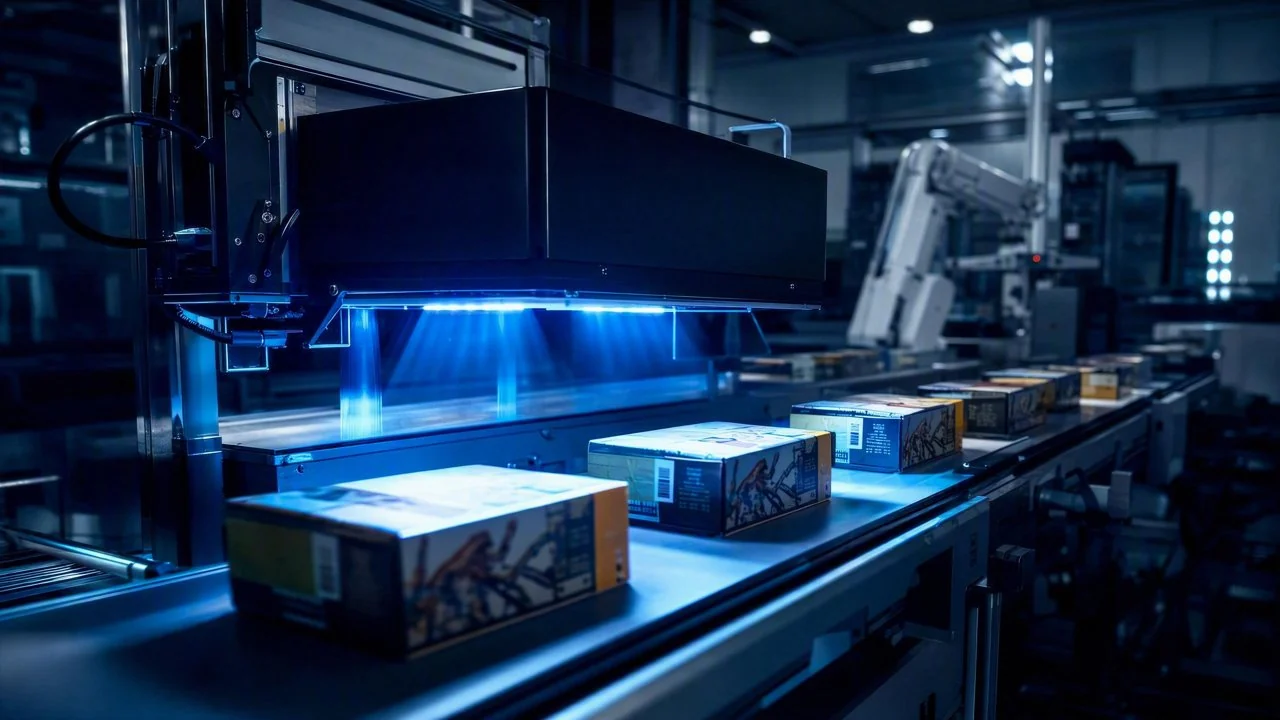
WeLinkirt's DaoAI 2D ACI equipment (high-resolution 2D imaging + deep learning secondary judgment, for surface/printing/OCR/assembly defects, high-speed online full inspection, micron-level, semantic false positive filtering) successfully reduced the manual re-inspection rate due to printing flaws from an industry average of 15% to below 3.8% by real-time monitoring and data analysis of consumer product packaging printing quality, significantly improving production efficiency and product consistency.
The consumer goods industry demands increasingly stringent quality for product packaging, especially in printing. Any subtle flaw can impact brand image and consumer purchase intent. Traditional packaging box printing quality inspection often relies on manual visual inspection or rule-based AOI equipment. Facing diverse printing defects (such as ink spots, scratches, color differences, missing prints, blurry characters) at high production speeds, these methods are not only inefficient but also prone to missed detections or false positives due to human fatigue and experience variations. Simultaneously, without effective data recording and analysis, it's difficult to trace back to specific production stages and causes once a quality issue arises, preventing the formation of an effective closed-loop quality management system. WeLinkirt's DaoAI 2D ACI equipment was developed to address this core pain point. It achieves online full inspection of packaging printing quality through high-resolution 2D imaging and deep learning secondary judgment technology, building a complete quality management system from defect identification to data traceability.
Pain Points: Why This Hurdle Is Difficult to Overcome
Quality inspection for packaging box printing faces multiple challenges. Firstly, **high rates of missed detections and false positives** persist: Traditional manual inspection on high-speed production lines can have an average missed detection rate of 3-5% for micron-level defects like tiny ink spots or minor scratches. Rule-based AOI equipment, due to its sensitivity to ambient light, material reflectivity, and background textures, often produces false positive rates as high as 10-15%, leading to numerous good products being misidentified and increasing re-inspection hours. Secondly, **difficulty in quality traceability**: When terminal products are found to have printing defects, the lack of detailed production process data makes it hard to quickly locate the problematic batch, production time, and specific cause, resulting in high recall costs and inability to fundamentally resolve issues. Finally, **high costs of manual re-judgment**: To cope with high false positive rates, companies need to deploy a large number of quality inspectors for secondary re-judgment. A mid-sized consumer goods packaging factory, for instance, incurs over 500 hours of re-judgment per month, severely impacting production efficiency and profit margins. These issues are particularly prominent in the current industry context, which pursues nanoscale precision inspection and breakthroughs in AI vision technology bottlenecks. Traditional solutions have reached their limits in recognizing complex textures, varying lighting, and subtle defects, making it difficult to meet high-standard, traceable production demands.
The root cause of these dilemmas lies in the complexity of the printing process and the diversity of defects. For example, ink fluidity, the microscopic structure of paper fibers, and mechanical vibrations of printing presses can all lead to irregular, minute defects. Traditional machine vision relies on preset thresholds and geometric features, making it difficult to distinguish these 'normal' process fluctuations from true defects. Furthermore, consumer product packaging boxes often feature multiple colors, complex patterns and texts, as well as special gloss or matte finishes, which makes defect imaging characteristics highly unstable, further increasing detection difficulty. At high production speeds, each image capture must be completed within milliseconds, and a judgment made quickly, posing extremely high demands on the real-time performance of image acquisition and processing.
Technical Principles
WeLinkirt's DaoAI 2D ACI equipment fundamentally solves traditional inspection challenges by combining high-resolution 2D imaging with advanced deep learning algorithms. Its core lies in **high-resolution industrial cameras** that capture micron-level image details, coupled with a **multi-spectral light source system** to ensure clear, stable defect feature images across various printing materials and gloss levels. After data acquisition, the **deep learning model** powered by WeLinkirt's Wemio engine begins its work. This model is pre-trained on a large-scale printing defect dataset and employs **APDT few-shot self-learning technology**, requiring only 1-20 good product images to complete model training for new products or defect types within 5 minutes. This enables the equipment to identify various complex and irregular printing defects, such as tiny ink spots, subtle scratches, slight color differences, and incomplete characters, much like an experienced quality inspection expert.
Compared to traditional rule-based AOI, the greatest advantage of WeLinkirt's DaoAI 2D ACI equipment is its **semantic false positive filtering capability**. Traditional rule-based AOI often misidentifies background textures, slight reflections, or normal process marks as defects, leading to numerous false positives. However, the deep learning model of WeLinkirt's Wemio engine can understand the 'semantic' information of images, distinguishing true defects from harmless background noise, thereby significantly reducing the false positive rate. For instance, for subtle paper textures on packaging boxes, traditional AOI might flag them as defects, but the AI model can recognize them as normal textures. Furthermore, WeLinkirt's DaoAI 2D ACI also integrates an **OCR (Optical Character Recognition) module** to accurately identify and compare printed characters, ensuring the correctness of critical information like batch numbers and production dates. This technical path, combining high-precision imaging, intelligent deep learning judgment, and semantic understanding, allows WeLinkirt's DaoAI 2D ACI to far surpass traditional methods in detection efficiency and accuracy, laying the foundation for subsequent quality traceability and data closed-loop.
Typical Application Scenarios
- **Packaging Box Surface Ink Spot and Foreign Object Detection:** WeLinkirt's DaoAI 2D ACI equipment utilizes high-resolution cameras to capture the packaging box surface, identifying and locating tiny ink spots, oil stains, fibers, and other foreign objects through a deep learning model. The challenge lies in the diverse shapes of ink spots and their potential to blend with the box's background color or pattern, making them easily missed by traditional methods. The DaoAI equipment accurately distinguishes these subtle flaws, boosting ink spot detection rates to over 99.7%.
- **Printed Character and Barcode OCR/OCV:** The equipment performs Optical Character Recognition (OCR) and Optical Character Verification (OCV) on production dates, batch numbers, expiration dates, barcodes/QR codes printed on packaging boxes, checking if characters are clear, complete, and accurate, and comparing them with database information. The difficulty lies in the wide variation of character fonts, sizes, and print quality, as well as potential blurring or breakage. The WeLinkirt Wemio engine ensures critical information accuracy through its powerful character recognition capabilities.
- **Pattern Misalignment and Missing Print Detection:** For common defects in multi-color printing such as misregistered patterns, localized missing prints, or print position shifts, WeLinkirt's DaoAI 2D ACI equipment uses image registration and regional feature comparison to real-time detect the accuracy of printed patterns. The challenge is that subtle registration deviations at high production speeds are difficult for human eyes or simple rules to identify, while the AI model can precisely capture these minor geometric deviations.
- **Surface Scratch and Dent Detection:** Packaging boxes may develop surface scratches or dents during production and transport, affecting their appearance. The equipment uses specific angle light sources combined with high-resolution imaging to enhance defect contrast, and a deep learning model to identify linear or point-like surface damage. The difficulty lies in scratches being very subtle and varying in direction; the AI model effectively filters background textures to accurately identify actual damage.
- **Lamination/Varnishing Defects:** For packaging boxes that undergo lamination or varnishing processes, defects such as bubbles, wrinkles, or flow marks may appear. WeLinkirt's DaoAI 2D ACI equipment enhances the visibility of these transparent or translucent defects through special light source configurations and image processing algorithms, and identifies them via a deep learning model. The difficulty lies in the complex optical properties of these defects, which are not easily captured effectively by traditional methods.
Case Study
A leading domestic consumer goods manufacturer, producing a large volume of popular product packaging boxes, had extremely high requirements for appearance quality. Previously, the manufacturer employed a combination of manual visual inspection and traditional rule-based AOI for quality control. However, due to fast production line speeds and diverse printing defect types, manual inspection had an average missed detection rate of around 4.5%, while rule-based AOI had a false positive rate as high as 12%, leading to an additional 3-4 quality inspectors per day for re-judgment, and still failing to eliminate customer complaints. To improve product quality, reduce costs, and establish a traceable quality system, the manufacturer introduced WeLinkirt's DaoAI 2D ACI equipment.
"WeLinkirt's DaoAI 2D ACI not only helped us significantly reduce manual re-inspection costs, but more importantly, it built a full-link quality traceability system from production to shipment, something we had never achieved before."
The WeLinkirt team first conducted a detailed survey of the client's production line and installed multiple sets of high-resolution 2D ACI equipment at the exit of the printing machine. In the initial deployment phase, using the APDT few-shot self-learning function of the WeLinkirt Wemio engine, the defect model for the manufacturer's specific packaging boxes was trained in just 30 minutes with only 15 good product images and a few typical defect images. After deployment, the equipment achieved online full inspection of ink spots, scratches, color differences, missing prints, and character OCR on the printed box surface. Before deployment, the production line's daily rework volume due to printing defects was approximately 2000 packaging boxes, and manual re-inspection hours due to false positives amounted to 8 hours per day. After deployment, WeLinkirt's DaoAI 2D ACI equipment successfully **reduced the missed detection rate to <0.4%**, and **lowered the false positive rate by 68%**, resulting in a **75% reduction** in manual re-inspection workload. More importantly, by recording the inspection results, defect types, locations, and timestamps for each packaging box, the manufacturer could conduct detailed quality traceability for every batch of products. If a problem arose, it could be quickly located and analyzed, shortening the quality issue response time by over 90% and significantly enhancing customer satisfaction and brand reputation.
WeLinkirt Solutions and Products
WeLinkirt's 2D ACI solution is centered around its core equipment – the **WeLinkirt DaoAI 2D ACI equipment**, which integrates a high-resolution 2D imaging system, multi-spectral light sources, and a powerful edge computing unit. On the software side, it is equipped with the **DaoAI ACI OS**, powered by the WeLinkirt Wemio engine. This system possesses visual foundation model feature recognition capabilities, allowing 0-code automatic programming for a new good product in just 5 minutes, greatly simplifying changeover operations. For new products or defect types, the APDT positive/few-shot learning function (requiring only 1–20 good product images) can quickly adapt, supporting semantic false positive filtering to ensure detection accuracy and stability. Furthermore, to achieve comprehensive quality traceability, WeLinkirt's DaoAI 2D ACI equipment can upload all inspection data (including defect images, coordinate locations, defect types, batch information, etc.) in real-time to the enterprise's MES/ERP system, or manage and analyze it visually through the **SkyVision platform**. This closed-loop data mechanism not only monitors production quality in real-time but also provides data support for process optimization, forming a continuously improving intelligent manufacturing system. WeLinkirt supports various deployment methods such as SDK/API/Docker and allows for 100% on-premises private deployment, ensuring customer data security without leaving the factory, fully meeting the high standards for data privacy and security in the consumer goods industry.
Through the deployment of WeLinkirt's DaoAI 2D ACI equipment, clients have realized significant business value. Firstly, the **product pass rate has increased to over 99.8%**, effectively reducing rework and scrap costs caused by quality issues. Secondly, **manual re-inspection workload has decreased by 75%**, significantly saving labor costs and freeing up quality inspectors from repetitive tasks for more valuable work. Thirdly, **changeover time has been reduced from 30 minutes with traditional AOI to less than 5 minutes**, greatly improving production line flexibility and efficiency. Finally, and most crucially, a **complete quality traceability and data closed-loop system** has been established, which not only enhances brand reputation but also lays a solid foundation for the enterprise's future smart factory construction. WeLinkirt's DaoAI 2D ACI equipment, with its excellent performance and data management capabilities, is an ideal choice for the consumer goods packaging printing industry to achieve high-quality and high-efficiency production.
FAQ
How does WeLinkirt's DaoAI 2D ACI equipment support quality traceability?
During the inspection process, WeLinkirt's DaoAI 2D ACI equipment records detailed data for each product, including inspection results, defect types, locations, and timestamps. This data can be uploaded in real-time to the customer's MES/ERP system or managed and analyzed centrally through WeLinkirt's SkyVision platform. In case of a quality issue, specific defect images and inspection records can be quickly traced back using product batch numbers or production times, enabling full-link quality traceability and root cause analysis to effectively support a closed-loop quality management system.
Compared to traditional rule-based AOI, what are the cost investment and payback period for WeLinkirt's DaoAI 2D ACI?
WeLinkirt's DaoAI 2D ACI equipment, integrating advanced deep learning technology, may have a slightly higher initial investment than traditional rule-based AOI. However, considering its significantly reduced missed detection rates, false positive rates, manual re-inspection costs (e.g., 75% reduction in re-inspection workload in this case), and improved product pass rates and brand reputation, its overall operating cost is lower. Typically, the return on investment is much shorter than traditional solutions, achieved through savings in labor costs, reduced scrap losses, and avoided customer claims. The specific payback period needs to be customized based on factors such as the customer's production line scale, defect rate, and labor costs. Please contact WeLinkirt for a detailed quote and ROI analysis.
How does WeLinkirt's DaoAI 2D ACI equipment quickly adapt to new packaging box designs or printing processes?
WeLinkirt's DaoAI 2D ACI equipment is equipped with the DaoAI ACI OS, powered by the WeLinkirt Wemio engine. This engine features visual foundation model's cognitive capabilities and APDT few-shot self-learning function. For new packaging box designs, it enables 0-code automatic programming in just 5 minutes; for new printing processes or defect types, models can be quickly trained with only 1–20 good product images and a few defect samples. This eliminates the need for professional vision engineers, greatly reducing changeover and debugging times, and ensuring production line flexibility.
Full solution for this scenario: Consumer / general industry solutions
This article was generated by AI. Customer cases are simulated scenarios based on real product capabilities and figures are illustrative; see product pages for official benchmarks.