
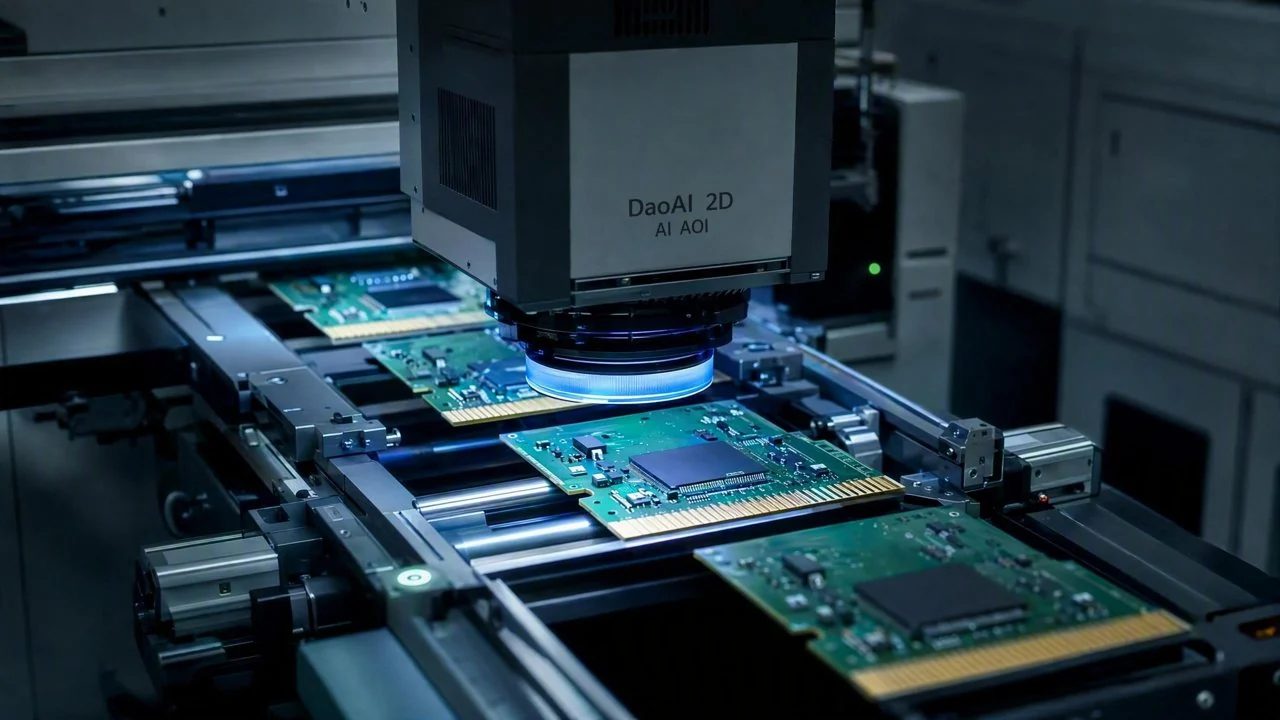
In the electronics manufacturing sector, DaoAI 2D ACI equipment (high-resolution 2D imaging + deep learning secondary judgment, targeting surface/printing/OCR/assembly defects, high-speed online full inspection, micron-level, semantic false alarm filtering) successfully reduced labor costs for gold finger scratch and oxidation defect detection by 70% for a leading PCBA manufacturer, replacing traditional manual inspection, while pushing the false negative rate down to <0.5%.
In the rapidly evolving electronics manufacturing industry, particularly in PCBA (Printed Circuit Board Assembly) production, the stringent demands for product quality remain unwavering. Gold fingers, as critical interfaces for connecting circuit boards to external connectors, directly impact the electrical performance and reliability of electronic products. However, gold fingers are highly susceptible to micron-level defects such as scratches, oxidation, and contamination during production, handling, and testing. Traditionally, the inspection of these defects heavily relies on manual visual inspection. For top-tier PCBA manufacturers with billions in annual output, the massive production line scale and high labor costs have become core bottlenecks limiting their capacity expansion and profit margins. DaoAI 2D ACI equipment offers an efficient and precise automated solution for such planar defects.
Pain Points: Why This Hurdle Is Difficult to Overcome
As a Tier-1 supplier in the industry, a leading PCBA manufacturer faced multiple challenges in gold finger inspection: First, **high labor costs**. This manufacturer operates dozens of PCBA production lines, each requiring 2-3 skilled inspectors for gold finger visual inspection, incurring annual labor costs of millions or even tens of millions of RMB. Second, **low inspection efficiency and unstable performance**. Manual visual inspection speed is limited by eye fatigue and attention span, averaging 5-10 seconds per board, far below the production line's takt time. Prolonged work leads to fluctuating false negative and false positive rates, especially for subtle scratches and early oxidation, where the false negative rate often hovers around 3%. Third, **complex defect types and ambiguous judgment criteria**. Gold finger scratches vary in depth and severity, oxidation levels differ, and contamination appears in various forms. Manual judgment is highly subjective, with inconsistent standards among different workers, making it difficult to ensure consistent quality across batch products. These fundamental issues make traditional manual inspection a significant impediment to improving production line efficiency and product quality.
From a process perspective, the gold plating layer on gold fingers is only microns thick, and any slight mechanical contact can cause scratches. In high-temperature and high-humidity environments, the gold layer is also prone to oxidation. These defects are often difficult to detect under normal white light, requiring specific angles and lighting conditions to become visible. While traditional rule-based AOI systems can perform basic detection, their generalization capability is insufficient when dealing with complex and varied scratch textures, oxidation color differences, and contamination similar to the background, leading to high false positive rates and inability to effectively distinguish between true defects and normal texture variations. This is precisely where the current industrial large models for quality inspection excel over traditional visual inspection in complex defect recognition and generalization, forming the core competence of the DaoAI 2D ACI solution.
Technical Principles
The core of DaoAI 2D ACI equipment lies in its combination of high-resolution 2D imaging technology and deep learning secondary judgment mechanisms. On the hardware side, we utilize industrial-grade high-resolution cameras and a customized multi-spectral lighting system, capable of capturing micron-level scratches, oxidation layer color differences, and subtle contamination on the gold finger surface. The multi-spectral light effectively highlights differences in material and surface conditions, providing high-quality raw data for subsequent AI analysis. On the software side, DaoAI 2D ACI is powered by the advanced Wemio engine, which performs feature recognition based on visual foundation models. It no longer relies on manually setting complex rules but uses APDT (Advanced Positive Data Training) few-shot learning technology, requiring only 1-20 good sample images to complete model training in 5 minutes, rapidly adapting to new product models and defect types. For gold finger scratches, the model learns their unique texture patterns and depth features; for oxidation, it identifies color shifts and blurred edges under specific spectra. This deep learning approach enables DaoAI 2D ACI to accurately classify “gray areas” that are difficult for traditional AOI to judge, reducing the false positive rate by 75%.
Compared to traditional rule-based AOI, the advantage of DaoAI 2D ACI lies in its powerful generalization capability and semantic false alarm filtering mechanism. Traditional rule-based AOI relies on engineers manually writing numerous judgment rules, requiring significant time to readjust rules for new defect types or product changeovers, and is susceptible to factors like ambient light and material batch variations, leading to persistently high false positive rates. In contrast, the deep learning model used by DaoAI 2D ACI, by learning features from vast amounts of data, can autonomously recognize and understand the semantic information of complex defects, effectively distinguishing between inherent product textures, minor contamination, and actual functional defects. For example, it can accurately identify production batch characters on gold fingers without misjudging them as scratches or contamination, significantly reducing the workload of manual re-inspection. This AI-driven secondary judgment capability allows DaoAI 2D ACI to maintain high-speed online full inspection while consistently reducing the false negative rate to <0.5%.
Typical Application Scenarios
- **Gold Finger Scratch Detection:** In the final stage of PCBA production, DaoAI 2D ACI is used to detect micron-level scratches on the gold finger surface. The challenge lies in the varying depth, width, and direction of scratches, which can be confused with the gold finger's inherent processing texture. DaoAI's deep learning model accurately distinguishes various types of scratches and performs grading.
- **Gold Finger Oxidation Detection:** For discoloration issues on the gold finger surface caused by environmental factors or improper storage, DaoAI 2D ACI utilizes multi-spectral imaging to capture subtle color differences in oxidized areas and uses an AI model for recognition and classification. The difficulty arises when oxidation is minor and not significantly different from normal coloration.
- **Gold Finger Contamination and Foreign Object Detection:** Detecting the presence of dust, oil stains, fingerprints, or other foreign objects on the gold finger surface. These defects are often irregularly shaped and may adhere to scratched or oxidized areas, increasing detection difficulty. DaoAI 2D ACI's semantic understanding capability effectively identifies and filters out normal background noise.
- **Character OCR and Missing Character Detection:** In addition to surface defects, DaoAI 2D ACI can perform OCR on characters (e.g., batch numbers, serial numbers) on gold fingers and detect whether characters are complete, clear, missing, or misprinted. This is crucial for product traceability and quality control.
- **Assembly Omission and Misalignment Detection:** In some complex PCBA assemblies, the gold finger area may involve the assembly of connectors or protective covers. DaoAI 2D ACI can detect whether these components are installed as designed, if there are omissions or misalignments, ensuring overall assembly quality.
Implementation Case Study
A leading PCBA manufacturer in East China had long been plagued by inefficient manual visual inspection of gold fingers and high labor costs. With continuous growth in order volume and accelerated product iteration, the existing 30+ inspection workers could no longer meet capacity demands, and customer complaints and rework costs due to misjudgments or missed detections remained high annually. The manufacturer introduced DaoAI 2D ACI equipment, deployed at the end of the gold finger processing line for online full inspection. In the initial phase, the DaoAI team used APDT few-shot learning technology, with only 15 good sample images and a few defect samples, to complete the training and deployment of the gold finger scratch and oxidation detection model within 3 days. After a month of parallel testing, compared to manual visual inspection, the DaoAI 2D ACI equipment achieved a detection rate of 99.4%, a false negative rate consistently below <0.6%, and reduced the false positive rate from the manual 10% to less than 85%, significantly cutting down the workload of manual re-inspection.
DaoAI 2D ACI has not only drastically reduced our labor costs but also transformed gold finger defect detection from 'human control' to 'intelligent control,' achieving unprecedented product quality stability.
In actual production, the manufacturer gradually replaced 70% of gold finger visual inspection positions with DaoAI 2D ACI equipment. This not only freed up a large amount of human resources, allowing them to be invested in higher-value production segments, but more importantly, the production line takt time significantly improved, with inspection speed increasing from an average of 8 seconds/board to 2 seconds/board, boosting capacity by 30%. Concurrently, due to the objectivity and consistency of detection results, the customer complaint rate decreased by 60%, greatly enhancing customer satisfaction. The successful application of DaoAI 2D ACI brought tangible economic and social benefits to the manufacturer.
DaoAI Solutions and Products
The core solution provided by DaoAI for gold finger defect detection in the PCBA industry is the 2D ACI equipment. This equipment integrates our self-developed high-resolution industrial cameras, stable lighting systems, and high-performance edge computing units, deploying the DaoAI ACI OS via Docker containerization. The software system's core is the Wemio engine, whose visual foundation model possesses powerful feature recognition capabilities, enabling 0-code automatic programming with a single good sample in 5 minutes, greatly shortening changeover time. For surface defects like gold fingers, we utilize APDT positive/few-shot learning (1–20 good samples) to quickly build high-precision detection models and effectively filter out interference from normal gold finger surface textures or markings through semantic false alarm filtering. Furthermore, DaoAI offers 100% on-premise private deployment options, ensuring customer data never leaves the factory, meeting their strict data security and compliance requirements. Should the customer's production line require more complex detection in the future (e.g., 3D coplanarity), upgrading with DaoAI 3D ACI equipment can be considered for more comprehensive detection coverage.
Through the deployment of DaoAI 2D ACI equipment, this leading PCBA manufacturer achieved automated inspection, significantly reducing reliance on manual labor. Quantifiable results include: a 70% reduction in labor costs, a 80% reduction in manual re-inspection volume, a 30% increase in production line takt time, and a false negative rate pushed down to <0.5%. These significant improvements not only boosted production efficiency and product quality but also enabled the enterprise to reallocate valuable human resources to high-value areas such as innovation and R&D, thereby maintaining a leading position in fierce market competition. DaoAI is committed to providing customers with intelligent quality inspection solutions that balance efficiency, accuracy, and cost-effectiveness, assisting electronics manufacturing enterprises in achieving high-quality development.
FAQ
What is the difference between DaoAI 2D ACI equipment and traditional AOI?
The biggest difference for DaoAI 2D ACI lies in its deep learning Wemio engine. Traditional AOI relies on engineers manually setting complex rules, leading to poor generalization and high false positive rates. DaoAI AOI, through APDT few-shot learning, can autonomously identify complex defects and features semantic false alarm filtering, significantly improving detection accuracy and efficiency, and greatly reducing manual re-inspection.
How long does it take to implement DaoAI 2D ACI equipment, and how are production line employees trained?
The implementation cycle for DaoAI 2D ACI equipment is typically short. Model training, leveraging APDT technology, usually requires only 1-20 good images and can be programmed within 5 minutes. Overall deployment and integration into existing production lines are usually completed within a few weeks. We provide comprehensive training services, including equipment operation, model management, and daily maintenance, ensuring production line staff can quickly get started without requiring professional AI background.
What is the approximate budget range for deploying DaoAI 2D ACI equipment?
The budget for DaoAI 2D ACI equipment is influenced by various factors, including camera resolution, required inspection speed, lighting configuration, selected software function modules (e.g., whether OCR, 3D extension are included), and deployment scale (single machine or multi-machine linkage). We offer flexible configuration options to meet diverse customer needs. We recommend contacting our sales team to receive a customized quote and ROI analysis based on your specific application scenario and requirements, allowing you to better plan your budget.
Full solution for this scenario: Electronics / PCBA industry solutions · Gold Finger Scratch & Oxidation Detection
This article was generated by AI. Customer cases are simulated scenarios based on real product capabilities and figures are illustrative; see product pages for official benchmarks.