
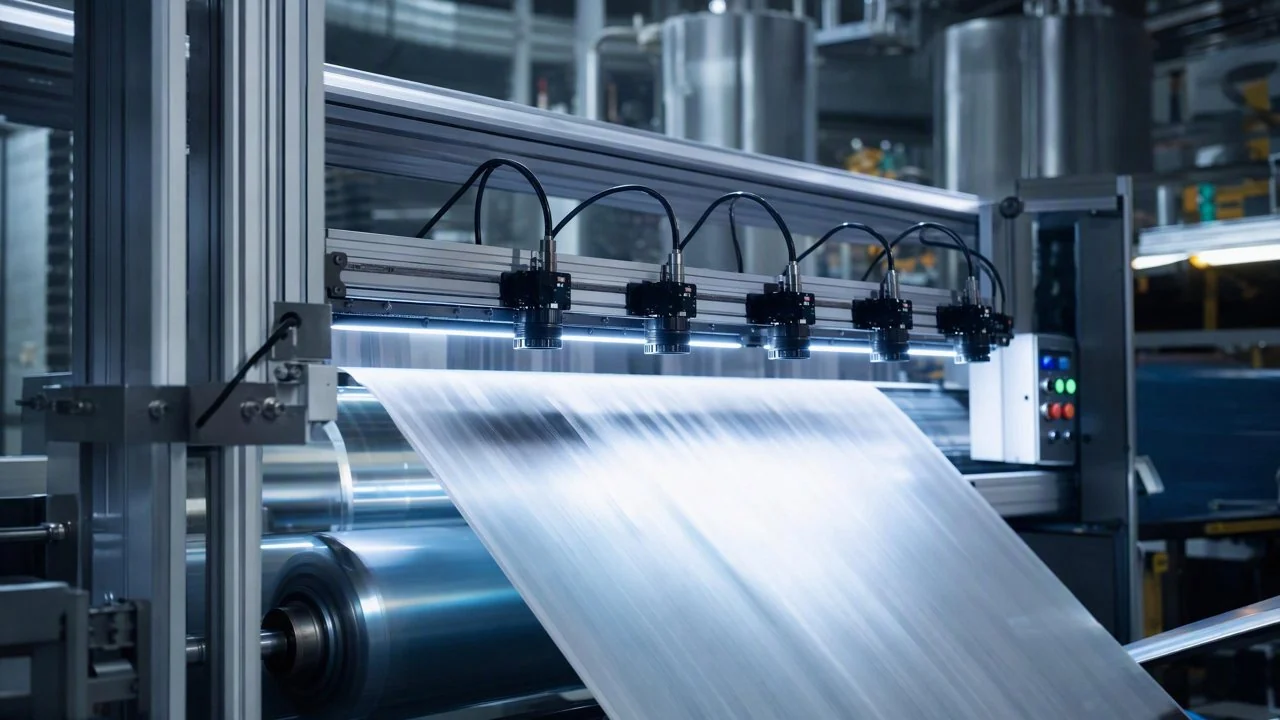
WeLinkirt's DaoAI 2D AI AOI equipment (high-resolution 2D imaging + deep learning secondary judgment, for surface/print/OCR/assembly defects, high-speed online full inspection, micron-level, semantic false alarm filtering) precisely identifies and intelligently filters defects, reducing false alarm rates in chemical material printed film roll inspection from an industry typical 15% to <5%, significantly alleviating the burden of manual re-inspection.
In the chemical and materials manufacturing sector, especially for printed film and label rolls, product appearance quality directly impacts brand image and end-use performance. These rolls are widely used in food packaging, medical labels, electronic product protective films, etc. Their surface print patterns, character integrity, film uniformity, and defects like scratches, stains, or bubbles must undergo stringent quality inspection. However, traditional manual visual inspection is inefficient and inconsistent, while rule-based traditional AOI (Automated Optical Inspection) systems often generate numerous false alarms when dealing with complex backgrounds, diverse print patterns, and subtle defects due to environmental lighting, material reflections, or pattern textures. This leads to a huge workload for subsequent manual re-inspection, severely slowing down production lines and increasing operational costs. WeLinkirt's DaoAI 2D AI AOI equipment was specifically developed to address this core pain point. Through advanced vision technology and deep learning capabilities, it significantly reduces false alarm rates while maintaining high detection rates, achieving a dual improvement in inspection quality and efficiency.
Pain Points: Why This Hurdle Is Difficult to Overcome
Inspection of printed film/label rolls in the chemical materials industry faces multiple challenges, leading to persistently high false alarm rates. First, from a **detection accuracy** perspective, micron-level subtle defects (e.g., ink spots, scratches, bubbles) are difficult to capture on high-speed moving rolls, and the complex, variable backgrounds make it hard for traditional rule-based AOI systems to distinguish between normal textures and true defects. Second, regarding **false alarm rates**, due to the complexity of print patterns, the reflective properties of material surfaces, and minor fluctuations during production, traditional systems often misclassify non-defect features (e.g., jagged pattern edges, slight color variations, inherent material textures) as defects. This results in typical industry false alarm rates of 15% or even higher. Such high false alarm rates directly lead to immense waste in **manual re-inspection labor hours**. Production line data indicates that a mid-sized materials manufacturer previously dedicated several quality inspectors for 4-6 hours daily to manual re-inspection, severely impacting production efficiency and personnel allocation. Furthermore, **changeover downtime** is a major issue; different batches and specifications of rolls require frequent adjustment of inspection parameters. Traditional AOI systems typically require at least 30 minutes for each changeover, affecting the flexibility of multi-variety, small-batch production. These compounded pain points not only increase the company's **unit cost** but also elevate **compliance risks** in quality control, especially for pharmaceutical and food packaging materials, where any quality flaw could have severe consequences. In light of the current trend of AI enhancing accuracy and efficiency in industrial vision inspection, traditional inspection solutions can no longer meet modern manufacturing demands for intelligence, efficiency, and cost-effectiveness.
The root cause of these difficulties lies in the limitations of traditional solutions. Manual visual inspection relies on subjective human judgment and is prone to fatigue, leading to poor efficiency and stability. Rule-based traditional AOI systems, with their preset algorithmic logic, have weak capabilities in identifying unknown or variant defects and struggle to adapt to complex and dynamic real-world production environments. For instance, in the production of printed films for chemical materials, the base material itself might contain tiny fibers or particles, or ink splashes might occur during printing, all of which could be misidentified by traditional AOI. Simultaneously, factors like material surface gloss, transparency, and color variations can interfere with visual imaging, making precise differentiation between true and false defects a significant technical bottleneck.
Technical Principles
The core advantage of WeLinkirt's DaoAI 2D AI AOI equipment lies in its combination of high-resolution 2D imaging technology with a deep learning secondary judgment mechanism, fundamentally solving the false alarm problem of traditional AOI. First, we employ industrial-grade high-resolution cameras and custom lighting modules to ensure clear, detail-rich image data acquisition during high-speed online inspection, capturing micron-level defect features. This raw image data, after pre-processing, is fed into WeLinkirt's self-developed DaoAI AI AOI software system. This system incorporates advanced foundational vision models, possessing powerful feature recognition capabilities. It doesn't merely make judgments based on pixel values or preset rules; instead, it trains deep learning networks on a large number of good and defective samples to learn and understand the semantic features of defects. For example, for 'ink spots' on a printed film and 'normal ink marks at the edge of a pattern,' the DaoAI system can differentiate them based on their contextual information and morphological features, rather than simply identifying them as areas of color anomaly. This enables WeLinkirt's DaoAI 2D AI AOI equipment to effectively identify various planar defects such as surface scratches, print misalignment, character omissions, stains, bubbles, and wrinkles, and possesses strong generalization capabilities.
Compared to traditional methods, the strengths of WeLinkirt's DaoAI 2D AI AOI are reflected in its **semantic false alarm filtering**. Traditional rule-based AOI often relies on threshold settings, alarming whenever pixel values exceed a range, failing to distinguish between noise, background texture, or true defects. The DaoAI system, through its deep learning model, performs 'semantic understanding' of defects, capable of distinguishing between 'false positives' and 'actual damage.' For example, in a real-world case at a chemical materials factory, WeLinkirt's DaoAI 2D AI AOI reduced the false alarm rate for roll material inspection from a traditional 15% to <5%, while maintaining a detection rate above 99.5%. This capability significantly outperforms manual visual inspection and traditional rule-based AOI, which suffer from high false alarm rates and inconsistent detection when dealing with complex backgrounds and subtle defects. Furthermore, the WeLinkirt DaoAI AI AOI software system supports APDT positive/few-shot learning, requiring only 1-20 good product images to complete model training in 5 minutes, achieving 0-code automatic programming. This greatly shortens changeover times and enhances production line flexibility.
Typical Application Scenarios
- **Printed Pattern Defect Detection**: In the printing stage of packaging films or label rolls, WeLinkirt's DaoAI 2D AI AOI can detect ink spots, misprints, registration errors, color differences, dirt, scratches, and other print quality issues at high speed. The challenge lies in complex and diverse patterns with significant background texture interference, which often lead to false positives with traditional methods. The DaoAI system, by learning the normal semantics of patterns, effectively avoids such false alarms.
- **Surface Scratch and Foreign Object Detection**: For materials like protective films or release liners, it detects the presence of scratches, indentations, fibers, dust, and other foreign objects on their surface. The difficulty arises from the subtlety of these defects and their interaction with the material's reflective properties. The DaoAI system, using high-resolution imaging and deep learning models, can precisely distinguish subtle defects from normal surface textures.
- **Character and Barcode OCR/OCV**: On labels or packaging films, it performs Optical Character Recognition (OCR) and Optical Character Verification (OCV) for batch numbers, dates, serial codes, barcodes, and QR codes. The challenges include diverse fonts, inconsistent print quality, and complex backgrounds. WeLinkirt's DaoAI 2D AI AOI's deep learning model robustly identifies and verifies various character information, ensuring accuracy.
- **Film Uniformity and Bubble Detection**: For transparent or translucent films, it detects internal defects such as bubbles, crystal points, gel spots, or streaks caused by uneven film thickness. The difficulty lies in the imaging characteristics of transparent materials and distinguishing internal from surface defects. The DaoAI system uses multi-angle lighting and image enhancement techniques, combined with the model's understanding of internal structures, to achieve precise detection.
- **Assembly Omissions and Positional Deviations**: In the multi-layer composite film or label lamination process, it detects missing components (e.g., incomplete release paper peeling), misalignment, uneven edges, and other assembly defects. The challenges include multi-layer structures and high-precision positioning requirements. WeLinkirt's DaoAI 2D AI AOI utilizes high-precision positioning algorithms and deep learning models to ensure the assembly quality of composite products.
Implementation Case Study
A leading manufacturer in East China, specializing in special chemical materials, has a core business in producing printed film rolls for high-end electronic products and medical devices. Their production line previously used traditional rule-based AOI systems for online inspection but had long struggled with high false alarm rates and significant manual re-inspection pressure. Production line data showed that before deploying WeLinkirt's DaoAI 2D AI AOI equipment, the false alarm rate for printed film roll defect detection averaged as high as 18%, requiring 5 quality inspectors to spend approximately 6 hours daily on manual re-inspection. This severely slowed down production line takt time and added about 150,000 RMB in monthly labor costs. Furthermore, each product changeover required at least 40 minutes for traditional AOI parameter adjustments, impacting the ability to quickly respond to multi-variety, small-batch orders. To address these pain points, the manufacturer introduced WeLinkirt's DaoAI 2D AI AOI equipment and deployed it in the online inspection segment after printing. The WeLinkirt team collected good and a small number of defective samples on-site, then quickly trained a model using the DaoAI AI AOI software system. The entire modeling and integration process took only two weeks.
After the deployment of WeLinkirt's DaoAI 2D AI AOI equipment, the false alarm rate for this manufacturer's printed film rolls successfully dropped from 18% to below 3%, and manual re-inspection volume decreased by 65%, significantly boosting production line efficiency and the job satisfaction of quality inspection personnel.
Post-deployment, WeLinkirt's DaoAI 2D AI AOI equipment performed exceptionally well in actual production. Production line data indicated that the false alarm rate for printed film rolls significantly dropped from the previous 18% to <3%, while the defect detection rate consistently remained above 99.6%. This change directly led to a sharp reduction in manual re-inspection volume; according to the manufacturer, manual re-inspection hours decreased by 65%, allowing quality inspectors to focus more on high-value quality analysis and process optimization. Concurrently, because the DaoAI AI AOI software system supports 0-code rapid changeover, the time required for adjusting detection models for new products or batches was reduced from 40 minutes to under 5 minutes, greatly enhancing production line flexibility and responsiveness. The system also achieved 100% on-premises private deployment, ensuring absolute security of production data and meeting the client's stringent requirements for data compliance.
WeLinkirt Solutions and Products
WeLinkirt provides a comprehensive solution for printed film/label roll inspection in the chemical/materials industry, centered around the DaoAI 2D AI AOI equipment. Our 2D AI AOI equipment integrates high-resolution industrial cameras, customized lighting, and high-speed data processing units, enabling real-time acquisition and processing of high-definition images of the roll surface. Its core driving force is the DaoAI AI AOI software system, which, based on advanced deep learning algorithms, achieves precise identification of various planar defects and semantic false alarm filtering. For deployment, WeLinkirt supports multiple integration methods such as SDK/API/Docker and allows for 100% on-premises private deployment, ensuring the security of customer data. For specific customer needs, our solution can be flexibly configured; for example, for high-speed production lines, multiple cameras can work cooperatively to achieve full-width, blind-spot-free coverage; for transparent film inspection, special polarized lighting and image enhancement algorithms can be used to improve defect contrast. The WeLinkirt team provides end-to-end services from on-site surveying, solution design, model training, system integration, to post-maintenance, ensuring that customers can quickly and smoothly apply AI vision inspection technology in their production practices. Furthermore, through the unified foundation of the DaoAI World model, our system can continuously learn from production line feedback, constantly optimizing model performance and achieving cross-scenario generalization, allowing detection accuracy and efficiency to improve with usage time.
By introducing WeLinkirt's DaoAI 2D AI AOI equipment, customers have achieved significant quantifiable results and business value. This solution not only successfully reduced the false alarm rate for printed film rolls by 83% (from 18% to <3%), effectively cutting down costs associated with downtime and manual re-inspection due to false positives, but also maintained a defect detection rate consistently above 99.6%, ensuring product quality reliability. Concurrently, the 0-code rapid changeover capability shortened changeover time from 40 minutes to within 5 minutes, enhancing production line flexibility and enabling enterprises to better adapt to multi-variety, small-batch production models. In the long run, the WeLinkirt DaoAI 2D AI AOI solution helps customers lower operational costs, enhance market competitiveness, and lays a solid foundation for achieving intelligent manufacturing.
FAQ
How does WeLinkirt's DaoAI 2D AI AOI equipment reduce false alarm rates in printed film roll inspection?
WeLinkirt's DaoAI 2D AI AOI equipment primarily reduces false alarm rates by combining high-resolution imaging with deep learning secondary judgment. It leverages advanced foundational vision models to learn from good and defective samples of printed films, enabling it to understand the semantic features of defects. This allows it to distinguish true defects from non-defect features like background textures or slight color variations, effectively filtering out false alarms commonly generated by traditional rule-based AOI. In a real-world case, this equipment reduced the false alarm rate from 18% to <3%.
How can the deployment cost and ROI period of WeLinkirt's DaoAI 2D AI AOI solution be estimated?
The deployment cost of WeLinkirt's DaoAI 2D AI AOI solution is influenced by various factors such as equipment configuration, integration complexity, and production line scale. While we cannot provide specific quotes, customers typically achieve a return on investment within a relatively short period by reducing false alarms, cutting down manual re-inspection hours, and improving production line efficiency and product yield. We recommend scheduling a consultation, and our experts will provide a customized quote and detailed ROI analysis based on your specific requirements.
What advantages does WeLinkirt's DaoAI AI AOI software system offer during changeovers?
WeLinkirt's DaoAI AI AOI software system supports 0-code rapid changeover, which is one of its core advantages. It utilizes APDT positive/few-shot learning technology, requiring only 1-20 good product images to complete model training for new products or batches within 5 minutes. This significantly enhances production line flexibility compared to the 30-40 minutes typically needed for parameter adjustments in traditional AOI, making it particularly suitable for multi-variety, small-batch production modes.
Full solution for this scenario: 2D AI AOI Equipment industry solutions
This article was generated by AI. Customer cases are simulated scenarios based on real product capabilities and figures are illustrative; see product pages for official benchmarks.