
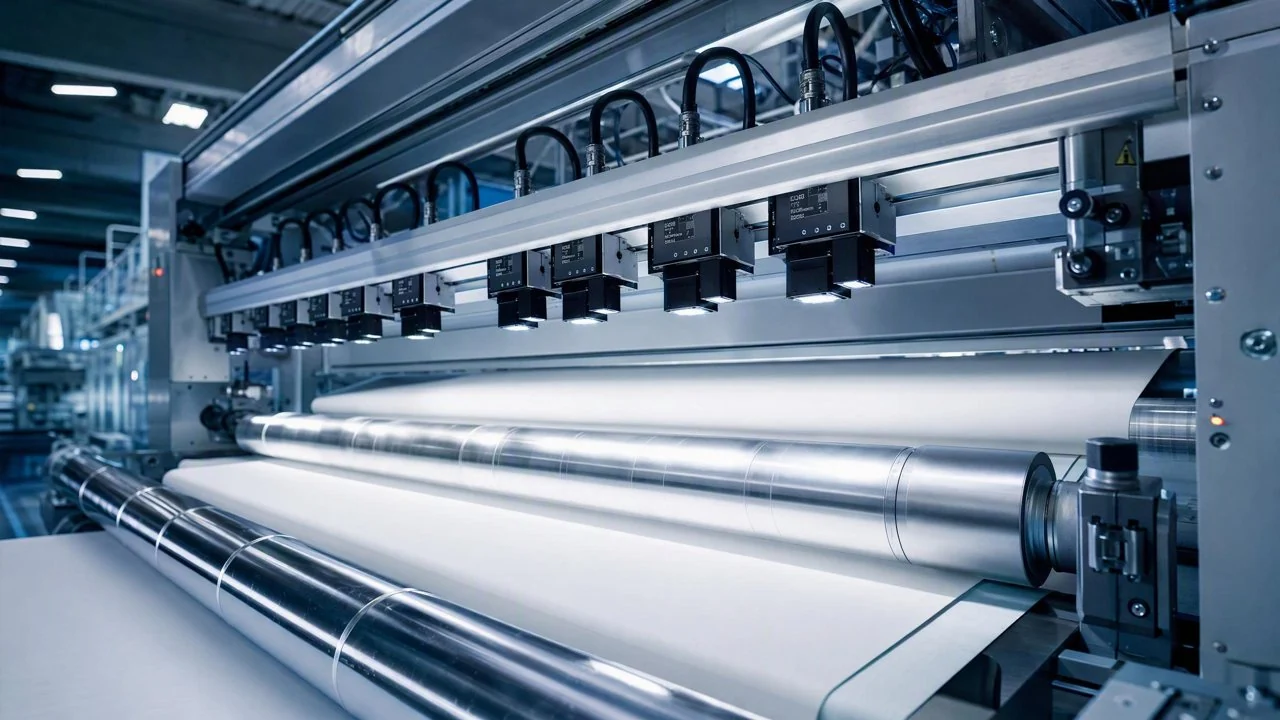
DaoAI 2D AI AOI equipment (high-resolution 2D imaging + deep learning secondary judgment, for surface/print/OCR/assembly defects, high-speed inline full inspection, micron-level, semantic false positive filtering), through local private deployment and advanced deep learning algorithms, reduced the missed detection rate for subtle stains, fiber clumps, and other flaws on paper surfaces from 1.2% to below 0.3% for a large specialty paper manufacturer, while ensuring absolute production data security and compliance.
In the chemical materials industry, particularly in the production of specialty papers, product quality stability and consistency are core competencies. Tiny surface flaws on paper, such as stains, fiber clumps, scratches, air bubbles, color differences, or printing defects, can lead to the rejection of entire batches, resulting in significant economic losses. Traditional manual inspection is not only inefficient and costly but also limited by human eye fatigue and subjective judgment, leading to high rates of missed detections and false positives, especially on high-speed production lines where 100% full inspection is challenging. Furthermore, for many specialty material manufacturers with core competitiveness, data security and intellectual property protection during the production process are paramount. Any data uploaded to the cloud or third-party platforms could pose potential risks. It is against this backdrop that DaoAI 2D AI AOI equipment, with its local private deployment capability, offers an ideal solution for customers with extremely high data security requirements.
Pain Points: Why This Hurdle Is Difficult to Overcome
Quality inspection on specialty paper production lines faces multiple challenges. First, there's the contradiction between detection accuracy and speed: high-speed production lines demand processing hundreds or even thousands of meters of paper per minute. Traditional rule-based machine vision systems struggle to capture micron-level subtle flaws at such speeds, leading to a missed detection rate of over 1.2% for manual inspection in a certain specialty paper factory, particularly for light-colored stains on light backgrounds. Second, false positive rates are high: many seemingly defective features are actually normal paper textures or light and shadow variations, causing traditional rule-based vision systems to have false positive rates as high as 15%. This requires extensive manual re-inspection, significantly increasing the factory's operational costs and causing production line stagnation and resource waste. Third, there are changeover and adaptability issues: the wide variety of specialty papers, with vast differences in base, coating, and texture, means traditional rule-based vision systems require hours or even days of reprogramming and debugging for each changeover, severely impacting production efficiency. Finally, and most critically, is data security and compliance. A leading specialty paper manufacturer stated that its production processes and product formulations involve core trade secrets, and no production data, including defect images and inspection parameters, are ever allowed to leave the factory's internal network. This has prevented the adoption of many cloud-dependent AI inspection solutions, becoming the biggest obstacle to its intelligent upgrade.
The root cause of these difficulties lies in the inherent complexity of paper materials, the precision of manufacturing processes, and the high demands for data security. The non-uniformity of paper and the randomness of fiber interweaving blur the line between 'defect' and 'normal texture'. Additionally, variations in raw material batches, environmental humidity, and calendering degree can all affect the paper surface, posing significant challenges to stable defect identification. Under high-speed production line cycles, traditional line scan cameras combined with rule-based algorithms struggle to complete image acquisition, feature extraction, and judgment within microseconds. A deeper reason is the chemical materials industry's greater emphasis on intellectual property protection and data privacy compared to general manufacturing, requiring all intelligent systems to support 100% local private deployment to ensure data never leaves the factory, avoiding any potential data leakage risks. This contrasts with current trends in garment manufacturing, where intelligent scheduling and resource optimization practices for multi-AI inspection model collaboration are more focused on model synergy and resource sharing, while the specialty paper industry emphasizes deep optimization and secure local operation of single-point models.
Technical Principles
DaoAI 2D AI AOI equipment precisely solves the challenges of paper flaw detection by combining high-resolution 2D imaging technology with a deep learning secondary judgment mechanism. The system employs customized industrial-grade high-resolution area scan or line scan cameras, paired with specialized light sources (such as diffuse reflection, transmission, or polarized light), capable of capturing micron-level texture details and defect features on the paper surface, ensuring clear and stable image quality even on high-speed production lines. After image acquisition, data first undergoes preliminary processing at edge computing nodes to filter out background noise. The core technology lies in the deep learning model powered by the DaoAI Wemio engine. This model is based on an advanced Convolutional Neural Network (CNN) architecture and incorporates an APDT positive/few-shot learning mechanism. This means that customers only need to provide 1–20 good samples, and the system can complete model training within 5 minutes, quickly adapting to the inspection needs of different papers and greatly shortening changeover times. For complex, hard-to-distinguish flaws, the DaoAI system also introduces a semantic false positive filtering mechanism. Traditional rule-based AOI often misidentifies normal texture variations or slight lighting effects as defects, whereas DaoAI's deep learning model, by learning from a large volume of real data, can understand the deeper semantics of 'defects', distinguishing true quality issues from harmless superficial features, thereby significantly reducing the false positive rate from 15% for traditional rule-based AOI to below 3%. Furthermore, a core competitive advantage of DaoAI is its 100% local private deployment capability, where all data processing, model training, and inference are performed on the customer's local servers, ensuring sensitive production data never leaves the factory network, fully complying with the stringent data security requirements of the chemical materials industry.
Compared to traditional inspection methods, the advantages of DaoAI 2D AI AOI equipment are evident in multiple aspects. Manual inspection is not only inefficient but also limited by human eye fatigue and subjective judgment, leading to high missed detection and false positive rates, and cannot achieve 100% inline full inspection. While traditional rule-based machine vision can achieve automation, its rule-based inspection method is helpless against complex, variable, and unstructured paper flaws, resulting in persistently high false positive rates, and each changeover requires significant human effort for rule adjustment. The DaoAI system, leveraging the powerful generalization capabilities of deep learning, can automatically learn and identify various complex defects without the need for cumbersome manual rule-setting. Especially when dealing with subtle stains, fiber clumps, and other defects with ambiguous boundaries, the advantage of its deep learning secondary judgment is particularly obvious, enabling micron-level high-precision detection, and through semantic false positive filtering, greatly reducing the workload of manual re-inspection. More importantly, in terms of data security, traditional cloud-based AI solutions cannot meet the requirements for local private deployment, while the DaoAI solution completely addresses this pain point, providing customers with robust data security guarantees.
Typical Application Scenarios
- **Detection of Micro Stains and Color Differences on Paper Surfaces:** DaoAI 2D AI AOI equipment, through high-resolution imaging and deep learning models, can accurately identify various micro stains on paper surfaces, such as oil, ink spots, dust, with diameters less than 50 micrometers, as well as localized color differences imperceptible to the naked eye. The challenge lies in the diverse forms of stains, low contrast with the paper background, and easy confusion with the paper's own fiber structure, but the DaoAI system can precisely distinguish them.
- **Detection of Fiber Clumps and Foreign Object Embeddings:** During pulp preparation and papermaking, fibers may form uneven clumps, or tiny foreign objects (such as metal shavings, plastic particles) may become embedded in the paper. The DaoAI system can identify these abnormal structures through deep analysis of image texture and density, enabling effective detection of internal structural defects in paper. The difficulty lies in the tiny size of foreign objects, which may be obscured by fibers.
- **Detection of Uneven Coating and Air Bubble Defects:** For coated paper, coating uniformity is crucial. The DaoAI Wemio 2D AI AOI equipment can detect defects such as uneven coating thickness, surface air bubbles, and scratches. By cooperating with special light sources, the system can capture tiny morphological changes on the coating surface and use deep learning models to determine whether they constitute defects. The challenge is that air bubbles or uneven coating may only cause subtle optical changes.
- **Print Quality and Character OCR Detection:** In the field of specialty printing paper, the DaoAI system can be used to detect misregistration, blur, missing parts, ink bleeding in printed patterns, as well as OCR recognition and verification of characters (such as batch numbers, serial codes). Even in high-speed printing environments, it can ensure the stability and traceability of print quality. The challenge lies in the complex and varied printing content, and images can easily blur under high-speed motion.
- **Detection of Edge Damage and Burrs:** During slitting and winding, paper edges are prone to damage, burrs, or folds. The DaoAI 2D AI AOI equipment continuously scans the paper edges with a line scan camera and combines it with a deep learning model to assess edge integrity, promptly detecting and marking these defects to avoid greater losses in subsequent processing. The difficulty is that edge defects are often subtle and irregular.
Case Study
A large specialty paper manufacturer in East China has long faced significant challenges in detecting surface flaws on paper. The specialty paper produced by this factory is widely used in high-end packaging, electronic substrates, and other fields, with extremely high product quality requirements. Traditionally, the factory relied on a combination of manual inspection and a small amount of rule-based machine vision for quality control. However, with the increase in production line speed and product variety, the missed detection rate of manual inspection remained high (production line data showed an average missed detection rate of 1.2%), and the false positive rate was as high as 15%, leading to a large number of qualified products being misjudged. This required significant human resources for re-inspection, severely restricting production capacity. More critically, the factory had an almost obsessive requirement for production data security, rejecting any solution that uploaded data to the cloud. After a thorough understanding of the customer's needs, DaoAI provided a local private deployment solution for its 2D AI AOI equipment. After one month of on-site integration and model training, the DaoAI system was successfully launched on a high-speed coated paper production line at the factory. After deployment, the factory's production data showed that the DaoAI 2D AI AOI equipment stably controlled the missed detection rate for paper flaws to below 0.3%, while reducing the false positive rate to 2.8%, thereby reducing manual re-inspection by 65%. Additionally, thanks to the system's support for APDT few-shot learning, the changeover time for new products was reduced from an average of 4 hours to less than 15 minutes. All inspection data, model training processes, and inference results were completed on the customer's local servers, ensuring that data never left the factory, fully complying with their strict data security policies. The factory manager stated that the DaoAI solution not only significantly improved inspection efficiency and accuracy but, more importantly, resolved their long-standing concerns about data security, laying a solid foundation for the enterprise's digital transformation.
DaoAI 2D AI AOI local private deployment is not just a technological upgrade, but a solemn commitment to customer's core data security.
DaoAI Solutions and Products
DaoAI provides a comprehensive solution for paper flaw detection in the chemical materials industry, centered around the 2D AI AOI equipment. This equipment integrates high-resolution industrial cameras, customized light sources, and high-performance edge computing units, powered by the DaoAI Wemio engine. For deployment, the DaoAI 2D AI AOI solution supports 100% local private deployment, where all data (including raw images, defect annotations, model parameters, detection results, etc.) are stored, processed, and computed within the customer's internal network environment, ensuring data never leaves the factory. For modeling, we utilize the DaoAI AI AOI software system, which, through its APDT positive/few-shot learning capability, allows customers to complete model self-training within minutes by providing only 1-20 good images, greatly simplifying the model building process and enabling 0-code rapid changeover. For complex defects, the system also features semantic false positive filtering, effectively distinguishing true defects from normal textures, reducing manual re-inspection. DaoAI also offers various integration methods such as SDK/API/Docker, facilitating seamless integration of its 2D AI AOI equipment into existing production line control systems (e.g., MES/SCADA) to achieve data closed-loop and quality traceability. Furthermore, while this article primarily focuses on the 2D AI AOI equipment, the DaoAI World global model, serving as a unified foundation, also provides possibilities for future cross-scenario generalization and continuous learning from production line feedback, further enhancing the system's intelligence.
Through the local private deployment of DaoAI 2D AI AOI equipment, customers not only gain high-precision, high-efficiency automated quality inspection capabilities but, more importantly, achieve absolute control over core production data. In this case, the DaoAI system reduced the missed detection rate for paper flaws to <0.3% and the false positive rate to 2.8%, and reduced manual re-inspection by 65%, significantly improving production line efficiency. At the same time, the changeover time for new products was shortened to 15min, greatly enhancing the flexibility of the production line. This localized, secure, and efficient intelligent inspection solution provides a solid quality assurance and digital transformation path for the chemical materials industry, especially for specialty paper manufacturers with stringent data security requirements.
FAQ
What quality inspection issues does DaoAI 2D AI AOI equipment primarily address in the chemical materials industry?
DaoAI 2D AI AOI equipment primarily targets surface defect detection for flat materials such as paper, films, and coatings in the chemical materials industry. Specifically, it solves problems including micro stains, fiber clumps, scratches, air bubbles, color differences, printing misalignment, OCR recognition for characters, and edge damage. Its high-precision imaging and deep learning capabilities ensure accurate identification of complex defects.
How does local private deployment ensure data security, and what is its difference from cloud deployment?
Local private deployment means all inspection data, model training, and inference processes are completed within the customer's internal network and servers, with data never uploaded to the cloud or third-party platforms. This fundamentally eliminates data leakage risks and meets the stringent protection requirements for core trade secrets and intellectual property in the chemical materials industry. Cloud deployment, conversely, relies on external servers for data processing, which may pose security risks during data transmission and storage.
What is the budget required for deploying DaoAI 2D AI AOI equipment, and what is the typical payback period?
The budget for DaoAI 2D AI AOI equipment varies depending on production line scale, required detection accuracy, and customized functionalities, typically involving hardware procurement, software licensing, and integration services. The payback period depends on factors such as the customer's current missed detection rate, false positive rate, labor costs, and scrap rate. By reducing manual re-inspection, lowering scrap rates, and improving production line efficiency, many customers achieve ROI within 6-12 months. We recommend contacting our sales team for a customized quote and detailed ROI analysis.
Full solution for this scenario: the full inspection solution for 2D AI AOI Equipment · Produce Ripeness Robotic Sorting: On-Premise Deployment
This article was generated by AI. Customer cases are simulated scenarios based on real product capabilities and figures are illustrative; see product pages for official benchmarks.