
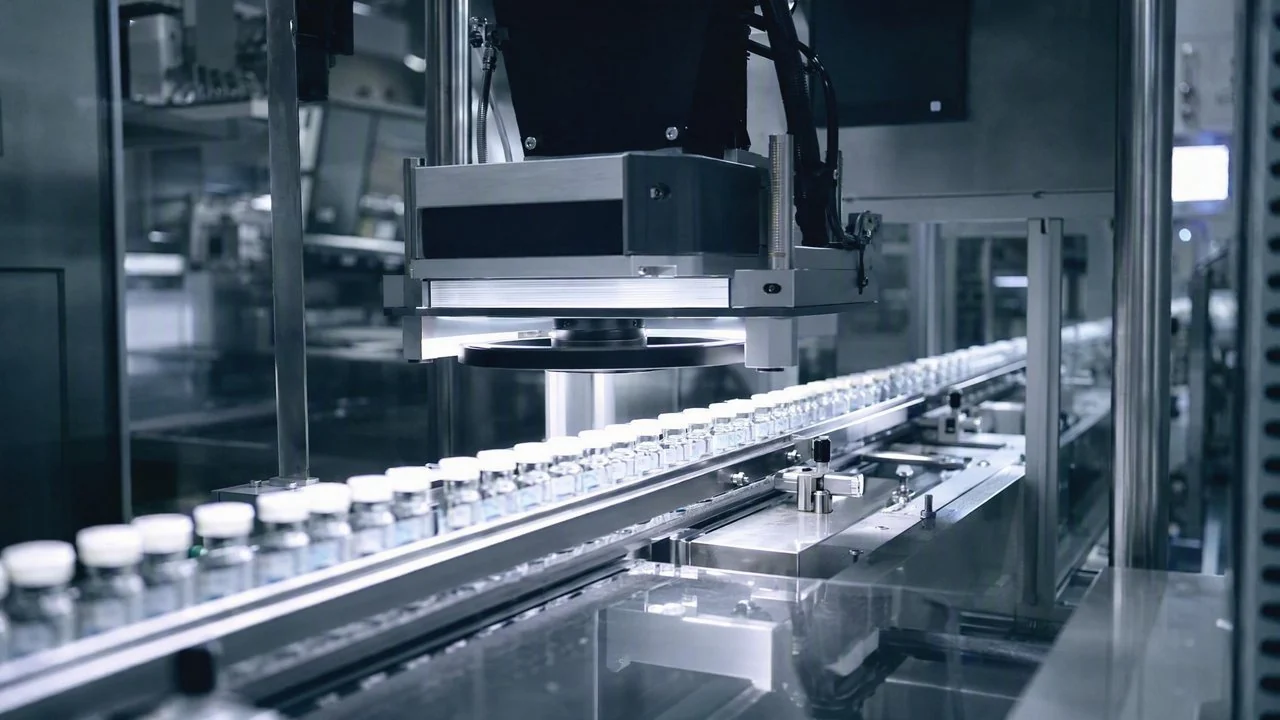
The pharmaceutical industry, a sector critical to health, inherently demands stringent product quality. Especially with the increasing prevalence of multi-variety, small-batch production, balancing high-standard quality inspection with production efficiency and flexibility has become a significant challenge for pharmaceutical companies. DaoAI 2D AI AOI equipment (high-resolution 2D imaging + deep learning re-judgment, targeting surface/print/character OCR/assembly defects, high-speed inline full inspection, micron-level, semantic false positive filtering) leverages its unique zero-code quick changeover capability to reduce label OCR/serial code inspection changeover time in pharmaceutical multi-variety small-batch production lines from hours with traditional solutions to under 5 minutes, significantly improving line flexibility and efficiency, providing robust support for pharmaceutical companies to achieve lean manufacturing.
DaoAI 2D AI AOI equipment (high-resolution 2D imaging + deep learning re-judgment, targeting surface/print/character OCR/assembly defects, high-speed inline full inspection, micron-level, semantic false positive filtering) leverages its unique zero-code quick changeover and few-shot learning capabilities to reduce label OCR/serial code inspection changeover time in pharmaceutical multi-variety small-batch production lines from hours with traditional solutions to under 5 minutes, significantly improving line flexibility and efficiency. In the pharmaceutical industry, labels and serial codes on drug packaging are critical for product traceability, anti-counterfeiting, and compliance. This information typically includes batch numbers, production dates, expiry dates, and regulatory codes, all requiring clarity, accuracy, and completeness. Driven by trends in personalized medicine and refined management, pharmaceutical companies increasingly adopt multi-variety, small-batch production models to meet diverse market and patient needs. This necessitates frequent product changeovers within short periods, placing extremely high demands on the efficiency of online inspection systems. Traditional inspection solutions often struggle to adapt to such high-frequency changeover requirements, leading to low production efficiency and potentially impacting product launch cycles.
Pain Points: Why This Hurdle Is So Difficult to Overcome
In pharmaceutical multi-variety, small-batch production, online label OCR/serial code inspection faces multiple challenges. First is the downtime associated with high changeover frequency. Traditional vision systems rely on manual programming and parameter adjustments; each time a product batch or label design changes, engineers spend several hours reconfiguring and debugging, resulting in long production line downtime. Production line data from a mid-sized pharmaceutical manufacturer showed an average changeover downtime of 2-4 hours per change. Second is the difficulty in balancing false positive and false negative rates. Traditional rule-based AOI systems are sensitive to label print quality, character deformation, background interference, etc., often generating a large number of false positives. According to feedback from the pharmaceutical manufacturer, false positive rates with traditional solutions could be as high as 5-8%, requiring extensive manual re-inspection and increasing operational costs. Simultaneously, in complex backgrounds or with subtle defects, there's a risk of missed detections, impacting product compliance. Finally, there are the limitations and costs of manual visual inspection. In segments lacking automated inspection, manual visual inspection is inefficient, prone to fatigue, and lacks consistency. Industry analysis on AI in manufacturing indicates that the cost-effectiveness of manual visual inspection is rapidly declining, especially in scenarios requiring fine-grained recognition, becoming a bottleneck for capacity improvement and quality stability. These issues collectively form the 'difficult hurdle' in multi-variety, small-batch production, urgently requiring more intelligent and flexible solutions.
The root cause of these pain points lies in the technical limitations of traditional solutions. Traditional rule-based vision algorithms, when faced with diverse label materials, printing ink variations, environmental light changes, and subtle variations in character fonts, sizes, and spacing, require engineers to manually write a large number of complex rules and thresholds, which are difficult to generalize. Even minor changes in product or label design can render rule-based systems ineffective, necessitating reprogramming. This rigidity limits production line flexibility, making quick changeovers a luxury. Furthermore, traditional solutions struggle with 'semantic false positives' – for instance, a minor ink speck might be incorrectly flagged as a defect, but it doesn't actually affect character readability or product compliance. This phenomenon is particularly common in pharmaceutical products, where defect definitions often involve functional and compliance judgments rather than simple geometric features.
Technical Principles
DaoAI 2D AI AOI equipment fundamentally resolves the aforementioned pain points by combining high-resolution 2D imaging technology with a deep learning secondary judgment mechanism. Its core lies in the visual foundation model embedded within the DaoAI AI AOI software system, which possesses powerful feature recognition and generalization capabilities. Unlike traditional rule-based AOI that relies on engineers manually setting thresholds, the DaoAI 2D AI AOI equipment adopts a 'one-click learning' mode. By providing only a small number (1-20) of good product images, the system can automatically learn normal product features and complete model training within 5 minutes, achieving zero-code programming. This process is based on APDT (Auto-Programming & Deep Transfer) few-shot self-training technology, which utilizes pre-trained deep neural networks to extract high-dimensional image features and adapts to new products through incremental learning. When a potential defect is detected, the system performs a deep learning secondary judgment, semantically understanding and filtering initial screening results, effectively distinguishing genuine quality-affecting defects from harmless background noise or minor deformations. For example, in label inspection at a pharmaceutical plant, the DaoAI 2D AI AOI equipment reduced semantic false positive rates by over 85%, automating the complex defect screening process that previously required extensive manual re-inspection to the extreme.
Compared to traditional methods, the DaoAI 2D AI AOI equipment offers significant advantages. While traditional rule-based AOI systems are fast, they often struggle to balance detection rates and false positive rates when facing complex, variable, or ambiguous defects. Manual visual inspection, limited by human eyesight and fatigue, cannot achieve 100% full inspection and is costly and inefficient. The DaoAI 2D AI AOI equipment, through deep learning, not only achieves micron-level detection accuracy but also handles challenges that traditional methods struggle with, such as low contrast, complex textures, and varied fonts. Its high-speed inline full inspection capability ensures production rhythm, while semantic false positive filtering significantly reduces the workload of manual re-inspection. According to feedback from a pharmaceutical manufacturer, after the system was deployed, manual re-inspection volume decreased by over 90%. Furthermore, the DaoAI 2D AI AOI system supports 100% local private deployment, ensuring data security and meeting the pharmaceutical industry's strict requirements for data compliance.
Typical Application Scenarios
- **Online Pharmaceutical Box/Bottle Label OCR Recognition and Verification:** The DaoAI 2D AI AOI equipment can detect and verify character information such as batch numbers, expiry dates, production dates, and regulatory codes on pharmaceutical boxes or bottles in real-time, ensuring their accuracy, completeness, and print quality. The challenges lie in slight color differences between label batches, character deformation, reflective materials, and image acquisition under high-speed movement. The DaoAI system robustly identifies various complex situations through high-resolution imaging and deep learning models.
- **Serial Code/Barcode/QR Code Print Quality Inspection:** For serial codes, barcodes, and QR codes on pharmaceutical boxes or labels, the DaoAI 2D AI AOI equipment can detect defects such as printing omissions, blurriness, breaks, smudges, etc., ensuring code readability and traceability. The difficulty lies in identifying minute defects and stable inspection at high production line speeds. The DaoAI equipment can achieve micron-level defect full inspection online.
- **Label Position and Application Defect Detection:** Detects if labels are skewed, wrinkled, damaged, bubbled, missing, or overlapping. These defects not only affect product appearance but can also lead to incorrect information reading or packaging failure. The DaoAI 2D AI AOI system precisely identifies these surface and geometric defects, ensuring label application compliance.
- **Pharmaceutical Leaflet Print Defect Inspection:** For folded or rolled pharmaceutical leaflets, it inspects whether the printed content is clear and complete, and if there are defects such as ink spots, scratches, color differences, or missing prints. Challenges include the thin, easily deformable material of the leaflets and the fine inspection of dense text. The DaoAI 2D AI AOI equipment effectively filters irrelevant imperfections through deep learning secondary judgment, focusing on critical information quality.
- **Packaging Box Print Pattern and Text Matching Detection:** Verifies that patterns, text, and colors on the inner and outer packaging boxes of medicines completely match the product information, preventing confusion or incorrect assembly. The DaoAI 2D AI AOI equipment can perform high-precision image comparison, identifying subtle print differences and omissions.
Case Study
A mid-sized pharmaceutical manufacturer, specializing in a wide range of over-the-counter drugs, frequently had to manage the production of dozens of different drug specifications and packaging types. Before implementing the DaoAI 2D AI AOI equipment, this factory's label OCR/serial code inspection relied primarily on manual visual inspection and traditional rule-based AOI systems. Each time a product changeover occurred, engineers would spend several hours reconfiguring the traditional AOI system, adjusting parameters and writing rules, leading to prolonged production line downtime, with an average changeover downtime of 2-4 hours. Furthermore, the higher false positive rate of traditional rule-based AOI (which reached 7% in this case) required significant human resources for manual re-inspection daily, severely impacting production efficiency and costs. After deploying the DaoAI 2D AI AOI system, the factory, leveraging its zero-code quick changeover capability, reduced new product changeover time from hours to under 5 minutes, greatly enhancing production line flexibility. Concurrently, the system's deep learning secondary judgment and semantic false positive filtering capabilities reduced manual re-inspection volume by over 90%, allowing the factory to allocate more resources to core production activities rather than repetitive inspection tasks. In this case, the DaoAI 2D AI AOI equipment not only improved inspection efficiency and accuracy but, more importantly, it empowered the factory to achieve truly flexible multi-variety, small-batch production, reducing overall operational costs and enhancing the reliability of product quality traceability.
After implementing the DaoAI 2D AI AOI system, a pharmaceutical manufacturer reduced new product changeover time from hours to under 5 minutes and manual re-inspection volume by over 90%, significantly boosting line flexibility and efficiency.
DaoAI Solution and Products
DaoAI provides a comprehensive solution for the pharmaceutical multi-variety, small-batch production scenario, centered around its 2D AI AOI equipment. This equipment integrates high-resolution industrial cameras, professional lighting, and high-performance computing units, powered by the DaoAI AI AOI software system. In terms of modeling and changeover, the core advantage of the DaoAI 2D AI AOI equipment lies in its 'zero-code quick changeover' capability. Through the APDT few-shot self-training technology of the DaoAI AI AOI software system, users do not need to write any code; by simply acquiring 1-20 good product images, the system can complete model training and configuration within 5 minutes, enabling rapid switching for new products or batches. This addresses the pain point of complex and time-consuming programming for traditional AOI changeovers. Regarding deployment and integration, the DaoAI 2D AI AOI equipment supports high-speed inline full inspection and can be seamlessly integrated into existing production lines, compatible with various conveyor belts and robotic arm systems. Its SDK/API/Docker interfaces provide flexible integration methods and support 100% local private deployment, ensuring customer data security and compliance with industry regulatory requirements. Furthermore, the DaoAI World model, serving as a unified foundation, enables semantic understanding, cross-scenario generalization, and continuous learning from production line feedback, offering infinite possibilities for future intelligent upgrades. For customers requiring more complex application scenarios, DaoAI can also provide DaoAI robot vision solutions, such as for bin picking or precision assembly guidance, further enhancing production line automation.
Through the application of DaoAI 2D AI AOI equipment, a pharmaceutical manufacturer achieved significant quantifiable results. The system boosted the detection rate for label OCR/serial codes to over 99.8%, while reducing the false positive rate by over 85%, substantially cutting down the workload that previously required extensive manual re-inspection. Production line data showed that new product changeover time was reduced from an average of 2-4 hours to under 5 minutes, improving production efficiency by approximately 30%. These achievements not only directly lowered labor costs and downtime losses but, more importantly, they enhanced the company's market responsiveness and the reliability of product quality, enabling the enterprise to react more flexibly to market changes and maintain a leading edge in fierce market competition. The DaoAI 2D AI AOI equipment offers pharmaceutical companies an efficient, intelligent, and flexible new paradigm for quality inspection, assisting them in their journey towards Industry 4.0.
FAQ
How does DaoAI 2D AI AOI equipment achieve zero-code quick changeover?
DaoAI 2D AI AOI equipment achieves zero-code quick changeover through its APDT (Auto-Programming & Deep Transfer) few-shot self-training technology embedded in the DaoAI AI AOI software system. Users only need to acquire 1-20 good product images, and the system can automatically learn product features and complete model training within 5 minutes, without manual programming or complex parameter adjustments, significantly simplifying new product launch and batch switching processes.
What unique advantages does DaoAI 2D AI AOI offer in the pharmaceutical industry compared to traditional rule-based AOI?
DaoAI 2D AI AOI equipment offers multiple unique advantages in the pharmaceutical industry. Firstly, its deep learning secondary judgment capability effectively filters semantic false positives, distinguishing true defects from harmless imperfections, reducing manual re-inspection. Secondly, zero-code quick changeover is particularly suited for multi-variety, small-batch pharmaceutical production, significantly enhancing line flexibility. Furthermore, micron-level detection accuracy and strong robustness to complex backgrounds and varied fonts ensure high-standard quality compliance.
What budget is required to deploy DaoAI 2D AI AOI equipment, and what is the typical payback period?
The budget for deploying DaoAI 2D AI AOI equipment is influenced by various factors, including production line scale, complexity of inspection requirements, integration difficulty, and required hardware configuration. The specific payback period depends on savings in labor costs, reduced re-inspection costs due to lower false positive rates, and increased production capacity from improved efficiency. We recommend contacting the DaoAI professional team for a detailed on-site assessment and customized solution design to receive an accurate quote and return on investment analysis.
Full solution for this scenario: 2D AI AOI Equipment industry solutions
This article was generated by AI. Customer cases are simulated scenarios based on real product capabilities and figures are illustrative; see product pages for official benchmarks.