
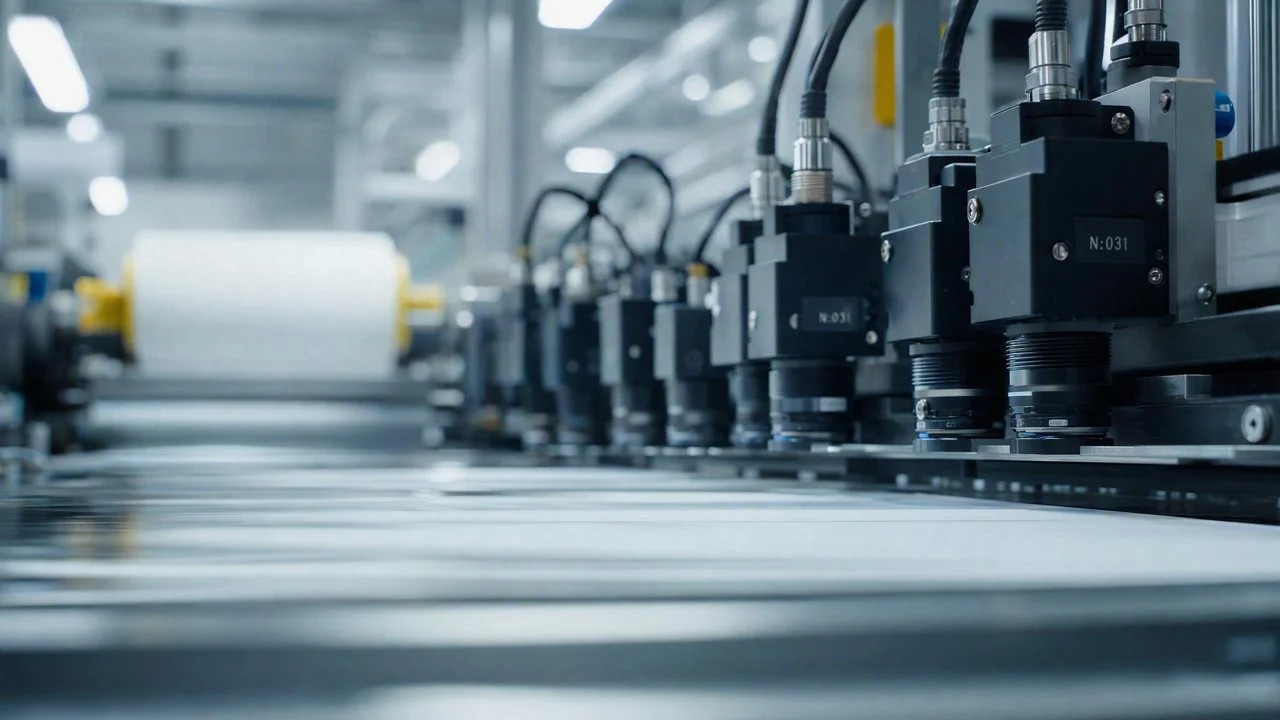
For common surface flaws in paper production within the chemical/material industry, DaoAI 2D AI AOI equipment (high-resolution 2D imaging + deep learning secondary judgment, targeting surface/print/OCR/assembly defects, high-speed online full inspection, micron-level, semantic false alarm filtering) significantly enhances product quality traceability and production efficiency by reducing traditional manual re-inspection hours from an average of 8 hours per shift to 2 hours through real-time online detection and intelligent data analysis.
For common surface flaws in paper production within the chemical/material industry, DaoAI 2D AI AOI equipment (high-resolution 2D imaging + deep learning secondary judgment, targeting surface/print/OCR/assembly defects, high-speed online full inspection, micron-level, semantic false alarm filtering) significantly enhances product quality traceability and production efficiency by reducing traditional manual re-inspection hours from an average of 8 hours per shift to 2 hours through real-time online detection and intelligent data analysis. In modern industrial production, especially in the chemical and material manufacturing sectors, paper, as a critical basic material, directly impacts the performance of downstream products and user experience. Any minute surface flaw, such as spots, fiber knots, wrinkles, black dots, or pinholes, in specialty paper, packaging paper, or industrial paper, can lead to batch rejection or customer complaints, thereby affecting corporate reputation and economic benefits. Therefore, achieving high-precision, high-efficiency quality inspection of paper production processes and implementing effective defect data traceability and closed-loop management has become a core issue urgently needing resolution in the industry.
Pain Points: Why This Hurdle Is Difficult to Overcome
Paper defect detection faces multiple challenges. Firstly, there's a **contradiction between detection rate and false alarm rate**: traditional manual visual inspection suffers from high rates of missed defects due to human fatigue and subjective judgment. Data from a large paper mill showed that under high-speed production line conditions, the missed detection rate for manual inspection could exceed 5%. At the same time, strict standards adopted to avoid missed detections often lead to false alarms, increasing unnecessary re-inspection hours. Secondly, there's the **pressure of high-speed production line cycles**: paper production lines typically operate at speeds of tens or even hundreds of meters per minute, making it difficult for traditional rule-based vision or manual inspection to keep up and achieve 100% online full inspection. Thirdly, the **diversity and complexity of defects**: paper defects are numerous and varied in form, and many exhibit subtle contrast changes under reflective light, easily being confused with normal textures. This is particularly true for reflective surface defect detection, such as uneven gloss or coating defects on paper surfaces, which are difficult to image, and traditional algorithms based on thresholds or edge detection struggle to identify them accurately. Furthermore, there's a **lack of effective quality traceability mechanisms**: even when defects are detected, it's difficult to quickly pinpoint when, where, and under what process parameters they occurred, making root cause analysis challenging and hindering the formation of a quality improvement loop. A medium-sized paper mill previously spent an average of 3-5 days resolving a single customer complaint due to a lack of traceability, severely impacting response times.
From a process and imaging perspective, the semi-transparency of paper, the irregularity of its fiber structure, and fluctuations in ambient light during production all pose significant challenges for high-precision visual inspection. The difficulty in detecting reflective surface defects lies in the fact that defects often manifest as minute differences in local reflectivity or changes in scattering characteristics, rather than significant geometric shape changes. Traditional image processing algorithms struggle to differentiate these subtle variations from the material's normal texture, leading to false alarms or missed detections. Simultaneously, due to the wide format of paper and the random distribution of defects, the detection system requires extremely high field of view, resolution, and data processing capabilities. These factors collectively constitute the 'difficult hurdle' for online paper defect inspection.
Technical Principles
The core of DaoAI 2D AI AOI equipment lies in its advanced technical architecture, combining **high-resolution 2D imaging systems** with **deep learning secondary judgment**. Firstly, the high-resolution 2D imaging system employs customized line scan cameras and precision light sources to scan and image the surface of the high-speed moving paper web with micron-level precision, capturing subtle textures and reflective features. For reflective surface defects, DaoAI optimizes light source angles and polarization techniques to maximize the contrast between defects and the background, ensuring the quality of image acquisition. Secondly, image data is fed into a deep learning model powered by the DaoAI Wemio engine for secondary judgment. This model, based on advanced vision foundation models, quickly establishes a baseline understanding of 'normal' paper surfaces using APDT positive sample/few-shot learning technology, requiring only a small number (1-20) of good product images. For potential defects detected, the model performs semantic-level understanding and classification, effectively filtering out semantic false alarms caused by paper's own texture or minor creases, ensuring judgment accuracy. This contrasts sharply with traditional rule-based AOI methods, which often require engineers to manually set complex parameters and thresholds, have poor adaptability to lighting changes and defect diversity, and struggle to distinguish between true and false defects.
Compared to traditional manual visual inspection, DaoAI 2D AI AOI equipment provides **non-contact, high-speed, objective, and consistent** inspection standards, completely eliminating the uncertainties caused by human eye fatigue and subjective judgment. Compared to traditional rule-based AOI, the deep learning capabilities of the DaoAI Wemio engine enable it to **adaptively handle complex and varied defect forms**, especially excelling at processing 'anomalies' that are difficult to define with explicit rules, such as randomly distributed pulp clumps or blurry stains, while also **significantly reducing the false alarm rate**. For instance, traditional rule-based AOI often generates numerous false alarms when dealing with paper fiber knots due to their similarity in form to normal fiber textures. In contrast, DaoAI AI AOI learns from a large number of samples to accurately distinguish between good product features and defect features, reducing the false alarm rate by over 80%. Furthermore, the DaoAI system also supports **quality traceability and data closed-loop**, with every inspection result tagged with a timestamp and location information, linked to production batches and process parameters, providing strong support for subsequent quality analysis and process optimization.
Typical Application Scenarios
- **Paper Surface Spot and Impurity Detection:** Detects various foreign objects mixed into paper during production, such as fiber knots, pulp clumps, oil stains, black spots, and color patches. The challenge lies in the minute size and diverse colors of these spots, which may also be close to the paper's base color. DaoAI 2D AI AOI equipment can accurately identify them through high-resolution imaging and deep learning models.
- **Coating and Printing Defect Detection:** For coated and printed paper, detects defects like uneven coating, bubbles, scratches, misprints, and registration errors. The difficulty lies in the high precision of coatings and printed patterns, where defects manifest as tiny texture or color deviations. The DaoAI system achieves high-precision detection through in-depth analysis of image details.
- **Paper Web Physical Damage Detection:** Includes structural defects such as wrinkles, pinholes, tears, and edge fraying. The challenge is that these defects may be discontinuous, irregular in shape, and difficult to capture at high speeds. DaoAI 2D AI AOI equipment can monitor and precisely locate them in real-time.
- **Watermark and Anti-counterfeiting Feature OCR/OVC:** Performs character recognition (OCR) and character verification (OVC) for watermarks, anti-counterfeiting codes, and batch numbers in specialty papers. The difficulty lies in characters that may be deformed, blurred, or blended with the background. The powerful recognition capabilities of the Wemio engine can handle character recognition and verification in complex environments.
Case Study
A leading paper manufacturer in East China, specializing in high-grade packaging paper and special industrial paper, faced significant quality control challenges before adopting DaoAI 2D AI AOI equipment. Due to the high speed of their paper production lines, traditional manual visual inspection suffered from a high rate of missed defects, particularly for micron-level flaws, leading to frequent customer complaints. To compensate for the shortcomings of manual inspection, the company invested substantial human resources in product re-inspection. On one production line, an average of 4-6 quality inspectors were required per shift for sampling and re-inspection, with re-inspection hours accounting for about 70% of total quality inspection hours. More critically, the lack of precise defect data and a traceability system made root cause analysis of quality issues and process improvement extremely difficult. After partnering with DaoAI, the company deployed multiple sets of 2D AI AOI equipment on its core production lines to perform 100% online full inspection of paper surfaces.
In the initial deployment phase, the DaoAI engineering team utilized APDT few-shot learning technology to establish and optimize detection models within hours by collecting a small number of good product samples. After the system went live, production line data showed that, in this case, DaoAI 2D AI AOI equipment **reduced the missed detection rate for paper defects from a traditional 5.5% to <0.4%**, achieving a significant improvement in product quality. Concurrently, thanks to the semantic false alarm filtering capability of the Wemio engine, the **false alarm rate was reduced by 82%**, greatly minimizing unnecessary downtime and manual re-inspection. The average 8 hours of manual re-inspection time per shift was **reduced to approximately 2 hours** with the system's assistance, optimizing quality inspection personnel allocation. Furthermore, the detailed defect reports, location coordinates, and trend analysis functions provided by the DaoAI system enabled the company to quickly trace defects back to specific batches, timestamps, and relevant process parameters, providing data support for production process optimization and achieving a closed-loop quality management from 'problem discovery' to 'problem resolution'. Customer feedback indicated that through DaoAI 2D AI AOI equipment, the product qualification rate increased by 1.5 percentage points, and customer satisfaction significantly improved.
DaoAI 2D AI AOI is not just a defect detection tool, but an intelligent engine that drives quality management from reactive response to proactive prevention, building quality traceability and data closed-loop across the entire production chain.
DaoAI Solutions and Products
DaoAI's 2D AI AOI solution for the chemical/material industry is built upon its core product, the DaoAI AI AOI software system, combined with high-performance hardware equipment, creating a complete intelligent detection and quality traceability system. In the modeling phase, the DaoAI AI AOI software system demonstrates its unique advantages: the powerful feature recognition capability of its vision foundation model allows engineers to achieve 0-code automatic programming in just 5 minutes with only one good product sample, greatly simplifying the complex parameter configuration process of traditional AOI. The APDT positive sample/few-shot learning technology (1-20 good product samples) effectively addresses the pain points of multi-variety, small-batch production and scarce defect samples in the industry, accelerating model deployment. The semantic false alarm filtering function, through deep learning, 'understands' defects, avoiding false alarms caused by non-defect factors such as paper texture or background noise, ensuring detection accuracy and stability. The system supports 100% local private deployment, ensuring the security and compliance of customer production data.
In practical implementation, DaoAI 2D AI AOI equipment uses high-resolution industrial cameras and professional light sources to image the paper surface at high speed, transmitting image data in real-time to edge computing devices equipped with the Wemio engine for intelligent analysis. The system accurately identifies and records the type, location, and size of each defect, generating detailed defect reports that seamlessly integrate with the manufacturing execution system (MES) to link quality data with production batches. This not only provides instant feedback, guiding production line workers to adjust processes, but also builds a complete quality traceability chain. Through this data, enterprises can trace any defective product, analyze its root cause, and even predict potential quality risks. DaoAI also offers the DaoAI World Model as a unified AI foundation, with semantic understanding and cross-scenario generalization capabilities, enabling continuous learning from production line feedback to constantly improve detection accuracy and adaptability. This holistic solution, encompassing data acquisition, intelligent analysis, quality traceability, and closed-loop improvement, provides a solid guarantee for chemical/material enterprises to achieve production-wide quality visualization and intelligent decision-making.
FAQ
What is the fundamental difference between DaoAI 2D AI AOI equipment and traditional rule-based AOI?
The core of DaoAI 2D AI AOI equipment lies in its adoption of deep learning technology, particularly the vision foundation models of the Wemio engine. Unlike traditional rule-based AOI, which relies on engineers manually setting complex rules and thresholds, AI AOI can autonomously learn defect features from a small amount of good product data through APDT few-shot learning, enabling semantic false alarm filtering. It exhibits stronger adaptability to complex and varied defect forms, significantly reduces false alarm and missed detection rates, and supports more powerful quality traceability functions.
How long does it take to implement a DaoAI 2D AI AOI solution? What are the modification requirements for existing production lines?
The implementation cycle for DaoAI 2D AI AOI solutions is relatively short. For hardware integration, it can usually be installed using existing production line space with minimal modification requirements. Software deployment and model training, thanks to 0-code programming and few-shot learning technology, typically complete initial configuration and begin trial operation within hours to days. The specific timeline depends on production line complexity and client integration needs. Our team provides full-process support from solution design, deployment, to post-maintenance.
How is the budget for DaoAI 2D AI AOI equipment estimated?
The budget for DaoAI 2D AI AOI equipment primarily depends on factors such as inspection width, precision, production line speed, number of cameras required, lighting configuration, and the degree of customization for software function modules (e.g., data traceability, MES integration). We offer flexible hardware and software configuration options to meet the specific needs and budgets of different clients. We recommend contacting our sales engineers with detailed production line information and inspection requirements for a customized technical solution and precise quotation.
This article was generated by AI. Customer cases are simulated scenarios based on real product capabilities and figures are illustrative; see product pages for official benchmarks.