
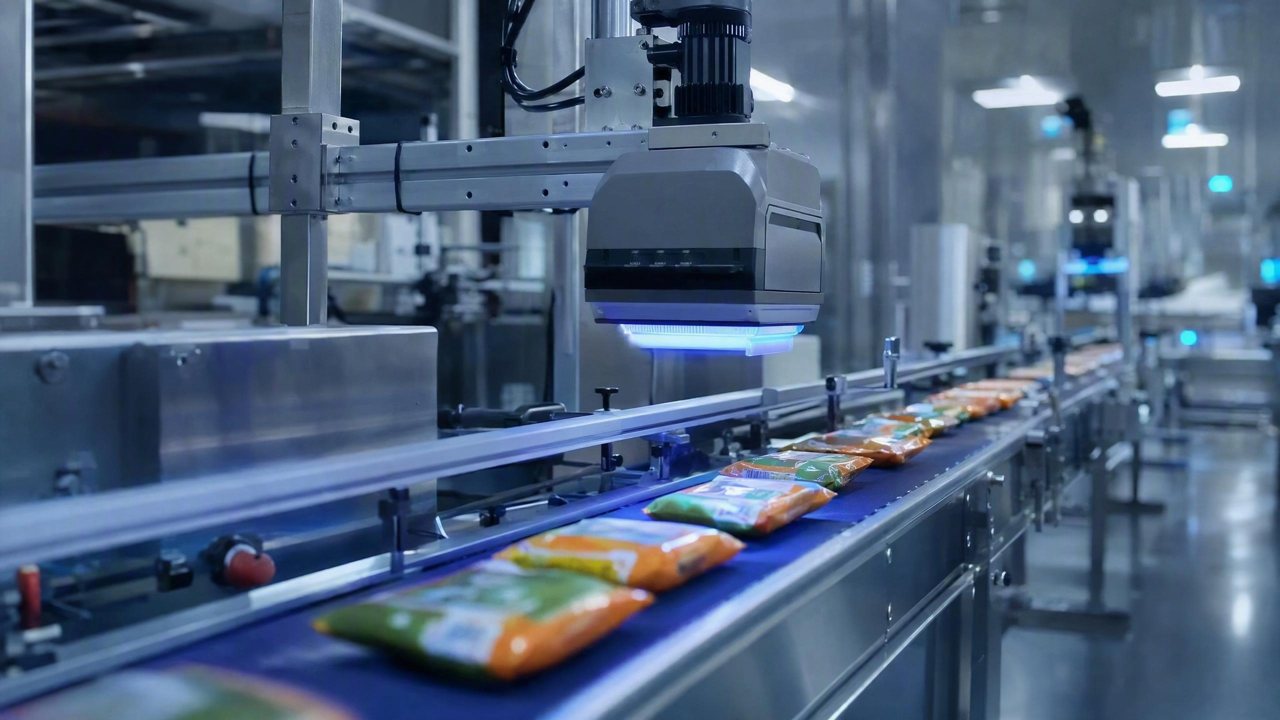
DaoAI 2D AI AOI equipment (high-resolution 2D imaging + deep learning secondary judgment, targeting surface/print/OCR/assembly defects, high-speed inline full inspection, micron-level accuracy, semantic false positive filtering) significantly enhanced production line flexibility and efficiency in the food industry. By leveraging zero-code quick changeover and few-shot learning, it reduced changeover time for packaging seal, label, and coding inspection in high-mix low-volume production from traditional 30 minutes to under 5 minutes.
In the food and agriculture sectors, increasing consumer focus on product quality and food safety directly drives the pursuit of zero-defect manufacturing. Especially in critical links like packaging seals, label integrity, and coding clarity, any subtle defect can lead to product recalls, brand damage, and even legal risks. However, the food industry features a wide variety of products, strong seasonality, and rapid market demand changes, making high-mix, low-volume production a norm. This creates significant efficiency bottlenecks and cost pressures for traditional manual inspection or rule-based AOI systems when facing frequent product changeovers. The DaoAI 2D AI AOI equipment emerges in this context, leveraging its powerful zero-code quick changeover capability to effectively address the core problem of inefficient inspection system changeovers for small and medium-sized food processing enterprises in high-SKU production, significantly enhancing production line flexibility and economic benefits.
Pain Points: Why This Hurdle Is Difficult to Overcome
Food packaging seal, label, and coding inspection face multiple challenges that make it difficult for traditional solutions to cope efficiently. Firstly, there's the issue of [High Changeover Frequency and Long Downtime]: A mid-sized food processing plant, due to frequent adjustments in product recipes, flavors, and packaging specifications, requires 3-5 changeovers per day on its production line. Each changeover with traditional rule-based AOI systems requires senior engineers to spend 30-60 minutes rewriting or adjusting inspection rules, leading to long production line downtime, averaging 1.5-3 hours of lost production time daily due to changeovers, severely impacting overall OEE (Overall Equipment Effectiveness).
Secondly, [Complex Defects and High False Positive/Negative Rates]: Food packaging materials are diverse, such as transparent films, aluminum foils, and color-printed cartons, with significant variations in reflectivity and texture, leading to complex imaging. Defects like wrinkles, bubbles, uneven heat seals at the sealing point, skewed, damaged, or blurry labels, and missing, ghosted, or smudged characters in codes are often visually similar or difficult to capture. Traditional AOI has limited recognition accuracy; factory data shows false positive rates as high as 5-8% for label skew and code character recognition, and false negative rates are difficult to reduce below 0.5%, resulting in extensive manual re-inspection workload and potential quality risks. Finally, [Talent Scarcity and High Maintenance Costs]: Traditional AOI systems demand high professional skills from operators, especially in parameter adjustment and troubleshooting. Food enterprises commonly face difficulties in recruiting automation engineers and experienced vision algorithm engineers, with high labor costs and maintenance expenses becoming obstacles to sustainable development. Coupled with the current challenges of achieving zero-defect manufacturing in complex industrial scenarios with AI vision inspection, traditional solutions lacking flexibility and struggling to adapt quickly to diverse production demands can no longer meet the dual stringent requirements of modern food production for efficiency and quality.
Technical Principles
The DaoAI 2D AI AOI equipment fundamentally resolves these pain points by integrating high-resolution 2D imaging technology with advanced deep learning algorithms. Its core lies in the [visual foundation model feature recognition] and [APDT positive/few-shot learning] mechanisms adopted by the DaoAI AI AOI software system. Unlike traditional rule-based AOI that relies on engineers manually setting thresholds and feature extraction rules, the DaoAI 2D AI AOI equipment, through pre-trained visual foundation models, can autonomously learn and understand high-level semantic features in images, such as “this is a complete seal” or “this is a clear label character.” This means it doesn't require explicit programming for each defect pattern but builds a general feature model of “normal” products by learning from a large number of good product images.
During changeovers, the DaoAI 2D AI AOI equipment only needs to import [1-20 good product images] of the new product. Utilizing APDT (Adaptive Pattern Description Technology) few-shot learning, the system can quickly learn and adapt the model for the new product within 5 minutes, achieving zero-code automatic programming. This learning method significantly shortens changeover time and reduces the professional skill requirements for operators. Furthermore, its [semantic false positive filtering] mechanism performs secondary judgment on defect areas through deep learning, distinguishing between normal textures, environmental lighting variations, and actual defects in images, effectively reducing the false positive rate common in traditional AOI. For instance, subtle textures on a packaging film might be misidentified as scratches by traditional AOI, but the DaoAI 2D AI AOI equipment can recognize them as normal features based on semantic understanding, significantly reducing manual re-inspection workload. Compared to manual inspection, which is prone to fatigue, subjectivity, and inefficiency, and traditional rule-based AOI, which suffers from complex changeovers, high false positive rates, and difficulty in handling complex defects, the DaoAI 2D AI AOI equipment demonstrates overwhelming advantages in accuracy, efficiency, and flexibility.
Typical Application Scenarios
- **Packaging Seal Integrity Inspection:** The DaoAI 2D AI AOI equipment accurately detects defects such as wrinkles, bubbles, incomplete seals, missing seals, and contamination in food packaging heat seals, ensuring seal integrity. The challenge lies in the varying transparency and reflective properties of different packaging materials, and distinguishing tiny deformations from actual defects.
- **Label Printing and Application Quality Inspection:** Detects blurry printing, missing characters, color deviations, misaligned patterns on labels, as well as skewed, bubbling, damaged, or missing labels. The difficulty lies in capturing tiny printing defects at high production speeds and accurately separating different background and label colors.
- **Product Coding and Date Character Recognition (OCR/OCV):** Performs high-precision OCR recognition and OCV verification for production dates, batch numbers, expiration dates, and other coded characters, ensuring characters are complete, clear, and correct. The challenge lies in the impact of ink bleed, background interference, character deformation, and high-speed motion blur on recognition accuracy.
- **Packaging Box Surface Defects and Printing Quality:** Detects scratches, stains, dents, indentations on the surface of outer packaging such as paper boxes and plastic boxes, as well as misregistration or uneven ink in printed patterns. The difficulty lies in identifying subtle surface defects against complex textured backgrounds and accurate judgment of print colors.
- **Assembly Shortages and Combination Packaging Integrity:** In multi-item combination packaging, detects missing products, omitted accessories, or misplaced packaging components. The challenge lies in the complexity of multi-target recognition and real-time judgment at high production speeds.
Case Study
A mid-sized snack food processing plant in East China, primarily producing various flavors of puffed foods and nut snacks, has over 50 product SKUs. The core challenge faced by this factory was the inefficiency caused by frequent changeovers in its high-mix, low-volume production model on the packaging line. Before implementation, their traditional rule-based AOI system required experienced engineers to manually adjust parameters and write new rules during each changeover, with an average downtime of 30-40 minutes per changeover. This directly resulted in 2-3 hours of lost production time daily due to changeovers, severely impacting order delivery cycles and overall capacity. Additionally, the traditional system had a false positive rate of up to 6% for skewed labels and blurry codes, requiring 2-3 workers to perform manual re-inspection for up to 4 hours daily, leading to high labor costs and susceptibility to errors.
“The zero-code quick changeover capability of DaoAI 2D AI AOI equipment truly enabled flexibility in our high-mix, low-volume production line. We no longer worry about downtime losses from frequent changeovers.” — Production Manager, a snack food factory
To address these issues, the factory introduced the DaoAI 2D AI AOI equipment. During implementation, the DaoAI team first collected data on various typical good products and used its APDT few-shot learning function to complete model training for core products in a short period. After actual line deployment, the system demonstrated excellent performance. Changeover operators only needed to import 10-15 good product images of the new product into the system, and through an intuitive user interface, the DaoAI 2D AI AOI equipment completed model updates and adaptation of inspection rules within 5 minutes. Production line data shows that in this case, the average changeover downtime was significantly reduced from 35 minutes to <5 minutes, improving changeover efficiency by over −85%. Concurrently, due to its semantic false positive filtering capability, the false positive rate for labels and codes was reduced to <0.8%, and manual re-inspection labor hours decreased by −80%, effectively freeing up human resources. Furthermore, the DaoAI 2D AI AOI equipment maintained a stable detection rate of over 99.6% for packaging seal defects, ensuring product quality and food safety compliance.
DaoAI Solution and Products
The 2D AI AOI solution provided by DaoAI centers on its core product—the DaoAI 2D AI AOI equipment—combined with the DaoAI AI AOI software system, offering revolutionary inspection capabilities for high-mix, low-volume production in the food industry. The primary advantage of this solution lies in its [zero-code quick changeover] and [few-shot learning]. Customers do not need to write any code; simply providing a small number of good product samples (1-20 images) allows the system to complete learning and deployment for new products within 5 minutes. This simplified operational process greatly reduces the technical requirements for operators, enabling production line engineers to easily manage and maintain the inspection system. The DaoAI 2D AI AOI equipment supports 100% local private deployment, ensuring customer data security remains on-site and meeting the stringent data compliance requirements of the food industry. Its high-resolution 2D imaging capability, combined with deep learning secondary judgment, achieves micron-level defect detection accuracy and effectively filters semantic false positives, ensuring accuracy and stability for high-speed inline full inspection.
In practical implementation, the DaoAI team provides customized imaging solutions (e.g., selecting suitable cameras and lighting combinations) and conducts on-site integration and debugging based on the customer's specific production line environment and product characteristics. We can also provide the DaoAI World universal model as a unified foundation for semantic understanding, cross-scenario generalization, and continuous learning and optimization from production line feedback. Through various deployment methods such as SDK/API/Docker, the DaoAI 2D AI AOI solution can be seamlessly integrated into existing production lines for rapid deployment. In this case, the DaoAI 2D AI AOI equipment helped the food factory achieve significant business value improvements. Changeover efficiency improved by over −85%, reducing daily production time lost due to changeovers from 2-3 hours to within 15-30 minutes, significantly increasing production line OEE. The false positive rate decreased by −80%, saving tens of thousands of yuan annually in manual re-inspection costs and reducing rework losses due to misjudgments. Concurrently, a stable and reliable detection rate of over 99.6% effectively ensured product quality and brand reputation, mitigating potential recall risks.
FAQ
How exactly does DaoAI 2D AI AOI equipment achieve zero-code quick changeover?
DaoAI 2D AI AOI equipment achieves zero-code quick changeover through the visual foundation model and APDT few-shot learning technology of the DaoAI AI AOI software system. Users only need to provide 1-20 good product images of the new product, and the system autonomously learns its features, automatically generating or adjusting the inspection model within 5 minutes. This eliminates the need for manual coding or complex parameter settings, greatly simplifying the changeover process.
What are the cost-benefit advantages of DaoAI 2D AI AOI compared to traditional AOI or manual inspection?
DaoAI 2D AI AOI offers significant cost-benefit advantages. It reduces reliance on highly skilled labor through automated inspection, lowering labor costs for manual inspection and human errors due to fatigue. Meanwhile, its quick changeover capability significantly reduces production line downtime, improving production efficiency and OEE. Its high precision and low false positive rate also reduce scrap rates and re-inspection costs, leading to substantially lower overall operating costs compared to traditional solutions in the long run.
How long does it take to deploy DaoAI 2D AI AOI equipment? Are there high requirements for existing production line modifications?
The deployment cycle for DaoAI 2D AI AOI equipment is relatively short, typically completed within a few weeks. We offer various flexible integration methods such as SDK/API/Docker, which can be adapted to the customer's existing production line conditions without requiring extensive modifications. Our engineering team provides on-site evaluation, customized imaging solutions, and full support from installation, debugging, to personnel training, ensuring seamless integration and rapid deployment of the system.
This article was generated by AI. Customer cases are simulated scenarios based on real product capabilities and figures are illustrative; see product pages for official benchmarks.