
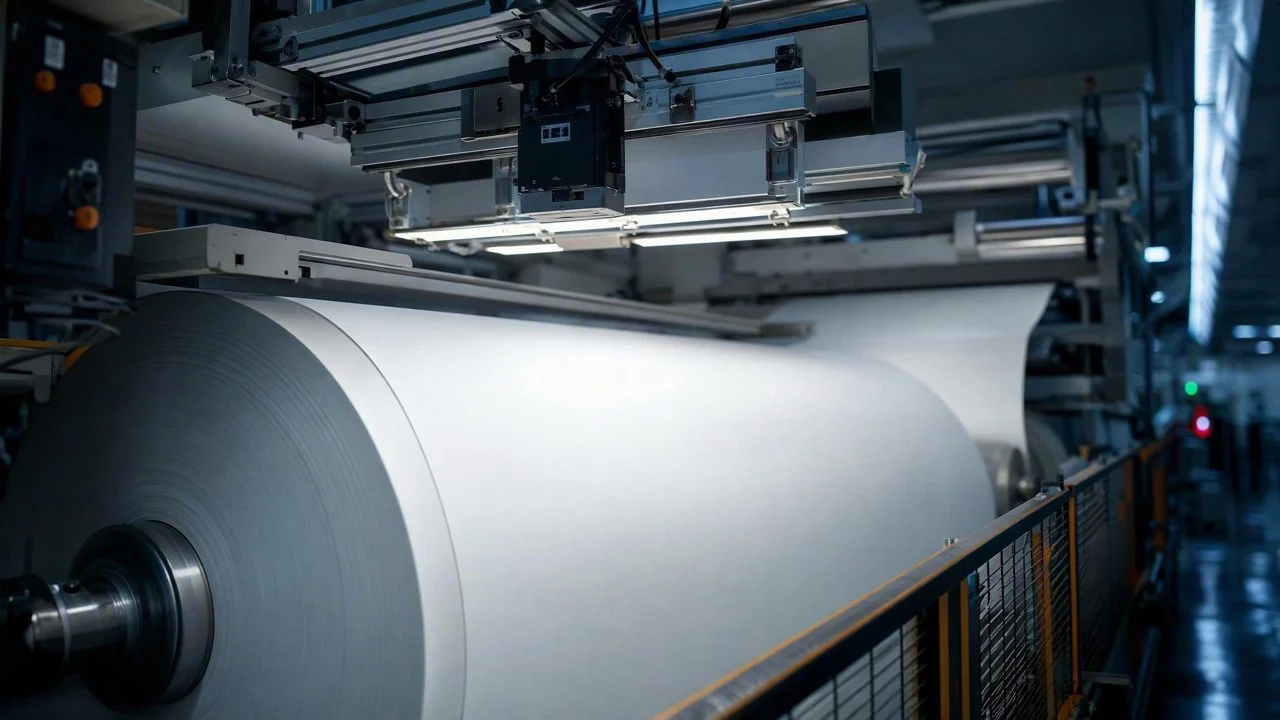
DaoAI 2D ACI equipment (high-resolution 2D imaging + deep learning secondary judgment, targeting surface/print/OCR/assembly defects, high-speed inline full inspection, micron-level accuracy, semantic false positive filtering) accurately identifies tiny surface defects on paper, reducing a large paper manufacturer's surface defect reinspection labor by nearly 70%, fundamentally solving the problems of low efficiency and high cost associated with traditional manual visual inspection. In the chemical and materials industry, paper production is a highly automated process with extremely stringent quality requirements. Whether for packaging, printing, or specialty uses, the surface quality of paper directly impacts the performance and market competitiveness of the final product. Especially on high-speed production lines, ensuring that every roll and every sheet of paper meets strict quality standards while controlling operational costs is a common challenge for many paper manufacturers.
Pain Points: Why This Hurdle Is Difficult to Overcome
In the finishing stages of paper production, especially for specialty papers or high-grade packaging papers, the tolerance for surface defects is extremely low. Traditionally, quality inspection for such products heavily relies on manual visual inspection. However, manual inspection presents multiple challenges: first, high labor costs, especially in continuous production models with three or four shifts, requiring a large number of quality inspectors, leading to enormous personnel expenses. Second, low efficiency; human eyes easily fatigue during long periods of high-intensity work, resulting in inspection speeds far below production line takt time, with a typical false negative rate fluctuating between 3% and 5%. Third, inconsistent standards; different inspectors may have subjective differences in judging the same defect, making it difficult to unify quality standards, and the false positive rate remains high, averaging over 10%, wasting significant resources on subsequent re-inspection and processing. Furthermore, paper surface defects are numerous and varied, such as black spots, fiber knots, wrinkles, scratches, air bubbles, color differences, uneven coating, etc., with some defects as small as tens of microns, making them difficult for the human eye to consistently capture. These issues not only increase production costs but also affect product delivery cycles and customer satisfaction.
The root cause of these difficulties lies in the fast production speed, wide web width, and often minute and diverse nature of defects in paper. Traditional rule-based machine vision systems struggle to adapt to such complex defect patterns, having limited recognition accuracy and generalization capabilities, often requiring extensive manual rule tuning, and performing poorly in identifying novel defects. While manual inspection possesses some generalization ability, its efficiency, stability, cost, and subjectivity have become key bottlenecks in production. The current trend in industrial AI quality inspection is shifting from traditional manual patrol inspection towards large model-driven approaches, with key technological breakthroughs in defect recognition accuracy and generalization capabilities, which are precisely what traditional solutions lack.
Technical Principles
DaoAI 2D ACI equipment offers a transformative solution by combining high-resolution 2D imaging technology with a deep learning secondary judgment mechanism. The system employs industrial-grade high-resolution line scan or area scan cameras, coupled with customized lighting (such as diffuse light, backlighting, coaxial light), to capture image data of the paper surface in real-time with micron-level accuracy. These images are then processed by DaoAI's self-developed AI vision engine. This engine is based on advanced deep learning frameworks, particularly adept at handling planar defects such as surface imperfections, print quality issues, OCR for characters, and assembly omissions.
Compared to traditional rule-based AOI solutions that rely on thresholds or feature extraction, the core advantage of DaoAI 2D ACI lies in its deep learning secondary judgment capability and semantic false positive filtering mechanism. Traditional rule-based AOI often generates a large number of false positives when dealing with complex, variable paper textures and subtle defects, necessitating extensive manual re-inspection. In contrast, the DaoAI AI engine, through extensive sample training, learns to understand the 'semantic' information of defects, distinguishing true product flaws from normal texture variations or environmental noise. For instance, it can accurately identify subtle scratches inconsistent with paper fiber direction while classifying normal fiber interweaving as good, thereby reducing the false positive rate by over 85%. Furthermore, the DaoAI ACI system supports APDT positive/few-shot learning (requiring only 1–20 good samples for training), significantly shortening model training and changeover debugging times. This makes DaoAI 2D ACI equipment superior to traditional methods in terms of detection accuracy, generalization capability, and deployment efficiency, effectively addressing the subjectivity of manual inspection and the limitations of machine vision.
Typical Application Scenarios
- **High-Speed Web Paper Surface Defect Detection:** In the winding stage of paper production lines, DaoAI 2D ACI equipment can achieve high-speed inline full inspection of various micron-level defects on the surface of web paper, such as black spots, fiber knots, air bubbles, wrinkles, and uneven coating. The challenge lies in the stability of image acquisition at high speeds and the accurate identification of subtle, low-contrast defects.
- **Printed Paper Color Register and Character OCR Detection:** For printed paper, the system can precisely detect color misregistration, ink spots, missing prints, ink bleed, and character blur, omission, or misalignment, as well as perform OCR comparison. The difficulty lies in the robustness of character recognition against different print colors and material backgrounds, and distinguishing subtle printing flaws.
- **Specialty Paper (e.g., Filter Paper, Insulating Paper) Hole and Foreign Object Detection:** In the production of high-value specialty papers, any tiny hole or embedded foreign object can lead to product rejection. DaoAI 2D ACI can accurately detect these extremely small and potentially transparent defects. The challenge involves uniform imaging of highly translucent materials and capturing extremely low-contrast defects.
- **Cardboard or Carton Indentation and Scratch Detection:** Before cardboard processing or carton forming, defects such as surface indentations, scratches, and damage are detected. The difficulty is in the 2D projection recognition of 3D morphological defects under specific lighting conditions, and distinguishing between acceptable indentations and actual defects.
- **Paper Cutting Edge Burrs and Delamination Detection:** After paper slitting or cutting, the system inspects for burrs, delamination, unevenness, and other issues at the edges to ensure cutting quality. The challenge is rapid detection of minute abnormalities along the edge line and adapting to different edge morphologies resulting from various cutting processes.
Implementation Case Study
A large paper manufacturer in East China, specializing in high-grade packaging paper and specialty industrial paper, had extremely high requirements for surface quality. Traditionally, they relied entirely on manual visual inspection, with 6-8 quality inspectors per production line working in three shifts. With increasing production line efficiency and rising labor costs year-on-year, the company faced significant operational pressure, and the false negative and false positive rates of manual inspection remained difficult to control. To address this pain point, the company introduced DaoAI 2D ACI equipment for a pilot project. During the three-month trial, the DaoAI engineering team worked closely with the client, utilizing the APDT few-shot learning feature to rapidly complete model training and line integration. Before deployment, the production line required approximately 18 person-hours daily for re-inspection and confirmation of surface defects. After the DaoAI 2D ACI system went live, at the manufacturer's site, its high-precision detection and semantic false positive filtering significantly improved the accuracy of inspection results, reducing the manual re-inspection volume by 68%, requiring only about 6 person-hours daily. This not only substantially lowered labor costs but also freed up personnel to engage in other higher-value tasks. Furthermore, the DaoAI 2D ACI system achieved 100% full inspection on high-speed production lines, reducing the false negative rate from an average of 3.5% with manual inspection to <0.4%.
“The introduction of DaoAI 2D ACI equipment has completely transformed our production line's quality inspection model. It has not only significantly reduced our labor costs but, more importantly, enhanced the overall quality of our products and customer satisfaction. We are now more confident in delivering high-quality paper products to the market.” – Production Director, Large Paper Manufacturer
The figures above are a typically achievable range in anonymized industry scenarios — a different line or a different batch of parts will move the result either way; on-site measurement governs.
DaoAI Solution and Products
The core offering provided by DaoAI to this client was the 2D ACI equipment, which integrates high-resolution industrial cameras, customized lighting, and an edge computing unit, powered by the DaoAI ACI OS. This software system, through the feature recognition capabilities of its visual foundation model, enables rapid changeover with “one good sample, 5 minutes, 0 code automatic programming,” greatly shortening the time for new product introduction and production line adjustments. For materials like paper with complex textures and diverse defects, the DaoAI AI engine can quickly adapt to new inspection tasks using APDT positive/few-shot learning (requiring only 1–20 good samples), achieving high-precision detection without needing a large number of defect samples. The system deployment supports 100% local private deployment, ensuring customer data security remains on-site. Concurrently, the DaoAI World model, serving as a unified foundation, endows the system with powerful semantic understanding and cross-scenario generalization capabilities, allowing it to continuously learn from production line feedback and optimize detection performance.
By implementing DaoAI 2D ACI equipment, this paper manufacturer achieved significant business value. Firstly, labor costs were substantially reduced, saving millions of RMB in personnel expenses annually. Secondly, product quality consistency was significantly improved, leading to fewer customer complaints and enhanced brand reputation. Thirdly, production efficiency and line takt time were optimized, reducing downtime and rework due to quality issues. DaoAI 2D ACI system is not merely an inspection tool; it is a critical component for enterprises to achieve digital transformation and enhance core competitiveness. Its automated, intelligent, and data-driven characteristics bring tangible economic and social benefits to the chemical/materials industry.
FAQ
How does DaoAI 2D ACI equipment reduce labor costs in paper production?
DaoAI 2D ACI equipment replaces traditional manual visual inspection with automated, high-precision inline full inspection. It identifies various paper surface defects with micron-level accuracy and significantly reduces false positives. This drastically lowers the demand for quality inspectors and the workload of subsequent manual re-inspection, directly cutting labor input and associated operational costs.
What are the advantages of DaoAI 2D ACI over traditional rule-based machine vision for paper defect detection?
The core advantage of DaoAI 2D ACI lies in its deep learning secondary judgment and semantic false positive filtering mechanisms. Traditional rule-based vision struggles with complex paper textures and diverse defects, often generating numerous false positives. DaoAI's AI engine learns the 'semantic' information of defects, accurately distinguishing true from false flaws, significantly improving detection accuracy and generalization, reducing false positive rates, and supporting few-shot rapid learning for more flexible and efficient deployment.
What is the budget required to deploy DaoAI 2D ACI equipment, and what is the typical payback period?
The budget for deploying DaoAI 2D ACI equipment depends on specific production line requirements, detection accuracy, speed, and configuration. We do not provide fixed pricing but offer customized solutions based on your detailed needs. By significantly reducing labor costs, improving product quality, and minimizing rework, ROI is typically achieved within 6-18 months. The exact period needs to be evaluated based on your production scale and current labor costs. We recommend contacting our sales team for personalized consultation and quotation.
Full solution for this scenario: Chemical / materials industry solutions
This article was generated by AI. Customer cases are simulated scenarios based on real product capabilities and figures are illustrative; see product pages for official benchmarks.