
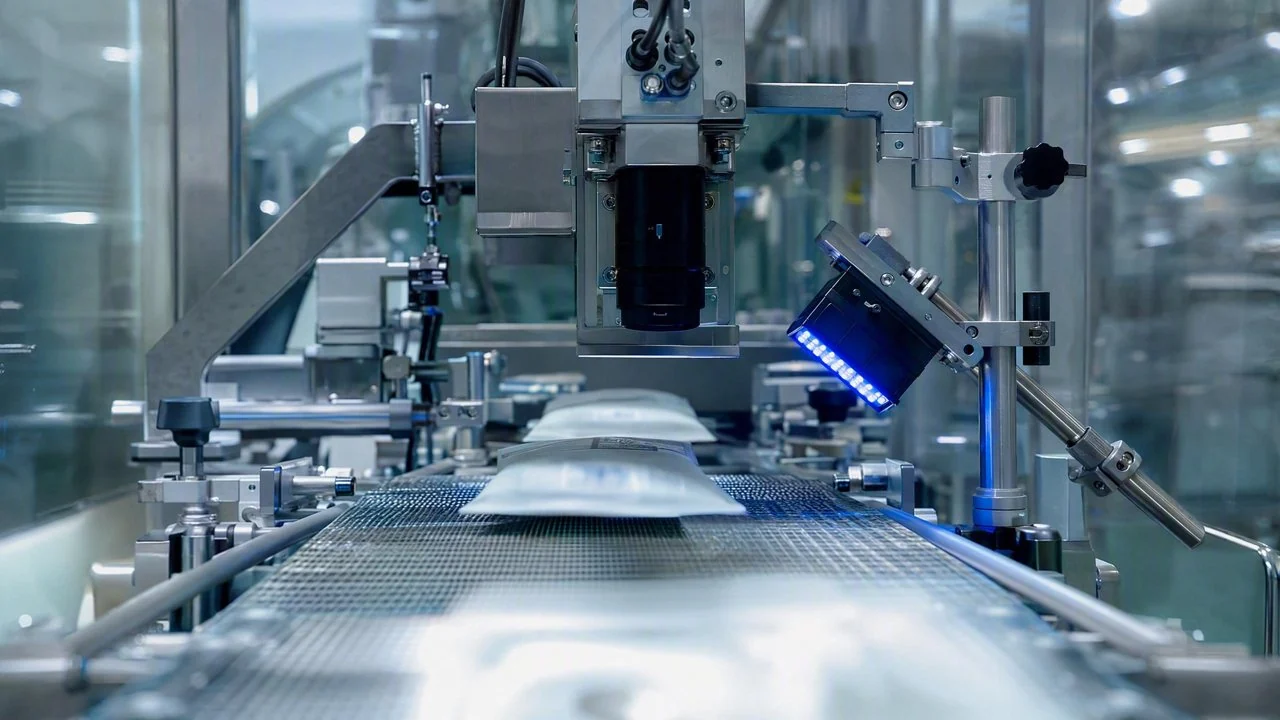
The DaoAI 2D ACI equipment (high-resolution 2D imaging + deep learning for secondary judgment, targeting planar defects such as surface imperfections, print quality, OCR character errors, and assembly omissions, offering high-speed online full inspection, micron-level precision, and semantic false positive filtering), utilizing its APDT few-shot self-training capability, reduces model changeover time in food packaging seal and coding inspection from hours with traditional solutions to just 5 minutes, while decreasing false positive rates by over 85%.
The food and agriculture industries face increasingly stringent quality control requirements, especially in packaging. Seal integrity, label print clarity, and coding accuracy directly impact food safety, brand reputation, and regulatory compliance. Traditional food packaging inspection solutions often rely on manual visual inspection or rule-based machine vision systems. However, these conventional methods prove inadequate in efficiency, accuracy, and flexibility when confronted with growing production demands, diverse packaging formats, and complex, varied defect types. Particularly for subtle defects in food packaging such as minor wrinkles, incomplete seals, ink spots, or blurred characters, manual inspection is prone to fatigue, while rule-based vision struggles to adapt to new product changeovers and defect variability. The DaoAI 2D ACI equipment is specifically designed to address these pain points, enabling food enterprises with advanced vision technology to ensure every product meets rigorous quality standards. Its high-speed online full inspection capability and micron-level precision make it an ideal choice for modern food production lines.
Pain Points: Why This Hurdle Is Difficult to Overcome
Food packaging inspection, covering sealing, labeling, and coding, presents multiple challenges for manufacturers. Firstly, frequent product changeovers lead to excessive "changeover downtime" for traditional inspection solutions. Each change in packaging specification, material, or coding content necessitates hours or even days of reprogramming and debugging for rule-based machine vision systems, severely impacting production rhythm. Secondly, on high-speed production lines, subtle defects like minor seal wrinkles, incomplete closures, misaligned labels, blurry prints, or missing/ghosted characters in coding result in high "under-detection rates" for traditional rule-based vision. These systems struggle to accurately identify irregular, low-contrast defects, allowing non-conforming products to reach the market. Concurrently, a persistently high "false positive rate" is another major issue, where many normal product features (e.g., inherent material textures, slight reflections) are misidentified as defects, leading to significant "manual re-inspection hours" wasted. Statistics indicate that traditional solutions typically have false positive rates between 10-20%, with some complex scenarios even higher, meaning 100-200 out of every 1000 products produced require manual secondary confirmation, substantially increasing operational costs. Furthermore, the diversity of food packaging materials (e.g., transparent films, matte surfaces, aluminum foil composites) poses significant imaging challenges, as traditional vision systems often struggle to maintain stable detection performance across different materials, compounding the complexity of inspection.
The root cause of these difficulties lies in the inherent limitations of traditional solutions when processing complex, variable, and unstructured visual information. Manual inspection is constrained by human eye stability and fatigue, and cannot meet high-throughput demands; rule-based machine vision, centered on predefined geometric features and thresholds, requires extensive rule library updates for new defect types or minor appearance changes, and struggles to discern the "semantics" of defects. For instance, whether a slight seal wrinkle constitutes a functional defect, or if a blurred code remains legible, requires higher-level intelligent judgment. The application of nanoscale AI vision inspection technology in semiconductor manufacturing has amply demonstrated deep learning's superior ability to handle microscopic, complex, and diverse defects. While food packaging inspection is not nanoscale, the subtlety and variety of its defects share similarities with challenges in the semiconductor sector, necessitating similarly intelligent solutions to achieve precise identification and domestic substitution.
Technical Principles
The DaoAI 2D ACI equipment's core lies in the deep integration of its high-resolution 2D imaging system and deep learning-based secondary judgment technology. The system employs industrial-grade high-resolution cameras with optimized lighting modules, capable of capturing micron-level details on packaging surfaces, printed text, and coded characters. Unlike traditional rule-based vision, the DaoAI / WeLinkirt ACI OS incorporates advanced foundational vision models, possessing powerful feature recognition capabilities. It does not rely on predefined geometric rules but rather learns from a large number of good samples to construct a model of the product's "normal" state. When new samples enter the field of view, the AI model can identify deviations from the good sample model and flag them as potential defects. Notably, the DaoAI / WeLinkirt APDT (Adaptive Progressive Deep Training) few-shot self-training function is key to achieving efficient changeovers and high accuracy. This function allows users to provide only 1–20 good sample images, enabling the system to complete new model training and deployment within minutes, significantly reducing changeover time. This contrasts sharply with traditional solutions requiring dozens or even hundreds of defect samples for model training, completely solving the pain point of scarce defect samples. Furthermore, the system includes semantic false positive filtering, intelligently judging based on defect context and severity to effectively distinguish between normal variations and actual defects, driving false positive rates to extremely low levels, significantly outperforming traditional rule-based AOI and manual inspection.
Compared to traditional rule-based AOI, the DaoAI 2D ACI's advantages lie in its "generalization capability" and "self-learning capability." Traditional rule-based AOI requires engineers to manually write or adjust complex rule codes for every new product or defect type, which is time-consuming, labor-intensive, and prone to missing edge defects. In contrast, the DaoAI / WeLinkirt AI system can autonomously extract and understand image features through deep learning, enabling it to identify even previously unseen defect types based on its learned "normal" patterns. This capability gives the DaoAI 2D ACI equipment stronger robustness when dealing with diverse and complex food packaging defects. Compared to manual inspection, ACI achieves 24/7 uninterrupted, fatigue-free high-speed full inspection, with detection rates and consistency far exceeding human capabilities, while maintaining under-detection rates consistently below <0.5%, an industry-leading level. This fundamentally improves inspection efficiency and product quality stability.
Typical Application Scenarios
- **Packaging Seal Integrity Inspection:** Detects defects such as wrinkles, incomplete seals, open seals, or foreign matter trapped in the sealing area of food bags, boxes, and cups. The challenge lies in the reflective properties of transparent film seals and the imaging variations of subtle wrinkles under different lighting. The DaoAI 2D ACI uses multi-angle illumination and deep learning models to precisely identify these minute defects.
- **Label Print Quality Inspection:** Checks for blurry prints, missing ink, misregistration, or color deviations in patterns, text, and barcodes/QR codes on food labels. Difficulties include contrast changes on different colored and textured labels, and the accuracy of small text recognition. DaoAI 2D ACI's high-resolution imaging and OCR algorithms ensure the clarity and completeness of text and patterns.
- **Coding Information Accuracy and Integrity Inspection:** Performs OCR on production dates, batch numbers, and expiry dates to verify content correctness, character clarity and completeness, absence of ghosting, missing ink dots, or positional shifts. Challenges arise from character morphology differences due to various coding methods (inkjet, laser) and capturing characters in high-speed motion. The DaoAI / WeLinkirt AI OCR possesses powerful anti-interference capabilities to ensure information legibility.
- **Packaging Appearance Defect Inspection:** Examines packaging surfaces for scratches, stains, damage, or deformation. Difficulties include the inherent texture and reflectivity of packaging materials, as well as the randomness and diversity of defects. The DaoAI 2D ACI's semantic false positive filtering effectively distinguishes between material's inherent features and actual defects, reducing false positives.
Implementation Case Study
A leading domestic food processing enterprise faced significant challenges in the packaging segment of its multiple yogurt production lines. Due to a wide range of product series and frequent changes in packaging box specifications and coding information, their traditional rule-based AOI system required at least 4-6 hours of downtime for parameter adjustment and rule rewriting with each changeover. Moreover, on high-speed production lines, the under-detection rate for subtle wrinkles at the seal and blurry codes was high, while the false positive rate for normal printing textures on packaging boxes was around 15%. This necessitated the daily deployment of 3-4 quality inspectors for extensive secondary manual re-inspection, severely limiting capacity and efficiency. Following the introduction of the DaoAI 2D ACI equipment, the manufacturer's production line saw significant improvements. Before deployment, each changeover took several hours, the under-detection rate for product coding was around 1.5%, and the false positive rate hovered at 15%. After deployment, at the enterprise's site, thanks to the DaoAI / WeLinkirt APDT few-shot self-training function, new product changeovers only required 5-10 good sample images, and the system completed model training and deployment within 5 minutes, reducing changeover downtime by over 98%. Concurrently, the under-detection rate for seal and coding defects was successfully reduced to <0.4%, and the false positive rate dramatically decreased by 85%, stabilizing below 2%. This not only completely eliminated the burden of manual re-inspection but also freed up significant human resources, allowing quality inspectors to focus on higher-value tasks. The system achieved a return on investment in a very short period and provided solid support for this tier-1 manufacturer's intelligent manufacturing transformation.
DaoAI 2D ACI's APDT few-shot self-training transforms food packaging inspection from 'hours-long' changeovers to 'minutes-long,' enabling production line transitions and significantly boosting quality inspection efficiency.
DaoAI / WeLinkirt Solution and Products
The DaoAI / WeLinkirt 2D ACI solution centers around its core equipment, the DaoAI 2D ACI device, combined with the DaoAI ACI OS, providing an end-to-end intelligent upgrade for food packaging inspection. The key advantage of this solution lies in its APDT few-shot self-training capability. Users can simply import a minimal number (1–20) of good product images through an intuitive graphical interface to quickly train and deploy new product models within 5 minutes, without any programming knowledge. This "0-code" automatic programming feature greatly lowers the barrier to applying AI vision technology, making it accessible even to production line engineers. The DaoAI / WeLinkirt ACI OS also includes a built-in semantic false positive filtering module, which intelligently identifies and excludes interferences caused by lighting, material, background, and other factors, ensuring that only genuine defects trigger alarms, significantly improving detection accuracy. For deployment, DaoAI / WeLinkirt supports various integration methods such as SDK / API / Docker and guarantees 100% local private deployment, ensuring customer data security remains on-site and fully complying with the stringent data management requirements of the food industry. Through the unified DaoAI World foundational model, the system possesses powerful semantic understanding and cross-scenario generalization capabilities, continuously learning and optimizing from production line feedback to enhance detection performance and adapt to more diverse future inspection needs.
By introducing the DaoAI 2D ACI equipment, customers have not only achieved a leap in inspection efficiency but also realized significant business value. Specific quantifiable results include: product changeover time dramatically reduced from hours to 5min, enhancing production line flexibility and utilization; under-detection rate consistently controlled at an ultra-low level of <0.4%, significantly reducing the risk of non-conforming products entering the market; false positive rate decreased by over 85%, substantially reducing manual re-inspection workload and operational costs; overall detection cycle time improved by 20%, helping customers expand production capacity. The DaoAI / WeLinkirt solution enables food enterprises to achieve a win-win in both product quality assurance and production efficiency with cost-effectiveness.
FAQ
How does APDT few-shot self-training help the food industry quickly adapt to new product changeovers?
DaoAI 2D ACI's APDT few-shot self-training technology allows users to train and deploy new product models within 5 minutes by providing only 1–20 good sample images. This fundamentally changes the traditional AOI scenario where changeovers typically require hours or even days of reprogramming, significantly reducing downtime and enabling food production lines to quickly adapt to diverse packaging designs and product types, enhancing production flexibility and efficiency.
What types of defects can the DaoAI 2D ACI equipment identify in food packaging seal inspection?
The DaoAI 2D ACI equipment can accurately identify various defects in food packaging sealing areas, including but not limited to: incomplete seals (false seals), wrinkles, foreign matter inclusion, poor heat seals, damage, bubbles, and irregularly shaped defects. Through high-resolution imaging and deep learning algorithms, the DaoAI / WeLinkirt system can capture micron-level subtle imperfections, ensuring seal integrity and product safety.
What is the initial investment required for deploying the DaoAI 2D ACI solution, and what is the typical payback period?
The investment cost for the DaoAI 2D ACI solution varies based on specific configurations (e.g., number of cameras, lighting, integration complexity) and detection requirements. While the initial investment is higher than traditional manual inspection, the high efficiency, low under-detection and false positive rates, and significant reductions in manual re-inspection and changeover downtime typically lead to a return on investment within 6–18 months. For a specific quote and payback period analysis, we recommend contacting our sales team for a detailed evaluation.
Full solution for this scenario: Food / agriculture industry solutions · Food Package Missing-Item, Misload & Overfill Detection
This article was generated by AI. Customer cases are simulated scenarios based on real product capabilities and figures are illustrative; see product pages for official benchmarks.