
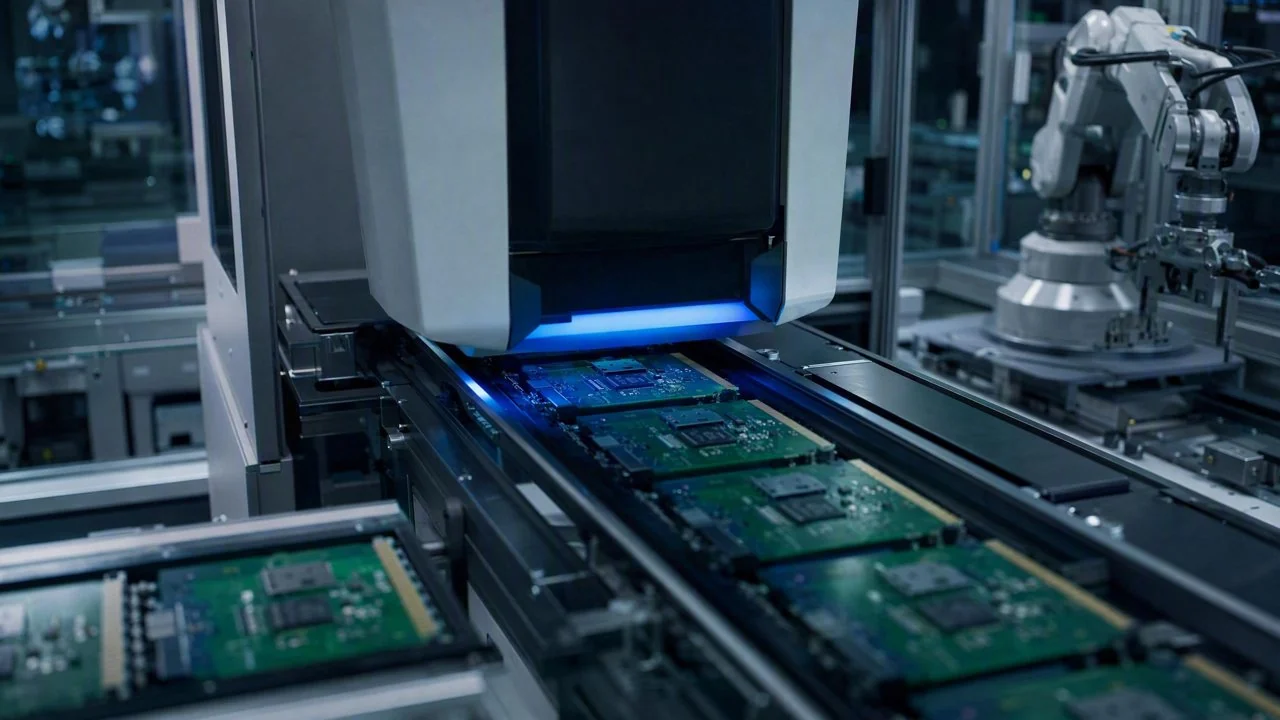
DaoAI 2D ACI equipment (high-resolution 2D imaging + deep learning secondary judgment, for surface/print/OCR/assembly defects, high-speed online full inspection, micron-level, semantic false positive filtering) significantly improved PCBA gold finger scratch and oxidation detection by introducing advanced AI vision models and high-speed imaging. It reduced the average inspection cycle time from 3.2 seconds/piece with traditional solutions to 0.8 seconds/piece, while suppressing the false negative rate to <0.3%, effectively resolving production capacity bottlenecks and quality risks associated with 100% full inspection at high cycle times in the electronics industry.
In the electronics manufacturing industry, particularly PCBA (Printed Circuit Board Assembly) production lines, product quality and production efficiency are core competitive advantages. Gold fingers, as critical interfaces between the PCBA and external connectors, their surface integrity directly affects the product's electrical performance and reliability. Any minute scratch, oxidation, dirt, or foreign matter can lead to poor contact or even functional failure. With the accelerating iteration of consumer electronic products, production line cycle times are continuously increasing, making the demand for automated 100% full inspection more urgent. However, traditional inspection methods, whether manual visual inspection or rule-based AOI (Automated Optical Inspection), face severe challenges when dealing with micron-level, morphologically diverse defects that require extremely high inspection cycle times. For instance, a leading electronics manufacturer previously used a combination of manual visual inspection and sampling for gold finger detection. Still, with production line upgrades and increased product complexity, traditional methods could no longer meet increasingly stringent quality standards and capacity requirements.
Pain Points: Why This Hurdle Is Difficult to Overcome
For PCBA gold finger scratch and oxidation detection, traditional solutions face multiple challenges, severely hindering the achievement of desired production cycle times and 100% full inspection capacity. Firstly, regarding detection accuracy, gold finger scratches are often micron-level or even sub-micron-level subtle marks, difficult for the naked eye to consistently identify. Oxidation, on the other hand, manifests as subtle changes in color and luster with blurred boundaries. Manual visual inspection typically results in a false negative rate of 3.5%~5%, and is prone to fatigue and subjective judgment, leading to inconsistent detection. Secondly, in terms of detection speed and efficiency, a high-cycle PCBA production line compresses the inspection time per board to the extreme. Traditional rule-based AOI, when dealing with complex and varied scratch and oxidation defects, requires writing a large number of intricate rules and is sensitive to lighting and angles, leading to persistently high false positive rates, averaging 15%~20%. High false positives necessitate extensive manual re-inspection, consuming valuable production line resources and resulting in actual detection cycle times far below expectations, averaging 3.2 seconds/piece, making 100% online full inspection unattainable. Finally, regarding flexibility and adaptability, PCBA products come in numerous models with diverse gold finger designs. Traditional rule-based AOI requires hours or even days to rewrite and debug rules for each product changeover, severely impacting the production line's utilization rate in multi-variety, small-batch production modes.
The root cause of these difficult-to-detect defects lies in the strong reflective properties of the gold finger surface. Minute scratches appear vastly different under varying lighting angles, increasing the difficulty of image acquisition. Concurrently, the oxidation layer is not uniformly distributed, and its subtle color and texture variations are easily confused with minor color differences in normal gold plating, posing extremely high demands on the robustness of image processing algorithms. Traditional image processing algorithms based on edge detection and threshold segmentation struggle to effectively differentiate between true defects and background noise or process textures. One of the key technical challenges facing the deployment of industrial AI large models in quality inspection is how to significantly improve detection speed while maintaining high detection accuracy to meet the high-cycle requirements of the electronics manufacturing industry. WeLinkirt deeply understands these challenges and has developed targeted solutions.
Technical Principles
The core advantage of WeLinkirt's DaoAI 2D ACI equipment in gold finger scratch and oxidation detection lies in its combination of a high-resolution 2D imaging system and a deep learning secondary judgment engine. This equipment utilizes customized high-speed industrial cameras and multi-angle annular lighting to capture subtle textures and reflective variations on the gold finger surface under different lighting conditions, obtaining high-quality, high-contrast raw images. These images are then transmitted to the built-in WeLinkirt AI vision engine. This engine, based on advanced Convolutional Neural Networks (CNN) and Transformer architectures, has been pre-trained on massive industrial defect data, endowing it with powerful feature recognition capabilities. In practical applications, leveraging APDT (Adaptive Positive/Few-Shot Training) technology, the system requires only 1-20 good samples to complete model training and deployment within 5 minutes, rapidly learning the normal morphology of gold fingers. For subtle structural defects like scratches, the model can precisely identify their geometric shape, depth, and orientation; for color and texture variations like oxidation, the model learns their spectral characteristics and spatial distribution patterns, effectively distinguishing between normal color differences and oxidized areas. WeLinkirt's introduction of a semantic false positive filtering mechanism further enhances judgment accuracy, effectively avoiding false positives common in traditional rule-based AOI due to factors like ambient light or product batch variations, ensuring stable and reliable detection results. For instance, WeLinkirt's DaoAI 2D ACI can reduce the false positive rate by 85% in real production lines, significantly reducing the workload of manual re-inspection.
Compared to traditional manual visual inspection, WeLinkirt's DaoAI 2D ACI equipment eliminates subjective judgment and fatigue factors, achieving 100% objective and consistent inspection at speeds far exceeding human capabilities. Compared to traditional rule-based AOI, its deep learning-based model requires no manual rule writing, possesses stronger generalization ability and robustness, and can automatically adapt to subtle differences between different batches and product models, significantly reducing both false negative and false positive rates. WeLinkirt's unique APDT few-shot learning function shortens product changeover time from hours to less than 5 minutes, greatly enhancing production line flexibility and efficiency. Furthermore, WeLinkirt's DaoAI 2D ACI equipment supports 100% local private deployment, ensuring sensitive production data remains in-house and meeting the stringent requirements for data security and compliance in the electronics industry.
Typical Application Scenarios
- **PCBA Surface Scratch Detection:** Targets micron-level scratches and abrasions on PCB substrates, pads, solder masks, and gold fingers. WeLinkirt's DaoAI 2D ACI equipment, through high-resolution imaging and deep learning models, can precisely identify scratches of various forms, even in highly reflective or complex background areas.
- **Gold Finger Oxidation and Contamination:** Focuses on detecting oxidation spots, fingerprints, foreign matter adhesion, and other defects on gold finger surfaces. Its deep learning model can learn subtle color and luster differences between oxidized layers and normal gold plating, and effectively distinguish contamination from normal textures, avoiding misjudgments.
- **Character OCR and Missing Elements:** Performs OCR recognition for silkscreen characters, serial numbers, batch numbers on PCBAs, and detects character print quality, missing, blurred, or ghosted characters. WeLinkirt's DaoAI 2D ACI equipment, combined with a powerful OCR engine, can handle characters of different fonts, backgrounds, and print qualities, ensuring information integrity and traceability.
- **Component Missing and Misplacement:** Detects missing, misplaced, reversed, tombstoned, or offset surface-mounted components (e.g., resistors, capacitors, chips) on PCBAs. By comparing against baseline images, WeLinkirt's DaoAI 2D ACI can quickly locate and identify anomalies, ensuring correct assembly.
- **Solder Joint Defect Detection:** Addresses surface defects of solder joints after SMT soldering, such as dry joints, bridging, insufficient solder, excessive solder, or solder balls. While 3D AOI excels at solder joint morphology detection, 2D ACI can still effectively identify some planar visible solder joint anomalies, serving as a complement to 3D solutions or as a standalone application.
Case Study
A tier-1 supplier specializing in high-end industrial control board manufacturing had extremely high quality requirements for PCBA gold fingers; any subtle scratch or oxidation could lead to product failure in harsh operating conditions. Previously, this manufacturer used a combination of manual visual inspection and traditional rule-based AOI for gold finger detection. However, with increasing order volumes and product complexity, the limitations of traditional solutions became apparent: high-cycle production lines led to inefficient and error-prone manual inspection, with an average false negative rate of 4.2%; rule-based AOI, due to the reflective properties of gold fingers and the diversity of defects, suffered from persistently high false positive rates, reaching 18%, consuming significant time in manual re-inspection and severely slowing down the overall production line cycle time, with an average inspection time of 3.2 seconds/piece, making 100% full inspection impossible. To address this bottleneck, the manufacturer introduced WeLinkirt's DaoAI 2D ACI equipment.
During implementation, the WeLinkirt engineering team collaborated closely with the client. Utilizing the APDT few-shot learning function, they trained and deployed the gold finger scratch and oxidation detection model rapidly using only 15 good samples. This model specifically learned the normal textures and common defect characteristics of the gold finger surface. After deployment, WeLinkirt's DaoAI 2D ACI equipment quickly demonstrated significant results with its outstanding performance. The system dramatically reduced the average cycle time for gold finger scratch and oxidation detection from 3.2 seconds/piece to 0.8 seconds/piece, achieving 100% online full inspection for the production line. Concurrently, thanks to the powerful feature extraction and semantic false positive filtering capabilities of deep learning, the false negative rate was suppressed to <0.3%, and the false positive rate was also significantly reduced by 85%, to approximately 2.7%. This not only substantially increased production capacity and ensured product quality but also significantly reduced the workload of manual re-inspection and production costs. The client's representative stated that the introduction of WeLinkirt's DaoAI 2D ACI made it possible for them to achieve high-quality shipments under high-cycle production, greatly enhancing their market competitiveness.
WeLinkirt's DaoAI 2D ACI equipment achieves 100% online full inspection at 0.8 seconds/piece, elevating quality control on high-cycle production lines to new heights.
The figures above are a typically achievable range in anonymized industry scenarios — a different line or a different batch of parts will move the result either way; on-site measurement governs.
WeLinkirt Solution and Products
WeLinkirt provides a comprehensive solution for gold finger scratch and oxidation detection in the electronics/PCBA industry, centered around its 2D ACI equipment. This equipment integrates self-developed high-speed, high-resolution industrial cameras, multi-channel intelligent lighting, and the powerful WeLinkirt DaoAI ACI OS. The software system is equipped with feature recognition capabilities based on foundational visual models. Through APDT (Adaptive Positive/Few-Shot Training) technology, customers only need to provide 1-20 good samples to complete model programming and changeover within 5 minutes, enabling 0-code rapid deployment. The deep learning secondary judgment function of WeLinkirt's DaoAI 2D ACI equipment can precisely identify micron-level scratches and subtle oxidation on gold fingers, and through semantic false positive filtering, effectively reduces common false positive issues of traditional AOI, ensuring the accuracy and stability of detection results. Furthermore, WeLinkirt also offers the DaoAI World global model as a unified foundation, enabling semantic understanding, cross-scenario generalization, and continuous learning from production line feedback to optimize model performance.
Regarding deployment, WeLinkirt's solution supports various integration methods such as SDK/API/Docker and offers 100% local private deployment to ensure customer data security. With WeLinkirt's DaoAI 2D ACI equipment, customers can not only achieve high-speed, high-precision full inspection of gold finger defects but also continuously optimize production processes through data feedback, further improving overall manufacturing levels. The introduction of this solution has led to a significant increase in production line cycle times; for example, in this case study, WeLinkirt's DaoAI 2D ACI reduced the single-piece inspection cycle time from 3.2 seconds to 0.8 seconds, directly boosting production efficiency. Concurrently, its false negative rate of <0.3% ensures the highest standards of product quality, bringing significant economic benefits and market competitiveness to enterprises.
FAQ
How does WeLinkirt's DaoAI 2D ACI equipment ensure high cycle times for electronic production lines?
WeLinkirt's DaoAI 2D ACI equipment achieves extremely fast detection speeds by combining high-speed industrial cameras, optimized image processing pipelines, and a deep learning inference engine. Its AI algorithms complete defect recognition and classification in milliseconds while maintaining micron-level accuracy. Additionally, the APDT few-shot learning function significantly shortens changeover times, reducing production line downtime and overall cycle time efficiency.
What unique advantages does WeLinkirt's DaoAI 2D ACI offer for gold finger inspection compared to traditional rule-based AOI?
Compared to traditional rule-based AOI, which relies on manually writing extensive complex rules, WeLinkirt's DaoAI 2D ACI, based on deep learning models, automatically learns defect features from a small number of samples without complex programming. This gives it stronger robustness and generalization capabilities when dealing with defects like gold finger scratches and oxidation, which have variable shapes and blurry boundaries. It significantly reduces false positive and false negative rates and drastically shortens product changeover time to under 5 minutes.
What is the budget required to deploy WeLinkirt's DaoAI 2D ACI equipment?
The budget for deploying WeLinkirt's DaoAI 2D ACI equipment is influenced by various factors, including production line speed, required detection accuracy, integration complexity, and whether private deployment is needed. We offer flexible configuration options to suit customers of different scales and needs. We recommend contacting our sales team directly; we will provide a customized solution and detailed quotation based on your specific production line conditions and evaluate the return on investment period.
Full solution for this scenario: Electronics / PCBA industry solutions
This article was generated by AI. Customer cases are simulated scenarios based on real product capabilities and figures are illustrative; see product pages for official benchmarks.