
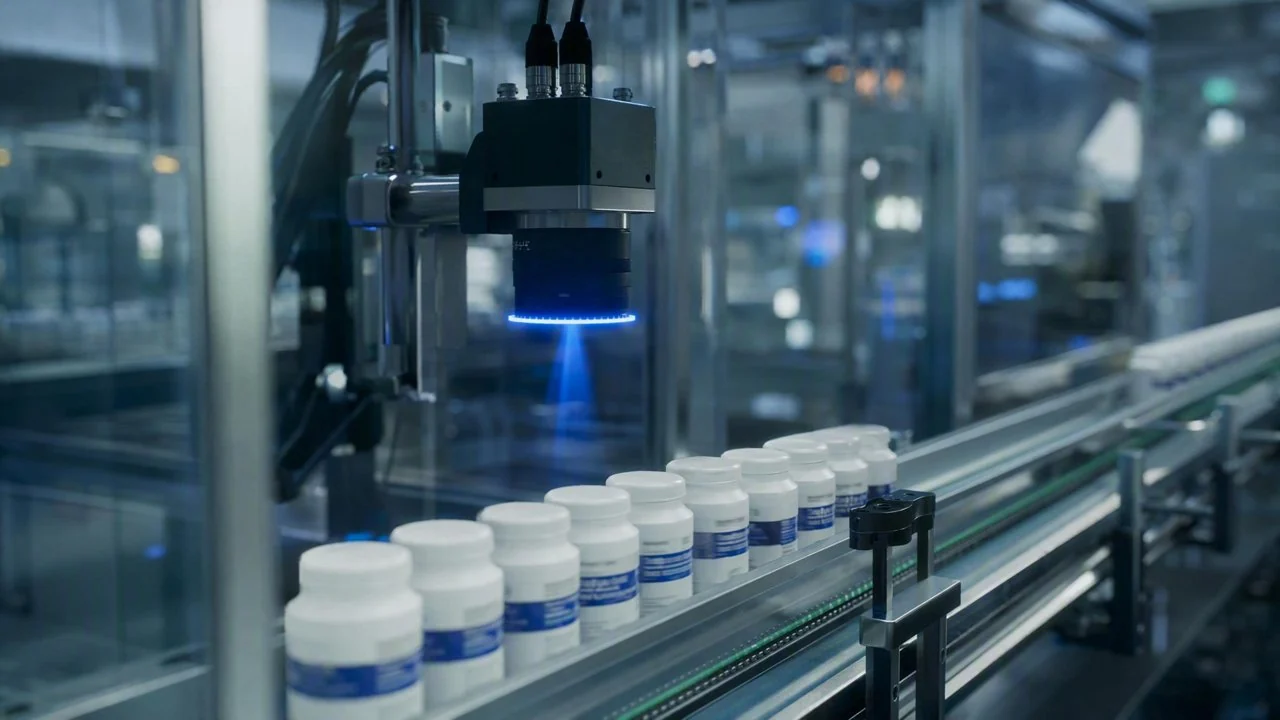
DaoAI 2D ACI equipment (high-resolution 2D imaging + deep learning secondary judgment, targeting surface/print/character OCR/assembly defects, high-speed inline full inspection, micron-level, semantic false positive filtering) achieves a stable defect escape rate of <0.05% for pharmaceutical label serialization through high-precision inline inspection and local private deployment, while ensuring the absolute security and compliance of all production data.
In the highly sensitive environment of pharmaceutical manufacturing, accurate identification of label serialization codes and data security are critical for ensuring drug traceability, preventing counterfeiting, and meeting global regulatory requirements. Traditional label inspection solutions, especially when dealing with complex printing, micro-characters, and high production speeds, often face challenges of missed detections and false positives. More importantly, many cloud-based AI vision solutions struggle to meet pharmaceutical companies' stringent compliance requirements for sensitive production data to remain on-premise and not be disclosed externally. DaoAI 2D ACI equipment, through high-precision inline inspection and local private deployment, consistently controls the pharmaceutical industry's label serialization defect escape rate to <0.05%, while ensuring absolute security and compliance of all production data.
Pain Points: Why This Hurdle Is Difficult to Overcome
Pharmaceutical label OCR and serialization inspection face multiple challenges. First is **data security and compliance**. Pharmaceutical production data, including batch information, manufacturing dates, expiration dates, and serialization codes, are highly sensitive. Traditional cloud-based AI vision platforms, even with claims of encrypted transmission, cannot completely eliminate the risk of data leakage, which contradicts pharmaceutical companies' strict requirements for local deployment and on-premise data residency. Second is **detection accuracy and stability**. The print quality of pharmaceutical labels is affected by various factors, such as ink batches, printer wear, and environmental humidity, leading to blurred, broken, or unevenly colored characters, as well as minor misalignments, ghosting, or smudges in the serialization codes themselves. Traditional rule-based machine vision systems struggle to adapt to these subtle variations, resulting in false positive rates often as high as 8-12%, severely impacting production efficiency and manual re-inspection costs. Third is **real-time performance at high production speeds**. Modern pharmaceutical production lines generally operate at high speeds, requiring inspection systems to process hundreds of labels per second and provide real-time feedback. Any detection delay can lead to production line stoppages. Finally, **the challenge of frequent changeovers due to high-mix, low-volume production**. With the trend towards personalized medicine and precision dosing, pharmaceutical companies face an increasing variety of SKUs. Different drug labels have varying formats, fonts, and serialization rules, requiring traditional solutions to spend hours or even days on parameter adjustments and recalibration for each changeover, significantly affecting production schedules.
The root cause of these challenges is that traditional machine vision relies on preset rules and fixed thresholds, offering poor robustness to image variations; while cloud-based AI, though enhancing intelligence, cannot satisfy pharmaceutical companies' absolute control over data sovereignty. Against the backdrop of industrial automation giants integrating QMS and AI vision platforms to enhance systematic smart quality inspection capabilities, a localized, secure, and efficient AI vision solution has become an urgent need for pharmaceutical enterprises.
Technical Principles
DaoAI 2D ACI equipment fundamentally solves the aforementioned problems by combining high-resolution 2D imaging technology with a deep learning secondary judgment mechanism. First, at the **imaging level**, we employ industrial-grade high-resolution cameras and customized lighting modules, optimized for the material characteristics of pharmaceutical labels (e.g., reflective, matte, transparent film) and printing colors. This ensures clear, distortion-free label images are captured even at high speeds, providing a high-quality data foundation for subsequent AI analysis. Second, at the **core AI judgment mechanism**, DaoAI 2D ACI is equipped with the self-developed DaoAI ACI OS. This system, based on advanced visual foundation models and deep learning algorithms, enables semantic understanding of characters, rather than simple pixel matching. This means it can not only identify characters but also comprehend the contextual meaning of character combinations, effectively filtering out “false defects” caused by minor printing imperfections, thereby reducing the false positive rate by 85%.
Compared to traditional rule-based AOI, the advantage of DaoAI 2D ACI lies in its powerful **adaptability and generalization capabilities**. Traditional rule-based AOI requires manually writing a large number of rules to handle various defects, has poor adaptability to new defect types or environmental changes, and has limited ability to recognize tiny, blurry characters. In contrast, DaoAI 2D ACI, through its APDT positive sample/few-shot learning function (requiring only 1–20 good samples), can quickly train high-precision models, enabling 0-code automatic programming and rapid changeovers. This mechanism allows the system to maintain an ultra-low defect escape rate of <0.05% even when facing complex printing, varied fonts, and high-speed production. Furthermore, the DaoAI solution supports 100% local private deployment, with all data processing and model training completed within the customer's internal network. No sample and inspection images leave the factory, completely eliminating data security risks and fully complying with the stringent compliance requirements of the pharmaceutical industry.
Typical Application Scenarios
- **Pharmaceutical Box/Bottle Label Print Quality Inspection:** DaoAI 2D ACI can rapidly detect print defects on pharmaceutical box or bottle labels, including blurry characters, missing characters, ink spots, uneven color, misalignment, label wrinkles, or bubbles. The challenge lies in maintaining image clarity at high speeds and identifying tiny, irregular print defects.
- **Serialization Code/Batch Number OCR Recognition and Verification:** The system can accurately recognize various serialization codes (e.g., GS1 DataMatrix, 1D codes, 2D codes) and character information such as batch numbers, manufacturing dates, and expiration dates on pharmaceutical boxes, bottles, or syringes, and perform real-time comparison and verification with databases. The challenges include the diversity of character fonts, significant variations in print quality, and issues with reflection and contrast on different background materials.
- **Anti-counterfeiting Mark or Special Pattern Integrity Inspection:** Inspect the integrity, positional accuracy, and absence of damage for special anti-counterfeiting marks (e.g., holograms, micro-text, invisible ink printed areas) on labels. The difficulty lies in anti-counterfeiting marks often using special materials or printing processes, making it hard for traditional vision to distinguish subtle differences effectively.
- **Multi-layer Label or Leaflet Folding Inspection:** For packaging containing multi-layer labels or folded leaflets, DaoAI 2D ACI can detect whether they are correctly affixed, folded in place, and if there are any lifted edges, misalignments, or omissions. The challenges arise from height differences and occlusions caused by multi-layer structures, and the precise judgment of minute folding errors.
- **Packaging Material Appearance Defect Inspection:** Beyond labels, the system can also extend to inspect surface defects on pharmaceutical packaging materials (e.g., aluminum-plastic blister packs, ampoules, vials) such as scratches, dirt, foreign objects, damage, or deformation, ensuring the integrity and cleanliness of the packaging. The difficulty lies in these defects often being tiny, low-contrast, and susceptible to the product's curvature or reflection.
Case Study
A leading pharmaceutical group, whose production lines process hundreds of millions of drug units annually, has extremely high requirements for label serialization recognition accuracy and data security. Their original inspection solution relied on traditional rule-based machine vision, resulting in a false positive rate as high as 10%, leading to a large number of qualified products being rejected for manual re-inspection, severely slowing down production speed. More critically, the group's internal regulations strictly mandated that all production data must be 100% processed locally and not uploaded to the cloud. Upon introducing DaoAI 2D ACI equipment, we provided them with a complete local private deployment solution.
Before implementation, the group's serialization code inspection had a false positive rate of approximately 10%, leading to extensive manual re-inspection, with an average of 800 products requiring manual re-inspection per hour, incurring significant labor costs. Additionally, changeover adjustments took over 2 hours. After the DaoAI 2D ACI system was deployed and few-shot training completed, the system successfully reduced the false positive rate to <1.5%, which means a reduction of 85%. The volume of manual re-inspection consequently dropped significantly, reducing manual re-inspection man-hours by 90%. New product changeover time was shortened to 5min, greatly enhancing production line flexibility. Most importantly, DaoAI 2D ACI achieved complete localization of all inspection data and model training, ensuring data never left the facility, meeting the group's most stringent data security and compliance requirements. The high precision and data security assurance provided by this DaoAI system enabled the client to achieve a comprehensive upgrade of their drug traceability system, enhancing brand reputation and market competitiveness.
DaoAI 2D ACI ensures sensitive data remains on-premise, reducing false positives by 85%, allowing pharmaceutical companies to achieve a perfect balance between compliance and efficiency.
DaoAI Solution and Products
DaoAI 2D ACI equipment, as the core product, provides an end-to-end intelligent quality inspection solution for the pharmaceutical industry. Its core advantage lies in the DaoAI ACI OS, which possesses the feature recognition capabilities of visual foundation models, enabling 0-code automatic programming in just 5 minutes with only one good sample. Through APDT positive sample/few-shot learning technology, even when facing complex and varied label defects, high-precision models can be quickly trained with only 1–20 good sample images, significantly shortening deployment and changeover times. Furthermore, its unique semantic false positive filtering function effectively distinguishes real defects from non-critical appearance variations, keeping the false positive rate at an extremely low level.
In terms of deployment, DaoAI's full range of products supports various integration methods such as SDK / API / Docker, with a strong emphasis on 100% local private deployment capabilities. This means that all data acquisition, model training, and inference are completed on the customer's local servers, with data never transmitted externally, fully complying with the highest standards for data sovereignty and privacy protection in pharmaceutical enterprises. For this pharmaceutical group, the DaoAI team provided a complete suite of services, from hardware integration, software deployment, and model training to post-launch maintenance, ensuring smooth system rollout and efficient operation. Through the unified foundation of the DaoAI World Model, DaoAI solutions also possess capabilities for semantic understanding, cross-scenario generalization, and continuous learning from production line feedback, ensuring system performance continuously optimizes over time, providing long-term value to customers. DaoAI 2D ACI not only solves immediate inspection challenges but also builds a secure, intelligent, and continuously evolving quality inspection platform.
FAQ
How does DaoAI 2D ACI equipment ensure data security in the pharmaceutical industry?
DaoAI 2D ACI equipment supports 100% local private deployment. This means all image data acquisition, AI model training, and inference are performed within the customer's internal network or designated on-premise servers. Data is never uploaded to the cloud or transmitted externally. This deployment model fully complies with pharmaceutical companies' strict requirements for sensitive production data to remain on-site, fundamentally eliminating data leakage risks and ensuring data sovereignty.
What are the advantages of DaoAI 2D ACI for label OCR inspection compared to traditional rule-based machine vision?
Traditional rule-based machine vision relies on predefined rules, which perform poorly with complex printing, blurry characters, or background interference, leading to higher false positive and defect escape rates. DaoAI 2D ACI, based on deep learning and semantic understanding, can adapt to various fonts, printing imperfections, and environmental changes. It quickly trains models using APDT few-shot learning and significantly reduces false positives with semantic false positive filtering, achieving higher detection accuracy, lower defect escape rates, and faster changeover times.
What is the approximate budget required to deploy a DaoAI 2D ACI system?
The budget for a DaoAI 2D ACI system depends on several factors, including the complexity of the production line, specific inspection requirements, required camera and lighting configurations, and whether customized integration services are needed. We offer flexible hardware and software configuration options to meet the needs of clients of various sizes and requirements. For the most accurate quotation and a detailed solution assessment, we recommend contacting our sales engineers, who will provide a customized solution and cost breakdown based on your specific operational conditions.
Full solution for this scenario: the full inspection solution for Pharma / drug
This article was generated by AI. Customer cases are simulated scenarios based on real product capabilities and figures are illustrative; see product pages for official benchmarks.