
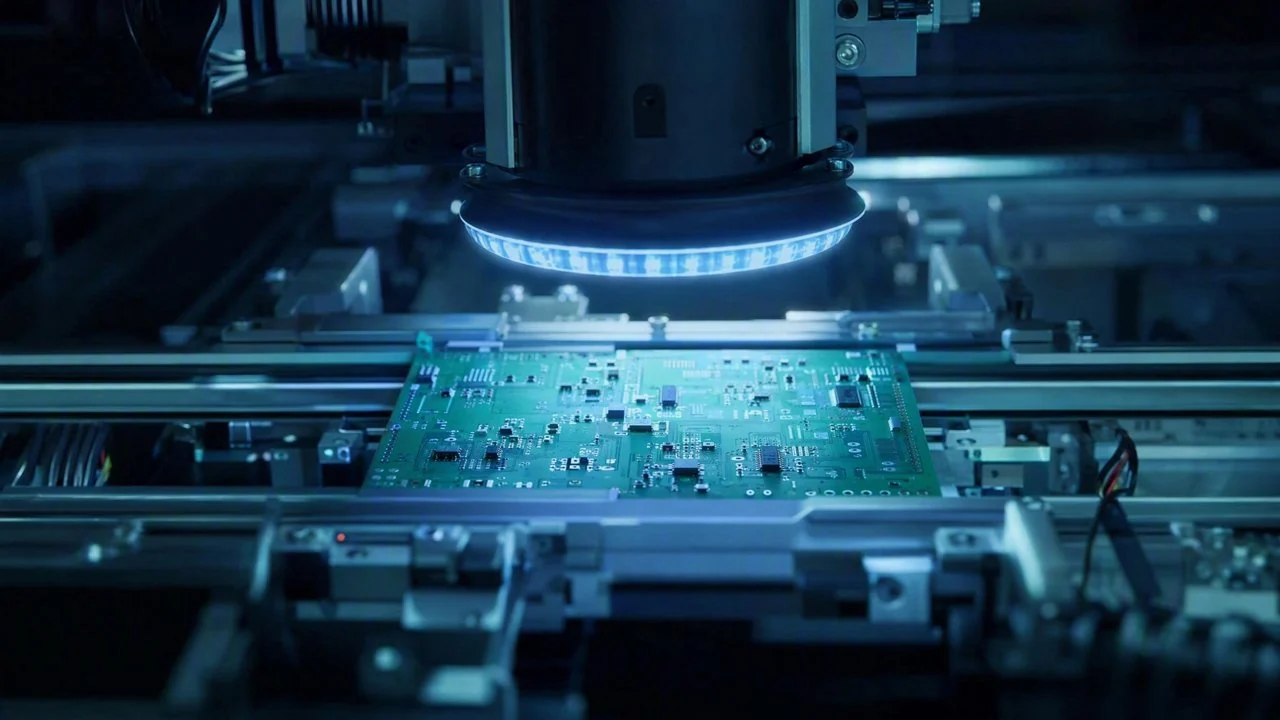
WeLinkirt's DaoAI 2D ACI equipment (high-resolution 2D imaging + deep learning secondary judgment, targeting surface/print/OCR/assembly defects, high-speed online full inspection, micron-level, semantic false positive filtering) significantly reduced the false positive rate in SMT solder joint inspection on electronic PCBA production lines from 15% to below 3% by introducing a deep learning-based semantic false positive filtering mechanism, thereby greatly alleviating the pressure of manual re-inspection and improving inspection efficiency.
In the electronics manufacturing industry, PCBA (Printed Circuit Board Assembly) is a critical link, and the quality of SMT (Surface Mount Technology) solder joints directly determines product functionality and reliability. As electronic products trend towards miniaturization and high density, components become smaller and pad spacing tighter, making solder joint defect inspection extremely complex. While traditional AOI equipment achieves automated inspection, it often struggles with common SMT solder joint defects like open circuits, solder bridges, and insufficient solder, due to its rule-based and image threshold-dependent judgment methods, leading to high false positive rates. These false positives not only waste significant manual re-inspection time but can also delay production cycles, posing a critical challenge for leading electronics manufacturers striving for ultimate efficiency and yield.
Pain Point: Why This Hurdle is Difficult to Overcome
In SMT solder joint inspection, traditional AOI solutions face multiple challenges, resulting in persistently high false positive rates and a heavy burden on production. Firstly, the limitations of optical imaging make defect detection on reflective solder surfaces a technical challenge. Solder surfaces often exhibit high reflectivity, meaning the same defect can present different optical appearances under varying lighting angles. For instance, an open circuit might be misidentified as normal due to changes in light reflection, or a normal solder joint might be misidentified as a solder bridge or insufficient solder due to excessive local reflection. Secondly, traditional rule-based AOI relies on preset image features and thresholds, lacking robustness against subtle differences in solder joint morphology, background noise (such as flux residue, minor board scratches), and component shadows, which frequently lead to false positives. According to internal statistics from a leading electronics manufacturer, their SMT production line's traditional AOI equipment maintained an average false positive rate of 12%–18%, requiring several hours of manual re-inspection daily to differentiate true defects from false ones. This high false positive rate not only increased labor costs but, more importantly, eroded trust in automated inspection results, making the re-inspection stage a production bottleneck and severely impacting overall production efficiency and delivery cycles. Furthermore, new product changeovers with traditional AOI required several hours or even half a day to rewrite and debug rules, further exacerbating production downtime.
The root causes of solder joint defects are diverse and complex, including solder paste printing quality, placement accuracy, and reflow oven temperature profile control. These factors lead to subtle variations in solder joint morphology at the microscopic level. For example, an open circuit might appear as a tiny gap between the solder joint and the pad, while a solder bridge might be a very fine tin bridge between two adjacent solder joints. In high-speed online inspection scenarios, precisely capturing these micron-level defects and effectively distinguishing true defects from optical illusions is an insurmountable obstacle for traditional AOI. Especially for reflective surface defect detection, the scattering and reflection characteristics of light on solder surfaces are complex, and traditional fixed light sources and algorithms struggle to adapt to this variability, making false positives a common occurrence.
Technical Principles
WeLinkirt's DaoAI 2D ACI equipment fundamentally solves the problem of high false positive rates in SMT solder joint inspection by combining high-resolution 2D imaging technology with advanced deep learning algorithms. The equipment first employs customized high-resolution industrial cameras and multi-angle annular illumination systems, capable of capturing rich details of the solder joint surface and effectively addressing imaging challenges on reflective surfaces. Through various combinations of light sources, the system can acquire multiple images under different lighting conditions, thus better identifying the true morphology of solder joints and suppressing false reflections. The core lies in its integrated WeLinkirt DaoAI ACI OS, which performs feature recognition based on visual foundation models and introduces a 'deep learning secondary judgment' mechanism. This means that after initial image processing identifies suspected defects, these images are fed into a deep learning model, trained on a large dataset of real defects and normal samples, for secondary judgment. This model can learn the semantic features of solder joint defects, such as the true visual manifestations of open circuits, solder bridges, and insufficient solder, and distinguish them from subtle differences caused by light and shadow, dirt, background noise, and other non-defect factors. In this way, WeLinkirt's DaoAI ACI equipment can filter out a large number of 'semantic false positives' that traditional AOI struggles to differentiate, reducing the SMT solder joint inspection false positive rate to below 3%, significantly enhancing inspection accuracy.
Compared to traditional rule-based AOI, the advantage of WeLinkirt's DaoAI 2D ACI lies in its learning and generalization capabilities. Traditional AOI relies on engineers manually writing complex rules to define defects, which is not only time-consuming and labor-intensive but also has poor recognition capabilities for unknown or variant defect types. Even minor changes in production processes or components require rule adjustments, leading to frequent downtime. In contrast, the WeLinkirt DaoAI ACI system can quickly establish or update inspection models with few-shot learning (APDT positive/few-shot learning, requiring only 1–20 good samples), greatly shortening changeover times. Furthermore, its 'semantic false positive filtering' mechanism is unparalleled by traditional AOI; it moves beyond simple pixel or morphology comparison to 'understanding' image content, thereby achieving intelligent differentiation between true and false defects and fundamentally resolving the re-inspection burden caused by high false positive rates. In practical applications, WeLinkirt's DaoAI ACI can reduce the false positive rate caused by open circuits, solder bridges, and insufficient solder on a manufacturer's SMT line by over −80%, thus substantially reducing manual re-inspection workload and effectively improving overall line OEE.
Typical Application Scenarios
- **SMT Open/Cold Solder Joint Detection:** Targets defects where the solder joint has poor contact with the pad or has not formed a good metallic connection. WeLinkirt's DaoAI 2D ACI equipment captures minute gaps or incomplete wetting areas at the solder joint edges with high-resolution imaging, combined with a deep learning model to determine if they constitute semantic features of an open circuit, avoiding misjudgments caused by light reflection.
- **SMT Solder Bridge/Short Circuit Detection:** Identifies unintended solder bridges formed between adjacent solder joints or pads, which can lead to electrical shorts. The system utilizes its micron-level detection precision to accurately identify tiny solder bridges and employs a deep learning model to distinguish true solder bridges from similar features caused by flux residue or optical illusions.
- **SMT Insufficient Solder/Open Circuit Detection:** Detects cases where solder volume is insufficient, not fully covering the pad, or forming an open circuit. WeLinkirt's DaoAI ACI can precisely measure solder joint area, shape, and brightness distribution to determine if solder volume meets standards, and uses an AI model to filter out insufficient solder false positives caused by component shadows or uneven reflections.
- **SMT Solder Joint Collapse/Abnormal Sphericity Detection:** Identifies irregular solder joint shapes, such as excessive flatness, collapse, or poor sphericity. The system analyzes the 2D projection of the solder joint's 3D morphology, combined with deep learning for abnormal shape recognition, ensuring solder joints have sufficient mechanical strength and electrical performance.
- **Component Polarity Reversal/Wrong Part Detection:** While primarily focused on solder joints, WeLinkirt's DaoAI 2D ACI can also perform component body inspection. Through OCR and image recognition technology, it checks if component silkscreen, model, and polarity markings are correct, preventing assembly defects caused by manual or machine placement errors, achieving comprehensive detection of various defects on the PCBA surface.
Implementation Case Study
A leading electronics manufacturer in South China, specializing in high-end consumer electronics PCBA modules, has extremely high demands for product quality and production efficiency. Previously, their SMT production line used traditional rule-based AOI for solder joint inspection but was long plagued by high false positive rates. According to their production department, the traditional AOI generated approximately 15% false positives daily, requiring 3-4 skilled operators to perform full-time re-inspection. These re-inspectors spent about 4-5 hours daily manually sifting through and confirming defects, severely slowing down the overall production rhythm and increasing operational costs. To address this pain point, the manufacturer introduced WeLinkirt's DaoAI 2D ACI equipment for a pilot project. After a one-month deployment and model training period, the WeLinkirt DaoAI ACI system was successfully brought online. Before deployment, the traditional AOI's false positive rate was approximately 15%; after deployment, WeLinkirt's 2D ACI's false positive rate was consistently controlled below 2.5%, representing an 83% reduction in false positives. The workload for manual re-inspection was drastically reduced; the previous 3-4 person re-inspection team now only requires 1 person to manage easily, reducing re-inspection hours by 75%.
WeLinkirt's DaoAI 2D ACI not only drastically reduced the SMT solder joint inspection false positive rate but also cut manual re-inspection hours by 75% through semantic false positive filtering, significantly boosting production line efficiency and inspection confidence.
The figures above are a typically achievable range in anonymized industry scenarios — a different line or a different batch of parts will move the result either way; on-site measurement governs.
WeLinkirt Solutions and Products
The core solution provided by WeLinkirt to this leading electronics manufacturer was its 2D ACI equipment, which integrates the WeLinkirt DaoAI ACI OS. During implementation, WeLinkirt engineers first collected and analyzed solder joint defect samples from the existing SMT production line, including various true defects like open circuits, solder bridges, insufficient solder, as well as common false positive samples from traditional AOI. Subsequently, utilizing the APDT few-shot self-training feature of the WeLinkirt DaoAI ACI OS, engineers rapidly completed the initial model establishment with only 10-20 good product images. For highly reflective solder joint surfaces, WeLinkirt's 2D ACI equipment employs its unique multi-angle illumination and high-resolution imaging technology to ensure high-quality raw image acquisition. During the model training phase, we focused on optimizing the deep learning model's semantic false positive filtering capability, enabling it to accurately identify and exclude false positives caused by light and shadow, flux residue, board texture, and other non-defect factors. The entire modeling and debugging process was efficient. For new product changeovers, engineers can complete the detection program switch for new products in just 5 minutes using the 0-code automatic programming function of the WeLinkirt DaoAI ACI OS, without complex rule writing or parameter adjustments, greatly reducing downtime. The system supports 100% local private deployment, ensuring the security and compliance of production data, fully meeting the client's requirements for data not leaving the factory. Additionally, WeLinkirt offers the DaoAI World Model as a unified foundation, capable of cross-scenario generalization and continuous learning from production line feedback in the future, further enhancing the intelligence level of the inspection system.
By deploying WeLinkirt's DaoAI 2D ACI equipment, the client not only resolved the long-standing issue of high false positive rates but also achieved significant business value. Firstly, the false positive rate decreased from 15% to below 2.5%, drastically reducing the manual re-inspection workload and directly saving approximately 75% in labor costs and time. Secondly, the accuracy and confidence of inspection results significantly improved, reducing the risk of rework or missed defects due to misjudgment, thereby enhancing product yield and customer satisfaction. Thirdly, the rapid changeover capability shortened new product introduction downtime from several hours to within 5min, greatly improving line flexibility and production efficiency. Overall, the WeLinkirt DaoAI ACI solution brought tangible cost reduction and efficiency gains to the manufacturer, accelerating their digital transformation process.
FAQ
How does WeLinkirt's DaoAI 2D ACI equipment effectively reduce the false positive rate in SMT solder joint inspection?
WeLinkirt's DaoAI 2D ACI equipment combines high-resolution 2D imaging with deep learning secondary judgment technology, enabling it to deeply understand the semantic features of solder joint defects. It not only captures subtle changes on the solder joint surface but also uses trained models to distinguish true defects from visual illusions caused by light, background noise, etc., thereby achieving semantic false positive filtering and fundamentally reducing the false positive issues that traditional AOI struggles with.
What are the differences in inspection efficiency and cost between WeLinkirt's DaoAI 2D ACI equipment and traditional AOI?
Traditional AOI relies on rule-based programming, leading to high false positive rates and extensive manual re-inspection, which increases labor costs and time consumption. WeLinkirt's DaoAI 2D ACI significantly reduces manual re-inspection hours (e.g., a 75% reduction in this case) by drastically lowering the false positive rate, directly saving operational costs. Additionally, its 0-code rapid changeover capability (5min) reduces downtime, improving overall production efficiency and line utilization.
How can I estimate the deployment cost and ROI period for WeLinkirt's DaoAI 2D ACI equipment?
The deployment cost of WeLinkirt's DaoAI 2D ACI equipment is influenced by various factors, including production line scale, required detection precision, customization needs, and integration with existing MES/SCADA systems. The return on investment period primarily depends on the efficiency gains and cost savings achieved, such as reduced manual re-inspection hours, improved product yield, and increased capacity due to shorter downtime. We recommend clients contact WeLinkirt's sales team with detailed production line conditions and requirements for a customized solution and a thorough ROI analysis.
This article is an original publication by WeLinkirt (DaoAI).