
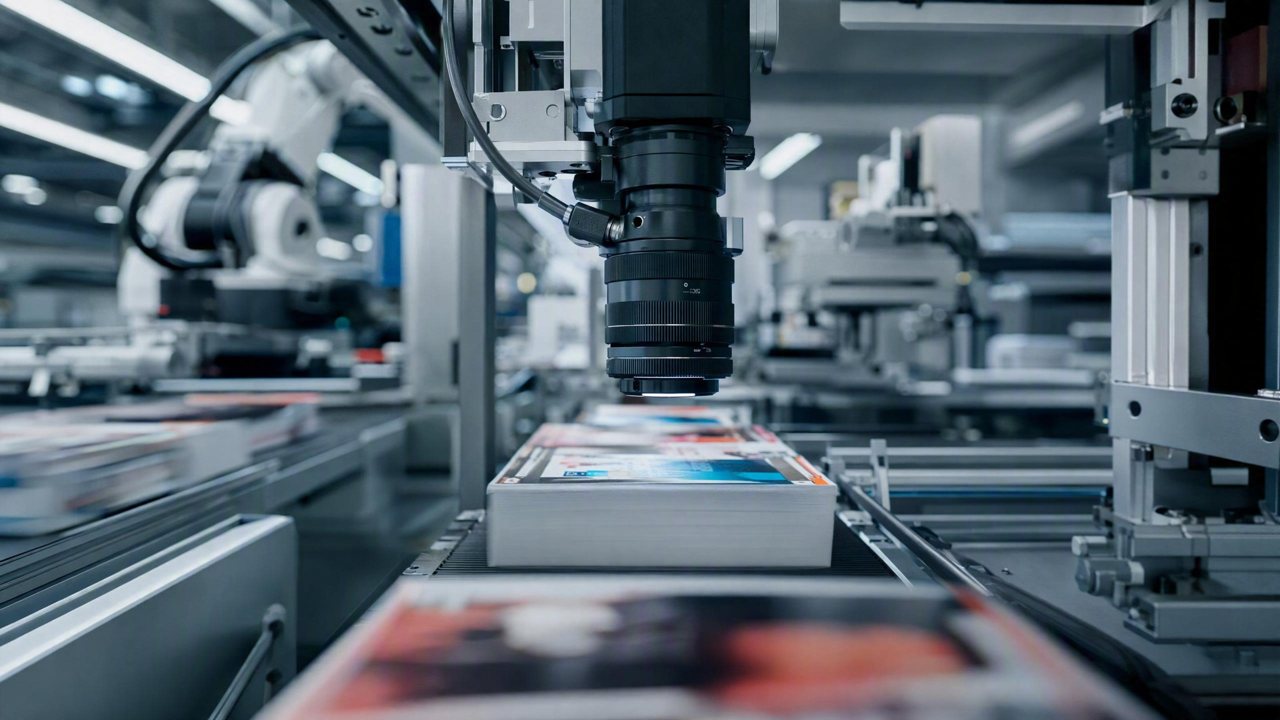
In the consumer goods packaging printing sector, DaoAI 2D AI AOI equipment (high-resolution 2D imaging + deep learning re-evaluation, targeting surface/printing/OCR/assembly defects, high-speed inline full inspection, micron-level precision, semantic false positive filtering) significantly reduced the packaging box printing false positive rate from 15% to 2.2% for a mid-sized consumer goods manufacturer through on-premises deployment, simultaneously ensuring absolute security and compliance of sensitive production data.
In the consumer goods packaging printing sector, DaoAI 2D AI AOI equipment (high-resolution 2D imaging + deep learning re-evaluation, targeting surface/printing/OCR/assembly defects, high-speed inline full inspection, micron-level precision, semantic false positive filtering) significantly reduced the packaging box printing false positive rate from 15% to 2.2% for a mid-sized consumer goods manufacturer through on-premises deployment, simultaneously ensuring absolute security and compliance of sensitive production data. The quality of packaging printing in the consumer goods industry directly impacts brand image and consumer trust; even minor defects can lead to recalls, returns, or damage to brand reputation. Traditional sampling or manual visual inspection is inefficient and inconsistent, struggling to meet the demands of modern high-speed, high-volume production. Especially for mid-sized enterprises, the core challenge in their digital transformation lies in balancing detection accuracy, cost control, and securing production data.
Pain Points: Why Is This Challenge So Difficult?
Quality control in packaging box printing faces multiple challenges. Firstly, printing defects are diverse, including but not limited to character ghosting, ink spots, scratches, color variations, misregistration, missing prints, and ink overflow. These defects often have irregular shapes, sizes, and positions, making precise identification difficult with traditional rule-based vision algorithms. Secondly, packaging materials vary widely, such as matte paper, laminated paper, and metallic films, each with vastly different surface reflection characteristics. Traditional lighting and camera combinations struggle to maintain high contrast while avoiding reflective interference, leading to unstable imaging quality. On highly reflective surfaces, like those treated with lamination or UV ink, reflected light can create specular or diffuse reflections, obscuring tiny defects or generating false signals, severely impacting detection reliability. Thirdly, fast production cycles are common, with packaging box printing lines often operating at hundreds of pieces per minute. Manual visual inspection typically has a miss rate of 5%~10% and is prone to fatigue, while traditional rule-based AOI often has false positive rates as high as 10%~20% when dealing with complex and varied defects. This leads to numerous good products being misidentified, increasing manual re-inspection time and production costs. For many enterprises, particularly mid-sized manufacturers, strict data security and compliance requirements make uploading production data to the cloud for AI training and inference unacceptable, hindering the adoption of cloud-based AI vision solutions. A particular mid-sized consumer goods manufacturer faced this exact dilemma, with character ghosting and subtle color variation defects on their packaging box printing line resulting in a miss rate of up to 2.5%, while traditional AOI's false positive rate remained stubbornly high, creating immense production pressure.
The root cause analysis reveals that detecting defects on reflective surfaces is inherently challenging due to imaging physics limitations. When light hits a highly reflective or semi-transparent surface, some light undergoes specular reflection, directly entering the camera and creating bright areas that obscure defect details. Other light undergoes diffuse reflection or transmission, blurring defect features. Traditional machine vision relies on fixed light sources and rigid thresholds, making it difficult to effectively distinguish real defects from reflective artifacts. Furthermore, printed characters vary widely in font, size, and color, making template-matching OCR methods insufficiently robust against slight deformations or blurring. Deep learning technology, especially the algorithms employed by DaoAI 2D AI AOI, can learn complex defect features from vast datasets and effectively suppress reflective interference, leading to more accurate discrimination. However, securely deploying this powerful capability on the client's premises, mitigating data leakage risks, is a critical challenge.
Technical Principles
DaoAI 2D AI AOI equipment fundamentally solves the inspection challenges in packaging box printing by combining high-resolution 2D imaging with a deep learning re-evaluation mechanism. At the hardware level, DaoAI 2D AI AOI utilizes customized multi-angle annular lighting and high-resolution industrial cameras. By optimizing the illumination scheme, it effectively suppresses reflections and enhances defect contrast. For instance, on highly reflective surfaces, the system employs polarized light or low-angle diffused light to minimize specular reflection that can mask defect features, ensuring clear and stable image data capture. This image data can reach micron-level resolution, providing high-quality input for subsequent AI evaluation.
At the software algorithm level, DaoAI 2D AI AOI is equipped with a deep learning model powered by the Wemio engine. This model, trained on vast industrial image datasets, possesses powerful feature extraction and pattern recognition capabilities. Compared to traditional rule-based AOI algorithms, our model can learn and understand the 'semantic' information of defects, rather than merely pixel-level grayscale or color differences. This means that even irregular, subtly colored character ghosting, slight color variations, or ink spots can be accurately identified by DaoAI 2D AI AOI. Crucially, its built-in semantic false positive filtering mechanism effectively distinguishes non-defect factors like reflections, smudges, and dust from actual defects, significantly reducing the false positive rate. Furthermore, DaoAI 2D AI AOI supports APDT positive sample/few-shot learning, requiring only 1–20 good samples to complete model training in 5 minutes, drastically shortening changeover times and enhancing production line flexibility. All these powerful AI capabilities support 100% local on-premises deployment, ensuring that sensitive production data remains within the client's facility, fundamentally addressing data security concerns.
Typical Application Scenarios
- **Printing Character Ghosting and Blurring Detection:** DaoAI 2D AI AOI captures character details through high-resolution imaging, combined with deep learning OCR technology, to precisely identify character ghosting, missing strokes, and blurring caused by misregistration or uneven roller pressure during printing. The difficulty lies in the variety of character sizes, fonts, and complex background patterns that can easily interfere with traditional OCR.
- **Packaging Box Surface Scratch and Dirt Detection:** For micron-level scratches, ink spots, and dust adhesion that may occur on packaging boxes during production and transportation, DaoAI 2D AI AOI can perform high-speed inline full inspection. The challenge is that these defects are often subtle and blend with background textures, while highly reflective surfaces are prone to generating false positives.
- **Printing Color Difference and Misregistration Detection:** DaoAI 2D AI AOI, through multi-spectral imaging technology (optional) and deep learning color analysis, can detect subtle color differences between batches or within the same batch, as well as misregistration issues in multi-color printing. The difficulty is that human eyes have limited sensitivity to color differences, and different materials present colors differently.
- **Barcode/QR Code Printing Quality Inspection:** Ensuring that barcodes and QR codes are printed clearly, completely, and with high readability, to avoid identification obstacles in subsequent logistics or sales stages due to printing quality issues. DaoAI 2D AI AOI can accurately judge code defects, including broken bars, excessively small quiet zones, and insufficient contrast.
- **Assembly Omissions and Misalignments Detection:** For packaging boxes with liners, accessories, or requiring folding and gluing, DaoAI 2D AI AOI can also detect assembly defects such as missing liners, incorrect positioning, and insecure adhesion. The difficulty lies in occlusion and complex geometric deformations in multi-layered structures.
Deployment Case Study
A mid-sized consumer goods manufacturer, whose main products are daily chemical goods, has extremely high requirements for packaging box printing quality. Before introducing DaoAI 2D AI AOI, the factory used manual sampling combined with a traditional rule-based AOI device for quality control. However, due to fast production cycles and complex, multi-colored packaging designs, the traditional rule-based AOI device had a false positive rate as high as 15%, requiring an additional 2 quality inspectors to perform 4 hours of manual re-inspection daily, severely slowing down overall production efficiency. At the same time, due to strict requirements for production data security, the enterprise could not accept any cloud-deployed AI solutions.
The DaoAI team provided an on-premises deployment solution for the 2D AI AOI equipment tailored to the client's specific needs. We first integrated high-resolution industrial cameras and customized lighting onto the client's existing production line and deployed the localized Wemio engine. In the initial phase, using 10 good samples and a few typical defect images provided by the client, DaoAI engineers completed the initial model training within 5 minutes. After two weeks of on-site debugging and iterative optimization, in this case, the DaoAI 2D AI AOI equipment successfully reduced the false positive rate for packaging box printing defects from 15% to 2.2%, with the miss rate consistently controlled below <0.4%. Production line data showed that manual re-inspection hours were reduced by 85%, from 8 man-hours per day to approximately 1.2 man-hours. More importantly, all production data was processed and stored on the client's local servers, fully complying with their strict data security and compliance requirements, completely eliminating concerns about data leakage.
DaoAI 2D AI AOI's on-premises deployment not only enhanced detection accuracy but also safeguarded the enterprise's core data assets, achieving a win-win in both economic benefits and compliance.
DaoAI Solutions and Products
DaoAI 2D AI AOI equipment, as the core of this solution, provides end-to-end intelligent inspection capabilities for the consumer goods packaging printing industry. Its deployment method supports 100% local on-premises installation, eliminating client concerns about data being uploaded to the cloud. In specific implementations, DaoAI engineers select the most suitable cameras, lighting, and mechanical structures for integration based on the client's production line environment and packaging product characteristics. Model training and deployment are entirely performed on local servers, utilizing the APDT few-shot learning capability of the DaoAI AI AOI software system. Clients only need to provide a small number of good samples (1-20 images) to quickly build the model. Subsequent accumulation of defect samples can be used for continuous model optimization, enabling self-iteration. The semantic false positive filtering function of DaoAI 2D AI AOI performs exceptionally well in practical applications, effectively reducing misjudgments caused by material reflections, ambient light interference, and other factors. Furthermore, DaoAI offers flexible SDK/API interfaces, making it convenient for clients to seamlessly integrate it with existing MES/WMS systems, achieving interconnected production data and traceability.
Through the application of DaoAI 2D AI AOI equipment, the mid-sized consumer goods manufacturer achieved significant quantified results. The system reduced the false positive rate by −85%, directly cutting down a large amount of manual re-inspection hours, shrinking the manual re-inspection workload per shift from 8 man-hours to 1.2 man-hours. Concurrently, the miss rate was consistently controlled below <0.4%, greatly improving outbound product quality and reducing the risk of customer complaints and recalls due to quality issues. More importantly, the on-premises deployment ensured absolute security of the client's core production data, meeting stringent industry compliance requirements and laying a solid foundation for the enterprise's future digital transformation.
FAQ
How does DaoAI 2D AI AOI's on-premises deployment ensure data security?
DaoAI 2D AI AOI supports 100% on-premises deployment, meaning all image data, trained models, and inference results are processed and stored on the client's local servers, never leaving the factory. This eliminates the need for clients to upload sensitive production data to the cloud, fundamentally preventing data leakage risks and fully complying with stringent data security and compliance requirements.
What are the advantages of DaoAI 2D AI AOI over traditional AOI equipment for reflective surface defect detection?
Traditional AOI often suffers from high false positives due to specular reflections and artifacts on reflective surfaces. DaoAI 2D AI AOI utilizes customized multi-angle lighting and deep learning algorithms to effectively suppress reflective interference and distinguish real defects from artifacts. Its semantic false positive filtering mechanism and precise recognition of complex defects significantly improve detection rates and substantially reduce false positives.
How long does it take to deploy DaoAI 2D AI AOI, and how is the cost evaluated?
Deployment time varies depending on production line complexity and integration requirements, typically completed within a few weeks. Cost evaluation involves hardware configuration (cameras, lighting, industrial PC), software licensing, integration services, and on-site commissioning. DaoAI offers flexible solution customization. We recommend contacting our sales team for a detailed quote and ROI analysis tailored to your specific needs.
This article was generated by AI. Customer cases are simulated scenarios based on real product capabilities and figures are illustrative; see product pages for official benchmarks.