
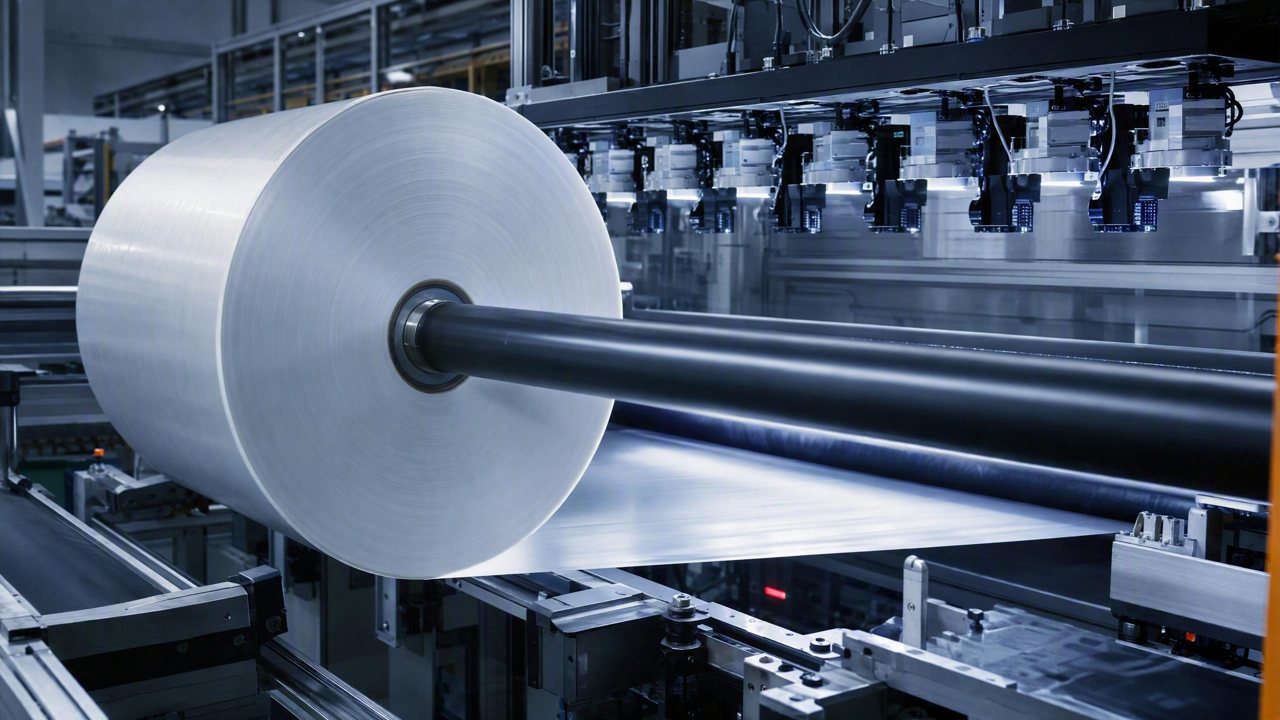
DaoAI 2D AI AOI equipment (high-resolution 2D imaging + deep learning secondary judgment, targeting surface/printing/OCR/assembly defects, high-speed online full inspection, micron-level, semantic false positive filtering) leveraged its APDT few-shot self-training capability to reduce false positives in printed film rolls from a traditional 20% to <5% for a leading chemical/material manufacturer. This significantly optimized production line efficiency and manual re-inspection costs. In the chemical/material industry, especially in the production of high-precision printed film rolls, product quality is crucial for subsequent processing and final application.
DaoAI 2D AI AOI equipment (high-resolution 2D imaging + deep learning secondary judgment, targeting surface/printing/OCR/assembly defects, high-speed online full inspection, micron-level, semantic false positive filtering) leveraged its APDT few-shot self-training capability to reduce false positives in printed film rolls from a traditional 20% to <5% for a leading chemical/material manufacturer. This significantly optimized production line efficiency and manual re-inspection costs. In the chemical/material industry, especially in the production of high-precision printed film rolls, product quality is crucial for subsequent processing and final application. These printed films are widely used in packaging, electronic materials, construction films, and other fields. Their surface print quality, color consistency, character integrity, and the presence of micron-level defects such as scratches, stains, or bubbles directly impact product performance and brand image. Traditional online inspection solutions often suffer from high false positive rates due to complex backgrounds, diverse defect types, and reflective lighting, severely affecting production efficiency and manual re-inspection costs. This case study focuses on a large chemical and material manufacturer whose main products are printed film rolls for high-end electronic products and special packaging, requiring 100% full inspection on high-speed production lines to ensure outgoing products meet stringent industry standards.
Pain Points: Why This Challenge Was Difficult to Overcome
The core challenge faced by this chemical and material manufacturer was the persistently high false positive rate in printed film roll inspection and frequent production line changeovers. Traditional rule-based AOI systems, when inspecting reflective or translucent materials, often misinterpret material textures, slight refractions, or environmental light changes as defects due to light reflection and microscopic structural differences in the film. Production line data showed a false positive rate of around 20%. This directly led to significant wasted re-inspection labor; according to the factory's statistics, at least 4 person-shifts were required daily for 6 hours of manual re-judgment, severely reducing production efficiency. Furthermore, with increasing product order diversity, the production line required 3-5 product changeovers per week. Each changeover necessitated 1-2 hours for traditional AOI systems to re-adjust parameters and calibration, during which the production line was halted, severely impacting production rhythm and delivery cycles. A deeper root cause lies in the vast variety of printed film materials, such as PET, PP, and PE, each with distinct surface characteristics, printing ink types, and defect manifestations. Especially under high-speed motion, micron-level bumps, ink spots, scratches, or registration errors are difficult for traditional algorithms to stably identify. Vision AI in reflective surface defect detection faces technical difficulties including specular reflection, scattering, and the interaction of light sources at different angles, all of which make defect feature extraction exceptionally complex, rendering traditional image processing methods ineffective in distinguishing real defects from background noise.
Technical Principles
The DaoAI 2D AI AOI equipment effectively addresses these challenges with its high-resolution 2D imaging system and deep learning-based secondary judgment engine. Its core technical advantage lies in the APDT (Adaptive Pattern Description and Transfer) few-shot self-training capability. Unlike traditional AOI which relies on a large number of defect samples for training, APDT allows users to provide only a very small number (1-20) of good product images. The system then builds a 'normal' pattern of the product through self-supervised learning. When an area with a significant deviation from this pattern is detected, a deep learning model performs secondary judgment to achieve precise defect identification. Specifically, the imaging system of DaoAI 2D AI AOI employs multi-angle annular lighting and polarized light technology to effectively suppress interference from reflective surfaces, acquiring high-quality, shadow-free images. Subsequently, these images are fed into the built-in Wemio engine, which is equipped with a Transformer-based vision foundation model capable of learning more generalized visual features from a small number of good samples. Upon identifying potential defects, the system initiates a semantic false positive filtering mechanism. Through contextual understanding and defect type clustering, it eliminates pseudo-defects caused by background textures, lighting fluctuations, or inherent material properties. Compared to traditional rule-based AOI that relies on manually set thresholds and feature extraction, the APDT mechanism of DaoAI 2D AI AOI adaptively responds to environmental changes and product diversity. In this case, it reduced the false positive rate of printed film by −75%, while maintaining a detection rate above 99.5%, significantly outperforming traditional solutions.
Compared with traditional methods, the advantages of DaoAI 2D AI AOI are reflected at multiple levels. Traditional rule-based AOI struggles with complex and variable materials like printed films, as its fixed algorithms and thresholds cannot adapt to diverse defects and constantly changing product batches, leading to persistently high false positive rates. Manual inspection, while flexible, is inefficient, inconsistent, and prone to missed detections due to fatigue under high-intensity work. DaoAI 2D AI AOI combines a high-resolution optical system with the powerful feature learning capabilities of deep learning, especially its APDT few-shot self-training function, which greatly simplifies model training and production line changeovers. Traditional solutions require several hours for parameter adjustments during changeovers, whereas DaoAI 2D AI AOI, through APDT, only needs 1-20 good samples to adapt the model for a new product within 5 minutes, achieving '0-code rapid changeover' and significantly reducing downtime. Furthermore, the semantic false positive filtering capability of the Wemio engine effectively identifies and filters out 'pseudo-defects' that have no substantial impact on product performance. This is particularly crucial in reflective surface inspection, preventing misjudgments caused by imaging noise or inherent material properties, thereby reducing re-inspection labor by −75%.
Typical Application Scenarios
- **Printed Surface Defect Detection:** Detecting micron-level surface defects such as uneven ink, ink spots, missing prints, color misregistration, scratches, bubbles, and foreign objects in printed film production. The challenge lies in small defect sizes, complex backgrounds, and low contrast due to reflection during high-speed online inspection, making traditional rules difficult to stably identify. DaoAI 2D AI AOI achieves precise localization and classification of these defects through high-resolution imaging and deep learning.
- **Character and Barcode OCR/OCV:** Verifying the completeness, clarity, and accuracy of batch numbers, production dates, product codes, and other characters printed on the film, as well as the readability and quality of barcodes. The difficulty lies in diverse character fonts, unstable print quality, and film reflection making recognition challenging. The OCR function of DaoAI 2D AI AOI adapts to various fonts and backgrounds, ensuring accurate character recognition.
- **Dimension and Position Accuracy Inspection:** Measuring the dimensions and relative positional accuracy of printed patterns, hole positions, and cut edges to ensure products meet design requirements. The challenge involves precise micron-level measurement under high-speed motion and potential measurement errors due to slight material deformation. DaoAI 2D AI AOI can perform real-time dimension measurement and deviation analysis with micron-level accuracy.
- **Surface Foreign Object and Contamination Detection:** Identifying dust, fibers, oil stains, and other foreign objects attached to the film surface to ensure product cleanliness. The difficulty lies in the tiny size of foreign objects, which may be similar in color to the film, making them easy to miss. DaoAI 2D AI AOI effectively captures minute foreign objects through its high-sensitivity imaging and deep learning models.
- **Color Consistency and Color Difference Detection:** Monitoring the color consistency of printed patterns and detecting color differences or deviations from standards. The challenge involves real-time online color calibration and stable color evaluation under different lighting conditions. DaoAI 2D AI AOI can assist in real-time monitoring and early warning for critical color areas.
Implementation Case Study
A leading chemical and material manufacturer in East China, specializing in the research and production of high-end electronic materials and special packaging films, had long been plagued by high false positive rates and production line downtime due to frequent changeovers. Before implementing the DaoAI solution, their traditional rule-based AOI system had a false positive rate of about 20% in high-speed roll material inspection. This necessitated at least 4 workers per day, working 6-hour shifts, for manual re-inspection and confirmation, incurring significant labor costs. Additionally, with an average of 4 product changeovers per week, engineers spent 1.5 hours each time adjusting parameters and calibrating, during which the production line was halted, severely impacting the production rhythm. To address these pain points, the manufacturer introduced DaoAI 2D AI AOI equipment. During the implementation, the DaoAI team, using the APDT few-shot self-training function, deployed the model for new products in just 5 minutes with only 15 good samples. Production line data showed that after the system went live, the false positive rate for printed film rolls significantly decreased from 20% to <5%, meaning a −75% reduction in manual re-inspection labor. Simultaneously, product changeover time was reduced from 1.5 hours to 5min, improving production line utilization. Furthermore, the DaoAI 2D AI AOI system consistently kept the printed film's missed detection rate below <0.5%, ensuring product quality.
"The APDT function of DaoAI 2D AI AOI has completely transformed our production line efficiency. The significant reduction in false positives and rapid changeovers have truly upgraded our production line to intelligent manufacturing." – Production Director, Chemical/Material Manufacturer
DaoAI Solution and Products
The core solution provided by DaoAI to this chemical and material manufacturer was its 2D AI AOI equipment, which integrates a high-resolution 2D imaging system and the powerful Wemio deep learning engine. During project implementation, the DaoAI technical team first conducted a detailed assessment of the client's production line, including film material characteristics, defect types, production tempo, and existing inspection processes. For the reflective properties of printed films, we configured customized multi-angle annular lighting and polarizing filters to ensure high-quality image acquisition. Subsequently, through the APDT few-shot self-training function of the DaoAI AI AOI software system, client production line engineers could quickly complete model training and deployment by providing only a small number of good samples, without writing any code. The system supports 100% on-premise private deployment, ensuring data security and preventing data from leaving the factory. It also seamlessly integrates with the client's existing MES/SCADA systems via SDK/API interfaces, achieving real-time synchronization of inspection data and production management. The DaoAI 2D AI AOI equipment not only provides high-precision defect detection but also greatly optimizes false positive issues with its semantic false positive filtering capability, accurately separating 'background noise' from 'real defects' that traditional AOI struggles to distinguish. Additionally, DaoAI can offer the DaoAI World model as a unified foundation for cross-scenario generalization and continuous learning, further enhancing the system's adaptability and intelligence.
Through the deployment of DaoAI 2D AI AOI equipment, this chemical and material manufacturer achieved significant business value and quantifiable results. Production line data showed that the false positive rate for printed film rolls decreased by −75%, directly reducing a substantial amount of manual re-inspection labor. It is estimated that approximately ¥694/min in re-inspection costs can be saved annually. Changeover time was reduced from 1.5 hours to 5min, improving production line utilization and order delivery capabilities. The DaoAI 2D AI AOI system consistently kept the missed detection rate below <0.5%, ensuring the reliability of product quality and effectively reducing customer complaints and brand risks caused by defective products. Furthermore, due to the convenience of APDT few-shot self-training, client production line engineers can independently complete the model deployment and maintenance for new products, reducing reliance on external technical support and enhancing the internal team's autonomous operation and maintenance capabilities.
FAQ
How does DaoAI 2D AI AOI equipment handle reflection issues on printed films?
DaoAI 2D AI AOI equipment utilizes customized multi-angle annular lighting and polarized light technology. This combination effectively suppresses specular reflection and scattering on the surface of printed films, acquiring high-quality, shadow-free images. This provides a clear data foundation for subsequent deep learning defect recognition, significantly outperforming traditional single-source lighting solutions in distinguishing real defects from lighting artifacts.
How does the APDT few-shot self-training feature impact the cost and deployment cycle of AOI systems?
The APDT few-shot self-training feature significantly reduces the deployment complexity and long-term maintenance costs of AOI systems. By requiring only a small number of good samples for training, clients avoid extensive time and resources for defect sample collection and annotation, greatly shortening the model training and go-live cycles. It also eliminates the need for engineers to spend long hours on-site for adjustments during production line changeovers, reducing operational costs and increasing line uptime, leading to a lower overall TCO.
What is the approximate budget for purchasing DaoAI 2D AI AOI equipment?
The specific budget for DaoAI 2D AI AOI equipment depends on various factors such as the client's inspection requirements, production line speed, detection accuracy, and integration complexity. We offer flexible hardware and software configuration options to meet the needs of clients of different scales and requirements. We recommend contacting our sales team with your detailed production line information for a customized solution and precise quotation.
This article was generated by AI. Customer cases are simulated scenarios based on real product capabilities and figures are illustrative; see product pages for official benchmarks.