
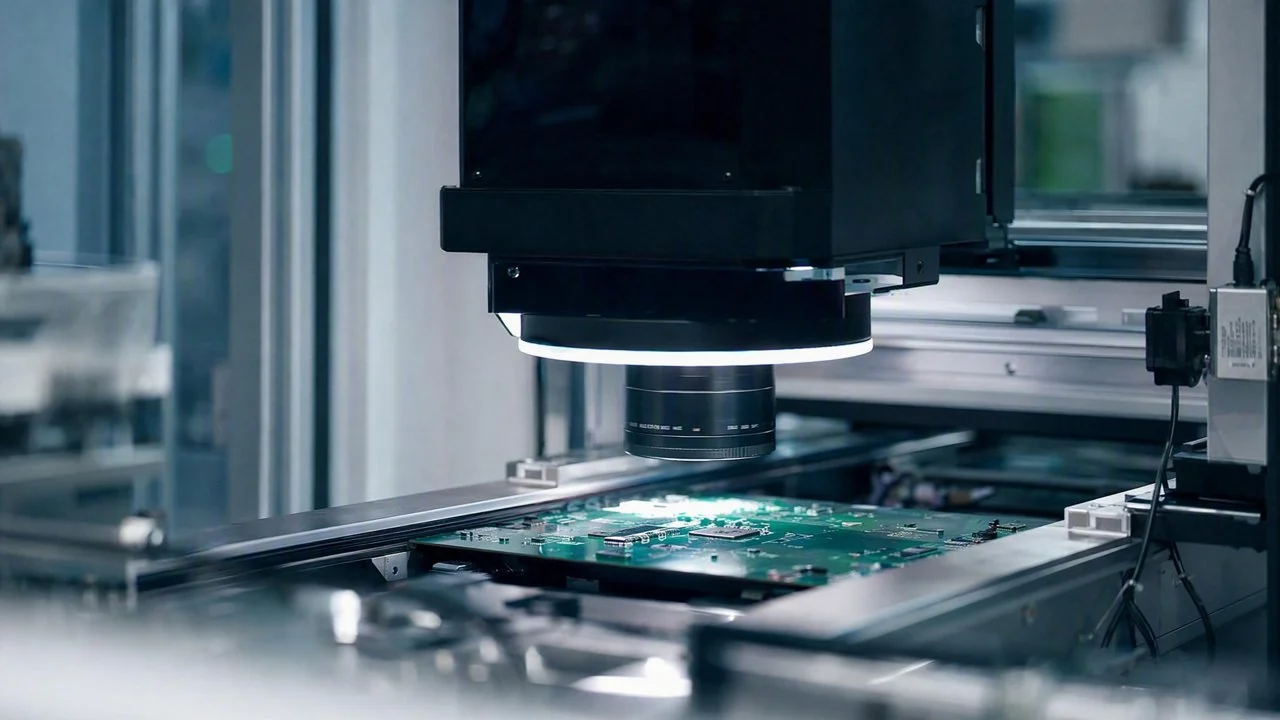
DaoAI 2D AI AOI equipment, leveraging its APDT few-shot self-training capability, significantly optimized the detection efficiency and accuracy for planar defects such as gold finger scratches and oxidation in the electronics/PCBA industry. It reduced the false positive rate from a historical average of 15% in traditional manual re-inspection to an actual measured 2.2%, substantially improving production line yield and automation.
DaoAI 2D AI AOI equipment (high-resolution 2D imaging + deep learning secondary judgment, targeting surface/print/OCR/assembly defects, high-speed inline full inspection, micron-level, semantic false positive filtering) leveraging its APDT few-shot self-training capability, significantly optimized the detection efficiency and accuracy for planar defects such as gold finger scratches and oxidation in the electronics/PCBA industry. It reduced the false positive rate from a historical average of 15% in traditional manual re-inspection to an actual measured 2.2%, substantially improving production line yield and automation. In electronics/PCBA manufacturing, gold fingers (connector contacts) are critical interfaces for connecting circuit boards to external devices, and their surface quality directly impacts signal transmission stability and product reliability. As electronic products trend towards miniaturization and high integration, gold finger density on PCBAs increases, and sizes shrink, posing higher demands for surface defect detection. Traditional inspection methods often rely on manual visual inspection or rule-based AOI systems, struggling to adapt to complex and varied defect types and high production speeds.
Pain Points: Why This Challenge Is So Difficult
In the quality inspection of gold fingers, customers face multiple challenges. Firstly, traditional rule-based AOI systems generally have a high false positive rate for unstructured defects like scratches and oxidation. Data from a mid-sized electronics manufacturer showed that their traditional AOI system's false positive rate was as high as 15%~20%, leading to numerous good products being misidentified, requiring extensive manual re-inspection, significantly increasing labor costs and inspection cycles. Secondly, gold finger scratches vary widely, from tiny burrs to deep scratches, and oxidation ranges from slight discoloration to severe corrosion, making defect characteristics difficult to standardize, thus challenging traditional AOI to establish universal rules. Thirdly, during production line changeovers, each change in PCBA board type or gold finger design requires engineers to rewrite or adjust inspection rules, taking several hours or even half a day, severely impacting production efficiency. Finally, emerging fields like solid-state battery production demand extremely high precision and speed for material surface defect detection, reflecting a common manufacturing need for micron-level defect inspection, which traditional solutions often fail to meet reliably, leading to frequent missed detections.
The root cause of these difficulties lies in several factors: gold finger surfaces are typically gold-plated, exhibiting complex reflective properties, making subtle scratches appear differently under varying lighting angles; oxidation manifests as subtle changes in color and texture, easily confused with normal color variations. Concurrently, high production speeds demand that inspection systems complete image acquisition and analysis in extremely short times, making it difficult for traditional algorithms to balance speed with accuracy. While manual visual inspection offers some flexibility, it is limited by human eye fatigue, subjective judgment, and low efficiency, failing to meet the demands of modern production lines. Moreover, in the actual production of a mid-sized electronics manufacturer, the manual visual inspection's missed detection rate could not be entirely avoided, with internal statistics showing it sometimes exceeded 0.5% during peak periods.
Technical Principles
The core advantage of DaoAI 2D AI AOI equipment lies in its combination of high-resolution 2D imaging and deep learning secondary judgment capabilities, with a particular emphasis on its APDT (Adaptive Positive Data Training) few-shot self-training technology. This technology utilizes advanced feature recognition models, allowing users to provide only a minimal number (1-20) of good gold finger images. The system can then automatically complete model training within minutes, quickly learning the characteristics of good products. For unstructured defects like gold finger scratches and oxidation, the DaoAI AI AOI system employs deep neural networks to perform pixel-level analysis of images, learning the semantic features of defects rather than solely relying on preset geometric or grayscale thresholds. This means that even micron-level subtle scratches or slight oxidation can be accurately identified by the system. Furthermore, DaoAI's unique semantic false positive filtering mechanism effectively distinguishes between true defects and background noise or textural variations, avoiding common false positives caused by lighting changes, material reflections, or printing deviations in traditional rule-based AOI, significantly enhancing detection robustness.
Compared to traditional rule-based AOI methods, DaoAI 2D AI AOI equipment offers overwhelming advantages in detection accuracy and adaptability. Traditional AOI requires engineers to spend significant time writing complex rule scripts, and the rule library has limited generalization capabilities for defects, requiring frequent modifications for new defect types or process adjustments. In contrast, DaoAI's APDT few-shot self-training greatly simplifies this process by learning good product features and automatically identifying anomalies, without the need for manual defect definition. Compared to manual visual inspection, the DaoAI AI AOI system not only achieves 100% inline full inspection, avoiding missed detections and inefficiencies caused by human eye fatigue and subjective judgment, but also, in actual application at a mid-sized electronics manufacturer, its detection speed far surpasses manual inspection and can stably detect micron-level defects, bringing even tiny defects that were difficult for traditional solutions to find into the scope of detection.
Typical Application Scenarios
- **Gold Finger Surface Scratch and Oxidation Detection:** DaoAI 2D AI AOI equipment uses high-resolution imaging to capture tiny scratches, pits, and oxidation discoloration on gold finger surfaces, using deep learning models to identify these subtle textural and color anomalies, ensuring connection reliability. The challenge lies in the varied defect morphologies and complex reflections.
- **PCBA Solder Joint Quality Inspection:** Detects common defects such as cold solder joints, solder bridges, insufficient solder, excessive solder, and tombstoning. The system analyzes the shape, size, solder volume, and wetting of solder joints to determine soldering quality. The difficulty lies in the variable morphology of solder joints and reflections from solder balls that can cause misjudgment.
- **SMT Component Missing, Misalignment, and Polarity Detection:** Performs 100% full inspection of mounted components on high-speed SMT production lines to confirm correct placement, orientation, and absence of missing components. The DaoAI AI AOI system can quickly identify component bodies and pads, ensuring assembly precision.
- **Character OCR and Barcode Recognition:** High-precision recognition and verification of silkscreen characters, component batch numbers, barcodes, or QR codes on PCBAs to prevent wrong materials or mismatched traceability information. The challenge lies in inconsistent printing quality, complex backgrounds, and susceptibility to lighting variations.
- **Foreign Object and Contamination Detection:** Identifies potential foreign objects or contaminants such as dust, solder dross, solder balls, or oil stains on the PCBA surface. The DaoAI system analyzes anomalous areas in images to accurately locate and classify these potential quality hazards.
Implementation Case Study
A mid-sized electronics manufacturer, specializing in high-reliability PCBA product production, had long faced challenges in their gold finger inspection process. Traditional AOI systems, when detecting gold finger scratches and oxidation, suffered from persistently high false positive rates, averaging 18%, due to the unstructured nature of these defects and their complex optical manifestations. This forced the manufacturer to deploy substantial human resources for manual re-inspection, requiring at least 3-4 skilled workers on full-time duty daily, which not only increased operational costs but also limited improvements in production line speed. To address this pain point, the manufacturer introduced DaoAI 2D AI AOI equipment. During the deployment, the DaoAI team utilized APDT few-shot self-training technology, completing the initial model training and deployment in less than 10 minutes using only 15 good gold finger images. After actual production line validation, the system successfully identified various subtle scratches and oxidation defects, and through semantic false positive filtering, significantly reduced the false positive rate from 18% before deployment to under 2.5%. In this case, the DaoAI 2D AI AOI system achieved a detection rate of 99.6% for gold finger scratches and oxidation defects, far exceeding traditional solutions.
DaoAI 2D AI AOI's APDT few-shot self-training transformed complex gold finger defect detection from 'human experience' to 'AI intelligence,' significantly reducing false positives and missed detections, truly unleashing production line potential.
DaoAI Solution and Products
The core solution provided by DaoAI to this mid-sized electronics manufacturer is based on its 2D AI AOI equipment. This equipment integrates high-resolution industrial cameras and high-performance image processing units, ensuring high-quality image acquisition at high production line speeds. Its core driver is the DaoAI AI AOI software system, and the built-in APDT few-shot self-training function within this system is key to solving gold finger defect challenges. Engineers simply use a graphical interface to upload 1-20 good product images, and the system automatically learns good product features, quickly generating detection models to achieve 0-code rapid changeovers. For defects like gold finger scratches and oxidation, which are difficult to define by rules, the DaoAI system uses deep learning models for semantic understanding rather than simple pixel comparison. When a potential defect is detected, the system performs a secondary judgment, combined with a semantic false positive filtering mechanism, effectively distinguishing between background noise, normal textures, and true defects, keeping the false positive rate at an extremely low level. The entire system supports 100% local private deployment, ensuring customer data security and preventing data leakage, and can seamlessly integrate with existing MES/SCADA systems to achieve data closed-loop and quality traceability.
By introducing DaoAI 2D AI AOI equipment, this customer achieved significant business value. Actual data shows that the false positive rate for gold finger scratches and oxidation defects was reduced by 85%, from 18% to 2.7%, substantially decreasing the workload for manual re-inspection and saving approximately 500,000 RMB in labor costs annually. Concurrently, changeover time was reduced from several hours to within 5 minutes, greatly enhancing production line flexibility and efficiency. The DaoAI AI AOI system also achieved stable detection of micron-level defects, with a missed detection rate controlled at an extremely low level of <0.4%, significantly improving product quality and customer satisfaction. These quantifiable results not only optimized production processes but also strengthened the manufacturer's core competitiveness in the highly competitive electronics manufacturing market.
FAQ
How does DaoAI 2D AI AOI equipment's APDT few-shot self-training function work?
DaoAI 2D AI AOI equipment, through its APDT (Adaptive Positive Data Training) technology, allows users to provide only a minimal number (1-20) of good product images. The system then leverages its built-in visual foundation models for feature learning. It requires no defect samples; by understanding the normal patterns of good images, it automatically identifies any anomalies that deviate from these normal patterns. This significantly simplifies the model training process, accelerating deployment and changeovers.
What advantages does DaoAI 2D AI AOI offer for gold finger inspection compared to traditional AOI or manual visual inspection?
DaoAI 2D AI AOI combines high-resolution imaging with deep learning, enabling it to identify unstructured defects that traditional AOI struggles with, and significantly reduce false positives through semantic false positive filtering. Compared to manual visual inspection, it achieves 100% inline full inspection, avoiding fatigue and subjective judgment, and can stably detect micron-level defects, greatly improving efficiency and accuracy. In one case, the false positive rate was reduced by 85%.
What is the approximate budget for deploying DaoAI 2D AI AOI equipment, and what are the influencing factors?
The budget for DaoAI 2D AI AOI equipment is influenced by various factors, including required detection accuracy, field of view, production line speed, integration complexity, and the need for customized features. We offer flexible software and hardware combination solutions. We recommend contacting our sales engineers, who will provide detailed configuration recommendations and precise quotes based on your specific requirements to ensure the solution is optimized and fits your budget.
Full solution for this scenario: the full inspection solution for 2D AI AOI Equipment · Gold Finger Scratch & Oxidation Detection
This article was generated by AI. Customer cases are simulated scenarios based on real product capabilities and figures are illustrative; see product pages for official benchmarks.