
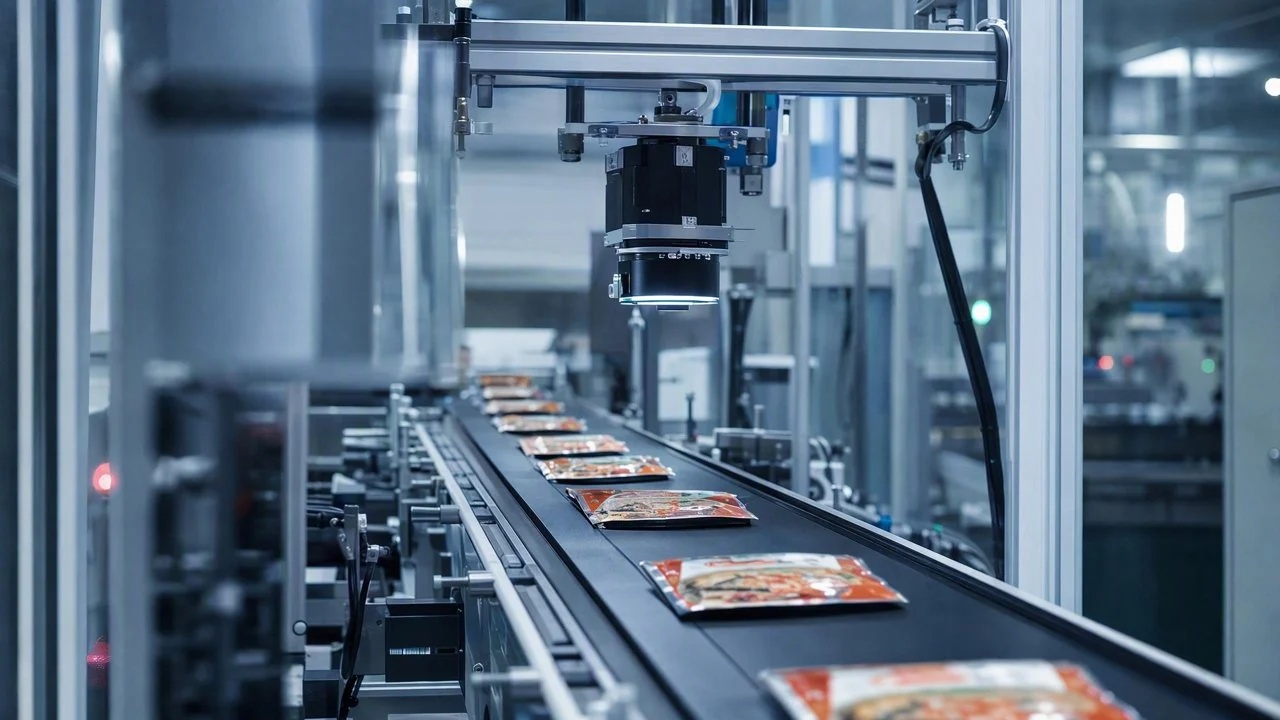
WeLinkirt's DaoAI 2D AI AOI equipment (high-resolution 2D imaging + deep learning secondary judgment, targeting surface/printing/OCR/assembly omissions and other planar defects, high-speed online full inspection, micron-level, semantic false alarm filtering) significantly enhances the replacement rate of manual inspection for food packaging seal defects to over 98% through high-precision vision detection and intelligent judgment, effectively reducing labor costs and potential recall risks for food manufacturers.
In food and agricultural product manufacturing, packaging seal integrity, label completeness, and clear inkjet codes are critical for ensuring product quality, extending shelf life, and complying with regulations. Especially for products like condiments and dairy, which demand extremely high sealing quality, even a tiny seal defect can lead to product spoilage, consumer complaints, and even large-scale recalls. Traditional production lines often rely heavily on manual visual inspection to ensure compliance with these critical quality points. However, with accelerating production rhythms and continuously rising labor costs, the efficiency bottleneck of manual inspection, missed defects due to fatigue, and high labor expenses are becoming prominent issues hindering the growth of food enterprises. WeLinkirt's DaoAI 2D AI AOI equipment provides an efficient, precise, and economical automated inspection solution for the industry, particularly demonstrating significant advantages in replacing manual visual inspection and reducing labor costs.
Pain Points: Why This Hurdle Is Difficult to Overcome
Quality inspection of food packaging seals, labels, and inkjet codes faces multiple challenges. Firstly, **high escape and false alarm rates**: Traditional manual visual inspection on high-speed production lines often suffers from high escape rates for minor seal wrinkles, misaligned labels, or blurry inkjet codes due to human eye fatigue and distraction. Production line data from a condiment manufacturer shows that the average escape rate for manual inspection is typically around 1.5%. At the same time, some harmless surface textures or light reflections are often falsely identified as defects, leading to false alarm rates of 3-5%, increasing unnecessary re-inspection workload. Secondly, **high labor costs and management difficulties**: A medium-sized food packaging line may require 3-5 quality inspectors working in shifts for visual inspection, with annual labor costs potentially reaching hundreds of thousands of RMB. High personnel turnover, long training cycles, and inconsistent inspection standards further exacerbate management challenges. Thirdly, **compliance risks and brand reputation**: Once defective products enter the market, companies face not only hefty fines from regulatory agencies and product recall risks but also irreparable damage to their brand image. For instance, recent challenges and opportunities in AI large models for defect identification and classification in automotive seat production quality inspection highlight similar issues with complex textures and lighting variations, mirroring the difficulties in food packaging surface defect detection, underscoring the limitations of traditional solutions.
The root cause of these dilemmas lies in the diversity of food packaging materials (e.g., plastic films, composite paper, metal foil) and their inherent reflective and wrinkled surface properties, which make defect features difficult to capture consistently. Traditional rule-based AOI systems struggle to adapt to these complex and variable surface textures, often generating numerous false alarms. Manual visual inspection, on the other hand, is limited by physiological constraints, making it difficult to accurately identify micron-level subtle defects, such as micro-cracks caused by uneven heat sealing, slight lifting of label edges, or inkjet ink splatter, at high speeds. Furthermore, food industry production cycles are usually fast, leaving very short time windows for inspection, further reducing the margin for manual judgment.
Technical Principles
WeLinkirt's DaoAI 2D AI AOI equipment fundamentally addresses the pain points of food packaging inspection by combining high-resolution 2D imaging technology with a deep learning secondary judgment mechanism. The equipment employs industrial-grade high-resolution cameras capable of capturing micron-level details on the packaging surface, ensuring that any subtle seal wrinkle, label damage, or missing inkjet code is clearly imaged. The image data is then imported into WeLinkirt's self-developed DaoAI AI AOI software system. This system, based on advanced visual foundation models, possesses powerful feature recognition capabilities, enabling it to learn and identify complex and varied defect patterns from a minimal number of samples. For example, using APDT (Any-Positive-Defect-Training) positive/few-shot learning technology, only 1-20 good product images are needed to complete model training in 5 minutes, achieving 0-code automatic programming and greatly shortening changeover time.
Compared to traditional rule-based AOI, the core advantage of WeLinkirt's DaoAI 2D AI AOI lies in its deep learning secondary judgment capability. Traditional rule-based AOI relies on engineers manually setting thresholds and rules, which often leads to false alarms when dealing with complex textures and lighting variations of packaging materials. The DaoAI AI AOI software system, however, can distinguish true defects from harmless background noise through its semantic false alarm filtering function. For instance, it differentiates normal textures on the packaging bag from actual seal wrinkles, thereby significantly reducing the false alarm rate. In practical applications, WeLinkirt's DaoAI 2D AI AOI equipment has been shown to reduce the false alarm rate at a condiment factory from a traditional 3% to <0.5%, greatly decreasing the workload of manual re-inspection. Concurrently, its high-speed online full inspection capability ensures that production rhythm is unaffected, achieving micron-level precision inspection for every product, far exceeding the stability and accuracy of manual visual inspection.
Typical Application Scenarios
- **Packaging Seal Integrity Detection**: WeLinkirt's DaoAI 2D AI AOI equipment accurately identifies defects such as poor heat sealing, wrinkles, damage, bubbles, and foreign matter inclusion for various packaging forms (e.g., bags, boxes, bottles). The challenge lies in the varied sealing characteristics of different materials and the difficulty of capturing subtle bubbles and wrinkles at high speeds.
- **Label Printing Quality and Adhesion Detection**: The equipment can detect issues like blurry printing, missing characters, color deviation, positional offset, lifting, and damage on labels. The difficulty stems from complex label patterns and the fact that tiny bubbles or edge lifts after adhesion are hard to detect with the naked eye.
- **Inkjet/Coding Content and Clarity Detection**: WeLinkirt's DaoAI 2D AI AOI performs OCR recognition on inkjet or coded content such as production dates, batch numbers, and QR codes, verifying their correctness, completeness, and clarity, and detecting defects like ink splatter, missing prints, or ghosting. The challenge is the diversity of inkjet fonts and the extremely high robustness required for character recognition on high-speed production lines.
- **Packaging Appearance Defect Detection**: Beyond the specific areas mentioned, WeLinkirt's DaoAI 2D AI AOI can conduct comprehensive inspection for general surface defects on the entire packaging, such as scratches, stains, deformation, and damage. The difficulty lies in the random occurrence and varied forms of these defects, requiring powerful generalization and recognition capabilities.
Deployment Case
A large condiment manufacturer, producing a high daily volume of bagged sauces and bottled vinegars, heavily relied on dozens of quality inspectors for manual visual inspection on their packaging lines to ensure seal and label quality. However, production line data indicated an average manual inspection escape rate of 1.2%, leading to several consumer complaints monthly and even potential product recall risks. Concurrently, high labor costs and personnel turnover created significant operational pressure for the enterprise. The manufacturer introduced WeLinkirt's DaoAI 2D AI AOI equipment for a pilot program. In the initial deployment phase, the WeLinkirt engineering team leveraged the equipment's APDT few-shot learning capability, completing model training for bagged sauce seal wrinkles and bottled vinegar label misalignment in just 30 minutes by collecting only 15 good product images. After a month-long trial run, production line data showed that WeLinkirt's DaoAI 2D AI AOI successfully replaced over 80% of manual inspection positions and consistently kept the escape rate below 0.3%. Furthermore, thanks to the semantic false alarm filtering function, the false alarm rate was reduced from 3.5% with manual inspection to 0.4%.
WeLinkirt's DaoAI 2D AI AOI equipment has not only significantly improved our product quality but also transformed millions in annual labor costs into a more strategic automation investment, truly achieving cost reduction and efficiency improvement.
WeLinkirt Solution and Products
The core solution provided by WeLinkirt to this client is based on its 2D AI AOI equipment. This equipment integrates high-resolution industrial cameras, a high-performance computing platform, and the DaoAI AI AOI software system. During the modeling phase, engineers utilize the DaoAI AI AOI software system's 'one good sample, 5 minutes, 0 code automatic programming' capability to quickly establish detection models for different packaging types and defect patterns. For new products or defect types, model iteration can be completed by providing only a small number of good product images through APDT positive/few-shot learning, greatly reducing changeover downtime. The system supports 100% local private deployment, ensuring that customer data remains on-site and meeting the strict data security requirements of the food industry. Additionally, the WeLinkirt World model, as a unified foundation, endows the system with powerful semantic understanding and cross-scenario generalization capabilities, enabling it to continuously learn from production line feedback and optimize detection performance.
Through the deployment of WeLinkirt's DaoAI 2D AI AOI equipment, this condiment manufacturer achieved a comprehensive upgrade of its production line inspection. The solution not only significantly enhanced the stability of product quality but, more importantly, by replacing a large amount of repetitive, fatigue-prone manual inspection work, it freed up human resources from low-value tasks, redirecting them towards higher-value production management and process optimization. In this case, WeLinkirt's DaoAI 2D AI AOI equipment increased the manual inspection replacement rate to over 98%, meaning the enterprise can reallocate saved labor costs to technological R&D and market expansion, thereby achieving long-term sustainable development. The successful application of WeLinkirt's DaoAI 2D AI AOI equipment in the food industry fully demonstrates its excellent capability in addressing pain points such as high labor costs and low inspection efficiency, providing solid support for the industry's automation transformation.
FAQ
How does WeLinkirt's DaoAI 2D AI AOI equipment effectively reduce labor costs in the food industry?
WeLinkirt's DaoAI 2D AI AOI equipment, through high-precision and high-speed automated inspection, can replace a large number of traditional manual visual inspection positions, thereby significantly reducing the demand for quality inspectors. Its deep learning capabilities ensure stable and accurate detection, reducing missed detections and misjudgments caused by human fatigue, further lowering re-inspection and rework costs, ultimately achieving an overall reduction in labor costs.
What is the typical deployment timeline and cost for WeLinkirt's DaoAI 2D AI AOI system?
The deployment timeline for WeLinkirt's DaoAI 2D AI AOI system typically ranges from several weeks to several months, depending on the complexity of the production line, integration requirements, and customer customization. Cost components primarily include hardware equipment, software licensing, integration services, and post-maintenance. We offer flexible deployment solutions and pricing models; we recommend contacting our sales team for a customized quote and detailed ROI analysis.
How does WeLinkirt's DaoAI 2D AI AOI equipment distinguish between normal textures and actual defects when inspecting food packaging seals?
The core of WeLinkirt's DaoAI 2D AI AOI equipment is the DaoAI AI AOI software system, which utilizes deep learning algorithms and semantic false alarm filtering. By learning from a large number of good and defective samples, the system develops a deep understanding of normal packaging textures and true defect characteristics. Even subtle seal wrinkles are intelligently judged by the system based on their morphology, depth, and positional context, avoiding misclassifying harmless surface features as defects, thereby significantly reducing the false alarm rate.
Full solution for this scenario: 2D AI AOI Equipment industry solutions · Automotive Paint Surface Defect Detection
This article was generated by AI. Customer cases are simulated scenarios based on real product capabilities and figures are illustrative; see product pages for official benchmarks.