
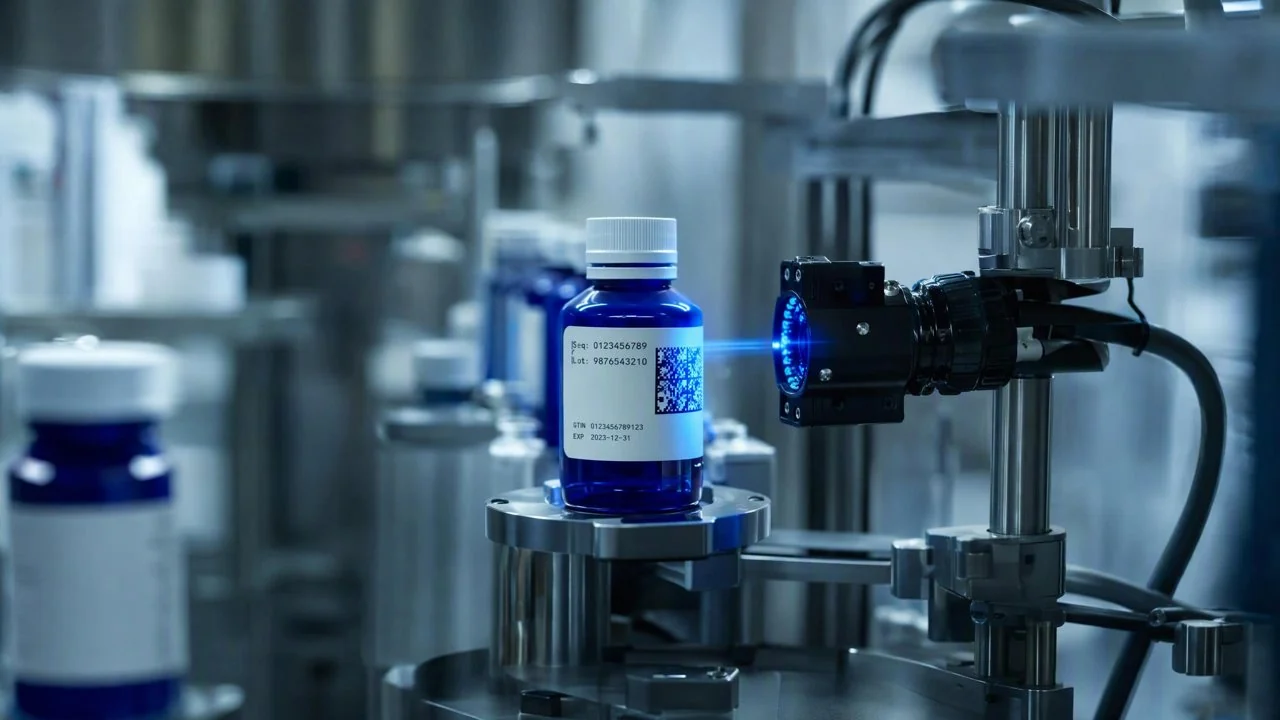
In the pharmaceutical industry, label OCR and serial codes on drug packaging are critical for ensuring product compliance, traceability, and consumer safety. With the widespread application of advanced manufacturing technologies like ultrasonic welding to enhance efficiency and reliability in high-precision industrial assembly lines, downstream inspection processes face increasingly stringent demands for speed and accuracy. Traditional vision inspection systems often struggle to balance production line throughput with the rigorous standards of 100% full inspection when confronted with high-speed lines and complex, variable character printing.
DaoAI 2D ACI equipment (high-resolution 2D imaging + deep learning secondary judgment, targeting surface/printing/character OCR/assembly defects, high-speed online full inspection, micron-level, semantic false alarm filtering) integrates high-precision vision and AI models to increase pharmaceutical production line throughput for label OCR/serial code inspection from 200 bottles/minute with traditional solutions to 250 bottles/minute. The pharmaceutical industry demands extremely high product quality and compliance, especially in packaging, where batch numbers, expiration dates, and serial codes on labels must be accurate, clear, and legible. Any missing, blurry, misprinted, or non-compliant characters can lead to entire product recalls, resulting in significant economic losses and brand reputation damage. A mid-sized pharmaceutical manufacturer's oral liquid filling line processes hundreds of bottles per minute, requiring 100% online inspection of 10-digit numerical serial codes and 8-character alphanumeric batch numbers on bottle labels.
Pain Points: Why This Hurdle Was Difficult to Overcome
Before deploying DaoAI 2D ACI, this pharmaceutical factory faced multiple challenges. First, the conflict between production line throughput and inspection accuracy: traditional rule-based OCR systems, when operating at high speeds, often struggled to achieve character recognition rates above 99.8%. Especially with reflective label surfaces, inconsistent print quality, or slight deformations, the missed detection rate often exceeded 0.5%, requiring manual re-inspection of approximately 1500 bottles per shift. Second, high false alarm rates: due to lighting variations, background texture interference, or slight character shifts, traditional systems had false alarm rates as high as 8%, leading to numerous good products being misidentified, increasing unnecessary re-inspection processes and material waste. Third, lengthy changeover and debugging times: slight differences in label materials, colors, and fonts between different product batches meant each changeover required about 30 minutes for parameter adjustment and model training, severely impacting production line efficiency. These issues not only increased operational costs but also posed potential compliance risks, as any error in a batch number or serial code could render products untraceable, failing to meet GMP standards.
The root cause of these difficulties lies in the extremely high demands placed on vision systems' image acquisition speed and processing capabilities by the high-speed pharmaceutical production line. At the same time, diverse label materials, ink adhesion, and glossiness all affect character clarity. Furthermore, while advanced assembly technologies like ultrasonic welding improve overall product quality, the minor deformations or surface texture changes they introduce can be misidentified as defects by traditional vision systems. Traditional OCR algorithms rely on preset rules and font matching, exhibiting poor robustness to image quality and character variations, making them difficult to adapt to the complex and variable conditions of real production lines.
Technical Principles
The core technology of DaoAI 2D ACI equipment lies in the tight integration of its high-resolution 2D imaging system and deep learning-based secondary judgment. The equipment utilizes customized high-speed industrial cameras and optimized lighting solutions to capture micron-level resolution label images on high-speed moving production lines, ensuring even tiny character defects are clearly presented. After image acquisition, data is transmitted in real-time to the DaoAI ACI OS operating system, which incorporates visual foundation model-based feature recognition capabilities. Unlike traditional rule-based AOI, DaoAI 2D ACI does not rely on hard-coded rules. Instead, it uses APDT positive/few-shot learning technology, requiring only 1-20 good sample images to complete model training within 5 minutes, achieving accurate recognition of various characters. Its deep learning model can learn and understand the semantic information of characters, distinguishing real defects from background interference, lighting variations, and other non-defect factors, thereby reducing the false alarm rate to below 1%. Furthermore, the semantic false alarm filtering mechanism further enhances judgment accuracy, ensuring only genuine defects are flagged, significantly reducing the workload of manual re-inspection. The DaoAI 2D ACI equipment achieves an inspection time of under 200 milliseconds per bottle label by optimizing the image processing pipeline and parallel computing architecture, meeting the demands of high-speed production line throughput.
Compared to traditional rule-based AOI systems, the advantage of DaoAI 2D ACI lies in its adaptability and robustness. Traditional AOI requires engineers to spend significant time writing complex rule sets to handle various defects and interferences, and it has poor adaptability to new defect types. Once there are minor changes in production line conditions or product design, the rule set needs to be re-adjusted, which is time-consuming and labor-intensive. In contrast, DaoAI 2D ACI, with its deep learning model, can autonomously learn defect features from data and has stronger anti-interference capabilities against lighting, background, and character deformations. In particular, its few-shot learning capability greatly shortens the debugging cycle for new product introduction and production line changeovers, from traditional hours to minutes. In practical applications, DaoAI 2D ACI reduced the missed detection rate for label OCR inspection at a pharmaceutical factory to <0.1%, significantly lower than the >0.5% of traditional solutions, greatly enhancing quality assurance.
Typical Application Scenarios
- **Pharmaceutical Packaging Label Character OCR Recognition**: High-speed online recognition and verification of critical characters such as batch numbers, expiration dates, serial codes, and production dates on drug bottles, cartons, and blister packs. Challenges include diverse character types, inconsistent print quality, complex backgrounds, and image acquisition under high-speed motion.
- **Anti-counterfeiting Code and QR Code Detection**: Inspecting the integrity, clarity, and readability of anti-counterfeiting codes, regulatory codes, and QR codes on pharmaceutical packaging, and performing real-time comparison with databases to prevent counterfeit products from entering the market. Challenges involve minor deformations, smudges, or print defects in QR codes that may lead to recognition failure.
- **Label Printing Defect Detection**: Detecting printing defects such as ink spots, scratches, missing prints, ink overflow, and uneven colors on the label surface. Challenges include tiny defect sizes that may be confused with label background textures, leading to false alarms with traditional methods.
- **Cap/Bottle Body Assembly Missing and Misalignment**: Detecting whether bottle caps are correctly installed, skewed, or missing, and whether bottle labels are properly affixed, free of bubbles or wrinkles. Challenges involve real-time, high-precision detection of minor assembly deviations on high-speed production lines.
- **Instruction Leaflet Folding and Insertion Integrity**: Before packaging, inspecting whether drug instruction leaflets are folded correctly and fully inserted, to avoid compliance risks due to missing or damaged leaflets. Challenges involve detecting subtle defects and deformations in thin, multi-layered paper.
Deployment Case Study
A mid-sized pharmaceutical factory, with an oral liquid filling line, had extremely high demands for a throughput of 200 bottles per minute, while also requiring 100% full inspection of serial codes and batch numbers on bottle labels. Before deployment, the factory used a traditional rule-based AOI system. Due to high-speed motion and label reflection, the missed detection rate was as high as 0.7%, and the false alarm rate remained around 6%, leading to an additional two workers per shift for re-inspection, consuming significant labor and time. Furthermore, each product changeover required a 40-minute shutdown for parameter adjustment. After introducing DaoAI 2D ACI equipment, the situation significantly improved. The DaoAI 2D ACI system, while maintaining the production line throughput, reduced the missed detection rate for label OCR/serial code inspection to <0.1% and the false alarm rate to 0.8%, virtually eliminating the need for manual re-inspection. More importantly, through the few-shot learning capability of DaoAI ACI OS, the changeover time for this production line was reduced from 40 minutes to 5 minutes, greatly enhancing line flexibility and overall equipment utilization. Production line data shows that in this case, DaoAI 2D ACI increased the product pass rate per shift by 1.5%, saving approximately 300,000 RMB annually in manual re-inspection costs, and effectively mitigating potential recall risks.
DaoAI 2D ACI truly achieved a dual breakthrough in production line throughput and inspection accuracy, allowing our high-speed line to ensure 100% full inspection without being troubled by false alarms and changeover downtime.
DaoAI Solution and Products
The core solution provided by DaoAI to this pharmaceutical factory was the 2D ACI equipment, combining high-resolution 2D imaging technology with the DaoAI ACI OS intelligent operating system. During implementation, we first conducted a detailed evaluation of the production line environment, including lighting conditions, conveyor speed, and product posture, and accordingly customized the most suitable industrial camera, lens, and lighting combination. The modeling process for DaoAI 2D ACI is extremely efficient; using the APDT positive/few-shot learning function of DaoAI ACI OS, only a small number of good samples (e.g., 10-15 images) are needed to complete model training and deployment within 5 minutes. Addressing the client's stringent requirements for production line throughput, DaoAI 2D ACI equipment optimized the image pre-processing and deep learning inference pipeline, ensuring micron-level inspection accuracy even at a high speed of 250 bottles/minute. The deployment supports 100% local private deployment, ensuring customer data security and independent production system operation. Furthermore, the DaoAI World universal model, serving as a unified foundation, continuously learns from production line feedback, further enhancing the model's generalization capability and long-term stability, ensuring DaoAI 2D ACI can handle more complex defect types that may arise in the future.
The DaoAI 2D ACI solution not only addressed the client's current pain points but also laid the foundation for the pharmaceutical factory's intelligent manufacturing upgrade through its continuous learning and generalization capabilities. The solution's semantic false alarm filtering function effectively distinguished normal production variations from true defects, significantly reducing the pressure of manual re-inspection. Through the application of DaoAI 2D ACI, the client achieved a leap from traditional manual visual inspection to intelligent vision-based full inspection, not only improving product quality but also optimizing production efficiency and cost structure. In actual operation, DaoAI 2D ACI ensured that the label information of every bottle was strictly verified, minimizing compliance risks and helping the client maintain a leading position in the highly competitive pharmaceutical market.
FAQ
How does DaoAI 2D ACI equipment improve production line throughput in pharmaceutical label OCR inspection?
DaoAI 2D ACI equipment enhances production line throughput by integrating high-speed industrial cameras, optimized image processing pipelines, and efficient deep learning inference engines. This ensures micron-level image acquisition and real-time data processing on high-speed lines. Its deep learning model quickly recognizes characters, combined with semantic false alarm filtering, reducing unnecessary re-inspections and controlling detection time to under 200 milliseconds, effectively boosting overall line throughput.
Compared to traditional rule-based AOI, how does DaoAI 2D ACI's few-shot learning capability reduce costs?
Traditional rule-based AOI requires extensive time to write and maintain complex rule sets, with each changeover or new defect type demanding hours of re-debugging. DaoAI 2D ACI, powered by DaoAI ACI OS, utilizes APDT few-shot learning technology. It only needs 1-20 good sample images to complete model training within 5 minutes, significantly reducing changeover downtime and engineer programming effort, thereby lowering operational and maintenance costs.
What is the budget required to deploy DaoAI 2D ACI equipment, and how is data security ensured?
The specific budget for DaoAI 2D ACI equipment depends on the scale of the production line, inspection requirements, and customization level. We offer flexible deployment options and support 100% local private deployment, ensuring that customer production data and intellectual property remain entirely on-site, meeting the strict compliance requirements of the pharmaceutical industry. We recommend contacting our sales team for a customized quote and detailed solution.
Full solution for this scenario: the full inspection solution for 2D ACI Equipment
This article was generated by AI. Customer cases are simulated scenarios based on real product capabilities and figures are illustrative; see product pages for official benchmarks.