
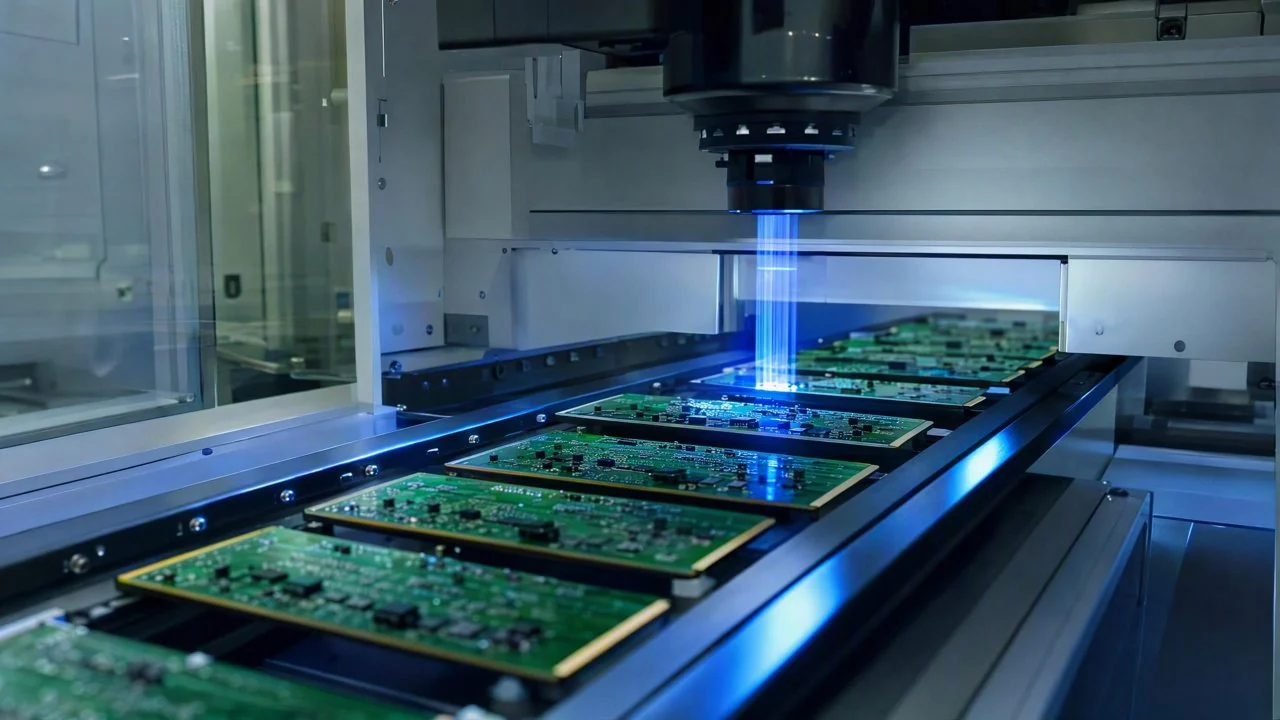
DaoAI 2D ACI equipment (high-resolution 2D imaging + deep learning secondary judgment, targeting surface/print/OCR/assembly defects, high-speed online full inspection, micron-level, semantic false positive filtering), with its innovative 0-code quick changeover and high-mix low-volume production optimization capabilities, successfully reduced PCBA gold finger scratch and oxidation defect detection changeover time for a mid-sized electronics manufacturer from a traditional 30 minutes to under 5 minutes. This significantly enhanced production line flexibility and overall efficiency. In the electronics manufacturing industry, particularly in PCBA production, gold fingers are critical connection interfaces whose surface quality directly impacts product performance and reliability. However, in high-density, high-mix low-volume (HMLV) production models, traditional inspection solutions often suffer from inefficiencies, high false positive rates, and heavy reliance on manual intervention when facing frequent changeovers, severely limiting production rhythm and cost control.
In the electronics manufacturing industry, PCBA (Printed Circuit Board Assembly) serves as a core component, and its quality directly determines the performance and reliability of end products. Among them, gold fingers are interfaces on PCBAs used to connect external devices. Due to their high conductivity and wear resistance requirements, surface defects such as scratches, oxidation, and contamination can lead to poor contact, subsequently causing product functional failure. With the increasing demand for rapid product iteration and customization in consumer electronics, industrial control, and automotive electronics, electronics manufacturing is transitioning to a high-mix low-volume (HMLV), fast-response market model. This demands extremely high flexibility and quick changeover capabilities from production lines. For gold finger inspection, traditional solutions often entail significant time for program adjustments and parameter calibration when encountering different PCBA models and layouts, severely impacting production efficiency and cost control. Therefore, introducing efficient, intelligent, and quick-changeover automated inspection solutions is a critical issue that electronics manufacturers urgently need to address.
Pain Points: Why This Hurdle Is Difficult to Overcome
In the high-mix low-volume PCBA gold finger inspection scenario, traditional solutions face multiple challenges. Firstly, **long changeover downtime** is a major issue. Production line data from a mid-sized electronics manufacturer showed that each time a PCBA model was switched, traditional AOI equipment required at least 30 minutes for program debugging, light source adjustment, and parameter optimization, leading to a significant drop in line efficiency and severely impacting the overall production rhythm. Secondly, **difficulty balancing missed detection and false positive rates**. Micron-level scratches, slight oxidation, or tiny particles on gold fingers are easily missed under complex backgrounds and reflective interference. Traditional rule-based AOI struggles to accurately identify such subtle defects, with actual missed detection rates often exceeding 1.5%. To reduce missed detections, sensitivity is increased, but this leads to soaring false positive rates, with production data showing false positive rates sometimes exceeding 10%, resulting in numerous good products being misjudged and increasing unnecessary re-inspection labor. Furthermore, **limited detection accuracy** means traditional vision systems lack the ability to identify minute burrs or uneven plating at the gold finger edges, failing to meet the micron-level defect detection requirements for high-end products. Finally, **high manual re-inspection costs**. Faced with high false positives and complex defects, significant manual labor is required for re-inspection, further increasing operational costs and human resource burden.
The root cause of these pain points lies in the complexity of gold finger inspection. Gold finger surfaces are typically gold-plated, exhibiting high reflectivity, which can cause specular reflections and glare, interfering with image acquisition. Simultaneously, defects such as scratches and oxidation vary in morphology and are microscopic, with subtle differences from normal textures. Especially under varying batch, supplier base material, and plating processes, visual features can subtly change, making it difficult for traditional threshold- or feature-matching algorithms to establish robust, generalized models. In high-mix low-volume production, lines require frequent product switching. Traditional solutions demand professional engineers to spend considerable time reprogramming and adjusting parameters for each changeover, making quick, automated adaptation to new products impossible. This over-reliance on manual experience and time-consuming parameter tuning constitutes an insurmountable barrier.
Technical Principles
DaoAI 2D ACI equipment fundamentally solves the challenges of gold finger defect detection, particularly in terms of quick changeover and multi-product adaptability, by combining high-resolution 2D imaging technology with a deep learning secondary judgment mechanism. The equipment utilizes industrial-grade high-resolution cameras and customized multi-angle annular lighting, capable of capturing clear, detail-rich images of the gold finger surface, effectively suppressing reflective interference, and ensuring the visibility of micron-level defects. Its core lies in the proprietary DaoAI ACI OS operating system, which integrates a visual foundation model with powerful feature recognition and generalization capabilities. When faced with a new PCBA model, engineers only need to provide 1-20 good samples. The system then uses APDT (Active Positive Data Training) for positive/few-shot learning to automatically complete model training and parameter optimization within 5 minutes, without requiring any code. This enables DaoAI 2D ACI to achieve true 0-code quick changeover.
Compared to traditional rule-based AOI, DaoAI 2D ACI's deep learning secondary judgment mechanism offers significant advantages. Traditional AOI relies on manually set thresholds and geometric rules, which have poor recognition capabilities for complex and varied defect morphologies, often leading to numerous false positives or missed detections. In contrast, DaoAI 2D ACI uses deep neural networks for semantic understanding of images, capable of learning and distinguishing subtle differences between normal textures, production process marks, and actual defects on gold fingers. For instance, even slight scratches, oxidation spots, or subtle color variations caused by the manufacturing process can be identified with high precision by this system. More importantly, the semantic false positive filtering function built into DaoAI 2D ACI intelligently identifies and filters out non-defect background noise or process features, thereby significantly reducing the false positive rate. Furthermore, DaoAI 2D ACI equipment supports 100% on-premise private deployment, ensuring customer data security and autonomous control over the production process.
Typical Application Scenarios
- **Gold Finger Scratch Detection**: Detects micro-scratches and abrasions on the gold finger surface caused during insertion/removal, transportation, or manufacturing. The difficulty lies in scratches often being thin, long, and unevenly reflective, making them prone to missed detection or misidentification of normal textures by traditional methods. DaoAI 2D ACI precisely identifies the geometric features and depth information of scratches through high-resolution imaging and deep learning models.
- **Gold Finger Oxidation/Contamination Detection**: Identifies oxidation discoloration, corrosion spots, or attached foreign objects (e.g., dust, grease) on the gold finger surface due to environment, storage, or poor contact. The challenge is that oxidation layers often have subtle color changes, and contaminants vary widely in form. DaoAI 2D ACI can capture subtle color and texture differences for high-precision identification.
- **Gold Finger Plating Defect Detection**: Checks for defects such as bubbles, uneven plating, or exposed copper on the gold finger plating. These defects can lead to reduced conductivity. DaoAI 2D ACI, with its micron-level detection accuracy, can effectively discover these microscopic defects.
- **Character OCR and Identification**: Beyond surface defects, DaoAI 2D ACI can also perform OCR on batch numbers, model codes, and other characters near the gold fingers to verify information correctness and prevent material mix-ups. The difficulty lies in characters potentially being printed on reflective surfaces, or being deformed or incomplete. DaoAI ACI OS's character recognition capabilities offer strong robustness.
- **PCBA Surface Foreign Objects and Assembly Omissions**: Extends detection to the PCBA surface beyond the gold finger area, checking for solder balls, solder paste residue, component misalignment, missing components, or incorrect components. DaoAI 2D ACI's comprehensive visual inspection capabilities cover various defect types on planar surfaces, ensuring overall PCBA quality.
Implementation Case Study
A mid-sized electronics manufacturer specializing in customized electronic products operates primarily on a high-mix, low-volume production model, switching between more than a dozen PCBA product models weekly. Before introducing DaoAI 2D ACI equipment, this manufacturer's gold finger inspection relied mainly on traditional AOI equipment and extensive manual re-inspection. Production line data showed that each product changeover required engineers to manually adjust AOI programs and light source parameters, averaging about 30 minutes. Furthermore, traditional AOI had a high false positive rate of around 8% for slight scratches and oxidation spots on gold fingers, leading to an additional 2 inspectors spending 4 hours daily on manual re-inspection, severely slowing down the overall production rhythm. Manual re-inspection also carried a risk of missed detections, with an actual missed detection rate of approximately 0.8%.
After the DaoAI 2D ACI equipment was deployed, the factory's gold finger inspection changeover time was sharply reduced from 30 minutes to 5 minutes, and the false positive rate decreased by 82%, significantly enhancing production line flexibility and efficiency.
After introducing DaoAI 2D ACI equipment, the manufacturer's production efficiency significantly improved. With the 0-code quick changeover capability provided by the DaoAI ACI OS operating system, engineers only needed to import good samples of new products. The system automatically completed model training and deployment within 5 minutes, drastically shortening changeover downtime. Concurrently, DaoAI 2D ACI's deep learning secondary judgment and semantic false positive filtering functions reduced the false positive rate for gold finger scratches and oxidation defects from 8% to <1.5%, greatly reducing the workload for manual re-inspection. In this case, the missed detection rate was also stably controlled below <0.2%. Production line data showed that after deployment, approximately 3.5 hours of manual re-inspection time were saved daily, equating to tens of thousands of yuan in labor cost savings annually. Moreover, the improved detection rate and reduced false positive rate effectively prevented defective products from flowing out, enhancing product quality and customer satisfaction.
DaoAI Solutions and Products
DaoAI provides an intelligent solution for PCBA gold finger defect detection, centered around its 2D ACI equipment. This equipment integrates a high-resolution 2D camera, customized lighting modules, and a powerful edge computing unit, capable of high-speed online image acquisition and real-time analysis. Its core advantage lies in the DaoAI ACI OS operating system, a culmination of DaoAI's years of experience in industrial vision, featuring a built-in visual foundation model with powerful generalization capabilities. For planar defects like gold finger scratches and oxidation, DaoAI ACI OS can leverage APDT positive/few-shot learning technology, requiring only 1-20 good samples to complete 0-code model programming within 5 minutes. This means customers do not need professional AI algorithm expertise to easily handle the frequent changeover demands of high-mix low-volume production.
In terms of deployment, DaoAI 2D ACI equipment supports flexible integration, allowing for customized installation based on the customer's existing production line layout, achieving integration with existing automation equipment. The system provides SDK/API interfaces for easy data exchange with MES/ERP systems, building a complete quality traceability system. Furthermore, DaoAI 2D ACI supports 100% on-premise private deployment, ensuring absolute security of customer production data. Combined with the semantic understanding and cross-scenario generalization capabilities of DaoAI World's unified foundation model, the 2D ACI equipment continuously learns and optimizes from production line feedback, further enhancing the robustness and accuracy of detection models. The DaoAI 2D ACI solution not only solves the precision and efficiency issues of gold finger detection but also, through its unique 0-code quick changeover capability, enables customers to achieve flexible and intelligent upgrades of their production lines, significantly enhancing market competitiveness.
FAQ
How does DaoAI 2D ACI equipment achieve 0-code quick changeover?
DaoAI 2D ACI equipment is equipped with the DaoAI ACI OS operating system, which includes a visual foundation model. Utilizing APDT positive/few-shot learning technology, it only requires 1-20 good samples for the system to automatically complete model training and parameter optimization within 5 minutes, without manual programming. This enables 0-code quick changeover, significantly boosting efficiency for high-mix low-volume production.
What are the false positive and missed detection rates of DaoAI 2D ACI equipment in gold finger inspection?
In real-world applications, DaoAI 2D ACI equipment, through its deep learning secondary judgment and semantic false positive filtering functions, can reduce the false positive rate for gold finger scratches and oxidation defects from 8% to <1.5%, with the missed detection rate stably controlled below <0.2%. This significantly outperforms traditional inspection solutions, effectively reducing manual re-inspection and improving product quality.
What is the budget and timeline for deploying DaoAI 2D ACI equipment?
The budget and deployment timeline for DaoAI 2D ACI equipment depend on specific production line environments, inspection requirements, and integration complexity. We offer flexible, customized solutions and support 100% on-premise private deployment. We recommend contacting our sales engineers for a detailed solution and precise quotation; deployment typically takes several weeks to complete.
Full solution for this scenario: 2D ACI Equipment industry solutions · Gold Finger Scratch & Oxidation Detection
This article was generated by AI. Customer cases are simulated scenarios based on real product capabilities and figures are illustrative; see product pages for official benchmarks.