
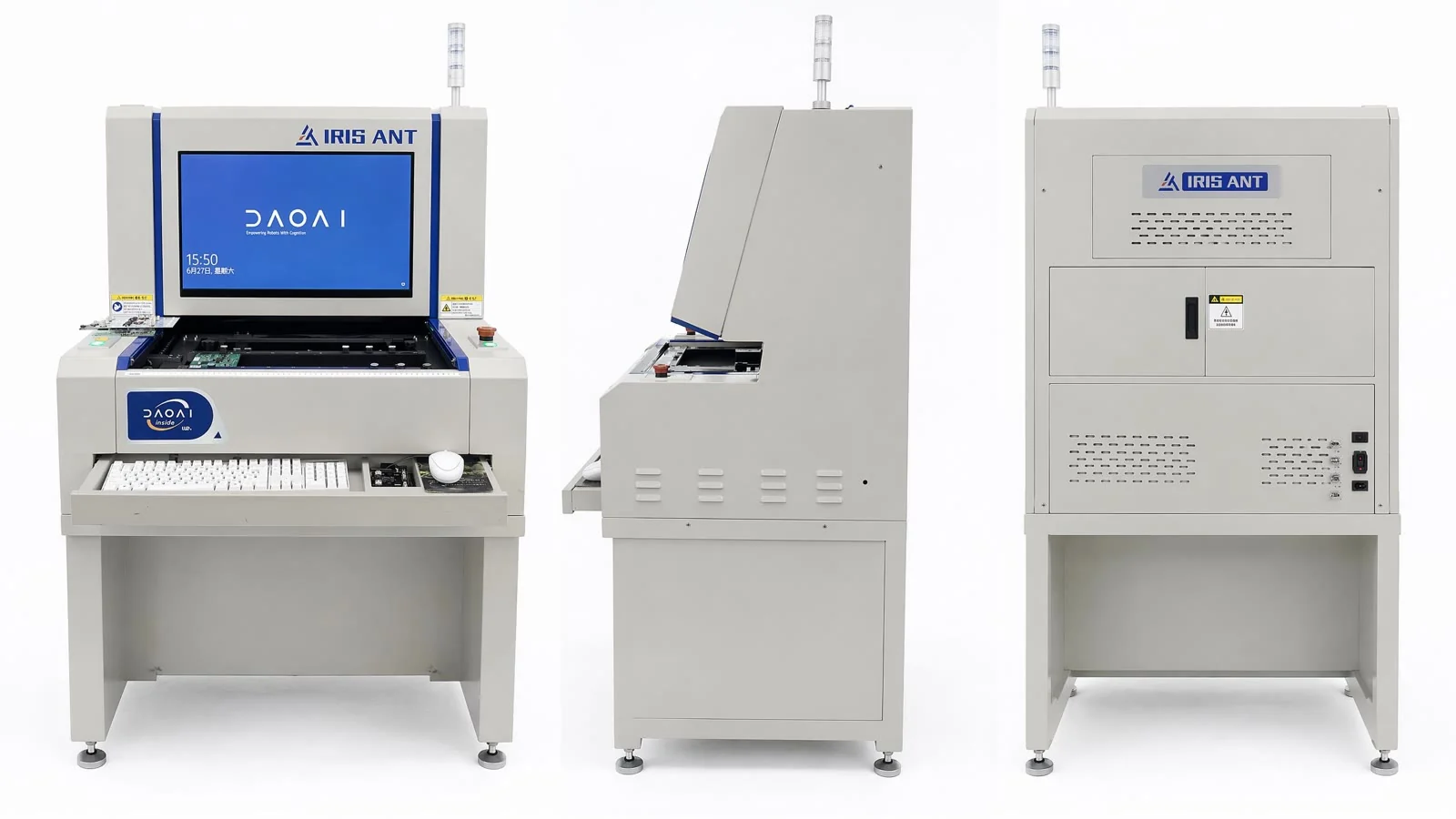
DaoAI 2D ACI equipment (high-resolution 2D imaging + deep learning re-inspection, targeting planar defects such as surface/printing/OCR/assembly omissions, high-speed online full inspection, micron-level, semantic false alarm filtering) fundamentally breaks the quality traceability efficiency bottleneck under traditional manual inspection for PCBA gold finger scratches and oxidation defects, significantly improving product yield and compliance through precise identification and data closure.
ACI in this article stands for Auto Cognitive Inspection — the next-generation term for AI AOI: keep the A and the I, and replace the O (optical) with C (cognitive), because the decision basis is cognition rather than the imaging method. The full argument is set out in From AI AOI to ACI.
The electronics / PCBA industry's relentless pursuit of product quality is ongoing. Among critical interconnects, gold fingers are particularly susceptible to surface defects like scratches and oxidation, which directly impact electrical performance and reliability. In the context of high-speed, high-volume production, efficient and precise detection of these micron-level defects, coupled with the establishment of a traceable and analyzable quality data closed-loop, presents a severe challenge. Traditional sampling or manual inspection methods fall short in terms of detection accuracy, efficiency, and data management for modern electronic manufacturing. Especially with the trend towards zero-defect manufacturing and predictive maintenance, real-time feedback and data traceability are crucial for improving product quality and production efficiency. DaoAI 2D ACI equipment is designed to address these core issues, offering a new solution for PCBA gold finger defect detection through advanced vision technology and deep learning capabilities.
Pain Points: Why This Hurdle Is Difficult to Overcome
Detecting scratches and oxidation defects on PCBA gold fingers faces multiple challenges. Firstly, the micron-level nature of these defects makes them highly susceptible to missed detection during traditional manual inspection, with missed detection rates potentially reaching 5%–10% in certain sub-processes on high-throughput lines. Secondly, the highly reflective surface of gold fingers, combined with diverse and fuzzy defect morphologies like scratches and oxidation, leads to high false alarm rates in traditional rule-based AOI systems. Production line data shows that a certain Tier-1 supplier's traditional AOI solution had false alarm rates exceeding 15%, resulting in numerous defect-free products being misidentified and increasing manual re-inspection time. Furthermore, root cause analysis and quality traceability for defects lack effective data support. When batch quality issues arise, it is difficult to quickly pinpoint the problematic batch, process, or even specific equipment, leading to high rework costs and significantly increased compliance risks. Moreover, traditional solutions lack automated data collection and analysis capabilities, hindering effective real-time feedback and predictive maintenance, thus impeding quality improvement and production efficiency optimization.
The root cause of these difficulties lies in the extremely thin gold finger plating layer, where even slight mechanical contact can cause scratches, and environmental factors like atmospheric sulfides and humidity can lead to oxidation. These defects manifest optically as subtle changes in color, texture, and reflectivity, posing significant challenges for traditional AOI algorithms based on thresholds or feature extraction. Additionally, high production throughput demands that inspection systems complete image acquisition and analysis within extremely short timeframes, while also accommodating subtle variations between product batches, which places stringent requirements on system robustness and adaptability.
Technical Principles
DaoAI 2D ACI equipment fundamentally solves the challenge of gold finger defect detection by integrating high-resolution 2D imaging systems with advanced deep learning algorithms. Its core mechanism involves: first, utilizing customized high-resolution industrial cameras and precise lighting solutions to capture micron-level defect images such as scratches, oxidation, and dirt on the gold finger surface, ensuring that image quality meets the high standards required for deep learning model training. Second, the visual foundation model embedded in the DaoAI ACI OS operating system possesses powerful feature recognition capabilities, enabling rapid learning of normal gold finger visual characteristics from extremely few good samples (1–20 good samples), achieving 0-code automatic programming in 5 minutes. For complex and diverse defect morphologies, the system employs APDT positive/few-shot learning technology, combined with defect samples for iterative optimization, effectively improving the detection rate. In practical applications, DaoAI 2D ACI equipment achieves a cold start detection accuracy of 98%, and after online iteration, the detection rate can reach 99.99%.
Compared to traditional rule-based AOI, the advantage of DaoAI 2D ACI lies in its deep learning-based secondary inspection capability. Traditional AOI relies on manually set rules and thresholds, which are highly prone to false alarms for components with complex surface characteristics like gold fingers, due to factors such as ambient light, material reflection, or subtle texture differences. DaoAI's deep learning model, however, can learn the “semantic” features of defects, distinguishing true defects from background noise, and significantly reducing false alarm rates through semantic false alarm filtering technology. Furthermore, traditional manual inspection is limited by human eye fatigue and subjective judgment, being inefficient and inconsistent. DaoAI 2D ACI equipment provides high-speed, stable, and objective online full inspection capabilities, with a single judgment latency as low as 12 milliseconds, ensuring quality control on high-throughput production lines and providing a reliable data source for subsequent quality traceability and data closure.
Typical Application Scenarios
- **Gold Finger Scratch Detection**: During PCBA assembly or testing, gold finger surfaces may develop minute scratches due to mechanical friction or improper handling. DaoAI 2D ACI, through high-resolution imaging, can clearly capture these micron-width scratches and use deep learning models to accurately distinguish them from normal textures, avoiding missed detections and false alarms.
- **Gold Finger Oxidation/Contamination Detection**: Gold fingers may oxidize, discolor, or become contaminated due to exposure to air, moisture, or pollutants during storage, transportation, or production. DaoAI 2D ACI can identify these subtle changes in color, gloss, or texture, determining if they constitute defects, thereby ensuring the reliability of electrical connections.
- **Character OCR and Printing Defects**: Batch numbers, manufacturer logos, and other characters or printed markings are often found on or near gold finger areas. DaoAI 2D ACI can perform high-precision OCR recognition to verify character integrity and accuracy, and detect printing defects such as ink spots, broken lines, or misalignment, ensuring correct product identification.
- **Solder Pad and Pin Coplanarity (Auxiliary for Planar Defects)**: While 2D ACI primarily targets planar defects, for solder pads or pins in the gold finger area, DaoAI 2D ACI can provide auxiliary detection for macroscopic planar defects such as flatness or deformation, identifying abnormal morphological changes and offering preliminary screening for backend 3D inspection.
- **Assembly Omissions and Misalignments**: In the area surrounding gold fingers, small components like resistors and capacitors may be assembled. DaoAI 2D ACI can detect the presence, position, and orientation of these components, ensuring assembly accuracy and preventing electrical failures due to omissions or misalignments.
Case Study
A leading Tier-1 PCBA supplier, whose main products are high-end server motherboards, found that its traditional manual inspection and rule-based AOI solutions could no longer meet its growing quality traceability demands for gold finger production due to the high value of the products and stringent reliability requirements. Before implementation, the supplier faced significant challenges: a high rate of missed gold finger scratch and oxidation defects, and an inability to quickly and accurately trace defects back to specific production batches, equipment parameters, and operators once discovered. This resulted in lengthy quality analysis cycles and high rework costs. Traditional paper records or fragmented data systems made data closure an impossible dream. To address this pain point, the supplier introduced DaoAI 2D ACI equipment and deployed it at the inspection stage after gold finger plating.
With DaoAI 2D ACI, we can finally monitor the quality status of every PCBA gold finger in real-time and establish comprehensive quality archives, laying a solid foundation for our zero-defect manufacturing goals.
After implementation, the DaoAI 2D ACI system achieved 100% online full inspection of gold finger defects. The most significant change was in quality traceability efficiency: when a gold finger defect was reported in a final product, the system, through its powerful data management module, could quickly locate all inspection data, image records, and even associated production parameters for that defective product during its manufacturing process. What previously took hours or even days of manual investigation could now be completed in minutes. Furthermore, the defect data recorded by the DaoAI 2D ACI system enabled the factory to continuously optimize its production processes, effectively reducing the incidence of gold finger scratches and oxidation. While specific false alarm rate data cannot be disclosed due to confidentiality agreements, after deployment, the workload for manual re-inspection shifted from individually re-inspecting every product flagged by the system to only confirming a small number of defects marked with high confidence by the system. This greatly reduced the burden on quality inspection personnel, allowing them to focus more on process improvement and preventive maintenance. In this case, DaoAI 2D ACI equipment successfully helped the client transition from reactive to proactive quality control, achieving a complete data closed-loop from defect discovery to root cause analysis.
The figures above are a typically achievable range in anonymized industry scenarios — a different line or a different batch of parts will move the result either way; on-site measurement governs.
DaoAI Solutions and Products
DaoAI, with its 2D ACI equipment as the core, provides a comprehensive solution for PCBA gold finger defect detection. This equipment integrates DaoAI's self-developed high-performance hardware platform and the DaoAI ACI OS operating system, ensuring stable operation in complex industrial environments. For modeling and changeover, the DaoAI ACI OS operating system supports zero-code configuration, allowing detection tasks to be created and parameters adjusted through a simple graphical interface. For new products or defect types, only a small number of good samples are needed, and the system can complete model training within 5 minutes, achieving rapid changeover and greatly reducing production line downtime. The deployment of DaoAI 2D ACI equipment is flexible, supporting various integration modes such as SDK/API/Docker, and can be 100% locally privatized, ensuring customer data security with detection images never leaving the factory. Furthermore, through connection to the unified foundation of the DaoAI World model, DaoAI 2D ACI possesses continuous learning and cross-scenario generalization capabilities, constantly optimizing model performance from production line feedback and enhancing detection robustness.
The quantifiable results and business value brought by the DaoAI 2D ACI solution are significant. The system not only boosts the detection rate of gold finger defects to an industry-leading level (up to 99.99% after online iteration) but also effectively reduces the false alarm rate through semantic false alarm filtering, thereby decreasing unnecessary re-inspection time. In actual production lines, customer data indicates a significant reduction in the false alarm rate for gold finger inspection and a decrease in manual re-inspection volume, which substantially lowers the cost of production line downtime per hour. More importantly, the complete quality traceability chain built by DaoAI 2D ACI equipment deeply links defect data with the production process, enabling a shift from “defect discovery” to “defect prevention,” advancing the zero-defect manufacturing process. This comprehensive data closed-loop capability not only enhances product quality and customer satisfaction but also provides enterprises with a competitive edge in a fierce market, aligning with the current industry trend of AI vision inspection technology improving product quality and production efficiency through real-time feedback and predictive maintenance.
FAQ
How does DaoAI 2D ACI equipment ensure micron-level accuracy in gold finger scratch detection?
DaoAI 2D ACI equipment achieves micron-level accuracy by integrating high-resolution industrial cameras and optimized optical imaging systems, capable of capturing minute scratch details on gold finger surfaces. Coupled with deep learning algorithms, the system precisely identifies and locates these subtle defects, far exceeding human visual capabilities, ensuring high-precision detection.
How does DaoAI 2D ACI's quality traceability and data closed-loop function help companies reduce costs?
The DaoAI 2D ACI system records detailed data and images for each inspected product in real-time. When defects occur, it can quickly trace back to the production batch, process, and equipment parameters. This significantly shortens problem analysis time, reduces batch rework and scrap caused by untraceable issues, thereby effectively lowering production costs and compliance risks.
What is the budget required to deploy DaoAI 2D ACI equipment, and what factors influence the quotation?
The specific quotation for DaoAI 2D ACI equipment is influenced by various factors, including production line speed, inspection area, required detection accuracy, integration complexity, and whether customized functions are needed. We recommend contacting our sales team with your specific requirements for a detailed customized solution and quotation.
Full solution for this scenario: 2D ACI Equipment industry solutions · Gold Finger Scratch & Oxidation Detection
This article is an original publication by WeLinkirt (DaoAI). Under customer confidentiality, cases are anonymized industry scenarios and figures are illustrative; see product pages for official benchmarks.