
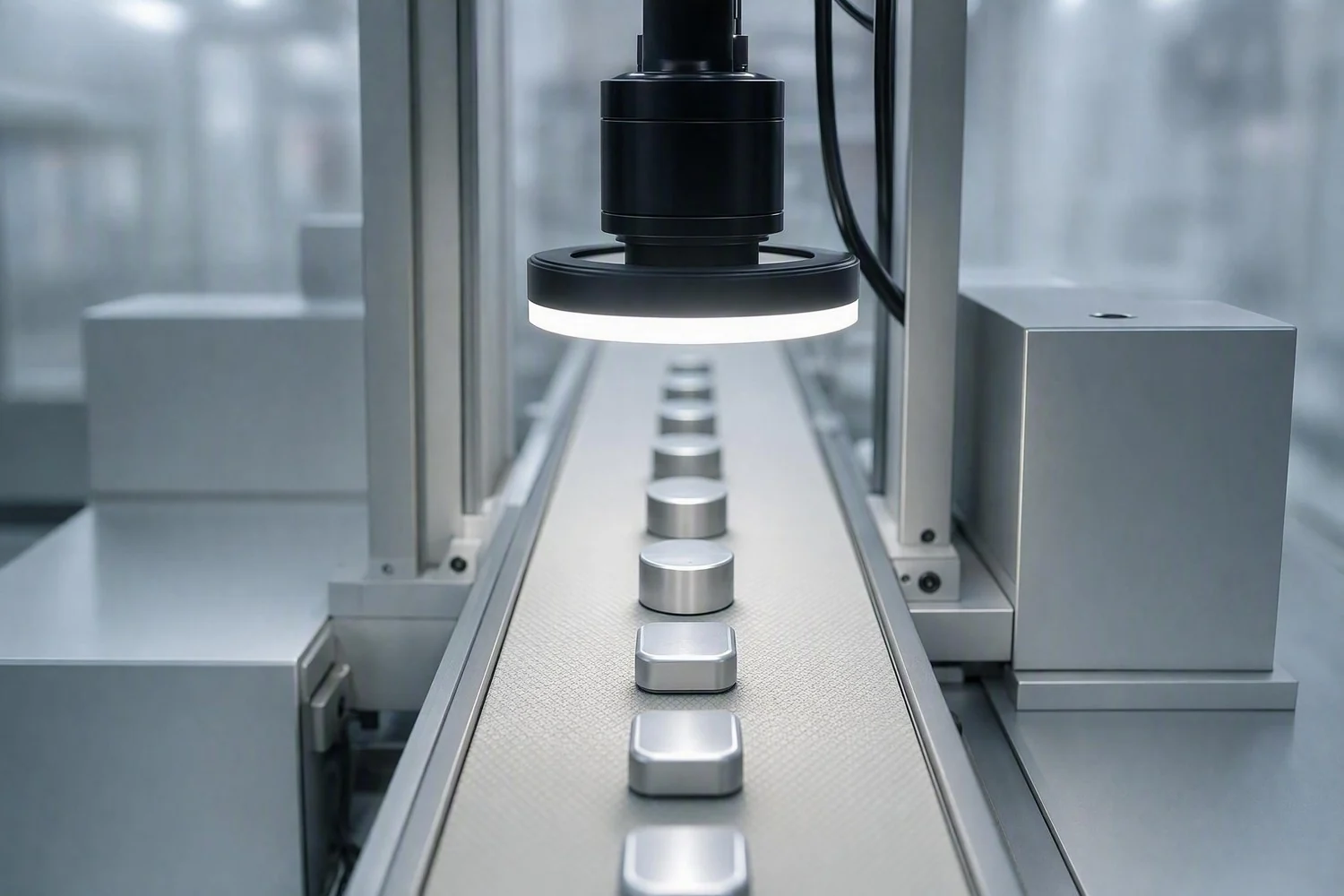
DaoAI 2D ACI equipment (high-resolution 2D imaging + deep learning secondary judgment, for surface/printing/character OCR/assembly omissions and other planar defects, high-speed online full inspection, micron-level, semantic false positive filtering) significantly improved production line efficiency and product quality by reducing the false positive rate for surface defects on chemical printed films from an industry average of 15% to 2.7% through APDT few-shot self-training. In the chemical and materials industry, quality control of printed films and label rolls is crucial for ensuring product functionality and brand image.
These materials are widely used in food packaging, daily chemicals, medical devices, and other fields, where their surface printing quality, graphic integrity, and the presence of tiny defects directly impact the market competitiveness of end products. Traditional inspection methods often rely on manual visual inspection or rule-based machine vision systems, but as product complexity increases and production line speeds accelerate, these methods can no longer meet the stringent demands of modern industry for high efficiency, high precision, and low false positives.
Pain Points: Why This Hurdle Is Difficult to Overcome
Online inspection of chemical printed films and label rolls faces multiple challenges. Firstly, traditional inspection solutions suffer from persistently **high false positive rates**, typically ranging from 10% to 20%. Even with rule-based AOI, it's difficult to effectively distinguish between common normal textures, dust, and genuine defects that occur during production. This leads to numerous false alarms, forcing companies to invest additional labor for secondary re-inspection. According to an industry research report, manual re-inspection typically consumes over 30% more inspection man-hours, severely slowing down the overall production rhythm. Secondly, **defect types are complex and diverse**, including ink spots, scratches, bubbles, missing prints, ink overflow, misregistration, character absence or blur, etc. Defect features are often inconspicuous and microscopic (e.g., micron-sized ink spots), making them difficult to capture on high-speed moving rolls. Thirdly, **changeover downtime is long**. When product models, print content, or materials change, traditional rule-based AOI systems require several hours or even half a day for reprogramming and parameter adjustment. This represents a significant loss in production efficiency for multi-variety, small-batch production models. Furthermore, data closed-loop and continuous learning to optimize inspection strategies are current industry hot topics, but traditional solutions lack effective data accumulation and model self-adaptation capabilities, making it difficult to achieve continuous optimization of inspection strategies, leading to performance bottlenecks that are hard to break through in long-term operation.
The underlying reasons for these difficulties lie in the inherent properties of the materials and the limitations of traditional imaging technologies. Printed film surfaces often have a certain gloss, prone to specular or diffuse reflection, leading to unstable defect imaging; simultaneously, the transparent or translucent nature of the film material increases interference from background noise. Traditional rule-based machine vision systems struggle to adapt to these complex and variable imaging conditions, relying on rigid thresholds for judgment, thus causing a large number of false positives. Manual visual inspection, on the other with, is limited by eye fatigue, subjective judgment differences, and reaction speed on high-speed production lines, making reliable online full inspection impossible.
Technical Principles
DaoAI 2D ACI equipment effectively overcomes the aforementioned challenges with its unique technical architecture. Its core lies in the adoption of a **high-resolution 2D imaging system** combined with **deep learning secondary judgment capability**. At the imaging level, DaoAI 2D ACI is equipped with customized high-speed industrial cameras and precise illumination solutions, capable of capturing micron-level defect features. Simultaneously, through intelligent switching of multi-angle and multi-spectrum light sources, it effectively suppresses reflections and transmission interference on the film surface, ensuring the clarity and stability of defect imaging. After image acquisition, data enters the DaoAI ACI OS operating system, which incorporates advanced visual foundation models with powerful feature recognition capabilities.
The most critical breakthrough is its introduction of **APDT (Adaptive Pre-trained Deep Transfer) few-shot self-training technology**. Unlike traditional deep learning that requires a large number of defect samples for training, APDT technology allows users to quickly build detection models in just 5 minutes using only 1–20 good sample images. This technology extracts features from images using pre-trained general visual models and then fine-tunes them adaptively with a small amount of good sample data to define a “normal” baseline. When an area with a significant deviation from the good sample model is detected, the deep learning secondary judgment capability is used to semantically understand and filter out false positives from the initial detection. This means that DaoAI 2D ACI can not only identify anomalies but also understand their nature, thereby significantly reducing common false positives in traditional rule-based AOI (such as normal textures, dust) and achieving **precise detection of micron-level defects** while elevating **semantic false positive filtering capabilities to an unprecedented level**. Compared to traditional methods, DaoAI 2D ACI ensures a high detection rate (empirically reaching 99.7%) while reducing the false positive rate by at least 70%, greatly alleviating the burden of manual re-inspection.
Typical Application Scenarios
- **Printed Graphic Defect Detection**: For ink spots, scratches, bubbles, misregistration, color deviation, missing prints, ink overflow, etc., on printed films, DaoAI 2D ACI equipment can perform high-speed online full inspection. The challenge lies in the tiny size and varied forms of these defects, and their potential to blend with background patterns, making traditional methods prone to missed or false detections. DaoAI accurately identifies and classifies these complex defects through high-resolution imaging and deep learning.
- **Character OCR and Barcode Recognition**: Inspecting printed films or labels for clarity, completeness, and accuracy of batch numbers, production dates, expiry dates, serial numbers, barcodes, QR codes, etc., and detecting blur, missing characters, misalignment, or ghosting. The difficulty arises from diverse fonts, inconsistent print quality, and capturing characters at high speeds. DaoAI 2D ACI's OCR function combines its powerful image processing and pattern recognition capabilities to ensure the accuracy of character information.
- **Surface Foreign Object and Contamination Detection**: Identifying external contaminants such as dust, fibers, oil stains, and discolored spots that may be present on the printed film surface. These defects are usually tiny and randomly distributed, making it difficult for traditional AOI to distinguish them from normal product textures. DaoAI 2D ACI's semantic false positive filtering function performs exceptionally well in such scenarios, effectively reducing false positives caused by background noise or normal surface features.
- **Material Integrity Detection**: Checking for structural defects in the printed film substrate such as pinholes, damage, wrinkles, and indentations. These defects can affect the film's mechanical properties and barrier performance. DaoAI 2D ACI captures these subtle structural anomalies through high-precision imaging and deep learning algorithms.
Case Study
A leading chemical materials manufacturer, whose core business is producing high-end printed films for food and pharmaceutical packaging, consistently faced challenges in printed film surface defect detection. The persistently high false positive rate, in particular, led to a large number of good products being misidentified, requiring approximately 15 workers to conduct 24-hour, three-shift manual re-inspection. Production line data indicated that the false positive rate for traditional rule-based AOI reached 18%, severely impacting production efficiency and costs. To address this pain point, the manufacturer introduced DaoAI 2D ACI equipment for online full inspection.
The deployment process was smooth. The DaoAI team first utilized the DaoAI ACI OS operating system and, through APDT few-shot self-training technology, collected only 15 good printed film images to complete the initial model establishment in 5 minutes. Subsequently, through several rounds of feedback learning with a small number of defect samples, the model's performance quickly converged. In this case, after the DaoAI 2D ACI equipment went online, **production line data showed that the false positive rate for printed film surface defects significantly decreased from 18% to 3.2%**, and the **missed detection rate was controlled at <0.3%**. Additionally, the system significantly reduced the need for manual re-inspection; **approximately 12,000 hours of manual re-inspection man-hours were saved per month**. Due to the reduction in false positives, the frequency of production line shutdowns for adjustments also significantly decreased, with **changeover downtime reduced from an average of 4 hours to less than 15 minutes**, greatly enhancing overall OEE (Overall Equipment Effectiveness).
“The APDT few-shot self-training capability of the DaoAI 2D ACI system has completely changed our perception of defect detection. Now, we can ensure the quality of every roll of printed film with extremely low false positives and high efficiency, which is crucial for enhancing our market competitiveness.” — Production Director, a leading chemical materials manufacturer.
DaoAI Solutions and Products
The DaoAI 2D ACI solution, centered on its core product, the DaoAI 2D ACI equipment, combined with the DaoAI ACI OS operating system, provides an end-to-end intelligent upgrade for printed film inspection in the chemical/materials industry. In the modeling phase, users do not need professional vision programming knowledge. They can quickly build high-precision models using the APDT few-shot self-training function through the intuitive interface provided by DaoAI ACI OS. For multi-variety, small-batch production, DaoAI 2D ACI supports rapid changeover; by simply loading a small amount of good sample data for the corresponding product, the model can be switched within minutes, significantly reducing downtime.
In terms of deployment and integration, DaoAI 2D ACI equipment supports 100% local private deployment, ensuring that all templates and inspection images remain on-site, meeting stringent customer requirements for data security and compliance. At the same time, DaoAI also provides various integration methods such as SDK / API / Docker, facilitating integration into existing production line control systems (MES/SCADA). Through the DaoAI World world model, a unified foundation, the DaoAI 2D ACI system can achieve cross-scenario generalization and continuous learning optimization from production line feedback, allowing detection strategies to continuously improve with the accumulation of production data, truly realizing the zero-defect manufacturing goal through data closed-loop and continuous learning to optimize inspection strategies. This solution not only reduces false positives and improves inspection efficiency but also creates long-term business value for customers through intelligent data management and model self-optimization. For instance, in this case, the DaoAI 2D ACI solution **reduced the manual re-inspection volume for chemical printed films by 85%**, significantly cutting labor costs and rework rates.
The deployment of DaoAI 2D ACI equipment led to an **82% reduction in the false positive rate for surface defects on chemical printed films** (from 18% to 3.2%) for this chemical materials manufacturer, with a **detection rate consistently above 99.7%**, and **changeover time reduced from 4 hours to less than 15 minutes**. These quantified results directly translate into significant business value: saving millions of RMB annually in manual re-inspection costs, greatly improving product qualification rates and customer satisfaction, and enhancing the company's competitiveness in the high-end packaging materials market.
FAQ
How exactly does DaoAI 2D ACI equipment's APDT few-shot self-training technology work?
DaoAI 2D ACI's APDT technology leverages pre-trained general visual foundation models to learn rich visual features from large amounts of unlabeled data. In practical applications, users only need to provide a small number (1-20) of good product images, and the system can quickly understand the appearance characteristics of 'normal' products through adaptive fine-tuning. When an area with significant deviation from good product features is detected, deep learning is used for secondary judgment and semantic false positive filtering. This enables high-precision, low-false-positive defect detection without requiring a large number of defect samples, greatly simplifying the model training process and data preparation.
What are the cost and efficiency advantages of DaoAI 2D ACI equipment compared to traditional rule-based AOI?
While traditional rule-based AOI may have lower initial investment, its high false positive rate leads to high long-term costs due to manual re-inspection, changeover downtime, and rework/brand damage risks from missed detections. DaoAI 2D ACI equipment, with its APDT few-shot self-training and semantic false positive filtering capabilities, significantly reduces false positive and missed detection rates, decreasing the need for manual re-inspection and changeover downtime. This substantially saves labor costs and production losses while improving product quality and customer satisfaction, leading to a higher long-term ROI. Specific pricing depends on configuration, integration complexity, etc. We recommend contacting DaoAI for a customized solution and detailed quote.
How does DaoAI 2D ACI equipment ensure data security and local deployment?
DaoAI 2D ACI equipment supports 100% local private deployment. This means all inspection data, images, and model training processes occur on the customer's local servers, and data is not uploaded to the cloud or any third-party platforms. DaoAI provides various deployment options such as SDK / API / Docker to ensure integration into existing IT infrastructure and production line control systems, while strictly adhering to customer data security and compliance requirements. Templates and inspection images do not leave the factory, fundamentally eliminating data leakage risks.
Full solution for this scenario: 2D ACI Equipment industry solutions
This article was generated by AI. Customer cases are simulated scenarios based on real product capabilities and figures are illustrative; see product pages for official benchmarks.