
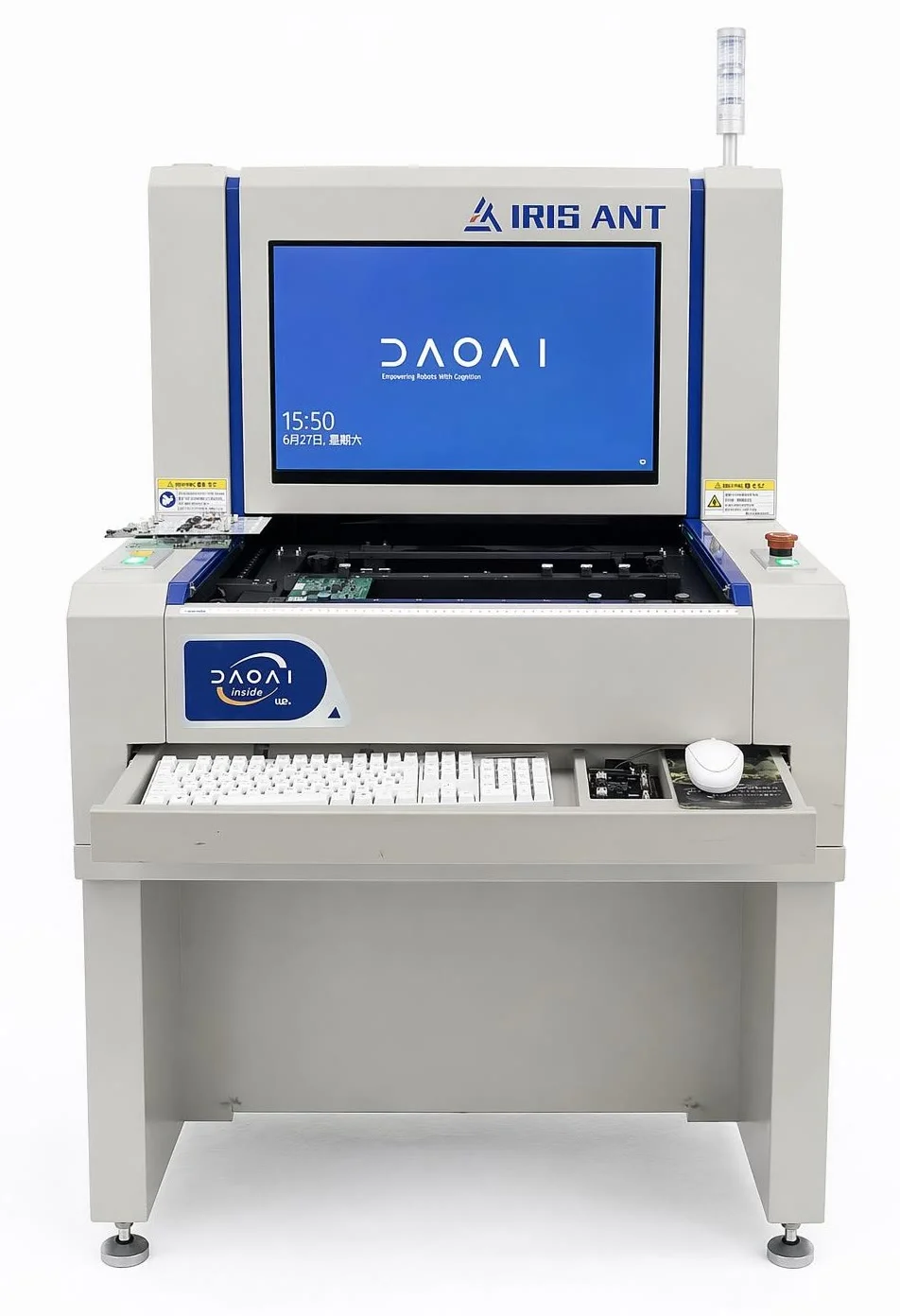
DaoAI 2D ACI equipment (high-resolution 2D imaging + deep learning secondary judgment, targeting surface/print/OCR/assembly defects, high-speed online full inspection, micron-level, semantic false positive filtering) achieves high-precision identification and semantic filtering of complex defects such as minor wrinkles, foreign material inclusions, and uneven heat seals in food packaging. This dramatically reduces missed detections from an average of 1.5% with traditional manual inspection and rule-based AOI to <0.4%, ensuring food safety and brand reputation.
The food industry demands extremely high standards for product quality and safety, with packaging seal integrity being a critical factor in ensuring food safety, extending shelf life, and maintaining product quality. Even a minor seal defect, such as a wrinkle, foreign material inclusion, or uneven heat seal, can lead to product spoilage, leakage, or even food safety incidents. In the dairy product production line of a mid-sized food processing plant, due to the diverse packaging materials and high production pace, traditional manual inspection and threshold-based rule-based AOI (Automated Optical Inspection) struggled to cope with these complex, micron-level seal defects. DaoAI 2D ACI equipment, by combining high-resolution imaging with deep learning for secondary judgment, effectively addressed these pain points, particularly excelling in reducing missed detections and optimizing false positives, thereby enhancing overall inspection reliability and efficiency.
Pain Points: Why This Hurdle Is Hard to Overcome
In the specific process of food packaging seal inspection, traditional solutions face multi-dimensional challenges. Firstly, **missed detection rates remain high**: Production line data indicates that traditional manual inspection methods missed micron-level seal wrinkles and transparent foreign material inclusions at an average rate of over 1.5%. This means for every 100,000 products manufactured, approximately 1,500 potentially unsafe defective products could enter the market, severely threatening consumer health and brand reputation. Secondly, **high false positive rates lead to heavy manual re-inspection burdens**: While rule-based AOI systems can perform initial screening, they are extremely sensitive to non-defect features like lighting variations, packaging material reflections, or minor print imperfections, typically resulting in false positive rates between 8% and 12%. This forced the factory's quality inspectors to spend significant time on manual re-inspection daily, processing thousands of 'suspected defects' per shift, consuming substantial human resources. Furthermore, **high changeover and maintenance costs**: This factory produces various specifications and materials of dairy products. Each time a product batch changes, traditional rule-based AOI systems require 30-60 minutes for parameter adjustment and recalibration, significantly reducing production line uptime. These challenges, similar to the complexity of accurately assessing the State of Health (SOH) and End of Life (EOL) of electric vehicle power batteries during in-service inspection, require both reliable detection results and consideration for production efficiency and cost control, posing a universal industry problem.
The root causes of these difficulties are multifaceted. From a **process perspective**, the heat-sealing process for food packaging inherently has subtle fluctuations, leading to minor unevenness at the seal edges. These non-critical but aesthetically undesirable features are easily misidentified. Concurrently, the transparent or translucent nature of packaging films makes tiny internal foreign objects (such as dust, fibers) difficult to image under conventional lighting. From an **imaging perspective**, traditional cameras struggle to capture micron-level subtle defects on high-speed production lines, and different packaging materials (e.g., matte, glossy, textured) exhibit vast differences in light reflection characteristics, making a single light source inadequate. Moreover, the high product throughput (this line processes approximately 180-220 products per minute) places stringent demands on the real-time processing capabilities of the inspection system. DaoAI 2D ACI equipment is precisely designed to address these underlying issues through comprehensive optimization of its technical approach.
Technical Principles
DaoAI 2D ACI equipment represents a leap forward from traditional solutions in its technical principles. Its core strength lies in combining the dual advantages of **high-resolution 2D imaging** and **deep learning for secondary judgment**. In the imaging phase, DaoAI 2D ACI utilizes customized high-speed industrial cameras and a multi-angle composite lighting system. This system intelligently adjusts illumination strategies based on different packaging materials and defect types, effectively eliminating the imaging blind spots of traditional single-light source systems when dealing with reflective or transparent materials. For instance, for minor wrinkles on seals, it can enhance shadow contrast through specific oblique lighting angles, making them clearly visible in high-resolution images. For internal foreign objects, it can employ transmitted light or polarized light technology to penetrate the packaging film and capture the object's contour information. The DaoAI 2D ACI system can acquire high-quality image data at micron-level resolution, consistently on high-speed production lines.
In the judgment phase, DaoAI 2D ACI is equipped with a deep learning model powered by the Wemio engine, achieving **semantic-level understanding** of defects and **false positive filtering**. Unlike traditional rule-based AOI that relies on manually set thresholds and feature libraries, the deep learning model of DaoAI 2D ACI leverages APDT positive/few-shot learning technology. It can rapidly train a high-precision defect recognition model with only 1-20 good samples. This model not only identifies various defects like seal wrinkles, foreign objects, and uneven heat seals but also distinguishes their 'severity' and 'semantic information.' For example, it can differentiate between minor cosmetic flaws that do not affect sealing integrity and structural defects that genuinely cause leakage, thereby effectively filtering out 8%–12% of non-defective false positives from traditional rule-based AOI. This significantly reduces the rate of human re-inspection. This intelligent judgment capability enables DaoAI 2D ACI equipment to greatly improve inspection efficiency and accuracy while maintaining a high detection rate and substantially reducing unnecessary alarms and manual intervention. This equipment has successfully reduced the missed detection rate to <0.4% in actual production lines.
Typical Application Scenarios
- **Packaging Seal Integrity Detection**: DaoAI 2D ACI equipment can high-speed detect tiny wrinkles, uneven seals, cold welds, unsealed areas, burn-throughs, and foreign materials such as dust, hair, or debris within the heat-sealed area of packaging bags. The challenge lies in the minute size and varied forms of these defects, coupled with the reflective properties of transparent or translucent packaging materials, making differentiation difficult for traditional methods.
- **Label Printing Defects and Position Detection**: For product labels on food packaging, DaoAI 2D ACI can perform comprehensive inspection for color deviation, blurriness, missing print, ink bleed, character defects, as well as skewed, bubbling, or damaged labels. The difficulty stems from complex label patterns, high background interference, and the wide variety of printing defects, requiring high resolution and robust pattern recognition capabilities.
- **Inkjet/Code Content and Quality Inspection (OCR/OCV)**: For production dates, batch numbers, and expiry dates printed or coded on packaging, DaoAI 2D ACI equipment performs OCR (Optical Character Recognition) verification to ensure character integrity, clarity, and correctness, and detects missing, double, blurry, or incorrect codes. Challenges include diverse font types, complex background colors, and character smearing at high production speeds.
- **Bottle Cap/Can Lid Sealing and Tamper-Evident Band Detection**: For bottled or canned food, DaoAI 2D ACI can detect warped, damaged, or insufficiently tightened caps, as well as broken, missing, or deformed tamper-evident bands. The difficulty lies in the often circular or irregular shapes of caps, requiring precise identification of their 3D deformation projections, and significant variations in reflective properties across different materials.
- **Spout/Zipper Packaging Attachment Defect Detection**: For flexible packaging with spouts or zippers, DaoAI 2D ACI can detect skewed, blocked, or damaged spouts, and incompletely closed, missing-toothed, or deformed zippers. The challenge is the fine structure of these attachments and their susceptibility to deformation at the connection points with the main package, requiring high-precision positioning and detailed recognition.
Case Study
A mid-sized dairy product processing plant, specializing in Tetra Pak and soft-pouch milk and yogurt, operated at a fast production pace with high daily output. Before deploying DaoAI 2D ACI equipment, the factory primarily relied on manual visual inspection combined with a limited number of rule-based AOI systems for packaging seal inspection. Pre-implementation data showed that due to human fatigue and the limitations of rule-based AOI, the missed seal detection rate was around 1.5%, leading to several thousand potentially problematic products entering the market each month, resulting in consumer complaints and a crisis of brand trust. Furthermore, the high false positive rate (approximately 10%) of the rule-based AOI forced quality control personnel to spend a significant amount of time on manual re-inspection, averaging 3-4 hours per shift just to re-evaluate non-defective products, severely impacting work efficiency and staff morale. Simultaneously, the factory frequently changed product batches, with each changeover requiring at least 45 minutes to adjust parameters for the traditional AOI, significantly affecting production line uptime.
After the deployment of DaoAI 2D ACI equipment, the dairy processing plant's packaging seal inspection efficiency and accuracy saw a qualitative leap, with the missed detection rate successfully reduced to <0.4%, false positive rate cut by 70%, and changeover time shortened by 90%.
The factory deployed DaoAI 2D ACI equipment at critical sealing stations. Following two weeks of on-site data collection and model training, the system was quickly put into operation. Post-implementation, production line data indicated that DaoAI 2D ACI successfully reduced the missed detection rate for minor wrinkles and foreign objects in packaging seals to <0.4%, significantly lower than the 1.5% of traditional solutions. Concurrently, thanks to its deep learning model's semantic false positive filtering capability, the false positive rate for manual re-inspection was drastically reduced by 70% from approximately 10% to <3%. This meant quality control personnel spent about 2.5 hours less each day on re-inspection, allowing them to focus on more valuable quality management tasks. Regarding changeover efficiency, leveraging the “one good sample, 5 minutes, 0-code automatic programming” feature of the DaoAI ACI OS operating system, the factory's changeover downtime was reduced from 45 minutes to less than 5 minutes, improving production line uptime by approximately 7%, resulting in significant economic benefits and enhanced production efficiency. This case fully demonstrates the powerful capabilities and practical value of DaoAI 2D ACI equipment in the field of food packaging inspection.
DaoAI Solutions and Products
DaoAI's core solution for food packaging seal inspection centers on its 2D ACI equipment, supplemented by the DaoAI ACI OS operating system, creating an efficient, precise, and easy-to-deploy intelligent inspection system. The DaoAI 2D ACI equipment integrates self-developed high-speed industrial cameras and intelligent lighting systems, capable of capturing high-resolution images that clearly reveal micron-level defects even on high-speed production lines. Its greatest advantage lies in its deep learning secondary judgment capability, powered by the Wemio engine. Through APDT positive/few-shot learning technology, the factory only needed to provide a small number of good samples (1-20 images) to complete model training in 5 minutes, achieving 0-code automatic programming. This significantly shortens deployment cycles and changeover times. This “one good sample, 5 minutes” rapid changeover capability makes DaoAI 2D ACI equipment particularly suitable for the multi-variety, small-batch production models prevalent in the food industry.
For implementation, DaoAI offers flexible deployment options, including SDK/API/Docker, supporting 100% on-premise private deployment to ensure customer data remains within the factory, meeting the stringent data security and compliance requirements of the food industry. The DaoAI 2D ACI equipment, through its advanced semantic false positive filtering function, effectively distinguishes between genuine defects and non-defective interferences, significantly reducing false positive rates and thereby decreasing the workload of manual re-inspection. Furthermore, the DaoAI World universal model, serving as a unified foundation, with its semantic understanding and cross-scenario generalization capabilities, enables the equipment to continuously learn from production line feedback, constantly optimizing inspection models to enhance long-term operational stability and accuracy. This solution not only improves product quality but also optimizes production efficiency, delivering tangible business value to customers.
FAQ
How does DaoAI 2D ACI equipment handle defect detection on reflective food packaging materials?
DaoAI 2D ACI equipment utilizes customized high-speed industrial cameras and a multi-angle composite lighting system. It intelligently adjusts illumination strategies, employing oblique, transmitted, or polarized light technologies to effectively eliminate reflective interference, enhance defect contrast, and ensure that even minute defects on transparent or glossy packaging are clearly captured and identified.
How does the deep learning model of DaoAI 2D ACI equipment ensure high detection rates with few samples?
DaoAI 2D ACI is equipped with APDT positive/few-shot learning technology powered by the Wemio engine. This technology employs transfer learning and adaptive feature extraction, allowing it to quickly train a highly generalizable model with only 1-20 good samples. This ensures high-precision detection of various complex defects, even without a large number of defect samples.
What are the cost components for deploying a DaoAI 2D ACI system for food packaging inspection?
The cost of DaoAI 2D ACI equipment primarily includes hardware (cameras, lighting, controller), software licenses (Wemio engine, ACI OS operating system), and on-site integration and service fees. Specific pricing varies based on production line speed, required inspection precision, types of defects to be detected, and deployment complexity. We recommend scheduling a consultation with our experts for a detailed needs assessment and a customized quote.
Full solution for this scenario: 2D ACI Equipment industry solutions · Food Package Missing-Item, Misload & Overfill Detection
This article was generated by AI. Customer cases are simulated scenarios based on real product capabilities and figures are illustrative; see product pages for official benchmarks.