
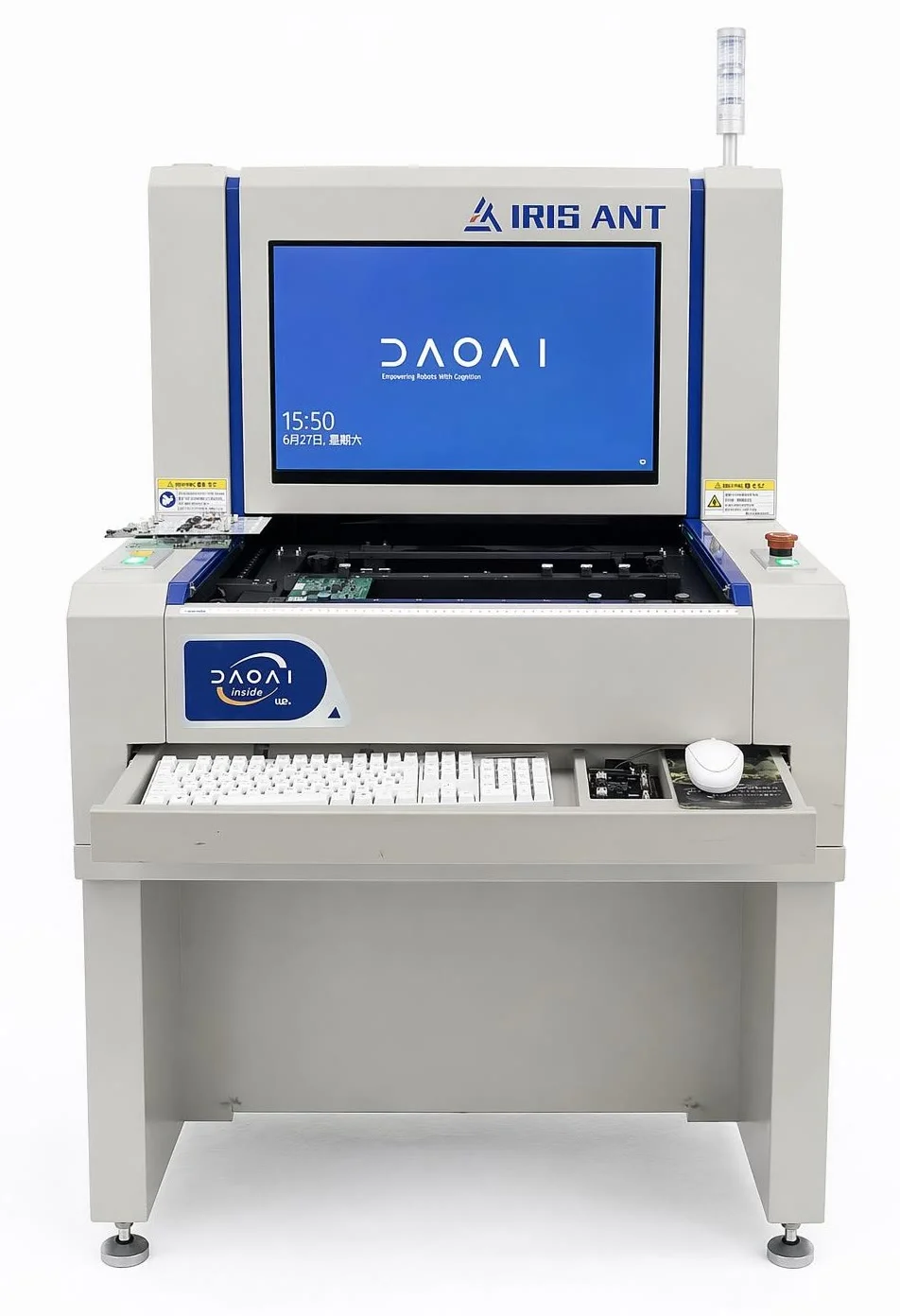
In the consumer goods packaging printing sector, DaoAI 2D ACI equipment (high-resolution 2D imaging + deep learning secondary judgment, targeting surface/print/OCR/assembly absence planar defects, high-speed online full inspection, micron-level precision, semantic false positive filtering) significantly improves production line flexibility and overall equipment effectiveness. By leveraging its unique zero-code fast changeover capability, it reduces the downtime for product changeover and debugging in high-mix low-volume production from several hours with traditional manual adjustments to just 5 minutes.
ACI in this article stands for Auto Cognitive Inspection — the next-generation term for AI AOI: keep the A and the I, and replace the O (optical) with C (cognitive), because the decision basis is cognition rather than the imaging method. The full argument is set out in From AI AOI to ACI.
The rapid iteration and market segmentation in the consumer goods industry have led to a clear trend of high-mix, low-volume production in packaging box printing. This means production lines frequently need to switch between different SKUs of packaging boxes, with each changeover potentially involving variations in print patterns, text, colors, and even box dimensions. Traditional manual inspection or rule-based AOI equipment often requires significant time for parameter adjustments, template resetting, and defect sample learning when faced with such frequent changeover demands. This not only leads to low production efficiency but also increases the risk of missed detections and false positives due to delayed debugging, directly impacting product launch speed and brand image. Particularly for niche markets with extremely high packaging appearance requirements, such as luxury goods, cosmetics, and high-end food, even minor printing defects can be perceived by consumers as product quality issues, leading to severe brand damage.
Pain Points: Why This Hurdle Is Difficult to Overcome
In packaging box printing, the high-mix low-volume production model presents multiple challenges. Firstly, traditional rule-based AOI systems require engineers to manually adjust hundreds of parameters and establish new defect regions and tolerance thresholds for each new product launch or specification change. In this case, this typically leads to hours of downtime, severely reducing the overall equipment effectiveness of the production line. Secondly, the efficiency and accuracy of manual inspection are limited by worker experience and fatigue, especially on high-speed production lines, where micron-level printing defects (such as ink spots, scratches, misregistration, subtle missing prints) are easily missed, allowing defective products to enter the market. Furthermore, traditional AOI often has a high false positive rate, especially for semantically ambiguous 'acceptable variations' (such as slight color depth differences or minor particles that do not affect overall aesthetics), which the system struggles to differentiate, leading to a large number of good products being misidentified. This increases unnecessary manual reinspection costs and material waste. For example, data from a consumer goods packaging manufacturer shows that manual reinspection due to false positives accounted for over 30% of total inspection man-hours in the past year. Additionally, the complexity of printing materials, ink types, and lamination processes imposes higher demands on imaging and detection algorithms, making it difficult for traditional solutions to achieve adaptive and continuous optimization on the production line, often becoming 'slower and less accurate over time'.
A deeper reason is that printing defects are diverse in form and lack fixed patterns. Their manifestations can also vary with printing batches, environmental temperature and humidity, and other factors. Traditional AOI relies on engineers explicitly defining and programming each defect, which proves inadequate when faced with a vast and dynamically changing array of defect patterns. Manual inspection, due to its subjectivity, struggles to maintain consistent detection standards across shifts and personnel. In the pursuit of 'getting more accurate with use' in industrial AI vision inspection, traditional solutions lack effective online learning and self-adaptive mechanisms. They cannot optimize models based on production line feedback, necessitating complex parameter adjustments and sample collection from scratch when new products or defects emerge, thereby preventing rapid response and iteration.
Technical Principles
The core advantage of DaoAI 2D ACI equipment lies in its combination of high-resolution 2D imaging and deep learning secondary judgment technology, powered by the DaoAI ACI OS operating system, achieving outstanding detection performance and zero-code fast changeover capability. The equipment utilizes industrial-grade high-resolution cameras and customized multi-spectral light sources to capture micron-level printing details and various defect types on the packaging box surface, ensuring high-quality image data input. Compared to traditional AOI, which relies solely on fixed thresholds and rule-based comparisons, DaoAI 2D ACI first screens potential defects using its built-in deep learning model after image acquisition. Through APDT positive/few-shot learning technology, it can complete model building for a good sample within 5 minutes, requiring only 1–20 good images, achieving a cold start detection accuracy of 98%.
Crucially, the deep learning secondary judgment stage of DaoAI 2D ACI incorporates a semantic false positive filtering mechanism. This means the system can not only identify abnormal areas but also understand the 'semantics' of these anomalies, differentiating between actual defects affecting aesthetics and function (e.g., ink spots, missing prints) and normal variations in the printing process (e.g., slight ink buildup at edges). This advanced semantic understanding significantly reduces the false positive rates common in traditional AOI. Concurrently, the DaoAI ACI OS operating system supports online adaptive and continuous optimization. With minimal false positive or missed detection data feedback from the production line, the model can rapidly iterate and learn, achieving a 'gets more accurate with use' effect. Compared to traditional manual inspection, DaoAI 2D ACI enables 100% full inspection on high-speed production lines with micron-level precision, completely eliminating instability caused by human eye fatigue and subjective judgment. Versus traditional rule-based AOI, its zero-code changeover method greatly simplifies operation, requiring no professional vision engineers for programming, allowing ordinary line operators to deploy new products quickly, significantly enhancing production line flexibility.
Typical Application Scenarios
- **Packaging Box Surface Print Defect Detection:** DaoAI 2D ACI equipment efficiently detects various printing defects on the packaging box surface, such as ink spots, scratches, smudges, color inconsistencies, and registration errors. The challenge lies in the diverse forms of defects, complex color variations, and their potential appearance anywhere on the pattern, which traditional methods struggle to cover comprehensively.
- **Character OCR Recognition and Verification:** For critical characters on packaging boxes like batch numbers, production dates, expiry dates, and barcodes, DaoAI 2D ACI performs high-precision OCR recognition and verification, ensuring information accuracy. Difficulties arise from potentially blurry, deformed, or missing characters, and interference from background patterns, leading to traditional OCR misreadings.
- **Hot Stamping/UV Coating Defect Detection:** For high-end packaging boxes often featuring hot stamping and UV coating processes, DaoAI 2D ACI can detect defects such as hot stamping detachment, uneven UV coating, bubbles, and scratches. These defects, due to their glossiness, transparency, and other optical properties, are challenging for traditional vision systems to image and recognize stably.
- **Packaging Box Structure and Assembly Deficiency Detection:** Beyond printing, DaoAI 2D ACI can also inspect the structural integrity of packaging boxes, including creases, indentations, die-cut deviations, and the absence of small internal accessories (e.g., instruction manuals, small gifts). The challenge involves simultaneously addressing planar printing and subtle 3D structural changes, as well as multi-target simultaneous detection.
Case Study
A leading packaging printing manufacturer, serving multiple internationally renowned consumer brands, faced long-standing challenges with high-mix, low-volume orders on their production lines. Traditionally, whenever a new product was launched or an existing product underwent a version update, they had to rely on experienced engineers to manually adjust the parameters of their AOI equipment. This process typically took 2-4 hours, causing production line downtime and severely impacting the flexibility of production planning. Furthermore, due to the varying complexity of print patterns across different products, the false positive rate of their traditional AOI system remained high, leading to a large volume of good products requiring manual secondary inspection, which added extra operational costs. After introducing DaoAI 2D ACI equipment, the manufacturer significantly alleviated these pain points.
Before implementation, the manufacturer required at least 2 hours of downtime for traditional AOI parameter debugging and template creation when switching to new products. Now, with the zero-code fast changeover capability of DaoAI 2D ACI, new product modeling and deployment can be completed in just 5 minutes. Production line data indicates that the deployment of DaoAI 2D ACI equipment significantly controlled the customer's false positive rate, reducing it from a previous 5-8% to less than 1%. This drastically cut down the workload for manual reinspection, transitioning from requiring several workers for full-time daily reinspection to only a small number of personnel handling the very few exceptions flagged by the system. This improvement not only boosted production line efficiency but also ensured that end consumers received high-quality packaged products, maintaining brand image.
The figures above are a typically achievable range in anonymized industry scenarios — a different line or a different batch of parts will move the result either way; on-site measurement governs.
The zero-code fast changeover of DaoAI 2D ACI equipment has turned our high-mix low-volume orders from a challenge into an opportunity, greatly enhancing production line flexibility.
DaoAI Solutions and Products
DaoAI offers a comprehensive solution centered around its 2D ACI equipment, addressing the high-mix low-volume inspection needs in consumer goods packaging printing. This equipment integrates high-resolution industrial cameras, customized light source modules, and high-performance edge computing units, capable of direct deployment on existing printing or packaging lines. Its core advantage lies in the DaoAI ACI OS operating system, which features a built-in visual foundation model supporting zero-code fast modeling. Utilizing APDT few-shot self-training technology, users only need to provide 1–20 good samples, and the system can automatically complete model training within minutes, requiring no programming knowledge. This means production line operators can independently configure new product changeovers, drastically reducing changeover downtime to 5 minutes. DaoAI 2D ACI equipment also boasts powerful semantic false positive filtering capabilities, effectively distinguishing between genuine defects and normal fluctuations in the printing process, thereby achieving extremely low false positive rates and reducing unnecessary reinspection steps. Furthermore, DaoAI 2D ACI equipment supports 100% local private deployment, ensuring all samples and inspection images remain on-site, strictly adhering to customer data security and privacy requirements.
The deployment of the DaoAI 2D ACI solution is swift and straightforward. Through various forms such as SDK/API/Docker, it can be integrated with existing MES/WMS systems to achieve closed-loop data management. The system's continuous learning capability ensures that the model 'gets more accurate with use.' When faced with new printing materials, inks, or defect types, it can rapidly iterate and optimize with minimal feedback data, guaranteeing long-term stability and high accuracy of detection. In this case, DaoAI 2D ACI equipment significantly boosted production efficiency by reducing changeover time from several hours with traditional manual adjustments to 5 minutes, and effectively lowered the cost of manual reinspection caused by false positives, achieving a higher return on investment.
FAQ
How does DaoAI 2D ACI equipment achieve zero-code fast changeover?
DaoAI 2D ACI equipment achieves zero-code fast changeover through the built-in visual foundation model of the DaoAI ACI OS operating system and APDT few-shot self-training technology. Users only need to provide 1-20 good samples, and the system can automatically complete model training and deployment within 5 minutes, without any programming.
What are the advantages of DaoAI 2D ACI's semantic false positive filtering function?
DaoAI 2D ACI's semantic false positive filtering function leverages deep learning to understand the 'semantics' of defects, distinguishing between actual quality-impacting defects and normal variations in the printing process. This function significantly reduces false positive rates, decreases manual reinspection workload, and improves production line efficiency and detection accuracy.
What are the main cost components for deploying DaoAI 2D ACI equipment?
The main costs for deploying DaoAI 2D ACI equipment include hardware (high-resolution cameras, lighting, edge computing units), software licenses (DaoAI ACI OS and related modules), integration services, and subsequent maintenance and upgrade fees. Specific pricing varies based on production line scale, complexity of detection requirements, and deployment method. We recommend scheduling a consultation with our experts for a customized solution and detailed quote.
Full solution for this scenario: the full inspection solution for 2D ACI Equipment
This article is an original publication by WeLinkirt (DaoAI). Under customer confidentiality, cases are anonymized industry scenarios and figures are illustrative; see product pages for official benchmarks.