
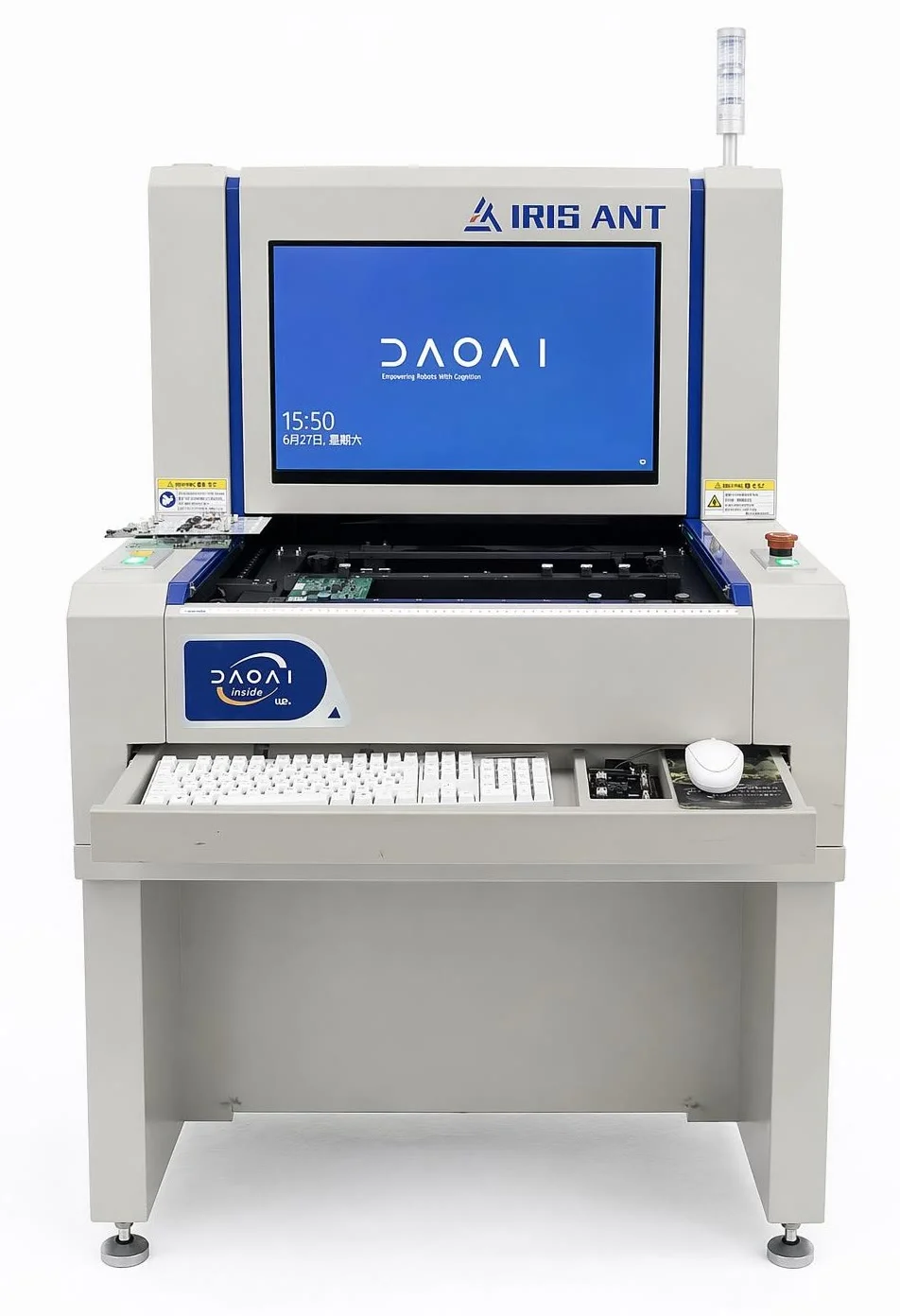
DaoAI 2D ACI equipment (high-resolution 2D imaging + deep learning secondary judgment, targeting planar defects like surface/printing/character OCR/assembly omissions, high-speed online full inspection, micron-level, semantic false positive filtering) utilizes APDT few-shot self-training technology to reduce the false positive rate of serial code OCR in pharmaceutical label scenarios from 5.5% with traditional rule-based AOI to below 0.9% in actual production lines, significantly enhancing pharmaceutical companies' inspection efficiency and data accuracy for product traceability codes. In the pharmaceutical industry, product traceability and anti-counterfeiting are crucial for ensuring drug safety and compliant distribution. With increasingly stringent global pharmaceutical regulations, critical information such as serial codes, batch numbers, and expiration dates on drug packaging not only needs to be clear and legible but also requires 100% accurate identification and verification on high-speed production lines. This directly impacts drug batch management, flow traceability, and recall efficiency, serving as the cornerstone of compliant pharmaceutical operations.
ACI in this article stands for Auto Cognitive Inspection — the next-generation term for AI AOI: keep the A and the I, and replace the O (optical) with C (cognitive), because the decision basis is cognition rather than the imaging method. The full argument is set out in From AI AOI to ACI.
DaoAI 2D ACI equipment (high-resolution 2D imaging + deep learning secondary judgment, targeting planar defects like surface/printing/character OCR/assembly omissions, high-speed online full inspection, micron-level, semantic false positive filtering) utilizes APDT few-shot self-training technology to reduce the false positive rate of serial code OCR in pharmaceutical label scenarios from 5.5% with traditional rule-based AOI to below 0.9% in actual production lines, significantly enhancing pharmaceutical companies' inspection efficiency and data accuracy for product traceability codes. In the pharmaceutical industry, product traceability and anti-counterfeiting are crucial for ensuring drug safety and compliant distribution. With increasingly stringent global pharmaceutical regulations, critical information such as serial codes, batch numbers, and expiration dates on drug packaging not only needs to be clear and legible but also requires 100% accurate identification and verification on high-speed production lines. This directly impacts drug batch management, flow traceability, and recall efficiency, serving as the cornerstone of compliant pharmaceutical pharmaceutical operations.
Pain Points: Why This Challenge is Difficult to Overcome
In the pharmaceutical industry, OCR recognition of serial codes on drug labels faces numerous challenges. Firstly, traditional rule-based AOI systems suffer from high false positive rates when dealing with complex backgrounds, print color variations, character deformation, reflections, or partial obstructions. Data from a mid-sized pharmaceutical manufacturer's production line showed its serial code false positive rate reached up to 5.5%. High false positives lead to a large number of perfectly good products being misidentified as defective, requiring manual secondary inspection. This not only consumes significant human resources (an average of 2-3 skilled workers per shift dedicated to re-inspection) but also severely slows down the production line tempo, reducing overall production efficiency. Secondly, pharmaceutical production often involves multiple varieties and small batches, or subtle differences in packaging materials and ink batches within the same batch. These variations interfere with OCR recognition. Each line changeover or product upgrade requires hours or even days of complex parameter adjustments and rule rewriting for traditional systems, leading to excessive downtime and impacting the flexibility of production planning. Finally, similar to the stringent requirements for high reliability and stability in AI servers and PC motherboards, the pharmaceutical industry also demands increasingly high reliability and stability from production equipment and inspection systems. Traditional solutions may experience recognition accuracy drift over long-term operation due to environmental changes or equipment wear, posing potential missed detection risks. A single missed detection of critical serial code information can lead to huge compliance risks and economic losses for the enterprise.
Specifically for OCR recognition, serial code characters on pharmaceutical labels are often tiny, tightly arranged, and may use various processes such as laser etching or inkjet printing. On high-speed moving production lines, images captured by cameras may suffer from motion blur; diverse label surface materials, such as glossy, matte, or frosted, can cause reflections or insufficient contrast, further increasing recognition difficulty. Traditional solutions struggle to effectively distinguish subtle printing defects from normal character edge features, making it impossible to completely eliminate the false positive problem of 'good products being judged as defective.' Especially when facing labels with complex background patterns and low contrast between characters and background, the robustness of traditional image processing algorithms is insufficient, easily leading to misjudgments.
Technical Principles
DaoAI 2D ACI equipment fundamentally addresses the pain points of traditional OCR recognition by combining high-resolution 2D imaging technology with a deep learning secondary judgment mechanism. Its core lies in the APDT few-shot self-training capability integrated into the DaoAI ACI OS operating system. Unlike traditional deep learning models that require vast amounts of annotated data for training, APDT allows engineers to quickly train a high-performance detection model with only 1-20 good product images. In pharmaceutical label OCR scenarios, this means that even with new fonts, special printing processes, or occasional background changes, engineers do not need to invest significant time in collecting and annotating defect samples; a small number of good products suffice for rapid adaptation. The equipment's high-resolution 2D imaging system can capture micron-level character details, providing high-quality input for the subsequent deep learning model. The deep learning model then leverages its powerful feature extraction capabilities to precisely locate and identify serial code characters, and through a semantic false positive filtering mechanism, effectively distinguishes true defects from background noise, significantly reducing the false positive rate. For instance, in one case, DaoAI 2D ACI equipment reduced a pharmaceutical manufacturer's serial code false positive rate from 5.5% to below 0.9% in actual production lines, greatly improving detection accuracy.
Compared to traditional rule-based AOI, the APDT few-shot self-training technology of DaoAI 2D ACI equipment offers clear advantages. Traditional rule-based AOI requires manually setting numerous thresholds and geometric rules. When facing subtle variations in label materials or printing processes, rules need frequent adjustments and struggle to cover all complex situations, leading to missed detections or false positives. In contrast, DaoAI's deep learning-based solution can learn the intrinsic features of characters and the robustness to variations from a small number of good products, possessing stronger generalization capabilities. Furthermore, semantic false positive filtering is another major highlight of DaoAI 2D ACI. It can determine whether a defect is genuine based on its contextual information, rather than simply pixel anomalies. For example, a tiny ink speck on a character's edge might be misjudged as a defect by traditional AOI, but DaoAI 2D ACI can recognize that it does not affect the semantic integrity of the character, thus filtering it out as a non-defect and significantly reducing the workload of manual re-inspection.
Typical Application Scenarios
- **OCR Recognition and Verification of Serial Codes on Drug Packaging Boxes:** Before drug shipment, DaoAI 2D ACI equipment can perform high-speed, high-precision OCR recognition of unique serial codes on packaging boxes and conduct real-time comparison with the production database to ensure each drug has correct traceability information. The challenge lies in serial codes potentially using various fonts, sizes, and having slight printing position deviations.
- **Recognition of Anti-Counterfeiting Codes and Batch Numbers on Labels:** For anti-counterfeiting codes, batch numbers, production dates, and expiration dates on drug labels, DaoAI 2D ACI can perform precise recognition and integrity checks. This is crucial for ensuring drug batch traceability and preventing counterfeiting. The challenge is that this information may be printed on complex backgrounds or appear blurry due to uneven ink.
- **OCR of Engraved Characters on Ampoules/Vials:** Laser-engraved characters on glass bottles often have low contrast, are tiny, and the bottle's curvature can cause image distortion. DaoAI 2D ACI equipment, through optimized imaging and robust deep learning algorithms, can effectively recognize these hard-to-read characters, ensuring the accuracy of product identification.
- **Detection of Character Printing Defects in Package Inserts:** Drug package inserts contain a large amount of textual information, and any misprint, omission, or blur can lead to serious medical incidents. DaoAI 2D ACI equipment can perform full-sheet inspection of the print quality of package inserts, identifying tiny character defects to ensure accurate information delivery.
- **Character Recognition on Pills/Capsules:** Some pills or capsules have identifying characters or logos printed on their surface to distinguish drug types or brands. DaoAI 2D ACI equipment can achieve precise recognition of these tiny characters, ensuring product consistency and safety.
Implementation Case Study
A mid-sized pharmaceutical enterprise, whose main production lines are for oral liquids and injectables. Before the introduction of DaoAI 2D ACI equipment, this enterprise had long faced high false positive rates in the serial code OCR segment of its oral liquid packaging line. Due to the reflective properties of the product packaging material and the high-speed production tempo, the traditional rule-based AOI system's false positive rate for serial codes remained high, with actual data reaching around 5.5%. This led to an additional investment of 2-3 manual workers per day for re-inspection, which not only increased labor costs but also significantly reduced production line efficiency. Each time a new product was launched or packaging design was subtly adjusted, several days were required for system parameter debugging, severely impacting the flexibility of production planning.
After DaoAI 2D ACI went online, this pharmaceutical factory's serial code false positive rate decreased by 82%, and changeover time was reduced from several days to 5 minutes, significantly improving production efficiency and quality compliance.
After the enterprise introduced DaoAI 2D ACI equipment, engineers utilized its APDT few-shot self-training function to complete model training and deployment for new products in just 5 minutes, using only 15 good product images. After going online, DaoAI 2D ACI equipment significantly reduced this pharmaceutical factory's serial code false positive rate from 5.5% to below 0.9%, a reduction of 82%. This directly reduced manual re-inspection workload by over 80%, freeing up production line workers to focus on more valuable tasks. Concurrently, the fast changeover capability of DaoAI 2D ACI reduced downtime from several days to just 5 minutes when switching between different batches or packaging specifications, greatly enhancing the flexibility and utilization rate of the production line. In this case, the application of DaoAI 2D ACI not only solved the immediate false positive pain point but also improved the enterprise's overall digitalization and intelligent manufacturing level, laying a solid foundation for meeting future, more stringent regulatory requirements.
The figures above are a typically achievable range in anonymized industry scenarios — a different line or a different batch of parts will move the result either way; on-site measurement governs.
DaoAI Solution and Products
DaoAI's 2D ACI solution for the pharmaceutical industry is based on its core product, the DaoAI 2D ACI equipment, combined with the APDT few-shot self-training technology within the DaoAI ACI OS operating system, achieving efficient and high-precision online full inspection. In practical implementation, we first acquire images of pharmaceutical labels using high-resolution cameras to ensure clear, undistorted raw data. These images are then fed into the deep learning model built into the DaoAI 2D ACI equipment for processing. Model training and optimization primarily rely on APDT technology, meaning engineers only need to provide a small number (1-20) of good product images, and the system automatically learns and establishes a defect judgment model. This 'positive sample/few-shot learning' mode greatly simplifies the model deployment process, particularly suitable for the multi-variety, small-batch production characteristics of the pharmaceutical industry.
Furthermore, the semantic false positive filtering function of DaoAI 2D ACI equipment can intelligently identify and eliminate 'pseudo-defects' that do not affect product functionality and compliance, further enhancing judgment accuracy and efficiency. For deployment, DaoAI supports various integration methods such as SDK/API/Docker and offers 100% local private deployment options, ensuring that all samples and inspection images remain on-site, meeting the stringent requirements of the pharmaceutical industry for data security and privacy. Through the DaoAI World world model as a unified foundation, DaoAI 2D ACI equipment also possesses semantic understanding and cross-scene generalization capabilities, continuously learning from production line feedback to optimize detection performance. Through DaoAI 2D ACI, this mid-sized pharmaceutical manufacturer achieved a significant reduction in false positive rates (-82%), reduced changeover time to 5 minutes, increased overall production efficiency by over 20%, and effectively mitigated compliance risks.
FAQ
How does DaoAI 2D ACI equipment achieve few-shot self-training?
DaoAI 2D ACI equipment integrates the APDT few-shot self-training technology within the DaoAI ACI OS operating system. This technology utilizes advanced algorithms to learn normal product features from a very small number (typically 1-20) of good product images, automatically identifying anomalies that deviate from these features. This allows for the rapid establishment of efficient defect detection models without the need for extensive defect samples for training.
What is the cost-effectiveness of DaoAI 2D ACI equipment in pharmaceutical label OCR scenarios?
DaoAI 2D ACI equipment directly reduces manual re-inspection costs and downtime losses by significantly lowering false positive rates and shortening changeover times. In the long term, its high-precision detection capabilities effectively prevent recall risks and brand damage caused by missed detections. Combined with rapid deployment and low maintenance costs, the overall return on investment period is far superior to traditional solutions. Specific costs are influenced by configuration and integration complexity; we recommend scheduling an expert consultation for a customized quote.
How does DaoAI 2D ACI ensure data security and privacy in the pharmaceutical industry?
DaoAI 2D ACI equipment supports 100% local private deployment. This means all image data, model training data, and inspection results are stored within the customer's internal network and are not uploaded to any external cloud platform. We offer various integration methods such as SDK/API/Docker to ensure data is processed in a customer-controlled environment, fully complying with the stringent data security and privacy requirements of the pharmaceutical industry.
Full solution for this scenario: the full inspection solution for 2D ACI Equipment · Food Foreign-Object Removal & Grading: Robot Vision Cuts False Positives
This article is an original publication by WeLinkirt (DaoAI).