
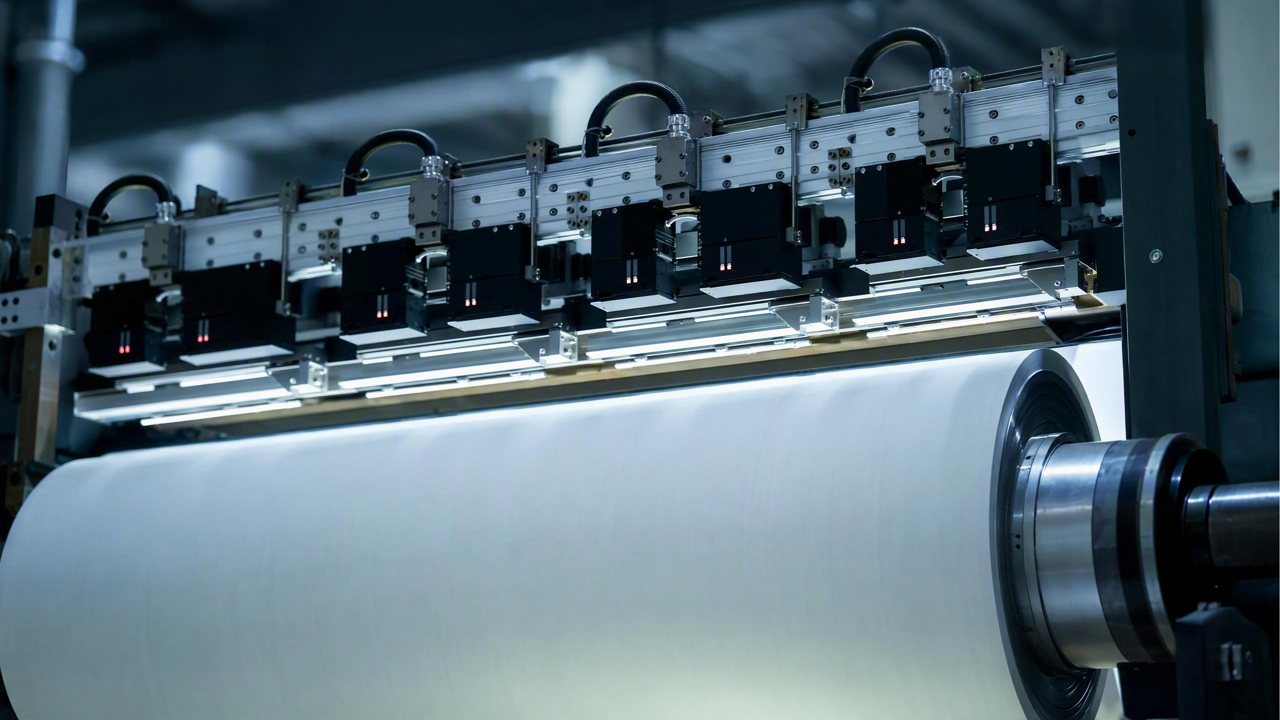
DaoAI 2D AI AOI equipment (high-resolution 2D imaging + deep learning for secondary judgment, targeting surface/printing/OCR/assembly defects, high-speed online full inspection, micron-level, semantic false positive filtering) has successfully overcome detection bottlenecks in the paper industry caused by high-speed production. It reduced the omission rate of surface foreign objects and creases in the paper coating process from a traditional 1.5% to below 0.2%, while also decreasing manual re-inspection by over 70%.
DaoAI 2D AI AOI equipment (high-resolution 2D imaging + deep learning for secondary judgment, targeting surface/printing/OCR/assembly defects, high-speed online full inspection, micron-level, semantic false positive filtering) has successfully overcome detection bottlenecks in the paper industry caused by high-speed production. It reduced the omission rate of surface foreign objects and creases in the paper coating process from a traditional 1.5% to below 0.2%, while also decreasing manual re-inspection by over 70%. The chemical and material industries, especially paper manufacturing, often operate production lines at extremely high speeds to meet market demands for high-volume, high-quality paper. From pulp preparation, papermaking, coating, and calendering to slitting, various minute defects such as fiber clumps, bubbles, impurities, uneven coating, creases, and pinholes can be introduced at each stage. These imperfections not only affect the aesthetic appeal of the paper but can also lead to processing difficulties in subsequent printing and packaging stages, or even directly impact the performance of the final product and customer satisfaction. Traditional inspection methods struggle to guarantee 100% full coverage at high throughput, let alone effectively differentiate complex defects.
Pain Points: Why This Hurdle Is Difficult to Clear
On a paper production line, speed is paramount, but speed also introduces unprecedented inspection challenges. A major paper manufacturer faced particularly acute pain points: their coating production line operates at speeds up to 1200 meters/minute, where traditional line scan cameras combined with rule-based AOI systems still yielded an omission rate of up to 1.5%, especially when dealing with minute foreign objects, subtle creases, and irregular coating flaws. A high omission rate meant a significant volume of non-conforming products flowed downstream, increasing customer complaints and return risks. Concurrently, the false positive rate of traditional AOI systems remained stubbornly high, around 15%, necessitating 8-10 man-hours daily for repeated re-inspection, severely hindering production line efficiency and incurring substantial operational costs. During changeovers, reconfiguring and parameter tuning for rule-based algorithms took at least 30 minutes, failing to accommodate the demands of multi-product, small-batch production. Furthermore, while the industry trend towards CV quality inspection large models has enhanced precision and efficiency in automotive manufacturing, their generalization capabilities and fine-grained capture of micron-level defects on flexible, highly reflective, and textured materials like paper still face bottlenecks, especially when aiming for ultimate production line throughput and zero omissions. Traditional solutions simply cannot meet these demands.
The root causes of these difficulties lie in several factors: Firstly, the complex and uneven texture of paper surfaces presents significant challenges for imaging quality and defect identification. Secondly, the extremely high production line speed allows for only a very narrow time window for image acquisition and algorithmic processing, making it difficult for traditional algorithms to perform high-precision judgments within such short periods. Moreover, many defects are diverse in form and have blurry boundaries, such as slight creases or fiber clumps, which do not significantly differ from normal paper textures, making them highly susceptible to misjudgment or omission by traditional rule-based algorithms. Manual visual inspection, at high throughput, cannot achieve 100% full coverage and is prone to fatigue and subjectivity, failing to guarantee consistency and reliability.
Technical Principles
The core of DaoAI's 2D AI AOI equipment lies in its 'high-resolution 2D imaging + deep learning secondary judgment' architecture. First, the system employs custom high-speed, high-resolution line scan cameras and multi-angle illumination optimized for paper characteristics, ensuring clear, streak-free micron-level images are captured even during high-speed motion. This precise imaging technology is fundamental for identifying subtle defects. Second, the captured image data is transmitted in real-time to a deep learning inference module powered by the Wemio engine. The Wemio engine doesn't merely perform image comparisons; instead, it leverages the powerful feature recognition capabilities of its visual foundation models to achieve deep semantic understanding of paper images. It learns the subtle textures, colors, structures, and other normal features from vast quantities of good product data, and based on this, it identifies any deviations from the 'normal' pattern, whether they are foreign objects, creases, or uneven coating.
Compared to traditional rule-based AOI, the advantage of DaoAI's 2D AI AOI equipment lies in its self-learning and semantic understanding capabilities. Traditional AOI relies on engineers manually setting thresholds and rules, which limits its adaptability to complex and varied defect types, often leading to a high volume of false positives and omissions. In contrast, the Wemio engine supports APDT few-shot learning (requiring only 1-20 good product images for model training), enabling rapid adaptation to subtle variations across different paper types and production batches. Its 'semantic false positive filtering' function, by understanding the context of defects, can effectively distinguish between genuine product defects and normal texture fluctuations, significantly reducing the false positive rate. For instance, for minor texture variations on the paper surface, traditional AOI might flag them as defects, but the Wemio engine can determine them to be normal production variations, thereby achieving more accurate judgments. This deep learning mechanism of DaoAI 2D AI AOI demonstrates stability and accuracy far superior to traditional methods in high-speed, complex, and variable production environments.
Typical Application Scenarios
- **Detection of Surface Foreign Objects and Particles in Coating Layer:** During the paper coating process, minute dust particles, fiber clumps from the air, or impurities in the coating material can adhere to the coated surface, forming tiny foreign objects or particles. DaoAI 2D AI AOI equipment, through high-resolution imaging, can precisely identify and locate these micron-sized foreign objects, effectively detecting them even in high-reflectance or low-contrast environments, ensuring the flatness and cleanliness of the coated surface.
- **Detection of Paper Creases and Wrinkles:** High-speed production lines or uneven winding tension can cause slight creases or wrinkles in the paper. These defects often resemble normal paper textures, making them difficult for traditional methods to distinguish. DaoAI's deep learning algorithms can learn and recognize the unique morphological features of creases, accurately detecting even light, inconspicuous creases to prevent non-conforming products from entering subsequent processes.
- **Detection of Uneven Coating and Streaks:** Deviations in coating quantity or wear on coating rollers can lead to uneven coating thickness, forming streaks or spots imperceptible to the naked eye. DaoAI 2D AI AOI can identify these minute coating defects by analyzing image grayscale variations and texture consistency, ensuring coating layer uniformity and improving printability.
- **Detection of Paper Pinholes and Damages:** During production, impurities in the pulp, stress concentrations during papermaking, or external abrasions can lead to pinholes or edge damage in the paper. The Wemio engine, with its powerful defect recognition capabilities, can accurately detect all types of defects, from pinholes to large-area damage, providing precise size and location information for timely warning and rejection of non-conforming products.
Implementation Case Study
A leading paper manufacturer in East China, operating a high-speed coating production line for premium printing paper, had long struggled with omissions and high false positives due to surface blemishes and subtle creases. Before adopting DaoAI 2D AI AOI equipment, despite having a rule-based traditional AOI system, their omission rate remained around 1.5%, with a false positive rate exceeding 15%, requiring significant daily human effort for re-inspection and verification. This not only increased operational costs but also impacted overall production line efficiency. The company decided to deploy the DaoAI 2D AI AOI system with the goal of achieving 100% online full inspection and effectively reducing false positives. During the onboarding process, DaoAI's engineering team leveraged the APDT few-shot learning function, completing model training and deployment in just 5 minutes using only 15 good product images, drastically shortening the debugging cycle. After deployment, its high-resolution imaging and the Wemio engine's deep learning secondary judgment capabilities immediately demonstrated outstanding performance.
After deploying the DaoAI 2D AI AOI system, we controlled the omission rate for surface foreign objects and creases in the paper coating process to below 0.2%, reducing manual re-inspection by 70%, which significantly boosted production line efficiency.
Before deployment, manual re-inspection occupied 8-10 hours daily, defect grading was inefficient, and new product changeovers required 30 minutes of downtime. Post-deployment, DaoAI's 2D AI AOI reduced average daily manual re-inspection time to less than 2 hours, and the false positive rate decreased by −75%. Crucially, while maintaining the production line's high throughput of 1200 meters/minute, the system achieved 100% full inspection coverage for micron-level defects, with the omission rate consistently controlled at <0.2%. For new products or process changeovers, the Wemio engine's rapid self-learning capability enabled model updates in just 5 minutes, greatly enhancing production line flexibility and utilization. This not only significantly improved product quality, reduced scrap rates and customer complaints, but also optimized human resource allocation, bringing tangible economic benefits to the enterprise.
DaoAI Solutions and Products
DaoAI's 2D AI AOI equipment is specifically designed for the high-precision, high-throughput inspection needs of the chemical/material industry. Its core is the DaoAI AI AOI software system, which features the Wemio engine. This engine integrates the feature recognition capabilities of visual foundation models, allowing defect identification to move beyond traditional rules and instead leverage deep learning for semantic understanding of complex defects. In paper defect detection scenarios, we utilize custom high-speed line scan cameras and precision lighting modules, coupled with DaoAI's self-developed image pre-processing algorithms, to ensure that even at a production line speed of 1200 meters/minute, lossless, high-contrast images of micron-level defects can still be captured. The modeling process is extremely straightforward: users only need to provide a small number of good product images (APDT positive sample/few-shot learning, 1–20 images), and the Wemio engine can automatically complete model training in 5 minutes, requiring no code. This '0-code automatic programming' capability significantly lowers the technical barrier and deployment cost.
Regarding deployment, DaoAI's 2D AI AOI equipment supports 100% local private deployment, with all data processed within the customer's factory, ensuring data security and privacy. The system smoothly integrates with existing production line control systems, providing real-time detection results and alarm signals, and can link with rejection or marking equipment for closed-loop control. In addition to the 2D AI AOI equipment, DaoAI also offers the DaoAI AI AOI software system as a standalone SDK/API/Docker deployment option, facilitating integration into customers' own hardware platforms. Through its powerful semantic false positive filtering function, DaoAI 2D AI AOI can effectively distinguish between true and false defects, reducing the false positive rate by over −75%, thereby significantly alleviating the burden of manual re-inspection. This comprehensive solution not only enhances detection accuracy and efficiency but also helps enterprises achieve smart manufacturing and lean production goals.
The quantifiable results demonstrated by DaoAI's 2D AI AOI in this case are significant: the omission rate was reduced to <0.2%, the false positive rate decreased by −75%, manual re-inspection volume was reduced by over −70%, and new product changeover time was shortened from 30min to 5min. These figures not only represent an improvement in detection capabilities but also directly translate into reduced production costs, stable product quality, and increased customer satisfaction. By achieving 100% full inspection on high-speed production lines, enterprises can effectively prevent non-conforming products from reaching the market, enhance brand reputation, and gain an advantage in fierce market competition. DaoAI is committed to providing reliable and efficient intelligent quality inspection solutions for the chemical/material industry, assisting enterprises in achieving intelligent manufacturing upgrades.
FAQ
How does DaoAI 2D AI AOI equipment achieve micron-level defect detection on high-speed production lines?
DaoAI 2D AI AOI equipment utilizes custom high-speed, high-resolution line scan cameras and multi-angle illumination optimized for paper characteristics, ensuring clear, streak-free micron-level images are captured during high-speed motion. Combined with the Wemio engine's powerful deep learning inference capabilities, it can process vast image data in real-time, accurately identifying and locating minute defects while maintaining production line throughput.
How does the Wemio engine's semantic false positive filtering function specifically work?
The Wemio engine uses deep learning for semantic understanding of defect images and their context, distinguishing between genuine product defects and normal material textures, background noise, or process variations. It doesn't rely on simple pixel values or geometric rules but learns the 'essential' characteristics of defects, thereby effectively filtering out common false positives from traditional AOI, significantly improving detection accuracy and efficiency, and reducing the burden of manual re-inspection.
How long does it take to deploy the DaoAI 2D AI AOI system? Does it support local deployment?
The deployment cycle for DaoAI 2D AI AOI system is short. Thanks to the APDT few-shot learning function, model training and deployment can typically be completed within 5 minutes using only 1-20 good product images. The system supports 100% local private deployment, with all data processed within the customer's factory, ensuring data security and privacy. Integration is also generally rapid, allowing smooth connection with existing production line control systems.
This article was generated by AI. Customer cases are simulated scenarios based on real product capabilities and figures are illustrative; see product pages for official benchmarks.