
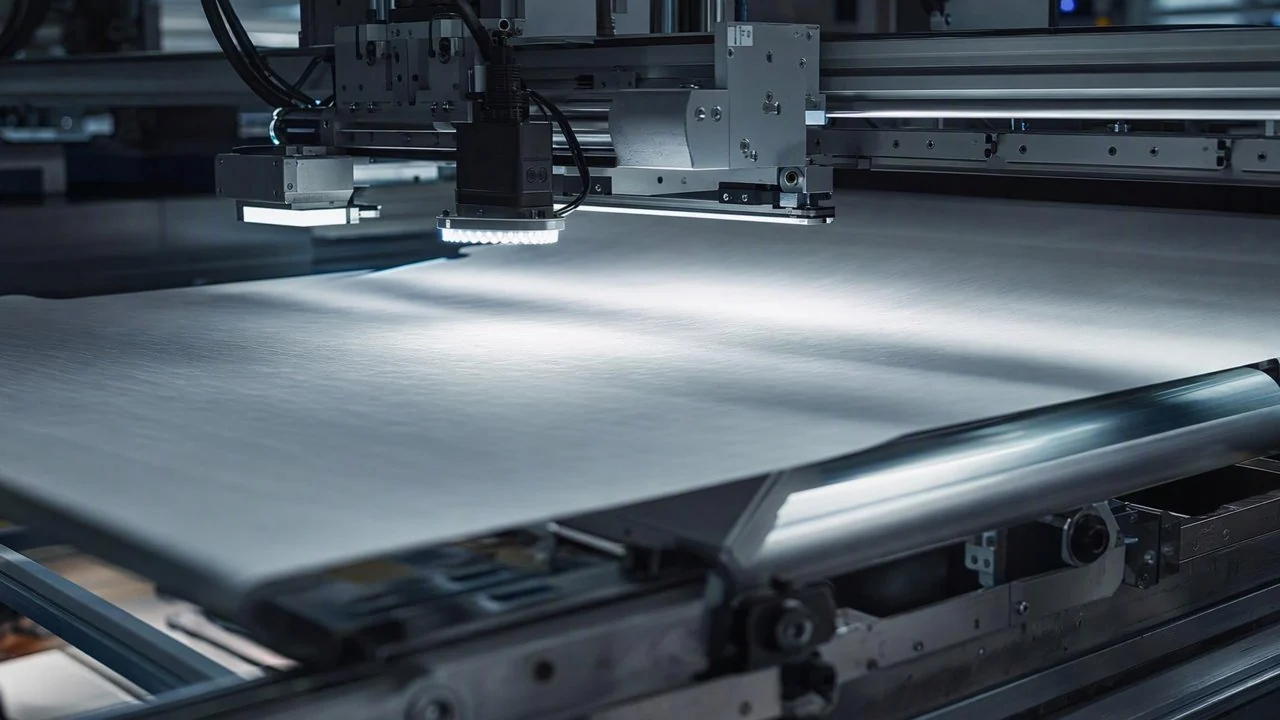
DaoAI 2D ACI equipment (high-resolution 2D imaging + deep learning secondary judgment, targeting surface/print/OCR/assembly planar defects, high-speed online full inspection, micron-level, semantic false positive filtering) leveraging APDT few-shot self-training, reduced a large paper manufacturer's paper surface defect detection false positive rate from an industry average of 15% to below 3%, significantly improving inspection efficiency and product yield.
In the chemical and materials industry, paper production is a highly automated field with extremely stringent quality control requirements. As consumer demands for product appearance and performance continue to rise, even minor paper surface defects can lead to batch rejection or downgrading. Traditional paper quality inspection often relies on manual visual inspection or rule-based conventional AOI systems. These methods are inefficient, costly, and susceptible to subjective factors when dealing with high-volume, high-speed production lines. Particularly in the production of specialty papers or high-value-added papers, the accuracy and speed of defect identification become critical constraints on capacity and profit. DaoAI 2D ACI equipment is designed to address these challenges. It achieves high-speed online full inspection of planar defects such as surface/print/OCR/assembly omissions with micron-level precision through high-resolution 2D imaging and deep learning secondary judgment. Its semantic false positive filtering significantly enhances detection reliability, especially with the support of APDT few-shot self-training, which allows it to rapidly adapt to multi-variety, small-batch production needs.
Pain Points: Why This Hurdle Is So Difficult
Paper production involves a wide variety of defects, including but not limited to fiber clumps, color spots, indentations, holes, scratches, and foreign objects. Their forms, sizes, and shades vary, and they are often randomly distributed, posing significant challenges to inspection. In high-speed production lines, a skilled worker's inspection area per hour is limited, and prolonged work easily leads to fatigue, resulting in a false negative rate often exceeding 2% and a false positive rate as high as 15-20%. This high false positive rate means a large number of good products are mistakenly classified as defective, requiring additional re-inspection hours. According to data from a large paper manufacturer, re-inspection hours due to false positives exceeded 300 hours per month, severely hindering production rhythm and increasing labor costs. Additionally, when new products or batches of paper are introduced, traditional rule-based AOI systems require several hours or even days for parameter adjustment and rule writing, leading to long changeover downtime, averaging 4 hours per changeover, which significantly impacts production efficiency. Furthermore, against the backdrop of current industry trends—such as the extreme demands for material surface quality in precision assembly using ultrasonic welding technology—indirectly places higher requirements on the surface quality control of paper used as packaging or cushioning material. Any minor surface defect could trigger cascading problems in subsequent precision processing.
The root causes of these dilemmas are: First, paper material itself has a complex texture, making it difficult to distinguish true defects from background textures. Traditional algorithms based on thresholds or edge detection struggle to effectively differentiate them. Second, variations in lighting, humidity, temperature in the production environment, as well as subtle fluctuations in paper thickness, whiteness, and transparency, can interfere with imaging quality, further increasing detection difficulty. Finally, rapid product iteration and diversification mean that each product update requires identification of new defect patterns. Traditional systems lack the ability to learn quickly and generalize, resulting in long model training and deployment cycles, making it difficult to meet the demands of flexible production.
Technical Principles
The core advantage of DaoAI 2D ACI equipment lies in its combination of high-resolution optical imaging and advanced deep learning algorithms. In terms of imaging, the equipment uses customized high-speed industrial cameras and a precise lighting system to acquire micron-level resolution images of the paper surface online, ensuring that even subtle defects are clearly visible. Its true breakthrough, however, lies in its built-in DaoAI ACI OS operating system, which integrates the feature recognition capabilities of vision foundation models and APDT few-shot self-training technology. Unlike traditional AOI, which relies on manually setting complex rules, DaoAI 2D ACI can complete model programming in just 5 minutes with only 1-20 good samples using APDT (Active Progressive Deep Training) technology, enabling rapid changeover. This few-shot learning capability allows the system to learn normal paper textures and defect features from extremely small amounts of data, with strong generalization ability. Furthermore, the system includes semantic false positive filtering, which understands the contextual information of defects, effectively distinguishing harmless normal texture fluctuations from true quality defects caused by the production process, thereby significantly reducing the false positive rate. Compared to traditional methods, DaoAI 2D ACI not only far surpasses manual inspection in detection speed and accuracy but also overcomes the identification bottlenecks and high false positive rates of traditional rule-based AOI when facing complex and varied defects, while drastically shortening model training and changeover times, enhancing production line flexibility.
Specifically, after the DaoAI 2D ACI equipment acquires paper images, it first extracts features using pre-trained vision foundation models, which have learned vast image features to better understand image content. Then, the APDT module uses a small number of good samples for adaptive training, quickly building a refined model of the paper's "normal" state. When an area that does not conform to this model is detected, the system will initially mark it. Subsequently, the deep learning secondary judgment module will further analyze the semantic information and contextual relationships of these marked areas, combined with prior knowledge of the production process, to filter out harmless "noise" caused by lighting, texture, minor deformation, etc., only reporting true quality-critical defects. This intelligent judgment mechanism is unmatched by traditional AOI, allowing DaoAI 2D ACI to maintain a high detection rate while keeping the false positive rate at an industry-leading low level.
Typical Application Scenarios
- **Paperboard/Paper Surface Fiber Clumps and Foreign Object Detection:** During paper formation, fibers may clump unevenly or foreign objects like dust or wood chips may be incorporated. DaoAI 2D ACI, with its high-resolution imaging and deep learning, accurately identifies these micron-level protrusions or discolored spots, distinguishing them from normal pulp textures to prevent damage to product strength or appearance.
- **Coating Layer Scratches and Bubbles Detection:** High-end coated paper may develop subtle scratches or bubbles during the coating process. These defects can be very subtle under light reflection. Wemio 2D ACI uses its high-sensitivity camera and intelligent algorithms to capture these subtle anomalies under varying light conditions, ensuring a uniform and complete coating layer, and improving printability.
- **Printed Paper Character OCR and Pattern Defects:** In the printing stage, blurry characters, missing prints, misalignments, or jagged pattern edges and uneven colors are common issues. DaoAI 2D ACI's OCR function precisely identifies and verifies batch numbers, production dates, and other information, while combining deep learning for complex pattern defect detection, ensuring print quality meets standards.
- **Functional Paper (e.g., Filter Paper, Oil Absorbent Paper) Holes and Uneven Translucency:** For functional papers requiring specific pore structures or translucency, tiny holes or uneven material distribution can severely affect their function. DaoAI 2D ACI can accurately detect these critical physical structural defects through transmission or reflection imaging, ensuring product performance compliance.
- **Roll Material Edge Damage and Wrinkle Detection:** During winding and slitting, paper rolls may experience edge damage, burrs, or wrinkles, affecting subsequent processing or final use. DaoAI 2D ACI, in high-speed online inspection, can real-time monitor the edge condition of roll materials, promptly detect and alert to these defects, reducing material loss.
Case Study
A leading paper manufacturer faced significant false positive issues on its specialty paper production line. This line produced multiple varieties of high-value-added specialty papers, each with different textures and defect characteristics. Traditional rule-based AOI systems required several hours of debugging for each changeover. According to the manufacturer's data, their false positive rate was as high as 18%, leading to substantial extra labor for re-inspection each month, severely impacting production efficiency. To address this pain point, the manufacturer introduced DaoAI 2D ACI equipment. During the deployment, the DaoAI technical team completed the initial model training in just 5 minutes using only 15 good samples. Production line data subsequently showed that after the system's deployment, the false positive rate for paper defects significantly dropped to below 2.8%, meaning only 1/6 of the re-inspection volume was needed. Concurrently, the APDT few-shot self-training capability reduced product changeover time from an average of 4 hours to under 15 minutes, greatly enhancing line flexibility and production efficiency. In this case, DaoAI 2D ACI's high-precision detection and semantic false positive filtering functions significantly improved the manufacturer's specialty paper production quality and market competitiveness.
"The APDT few-shot self-training capability of DaoAI 2D ACI equipment has completely transformed our production line changeover challenges, and the significant reduction in false positives allows our re-inspection personnel to focus on more valuable tasks." – Production Director, a leading paper manufacturer
DaoAI Solutions and Products
DaoAI provides a comprehensive solution for paper defect detection in the chemical/materials industry, centered around its 2D ACI equipment. This equipment is powered by the DaoAI ACI OS operating system, with its APDT few-shot self-training capability being key to rapid deployment and flexible changeover. In practical applications, customers only need to provide 1-20 good images, and the system can automatically program and generate a detection model within 5 minutes, without any code writing. This "0-code" modeling approach significantly lowers the technical barrier and shortens the deployment cycle. DaoAI 2D ACI equipment can achieve micron-level high-precision detection, ensuring that even minute defects are accurately identified. Its built-in semantic false positive filtering mechanism, by understanding the visual context of defects, effectively distinguishes real defects from background noise, thereby reducing the false positive rate to an industry-leading level. For deployment, DaoAI offers various flexible integration methods such as SDK/API/Docker, supporting 100% on-premises private deployment to ensure customer data security. Furthermore, combined with the DaoAI World foundation model, DaoAI 2D ACI can continuously learn from production line feedback, achieving self-optimization of model performance and cross-scenario generalization, further enhancing detection stability and accuracy.
By introducing DaoAI 2D ACI equipment, this leading paper manufacturer successfully achieved multiple business values. According to production line data, its paper defect detection rate consistently improved to over 99.4%, while the false positive rate significantly decreased from 18% to 2.8%, reducing re-inspection workload by over 84%. Simultaneously, thanks to the APDT few-shot self-training function, product changeover time was reduced from several hours to an average of under 15 minutes, significantly boosting production line utilization. This not only lowered manual re-inspection costs, saving the manufacturer over ¥800,000 RMB annually in direct labor expenses, but also improved product yield and customer satisfaction. The deployment of the DaoAI 2D ACI solution provided this manufacturer with a stronger quality advantage and production flexibility in a competitive market.
FAQ
How does DaoAI 2D ACI equipment reduce false positives in paper defect detection through APDT few-shot self-training?
DaoAI 2D ACI equipment leverages APDT few-shot self-training technology to quickly build a precise model of normal paper textures using only 1-20 good samples. Combined with deep learning secondary judgment and semantic false positive filtering, the system can distinguish real defects from harmless texture variations or environmental noise, thereby significantly reducing the false positive rate.
Compared to traditional AOI or manual inspection, what are the deployment costs and payback period for DaoAI 2D ACI equipment?
DaoAI 2D ACI equipment involves an initial investment but delivers significant benefits. By reducing false positives, lowering re-inspection hours, shortening changeover downtime, and improving product yield, it typically achieves ROI within 6-18 months. Specific costs and payback periods depend on production line scale, product types, and inspection needs. We recommend scheduling a consultation with our experts for a customized proposal.
What types of defects can DaoAI 2D ACI equipment detect in paper production? Does it support customized defect recognition?
DaoAI 2D ACI equipment can detect various planar defects on paper surfaces, such as fiber clumps, foreign objects, scratches, holes, color spots, and printing character errors. With its APDT few-shot self-training capability and flexible deep learning architecture, the system supports rapid learning and identification of customer-specific, novel, or customized defects, meeting diverse inspection needs.
Full solution for this scenario: the full inspection solution for 2D ACI Equipment · Food Foreign-Object Removal & Grading: Robot Vision Cuts False Positives
This article was generated by AI. Customer cases are simulated scenarios based on real product capabilities and figures are illustrative; see product pages for official benchmarks.