
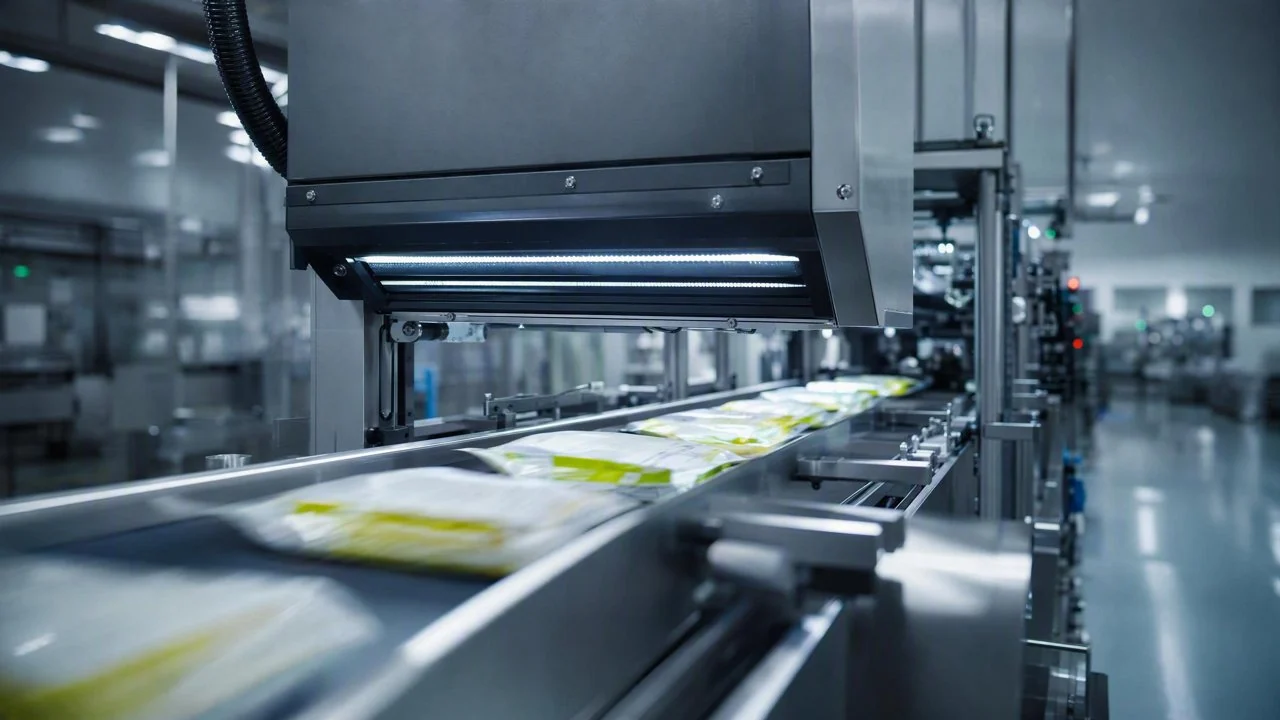
DaoAI's 2D AI AOI equipment (high-resolution 2D imaging + deep learning re-evaluation, targeting surface/print/OCR/assembly defects, high-speed online full inspection, micron-level accuracy, semantic false positive filtering) replaced traditional manual inspection, reducing the manual re-inspection rate for packaging seal integrity at a leading food manufacturer from approximately 15% to <2%, significantly optimizing labor costs and production efficiency.
In the food industry, packaging seal quality is crucial for ensuring product safety, extending shelf life, and maintaining brand reputation. Especially for moisture-sensitive, oxygen-sensitive, or microbiologically sensitive foods such as puffed snacks, dairy products, and meat products, any minute seal defect can lead to product spoilage, triggering food safety issues and substantial recall costs. Traditional packaging seal inspection heavily relies on manual visual inspection, which faces significant challenges in efficiency, accuracy, and consistency on high-speed, high-volume production lines. DaoAI's 2D AI AOI equipment is specifically designed to address this core pain point, enabling food enterprises with high-precision, fully automated quality control on their production lines through advanced vision technology and intelligent algorithms.
Pain Points: Why This Hurdle Is So Difficult to Overcome
In the inspection of food packaging seals, labels, and codes, manual visual inspection faces multi-dimensional and difficult-to-quantify challenges. First, there's a **high risk of missed detections**: for micron-level seal wrinkles, subtle air leak channels, or blurry/missing inkjet characters, the human eye is highly prone to fatigue on high-speed lines (e.g., hundreds of packages per minute), leading to missed detection rates as high as 2-5%. This directly jeopardizes food safety and brand reputation. Second, **high false positive rates and re-inspection costs**: due to environmental lighting changes, packaging material reflections, and product textures, manual judgments often result in false positives, requiring significant human resources for secondary re-inspection. A client's data showed that manual re-inspection labor could account for over 30% of total inspection hours. Third, **high labor costs and recruitment difficulties**: the food industry widely faces rising labor costs and a reluctance among younger workers to perform tedious, repetitive tasks. Recruiting and training qualified QC personnel is increasingly difficult, and high staff turnover adds to operational burdens. Finally, **long changeover downtime**: when product specifications or packaging materials change, manual inspection rules require retraining and adaptation, leading to extended production line downtime and impacting efficiency.
The root cause of these difficulties lies in the **complexity and diversity of food packaging**. For instance, composite film packaging materials often have subtle textures or printed patterns that can be confused with defects; transparent or translucent packaging can produce reflections or refractions under light sources, interfering with image acquisition; high-speed lines demand extremely short exposure and processing times, making it difficult for traditional rule-based vision to balance speed and accuracy. Moreover, leak detection often involves minute deformations or bubbles, requiring extremely high resolution and algorithm sensitivity. Against the backdrop of the industry trend “how AI smart cameras improve inspection efficiency by simplifying operation processes in complex manufacturing scenarios,” traditional vision systems often require engineers to write complex rules and parameters, which is time-consuming and labor-intensive, and struggles to adapt to diverse products and defect types, limiting their application in the food industry.
Technical Principles
DaoAI's 2D AI AOI equipment effectively overcomes these challenges with its core technologies. The device employs a **high-resolution 2D imaging system**, equipped with industrial line scan or area scan cameras, combined with customized lighting (e.g., polarized light, multi-angle ring light). This setup captures micron-level details of packaging seals, labels, and codes, effectively suppressing reflections and texture interference to ensure high-quality image data input. The core lies in its integrated **deep learning re-evaluation engine**. Unlike traditional rule-based vision (based on thresholds, edge detection, etc., hard-coded logic), DaoAI's 2D AI AOI utilizes advanced Convolutional Neural Networks (CNNs) and Transformer architectures. By learning from a large number of good samples and a few defect samples, it establishes a precise cognitive model of 'good products.' This means it can identify **semantic-level defects**, not just pixel-level anomalies. For example, for minor wrinkles or indentations on a seal, the human eye might struggle to distinguish if they affect seal integrity, but DaoAI's 2D AI AOI deep learning model can learn the correlation between different degrees of wrinkles and actual leak risks, making a more intelligent judgment.
The power of DaoAI's 2D AI AOI also lies in its **semantic false positive filtering capability**. Through deep learning's feature recognition and contextual understanding, the system can differentiate between 'false defects' caused by packaging material characteristics (e.g., print patterns, creases, surface textures) and genuine quality issues. This results in **significantly lower false positive rates** for DaoAI's 2D AI AOI in complex scenarios compared to traditional rule-based AOI, thereby greatly reducing the need for manual re-inspection. Furthermore, combined with DaoAI's APDT positive/few-shot learning technology, the equipment requires only 1–20 good samples to complete model training in 5 minutes, achieving 0-code automatic programming. This greatly simplifies the operation process and improves changeover efficiency, in stark contrast to traditional AOI where engineers spend hours or even days writing rules. Compared to traditional manual visual inspection, DaoAI's 2D AI AOI can operate stably 24/7, with detection speeds of hundreds of items per minute, and its detection accuracy and consistency far exceed human capabilities, controlling the missed detection rate to <0.5%. This fundamentally solves the problems of high labor costs, low inspection efficiency, and high risk of missed detections.
Typical Application Scenarios
- **Packaging Seal Integrity Inspection**: For various packaging types such as heat seals, pressure seals, and ultrasonic seals, DaoAI's 2D AI AOI can detect minute defects like wrinkles, bubbles, foreign matter inclusions, cold welds, damage, and contamination at the seal. The challenge lies in the diversity of packaging materials and the minute, irregular nature of defects, requiring the system to have high-resolution imaging and sensitive recognition of subtle texture variations.
- **Label Position and Print Quality Inspection**: Detects whether labels are misaligned, peeling, damaged, have blurred or misplaced print content, color deviation, or illegible barcodes/QR codes. The difficulty lies in precise label positioning during high-speed movement and distinguishing complex print patterns from backgrounds. DaoAI's 2D AI AOI's OCR function and defect classification capabilities are crucial here.
- **Inkjet Code Content and Clarity Inspection**: Verifies that inkjet codes for production dates, batch numbers, expiration dates, etc., are correct, complete, and clear, and checks for missing, double-printed, incomplete, or blurred characters. The challenge is that inkjet characters are often small, have low color contrast, and are susceptible to issues like clogged print heads or printing speed. DaoAI's 2D AI AOI's Optical Character Recognition (OCR) and quality assessment algorithms effectively handle these.
- **Product Assembly Omissions and Foreign Object Detection (Inside Packaging)**: For transparent or translucent packaging, inspects whether all product components are present and if there are any extraneous foreign objects. For example, checking the correct number of candies in a package or the presence of packaging material debris. The difficulty lies in inspecting through packaging materials and the similarity between target objects and the background. DaoAI's 2D AI AOI, combined with specific lighting, can enhance target contrast and use deep learning for precise recognition.
Case Study
A leading domestic snack food manufacturer operates multiple high-speed packaging lines, each processing hundreds of puffed food packages per minute. Previously, their packaging seal, label, and inkjet code inspection relied primarily on a three-shift manual visual inspection team, with 3-4 QC personnel per line. However, due to the high line speed, reflective packaging materials, and minute seal defects, the manual inspection's missed detection rate remained high, leading to significant monthly customer complaints and return costs due to packaging issues. More critically, the intense, repetitive work resulted in high staff turnover, with increasing costs for recruiting and training new employees, severely impacting production continuity and quality stability. The manufacturer urgently needed an automated solution that could replace manual labor, improve efficiency, and enhance accuracy.
After implementing DaoAI's 2D AI AOI equipment, the situation changed dramatically. DaoAI's engineering team deployed a customized 2D AI AOI system on the manufacturer's packaging lines, using multi-angle lighting and high-resolution cameras to capture images of packaging seals, labels, and inkjet codes. Through APDT few-shot learning, the system completed model training in less than 10 minutes, using only 15 good samples and a few defect images, achieving precise recognition of various defects such as seal wrinkles, air leaks, misaligned labels, and blurry inkjet codes. After deployment, the system achieved 100% online full inspection and increased detection speed to 600 pieces/minute. The manual re-inspection rate decreased from approximately 15% before deployment to <2%, meaning the QC team could dedicate more effort to production process optimization and complex problem analysis, rather than simple defect identification. The deployment of DaoAI's 2D AI AOI allowed the manufacturer to successfully reduce the number of manual QC personnel per line from 3-4 to 1 (responsible for supervision and anomaly handling), saving millions in labor costs annually, while also increasing the product qualification rate by 0.8%, effectively reducing recall risks and brand losses.
DaoAI's 2D AI AOI significantly reduced reliance on manual inspection, cutting traditional manual re-inspection rates by over 85%, effectively optimizing labor costs and production efficiency.
DaoAI Solutions and Products
DaoAI provides a comprehensive, efficient, and intelligent 2D AI AOI solution for packaging seal, label, and inkjet code inspection in the food/agriculture industry. The core product is the **DaoAI 2D AI AOI equipment**, which integrates high-performance industrial cameras, customized lighting, edge computing units, and DaoAI's self-developed AI AOI software system. This system, with its unique **visual foundation model feature recognition** capability, enables 0-code automatic programming in 5 minutes with just one good sample, greatly lowering deployment and maintenance barriers. Its powerful **APDT positive/few-shot learning** function allows for rapid model training with only 1-20 good samples, adapting to the fast product iteration and diverse packaging characteristics of the food industry. Semantic false positive filtering is another major highlight of DaoAI's 2D AI AOI, effectively distinguishing real defects from background interference, keeping false positive rates extremely low, and thus significantly reducing manual re-inspection workload. DaoAI solutions support 100% local private deployment, ensuring customer data security remains on-site, meeting the strict data compliance requirements of the food industry.
During implementation, DaoAI's engineering team provides end-to-end services, from initial demand analysis, imaging solution design, equipment integration, and model training to post-deployment operation and maintenance. By smoothly integrating with existing customer production lines, the DaoAI 2D AI AOI equipment achieves high-speed online full inspection, outputs real-time detection results, and links with the production line's PLC system for automatic rejection of defective products. Furthermore, the DaoAI World foundation model, as a unified platform, ensures the system's semantic understanding and cross-scenario generalization capabilities, allowing it to continuously learn from production line feedback and optimize detection performance. By deploying DaoAI's 2D AI AOI equipment, customers can not only significantly reduce labor costs, enhance detection accuracy and efficiency, but also effectively mitigate food safety risks and improve brand competitiveness. This solution reduces the average manual inspection missed detection rate from 2% to <0.5% and decreases the manual re-inspection rate by over 85%, significantly boosting overall production efficiency and product quality.
FAQ
How does DaoAI's 2D AI AOI equipment address issues caused by reflections on food packaging?
DaoAI's 2D AI AOI equipment utilizes customized multi-angle lighting (such as polarized light or ring light) and advanced image processing algorithms. This effectively suppresses reflections and refractions from packaging material surfaces, enhancing the contrast between defects and the background. This ensures clear, high-quality images even under complex lighting conditions, thereby improving detection accuracy.
Compared to other vision inspection solutions, what advantages does DaoAI's 2D AI AOI offer in optimizing labor costs?
DaoAI's 2D AI AOI's key advantage lies in its deep learning re-evaluation and semantic false positive filtering capabilities, significantly reducing false positive rates and the need for manual re-inspection, thereby directly decreasing reliance on a large number of QC personnel. Additionally, APDT few-shot learning and 0-code programming drastically cut down model training and line changeover times, reducing long-term investment in specialized vision engineers, optimizing labor costs from multiple angles.
Does this equipment support high-speed online inspection, and will it affect existing production line cycle times?
Yes, DaoAI's 2D AI AOI equipment is specifically designed for high-speed online full inspection. It incorporates high-performance industrial cameras and edge computing units, achieving single-unit detection speeds of hundreds of products per minute. It can be smoothly integrated into existing production lines, performing real-time image acquisition, AI analysis, and result output without impacting current line cycle times, ensuring production continuity and efficiency.
This article was generated by AI. Customer cases are simulated scenarios based on real product capabilities and figures are illustrative; see product pages for official benchmarks.