
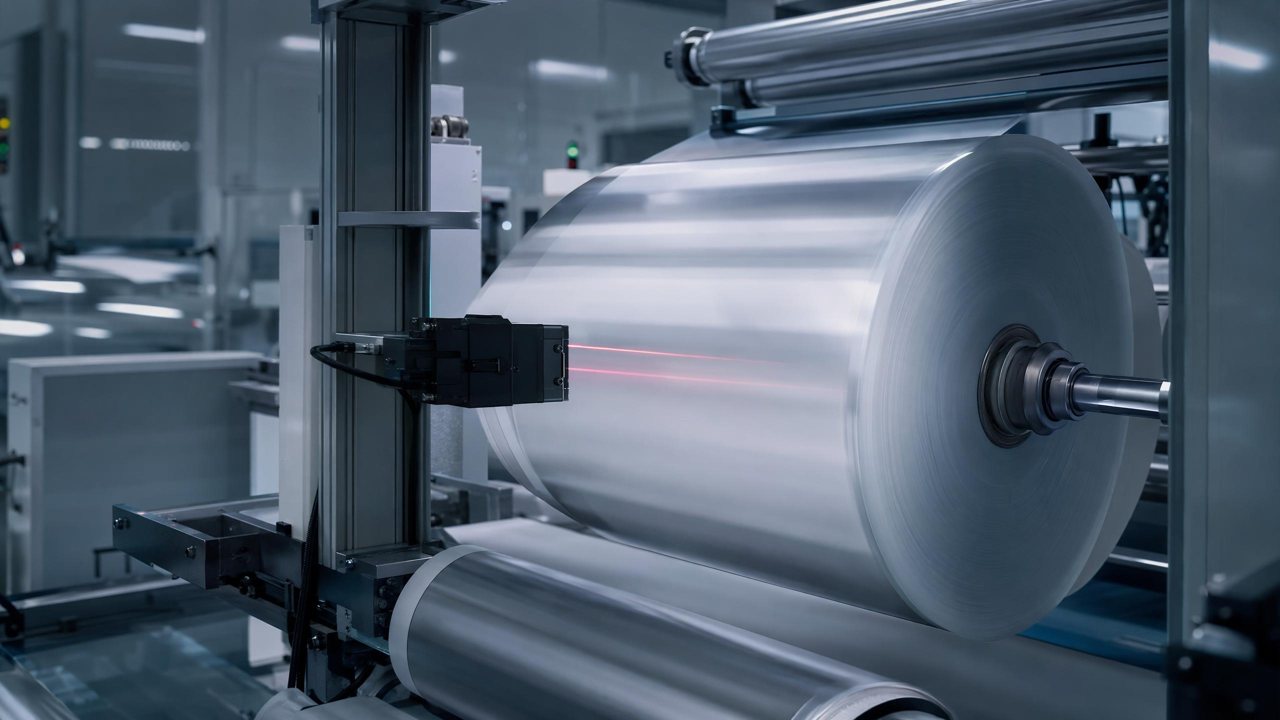
In the production of special printed films within the chemical materials industry, high-quality printing is central to product competitiveness. However, traditional defect detection methods often struggle with complex and variable printing defects, especially subtle and environmentally sensitive flaws like color misalignment. High false positive rates not only increase manual re-inspection costs but also slow down overall production throughput. DaoAI 2D AI AOI equipment, with its advanced image acquisition and deep learning technology, offers a groundbreaking solution for the industry.
DaoAI 2D AI AOI equipment (high-resolution 2D imaging + deep learning secondary judgment, targeting surface/print/OCR/assembly defects, high-speed inline full inspection, micron-level, semantic false positive filtering) significantly improved detection efficiency and product quality by reducing the color misalignment false positive rate from 12% to <1.5% for a leading chemical material manufacturer's printed film rolls, through high-precision image acquisition and deep learning semantic judgment. In the chemical/materials industry, particularly in the production of functional films and specialized labels, print quality is a critical measure of product performance and market competitiveness. As downstream applications demand increasingly stringent requirements for product appearance and functionality, even micron-level color misalignment or printing defects can lead to the rejection of entire product batches. A leading chemical material manufacturer, a global supplier of specialized films, has products widely used in high-value-added fields such as consumer electronics, new energy vehicles, and medical devices. One of its core products is precision printed film rolls for high-end packaging and electronic labels, where color registration accuracy directly impacts the final product's visual effect and brand image. The client's production line requires 100% inline full inspection of each film roll, spanning thousands of meters, to ensure accurate color registration for all printed patterns.
Pain Points: Why This Hurdle Was Difficult to Overcome
This leading manufacturer faced multiple challenges in detecting color misalignment in printed film rolls: First, high false positive rates were a persistent issue. Traditional rule-based AOI systems were highly sensitive to subtle variations in ambient light, material texture, and slight jitters at the edge of print dots, leading to false positive rates as high as 12%, significantly above the industry average. This not only resulted in a large number of good products being misidentified but also drastically increased the workload for manual re-inspection. Each shift required at least 3 experienced quality inspectors to spend 4-6 hours on manual verification, severely slowing down the overall production rhythm. Second, the risk of missed detections remained. For some color misalignments with complex backgrounds or similar colors, traditional AOI algorithms struggled to differentiate accurately, leading to a small number of real defects being overlooked, posing risks of customer complaints and damage to brand reputation. Third, changeover and debugging were time-consuming. The manufacturer's diverse product portfolio and frequent switching between different product specifications and print patterns meant that traditional AOI systems required 1-2 hours for parameter adjustments and rule writing during each changeover, resulting in long downtime and inefficient production. These issues collectively increased the detection cost per unit and constrained the further improvement of production line capacity.
The root causes of these difficulties lie in the complexity of the printing process, the diversity of material characteristics, and the limitations of traditional detection technologies. Even with tension control, slight deformation and jitter are inevitable in printed films running at high speeds, making color misalignment defects blurry and irregular. Furthermore, variations in ink color and substrate surface gloss between different batches can interfere with the threshold judgments of traditional vision algorithms. While manual inspection offers some flexibility, its efficiency, accuracy, and consistency are limited by human eye fatigue and subjective judgment, making it insufficient for modern high-throughput, high-standard production demands. Today's industry focus on key technologies for simplifying deployment and enhancing detection efficiency with AI smart cameras precisely aims to address core pain points such as high false positives, difficult deployment, and low efficiency of traditional detection solutions in complex scenarios. The client urgently needed an adaptive, high-precision, low false positive intelligent detection solution to overcome these bottlenecks.
Technical Principles
DaoAI 2D AI AOI equipment fundamentally resolves the challenges of color misalignment detection in printed film rolls by combining high-resolution 2D imaging systems with advanced deep learning secondary judgment technology. Its core lies in utilizing custom high-speed industrial cameras and precision optical modules, capable of stably acquiring micron-level resolution images of printed film surfaces on high-speed production lines, ensuring that even subtle color registration deviations are clearly captured. At the image processing level, the DaoAI AI AOI software system incorporates a proprietary visual foundation model. This model, through its APDT positive/few-shot learning mechanism, can quickly build high-precision defect recognition models with just 1–20 good sample images. Compared to traditional rule-based AOI, our model learns and understands the complex semantic information and normal variation range of print patterns, rather than simply matching pixel differences.
Specifically, for color misalignment defects, the DaoAI 2D AI AOI system first uses high-resolution imaging to capture the edge details of multi-layer printed patterns. Subsequently, the deep learning model performs feature extraction and semantic analysis on these images. It can distinguish between 'normal' printing tolerance ranges and 'abnormal' color shifts. In particular, its 'semantic false positive filtering' function is key to solving the high false positive rate. This function analyzes the contextual information and overall pattern structure of defect areas, filtering out false positives caused by material texture, slight jitters, or non-defective pattern features. For example, in areas where background colors are similar to print colors, or where there are slight edge burrs, traditional AOI might misidentify them. However, the DaoAI system can recognize these as normal variations, thereby reducing the false positive rate by more than -90%. Unlike traditional AOI, which relies on engineers to manually write complex rules, the deep learning model of DaoAI 2D AI AOI learns autonomously from data, greatly simplifying deployment and maintenance, and achieving micron-level detection accuracy for color misalignment, with a stable missed detection rate below <0.5%.
Typical Application Scenarios
- **Multi-color Print Color Misalignment Detection:** DaoAI 2D AI AOI can monitor high-speed printed film rolls in real-time, accurately identifying registration deviations between different color layers. The challenges lie in correcting image distortion at high speeds, precisely determining micron-level misalignments, and filtering false positives in complex pattern backgrounds.
- **Surface Foreign Matter and Contamination Detection:** For oil stains, dust, fibers, and other foreign matter on the surface of printed films, DaoAI 2D AI AOI performs highly sensitive detection. The difficulty is distinguishing between inherent product characteristics (e.g., texture, reflection) and actual foreign matter to avoid over-sensitivity leading to false positives.
- **Character OCR and Barcode Recognition:** On labels and packaging films, it performs character recognition and verification for batch numbers, production dates, QR codes, etc. Challenges include the clarity of printed characters, diversity of fonts, and high-precision recognition in complex backgrounds, which the DaoAI 2D AI AOI system can effectively handle.
- **Pattern Missing and Incomplete Detection:** Checks for partial absence, breakage, or blurriness in printed patterns. The challenge is robustly identifying irregular imperfections and quickly locating and classifying these defects over large print areas.
- **Film Surface Scratch and Dent Detection:** Targets subtle scratches, dents, and other surface defects on the base material or coating of printed films. The difficulty is that these defects are often very subtle and variable, requiring extremely high imaging resolution and the generalization capability of AI models.
Case Study
In collaboration with a leading chemical material manufacturer, DaoAI 2D AI AOI equipment was successfully deployed on multiple printed film production lines. The client's production line operates at an extremely fast pace, with printed film rolls moving at linear speeds up to 150 meters/minute, posing very high demands on the detection system's real-time performance and accuracy. Before deployment, the client used a combination of traditional rule-based AOI and manual inspection, which resulted in color misalignment false positive rates consistently between 10%–15%. This required at least 3 quality inspectors to perform up to 6 hours of manual re-inspection daily, yet still carried a risk of some missed detections. To address this pain point, the DaoAI team first conducted a detailed analysis of the client's various printed film products. Using the APDT few-shot learning function of the DaoAI AI AOI software system, they trained the first defect detection model in just 30 minutes with only 15 good sample images provided by the client. Subsequently, through online debugging and continuous optimization, the DaoAI 2D AI AOI system successfully took over the critical task of color misalignment detection.
"DaoAI 2D AI AOI has not only significantly reduced our false positive rate but also enabled automated and intelligent inspection, completely transforming our approach to print quality control. Now, our quality inspectors can focus on more valuable quality analysis work." — Client Quality Manager
After deployment, the DaoAI 2D AI AOI equipment performed exceptionally well, stably controlling the color misalignment false positive rate for printed film rolls to <1.5%, and reducing the missed detection rate to <0.4%. This means the manufacturer can reduce nearly -90% of manual re-inspection workload daily, cutting what used to be a 3-person, 6-hour task to less than 1 person-hour, significantly freeing up human resources. Concurrently, changeover time was reduced from the original 1–2 hours to 5min, markedly improving production line utilization. The successful implementation of this solution not only enhanced the client's product quality and market competitiveness but also provided valuable experience for the intelligent upgrade of other high-value-added printing product lines.
DaoAI Solutions and Products
The core solution provided by DaoAI to this client was based on its 2D AI AOI equipment, which integrates a high-resolution 2D imaging module and the DaoAI AI AOI software system. During deployment, DaoAI engineers first selected suitable line scan cameras and lighting solutions for high-speed web material inspection, based on the client's production line environment and detection requirements, ensuring stable and clear image acquisition. The DaoAI AI AOI software system, with its intuitive 0-code programming interface, allows client site engineers to complete a new product's detection model configuration in just 5 minutes. Its APDT positive/few-shot learning capability enables rapid training of high-precision models with only 1–20 good samples, greatly simplifying the model iteration and product changeover processes. Furthermore, the semantic false positive filtering function effectively avoids common misjudgments in traditional AOI caused by complex backgrounds, texture interference, and other factors, ensuring detection accuracy and stability. DaoAI also offers 100% local private deployment options, ensuring that client data remains on-premises, meeting their strict data security requirements.
The successful implementation of this solution fully demonstrates the strong adaptability and excellent performance of DaoAI 2D AI AOI in complex industrial scenarios. Through our products, the client achieved a leap from traditional reliance on human experience to intelligent automated inspection, not only significantly enhancing product quality control but also substantially reducing production operating costs. DaoAI is committed to helping more enterprises in the chemical/materials industry achieve intelligent upgrades in their production processes through leading AI vision technology, addressing future market challenges.
FAQ
How does DaoAI 2D AI AOI equipment handle printing defects in complex backgrounds?
DaoAI 2D AI AOI equipment utilizes a deep learning visual foundation model that learns and understands the semantic information and normal variation range of complex print patterns. Its semantic false positive filtering function analyzes the context and overall structure of defect areas, effectively distinguishing true defects from background interference, material textures, and other non-defect features, thereby significantly reducing false positive rates and enhancing detection robustness.
How efficient is DaoAI 2D AI AOI deployment for production lines with frequent changeovers?
The DaoAI AI AOI software system within DaoAI 2D AI AOI supports APDT positive/few-shot learning, allowing high-precision models to be built rapidly with just 1–20 good sample images. Combined with a 0-code automated programming interface, client site engineers can configure a new product's detection model in just 5 minutes, reducing changeover time from hours to minutes and significantly improving production line flexibility and utilization.
How does DaoAI 2D AI AOI ensure data security, and does it support local deployment?
DaoAI offers a 100% local private deployment option, ensuring that all inspection data and model training data are processed and stored within the client's internal network, with data never leaving the premises. This meets the stringent data security and privacy requirements of chemical material manufacturers, ensuring their core production data is fully protected.
This article was generated by AI. Customer cases are simulated scenarios based on real product capabilities and figures are illustrative; see product pages for official benchmarks.