
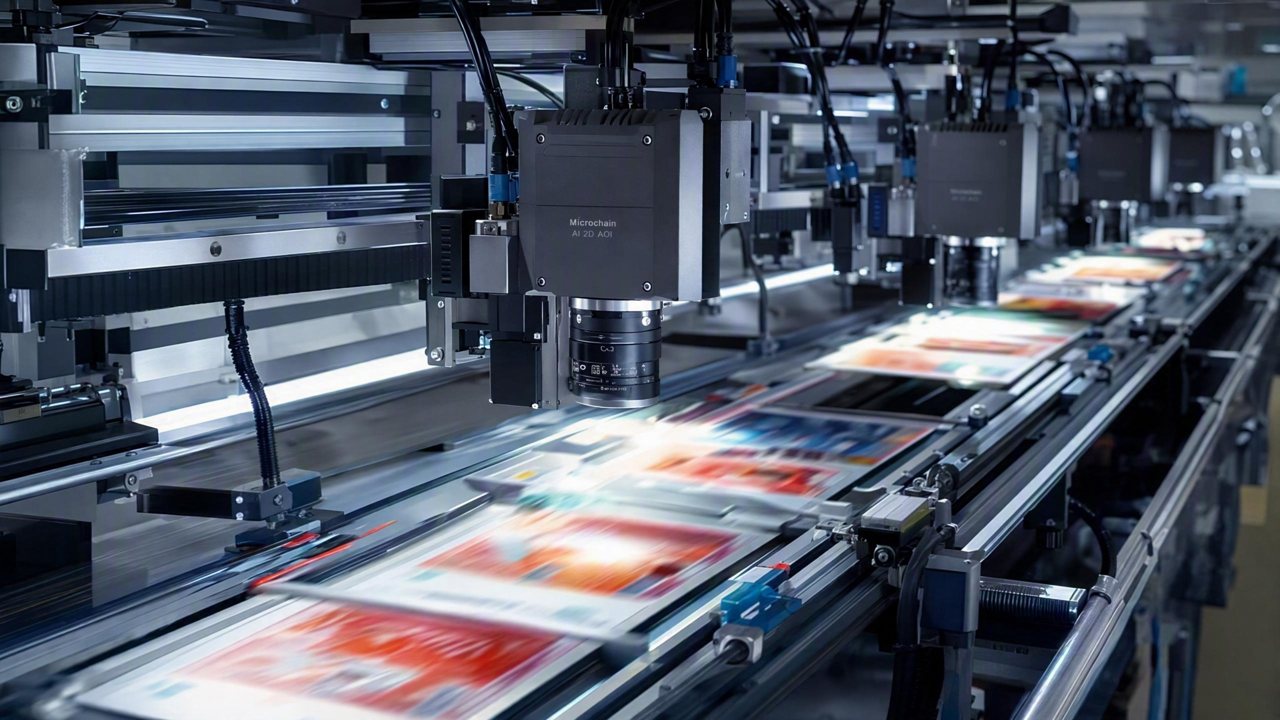
DaoAI 2D AI AOI equipment (high-resolution 2D imaging + deep learning secondary judgment, targeting surface/print/character OCR/assembly omissions and other planar defects, high-speed inline full inspection, micron-level, semantic false positive filtering) effectively addresses core issues such as high false positives and slow changeovers caused by subtle color registration misalignment and character print deviations in consumer product packaging printing, reducing the false positive rate in manual re-inspection by -65% through APDT few-shot self-training capabilities. In the consumer goods sector, packaging boxes are not merely physical carriers but direct representations of brand image and market competitiveness. Especially in fast-moving consumer goods industries like food, cosmetics, and electronics, the printing quality, color consistency, text clarity, and pattern registration accuracy of packaging boxes directly influence consumers' initial perception and purchasing decisions. However, with the increase in personalized, small-batch orders and the widespread adoption of high-precision, multi-color printing processes, traditional quality inspection methods face growing challenges in dealing with micro-defects in packaging prints. Particularly, subtle color registration deviations, blurry characters, or 'burrs' on graphic edges are not only difficult for the human eye to quickly identify but also prone to generating a large number of false positives even with traditional rule-based AOI, leading to low production efficiency and soaring manual re-inspection costs.
In the consumer product packaging printing industry, the visual quality of products is key to capturing consumer mindshare. Especially in the printing of high-end customized and limited-edition products, any minor flaw can impact brand image and market acceptance. In the printing process, the accuracy of ink registration, the clarity of character printing, and the integrity of various patterns are important criteria for measuring product quality. As the market demands increasing packaging diversity and rapid iteration, traditional sampling inspection or reliance on manual visual inspection methods can no longer meet the needs of high-speed, high-precision production. Faced with millions of packaging boxes daily, even micron-level color registration deviations or ink overflows must be accurately identified and removed early in production to avoid large-scale rework and brand damage risks. DaoAI is committed to providing efficient and reliable automated inspection solutions for such scenarios.
Pain Points: Why This Hurdle Is So Difficult to Clear
In the packaging box printing sector, especially in scenarios involving multi-color overprinting and complex patterns, traditional quality inspection faces multiple challenges: First, extremely high false positive rates are common. A leading packaging printing manufacturer reported that its traditional rule-based AOI system had a false positive rate as high as 35% when detecting color registration deviations, leading to over 6 hours of daily manual re-inspection time, severely dragging down production line efficiency. Second, long changeover downtime is an issue; whenever product batches are changed or print content is adjusted, traditional AOI requires several hours for parameter tuning and rule reconstruction, resulting in an average changeover downtime exceeding 1.5 hours, directly affecting production rhythm. Furthermore, for new and complex defects, such as the high-precision coating defects common in automotive manufacturing, manual visual inspection or traditional AOI struggles to adapt. Consumer product packaging faces similar challenges, such as minor scratches on metallic inks or slight deformations in embossed patterns. These defects often have 'soft' characteristics, making them difficult to precisely define with fixed thresholds or hard-coded rules, potentially leading to a leak detection rate of 3-5%, severely impacting the yield of qualified products.
The root cause of these difficulties lies in the inherent complexity of the printing process. The superposition of multiple layers of ink, the impact of different materials (e.g., cardboard, laminated film) on light reflection and absorption characteristics, and subtle deformations caused by fluctuations in ambient temperature and humidity during printing all contribute to high uncertainty in defect imaging. For instance, a subtle color registration misalignment might appear as a normal edge from certain angles but as a defect from others. Additionally, in character OCR detection, slight ink bleeding can cause character strokes to merge, but not entirely blur. This ambiguous state, somewhere between 'good' and 'defective,' poses a significant challenge for traditional AOI algorithms based on fixed pixel differences or template matching. The minuscule scale (typically tens to hundreds of microns) and diversity of these defects make it difficult for any single rule to cover all cases, rendering manual visual inspection inefficient and inconsistent on high-speed production lines.
Technical Principles
DaoAI 2D AI AOI equipment effectively tackles complex micro-defects in packaging printing by combining high-resolution 2D imaging with deep learning-based secondary judgment technology. Its core lies in the introduction of APDT (Adaptive Pre-training and Dynamic Tuning) few-shot self-training capability. Unlike traditional deep learning models that require a large number of defect samples for training, APDT allows the model to quickly adapt to new inspection tasks with only 1-20 good samples (or a small number of defect samples). DaoAI's APDT technology first leverages a visual foundation model pre-trained on massive generic industrial images, which already possesses strong feature recognition capabilities, enabling it to understand universal visual elements like textures, edges, and shapes in various images. When faced with a new printing inspection task, APDT, through its dynamic tuning mechanism, transfers and focuses this general feature knowledge onto the specific good patterns of the target print, thereby achieving sensitive capture of subtle deviations and anomalies.
Compared to traditional methods, the advantages of DaoAI 2D AI AOI are significant. Traditional rule-based AOI relies on engineers manually writing complex rule sets and thresholds, requiring precise definitions for each defect type, and exhibiting poor robustness to changes in ambient light, material texture, etc., leading to persistently high false positive rates and long changeover times. Manual visual inspection, on the other hand, is limited by eye fatigue, subjective judgment differences, and production rhythm constraints. DaoAI, through its AI algorithms, can perform 'semantic-level' understanding of defects, for example, distinguishing between 'normal texture of a printed pattern' and 'ink splatter,' thereby significantly reducing semantic false positives. This advantage of deep learning judgment allows DaoAI to reduce the false positive rate for complex printed materials by over -65% while shortening the changeover time for new products from hours to 5min, greatly enhancing production line flexibility and efficiency. Furthermore, the micron-level detection accuracy of the DaoAI 2D AI AOI system can capture subtle defects invisible to the human eye, ensuring the ultimate quality of outgoing products.
Typical Application Scenarios
- **Multi-color Overprint Misregistration Detection:** In multi-color printing, the registration accuracy between different color blocks is crucial. DaoAI 2D AI AOI equipment can detect minute offsets between print color blocks with micron-level precision, such as misregistration between any two colors in CMYK four-color printing. The challenge lies in the different diffusion characteristics of various inks on paper, requiring AI to learn and identify subtle and irregular edge deviations.
- **Character OCR Print Quality Inspection:** Comprehensive inspection of the print quality of variable information and fixed characters such as product batch numbers, production dates, barcodes, and QR codes, including character absence, blurriness, stroke adhesion, ink spots, breaks, and print position shifts. The difficulty lies in font diversity, complex backgrounds, and varying ink performance on different materials, which DaoAI can efficiently handle.
- **Surface Stains and Ink Splatter:** Common ink stains, splatters, scratches, indentations, and dirt on printed surfaces. These defects are often small, irregular in shape, and similar to background textures, making traditional methods highly prone to false positives. DaoAI uses deep learning to effectively distinguish these random defects from normal patterns.
- **Graphic/Text Omissions and Deformations:** Detecting 'burrs' on pattern edges, partial absence of graphics or text, pattern deformation, missed prints, and plate clogging issues. Particularly, fine lines or complex textures are prone to incomplete printing under high-speed conditions, which DaoAI can accurately identify.
- **Lamination and Varnishing Defects:** Addressing defects such as bubbles, scratches, trapped dust, and uneven gloss after lamination or varnishing on packaging boxes. These defects are often only visible under specific lighting conditions, and DaoAI's high-resolution imaging combined with intelligent algorithms can effectively capture and differentiate them.
Case Study
A medium-sized packaging printing enterprise in East China, primarily undertaking custom packaging box printing for the food and pharmaceutical industries, characterized by multi-color high-precision printing and frequent changeovers. Previously, the company was plagued by high false positive rates and lengthy changeover times of its traditional AOI system. To detect subtle color misregistration and character defects, the production line had to employ multiple quality inspectors for round-the-clock re-inspection, leading to high labor costs, and the accuracy of manual re-inspection varied greatly due to individual differences. Before adopting the DaoAI 2D AI AOI equipment, their new product introduction typically required 3-4 hours for AOI parameter configuration and debugging, with daily cumulative downtime and manual re-inspection time due to false positives exceeding 8 hours. After an in-depth evaluation of the DaoAI solution, they decided to deploy the DaoAI 2D AI AOI system on two core printing lines.
“DaoAI's APDT few-shot self-training capability has completely changed our perception of new product introduction. Now, changeovers can be completed in 5 minutes, almost plug-and-play, which was unimaginable before.”
After deployment, the DaoAI 2D AI AOI system, leveraging its APDT few-shot self-training capability, only required 5-10 good samples to complete model training and production line changeover for new products within 5min, significantly reducing production line downtime. Through high-resolution imaging and deep learning semantic judgment, the system accurately identifies various micron-level defects, keeping the overall leak detection rate below <0.4% while reducing the false positive rate by -65%. The workload for manual re-inspection was significantly reduced, with daily quality inspector re-inspection hours decreasing from 8 hours to 2 hours, greatly optimizing human resource allocation. The enterprise stated that the DaoAI solution not only improved product quality consistency but also effectively reduced operating costs and enhanced market competitiveness.
DaoAI Solutions and Products
DaoAI's core solution is based on its powerful DaoAI AI AOI software system and 2D AI AOI equipment. The system centers on a visual foundation model, featuring APDT positive/few-shot learning capabilities. Users only need to provide 1-20 good images to complete model self-training and deployment within 5min. This '0 code' automatic programming feature greatly lowers the threshold for AOI system usage and changeover costs. The DaoAI 2D AI AOI equipment integrates high-resolution industrial cameras and high-performance computing units, enabling high-speed inline full inspection at tens of frames per second, capturing subtle defects at micron-level dimensions. Its unique semantic false positive filtering mechanism intelligently distinguishes between the product's normal textures, background noise, and actual defects, effectively suppressing false positives and preventing unnecessary production line downtime. Furthermore, the DaoAI AI AOI software system supports various deployment methods such as SDK/API/Docker and allows 100% local private deployment, ensuring customer data security. For more complex scenarios, DaoAI can also integrate with the DaoAI World global model to achieve cross-scenario generalization and continuous learning, continuously optimizing detection performance.
By deploying DaoAI 2D AI AOI equipment, customers have realized significant business value in packaging box printing defect detection. First, product quality consistency is ensured, with the leak detection rate strictly controlled below <0.4%, safeguarding brand image and customer satisfaction. Second, production efficiency has greatly improved, with new product changeover time reduced to 5min, minimizing non-production time. Third, the false positive rate has decreased by -65%, significantly reducing manual re-inspection workload and lowering operating costs. Finally, the flexibility and adaptability of the DaoAI solution enable enterprises to respond faster to market changes, accept more personalized, small-batch orders, and enhance market competitiveness. These quantified results collectively represent the core value DaoAI brings to its customers.
FAQ
How does DaoAI 2D AI AOI equipment achieve few-shot learning?
DaoAI 2D AI AOI equipment utilizes APDT (Adaptive Pre-training and Dynamic Tuning) few-shot self-training technology. This technology, based on a pre-trained visual foundation model and its robust feature recognition capabilities, employs a dynamic tuning mechanism to quickly adapt to new inspection tasks with just 1-20 good samples, significantly reducing training data requirements and time.
What are the specific advantages of APDT few-shot self-training for packaging print defect detection?
APDT few-shot self-training drastically shortens the changeover time for new product introduction, from hours to 5min. Simultaneously, it effectively addresses complex micro-defects challenging traditional methods, such as subtle color misregistration and blurry characters, significantly reducing false positive rates and improving detection accuracy, ensuring efficient and stable quality inspection even in small-batch, multi-variety production.
How does DaoAI 2D AI AOI equipment ensure data security and local deployment?
DaoAI product lines support 100% on-premise private deployment, ensuring all inspection and model training data remain within the customer's facility, stored entirely on local servers. We offer flexible deployment options like SDK/API/Docker, allowing customers to choose the most suitable integration scheme based on their IT architecture, strictly adhering to data security compliance requirements.
This article was generated by AI. Customer cases are simulated scenarios based on real product capabilities and figures are illustrative; see product pages for official benchmarks.