
As industrial enterprises actively explore AI applications and strive to navigate the deep waters of implementation, the electronics manufacturing industry faces complex and stringent quality control challenges. Among these, the quality inspection of PCBA silkscreen characters, due to their minute, diverse, and environment-sensitive nature, has become a bottleneck that traditional AOI struggles to overcome. DaoAI 2D ACI equipment (high-resolution 2D imaging + deep learning secondary judgment, for surface/print/OCR characters/assembly defects, high-speed inline full inspection, micron-level, semantic false alarm filtering) precisely identifies PCBA silkscreen character defects, blur, misalignment, and foreign objects, reducing traditional AOI false alarm rates from 15% to 5.7%. This significant improvement not only optimizes the inspection process but also brings substantial economic benefits and quality assurance to clients in actual production.
DaoAI 2D ACI equipment (high-resolution 2D imaging + deep learning secondary judgment, for surface/print/OCR characters/assembly defects, high-speed inline full inspection, micron-level, semantic false alarm filtering) precisely identifies PCBA silkscreen character defects, blur, misalignment, and foreign objects through deep learning models, reducing traditional AOI false alarm rates from 15% to 5.7%. The electronics / PCBA industry, as a core component of modern industry, has product quality directly impacting the performance and reliability of end devices. In the PCBA manufacturing process, silkscreen printing is used to print critical information such as component identifiers, polarity indicators, and version numbers on the circuit board. These characters are not only important for production traceability and repair but also prerequisites for ensuring correct product assembly and functionality. However, due to the tiny size of silkscreen characters, diverse fonts, potentially low color contrast, and common defects such as ink bleeding, breaks, and misalignment during printing, traditional optical inspection methods face significant challenges in this segment. Especially for leading electronics manufacturers with extremely high demands for product consistency, any subtle character defect can lead to batch quality issues and even recall risks. This case focuses on a leading EMS manufacturer with an urgent need for quality inspection of board-level silkscreen characters on their PCBA production line, aiming to solve problems caused by inefficient manual inspection and high false alarm rates of traditional rule-based AOI.
Pain Points: Why This Hurdle is Difficult to Overcome
This leading EMS manufacturer faced multiple challenges in PCBA silkscreen character inspection: Firstly, traditional rule-based AOI systems had a false alarm rate of up to 15% for character defects, leading to significant time spent on manual re-inspection. This required an additional 2-3 skilled workers per shift for re-inspection, greatly increasing labor costs and production cycle pressure. Secondly, due to the wide variety of character defects (e.g., missing ink, broken strokes, blurred characters, print offset, foreign object contamination), and influences from board surface reflections, character color, and background textures, it was difficult for traditional rule-based AOI to develop stable rules covering all situations. This occasionally led to missed detections, especially in small-batch, multi-model production. Changeover rule adjustments were time-consuming, increasing downtime by 30-60 minutes. Thirdly, for micron-level character defects, manual inspection was prone to fatigue, and inconsistent judgment standards among different inspectors led to poor consistency and compliance risks. The current challenge for industrial enterprises venturing into AI, navigating the deep waters of implementation, lies in addressing the actual production benefits and deployment costs of AI applications. For complex scenarios like PCBA silkscreen inspection, the difficulty of traditional methods stems from a lack of 'feature diversity' and 'environmental robustness'.
From a process perspective, the print quality of silkscreen characters is affected by various factors such as ink viscosity, squeegee pressure, and stencil wear, leading to diverse defect morphologies that cannot be precisely described by simple geometric rules. For example, a slight ink bleed might appear differently depending on its location and background. From an imaging perspective, PCBA surfaces often have reflections, solder pad or trace interference, which blur character edges or reduce contrast with the background, making it difficult for traditional image processing algorithms to effectively segment character regions. Furthermore, environmental factors such as production line vibrations and uneven lighting further increase inspection difficulty. These complex variables cause traditional feature extraction and rule-based AOI systems to either false alarm or miss defects when encountering 'atypical' or 'edge' defects, failing to meet high-standard production requirements. Navigating the deep waters of AI implementation specifically requires overcoming these 'long-tail problems' and 'lack of generalization'.
Technical Principles
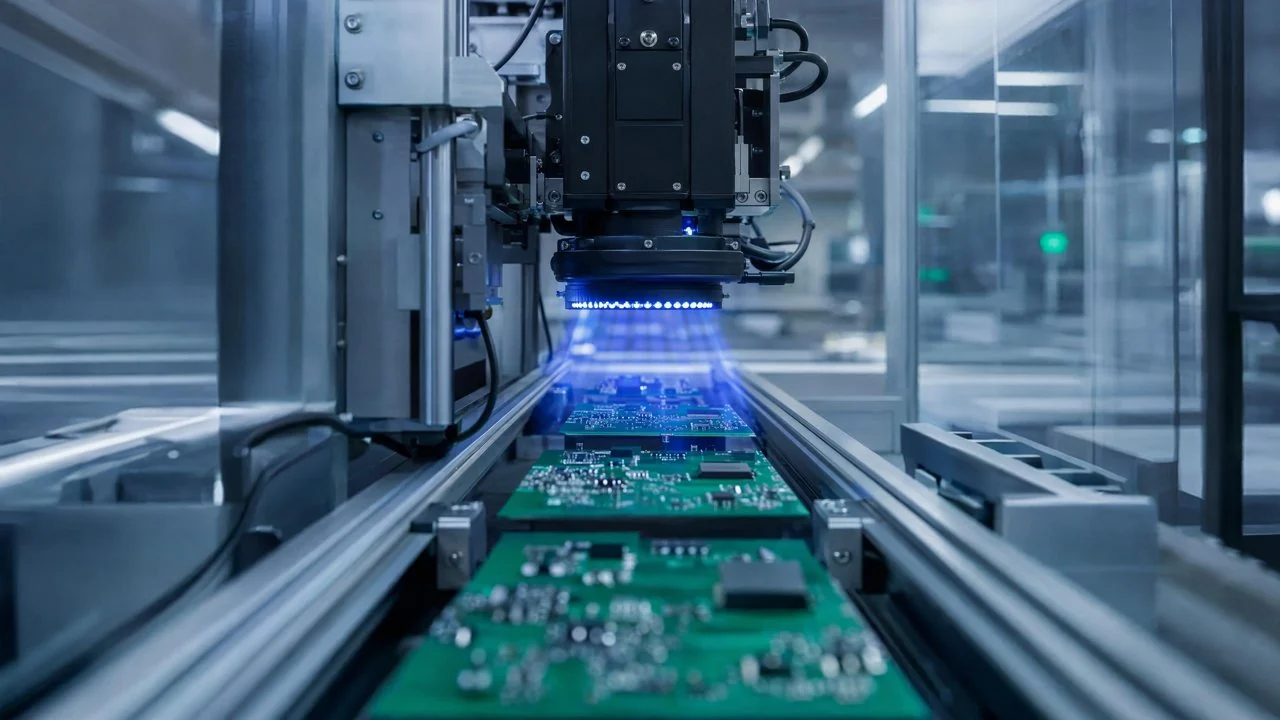
The core of DaoAI's 2D ACI equipment lies in the tight integration of its high-resolution 2D imaging system with deep learning secondary judgment. First, we use industrial-grade high-resolution cameras and precision optical lenses, combined with multi-angle annular lighting, to ensure clear, shadow-free PCBA silkscreen images at micron-level detail, maximizing the restoration of character details. This is the foundation for effective deep learning model operation. Second, after image acquisition, data is transmitted to an industrial controller equipped with the DaoAI ACI OS. This software, based on DaoAI's self-developed vision foundation model, utilizes APDT positive/few-shot learning technology, requiring only 1–20 good samples to complete model training in 5 minutes, with automatic, code-free programming. The model learns and establishes the semantic features of 'normal' silkscreen characters, rather than simple pixel matching. When a deviation from the 'normal' pattern is detected, the system flags it as a potential defect.
Compared to traditional rule-based AOI systems, the advantage of DaoAI's 2D ACI lies in its 'semantic false alarm filtering' capability. Traditional AOI relies on engineers manually setting numerous thresholds and rules (e.g., area, length, contrast). For 'benign' visual variations such as light changes, background textures, or slight deformations, it is prone to false alarms. Our deep learning model, through learning from extensive image data, can understand the 'semantic' meaning of characters, distinguishing between 'normal variations' and 'true defects'. For instance, a tiny ink bleed, if the model determines it does not affect character readability or overall shape, will not be falsely flagged as a defect. This intelligent filtering mechanism significantly reduces false alarms and improves inspection accuracy and efficiency. Furthermore, our system supports 100% local private deployment, ensuring data security and compliance for clients by keeping data on-premises.
Typical Application Scenarios
- **Character Missing and Breaking Detection:** Detects if silkscreen character strokes are missing, broken, or have uneven ink leading to transparent areas. The challenge lies in identifying minute breaks and distinguishing them from normal stroke gaps; the AI model precisely judges defects by learning from numerous normal and abnormal samples.
- **Character Blurring and Smudging Detection:** Identifies blurred character edges or overall smudging caused by ink spread, uneven printing pressure, or foreign object contamination. The difficulty lies in differentiating slight blurring from severe smudging, and interference from board textures; AI judges by perceiving the overall character morphology.
- **Character Misalignment and Deformation Detection:** Checks for character offset, rotation, or deformation relative to the design position. The challenge is high-precision localization and quantification of minute deformation; AI leverages its powerful pattern recognition capabilities to accurately capture these subtle deviations.
- **OCR Character Recognition and Content Verification:** Not only detects character appearance defects but also performs Optical Character Recognition (OCR) to verify if the actual printed content matches the design file, ensuring correct version numbers, batch numbers, and other information. The challenge is high-robustness recognition under varying fonts, sizes, and print qualities; the AI model achieves high accuracy through multi-layer feature extraction.
- **Foreign Object Detection:** Identifies minute foreign objects (e.g., dust, fibers) within the silkscreen area or on characters. The difficulty lies in distinguishing foreign objects from fine features of the characters themselves or background noise; AI's semantic understanding capability effectively filters out irrelevant interference.
Implementation Case Study
A globally leading Tier-1 automotive electronics supplier faced severe silkscreen character quality challenges on its latest in-vehicle controller PCBA production line. This product demands extremely high reliability, and any character printing defect could lead to batch rework or recalls. Previously, they used traditional rule-based AOI for initial inspection, but a false alarm rate of up to 15% meant that three experienced quality inspectors were required daily for manual re-inspection, which was inefficient, taking about 30-40 seconds per board. After introducing DaoAI's 2D ACI equipment, we first conducted an on-site survey, deploying a customized solution based on their production line characteristics and product specifications. During the modeling phase, utilizing the APDT few-shot learning capability of DaoAI ACI OS, a basic model was trained in just 4 minutes using only 15 good PCBA images. Subsequently, the model was iteratively optimized with small-batch production data and rigorously validated.
“DaoAI 2D ACI not only significantly reduced our false alarm rate but, more importantly, freed us from tedious manual re-inspection, allowing us to focus more on process optimization, truly achieving both quality and efficiency improvements.” – Quality Manager, a leading automotive electronics supplier
Post-implementation, the supplier's PCBA silkscreen character inspection efficiency significantly improved. At the supplier's site, compared to traditional rule-based AOI, the false alarm rate dropped from 15% to 5.7%, meaning the workload for manual re-inspection was reduced by 62%. Previously, three quality inspectors were needed for full-time re-inspection; now, one can easily manage. Concurrently, due to the AI model's accuracy, the missed detection rate remained at an extremely low level (<0.5%), well below the industry average. Furthermore, for multi-model production, changeover time was reduced from the original 30-60 minutes to less than 5 minutes, greatly enhancing production line flexibility. This successful case not only resolved the client's immediate concerns but also provided valuable experience in navigating the deep waters of industrial AI adoption, demonstrating the immense potential of AI vision in complex manufacturing scenarios.
The figures above are a typically achievable range in anonymized industry scenarios — a different line or a different batch of parts will move the result either way; on-site measurement governs.
DaoAI Solution and Products
The DaoAI 2D ACI solution, centered around its core product – the 2D ACI equipment, provides end-to-end capabilities for PCBA silkscreen character inspection. This equipment integrates our self-developed high-resolution industrial cameras, precision optical systems, and high-performance edge computing units. At its heart is the DaoAI ACI OS, which, based on advanced vision foundation models, boasts the ability for 'one good sample, 5 minutes, 0 code automatic programming'. This means users don't need specialized AI knowledge; by simply providing 1-20 good samples, the system can quickly learn and generate high-precision inspection models. For deployment, we offer flexible SDK/API/Docker interfaces, supporting 100% local private deployment, ensuring customer data security and system integration convenience. The model's continuous learning capability, enabled by the DaoAI World universal foundation, can continuously optimize from production line feedback, enhancing cross-scenario generalization. In practical implementation, our engineers work closely with clients, providing full-process support from line integration, data acquisition, model training, to final deployment and maintenance, ensuring stable and efficient system operation. Additionally, we can, based on customer needs, integrate with DaoAI Robot Vision to achieve automatic sorting or marking of defective products, further enhancing production line automation.
Through the above solution, the core value we bring to our clients is: significantly improved inspection accuracy, reducing traditional AOI false alarm rates by 62%, greatly cutting down manual re-inspection workload and production costs; drastically shortened changeover time, from 30-60 minutes to less than 5 minutes, increasing production line flexibility and utilization rate; simultaneously, ensuring micron-level defect detection capability, keeping the missed detection rate below <0.5%, fundamentally guaranteeing product quality and brand reputation. This is not only a technological breakthrough but also a powerful practice and proof for the core question of 'how industrial enterprises venture into AI and navigate the deep waters of implementation'.
FAQ
How does DaoAI 2D ACI handle minute defects in PCBA silkscreen characters?
Our 2D ACI equipment utilizes high-resolution 2D imaging technology combined with deep learning algorithms to identify micron-level character defects, breaks, or blurriness. The AI model learns semantic features of characters from numerous good samples, precisely distinguishing subtle defects from normal variations, ensuring high-precision inspection.
How does DaoAI 2D ACI Equipment reduce false alarms and improve efficiency in PCBA silkscreen inspection?
The system leverages deep learning's semantic false alarm filtering to understand the overall shape and readability of characters, avoiding misjudgments caused by light, texture, or slight deformation in traditional rule-based AOI. This significantly reduces the need for manual re-inspection, lowering the false alarm rate from 15% to 5.7%, and boosting inspection efficiency and production throughput.
Is the deployment and modeling process of DaoAI ACI system complex?
No, it's not complex. Our DaoAI ACI OS supports 'one good sample, 5 minutes, 0 code automatic programming'. You only need to provide 1–20 good images for the system to quickly complete model training. Deployment supports 100% local private installation, and flexible integration into existing production lines via SDK/API/Docker interfaces, lowering the barrier for AI adoption for clients.
Full solution for this scenario: the full inspection solution for Electronics / PCBA
This article is an original publication by WeLinkirt (DaoAI).