
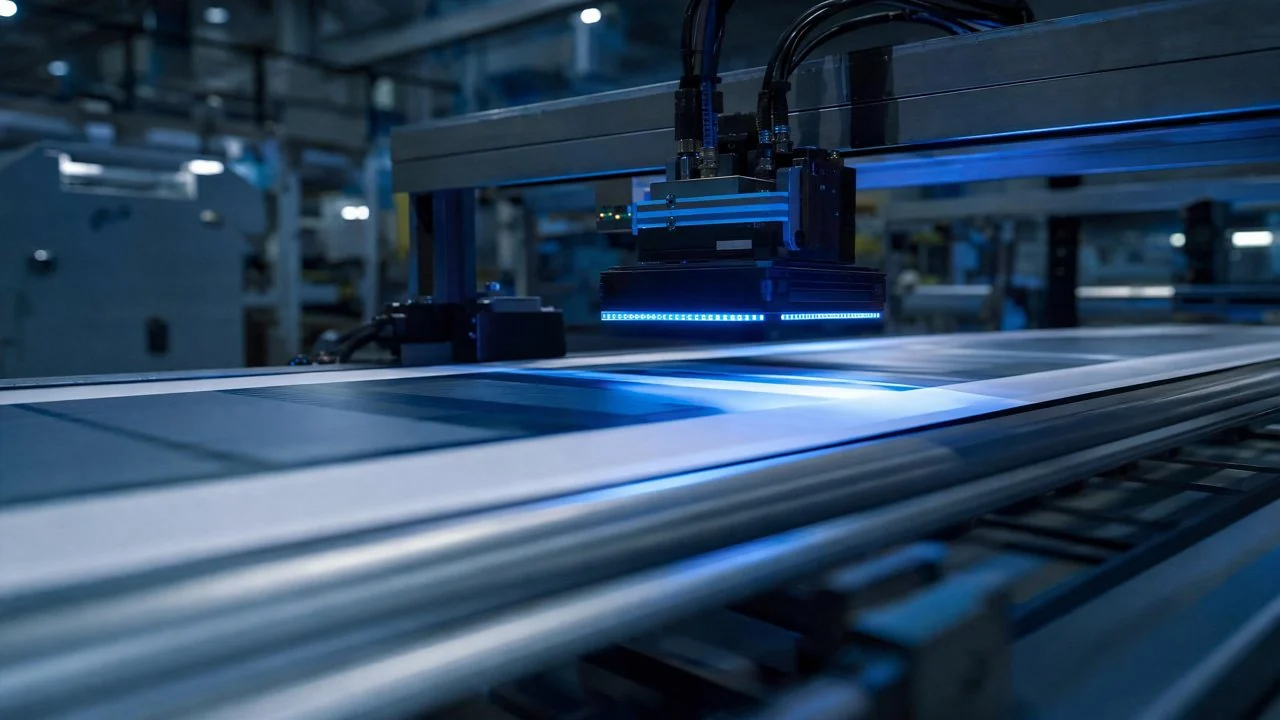
As industrial production places higher demands on product quality, the quality inspection of printing films and label coils in the chemical/materials industry faces greater challenges. The emergence of WeLinkirt's 2D ACI equipment has brought new breakthroughs to this field.
In the chemical/materials industry, printing films and label coils are widely used in various fields such as packaging and labeling. The quality of these products directly affects the appearance and performance of the final products. Therefore, strict quality inspection is crucial. A leading manufacturer in the chemical materials field needs to conduct comprehensive inspections on the printing quality, character clarity, and assembly integrity of the product surface on its printing film/label coil production line. The inspection objects include various types of printing films and label coils with different specifications and uses to ensure that the products meet relevant standards and customer requirements.
Pain Points: Why Is It Difficult?
Traditional inspection methods face many quantitative difficulties in this scenario. In terms of the missed detection rate, it is about 1.2%, which means that some defective products may enter the market. These defective products may have printing defects, blurred characters, etc., which will seriously affect the brand reputation. For example, using defective labels on food packaging may lead to consumer distrust of the product.
In terms of the false alarm rate, it is as high as 35%, which causes a large number of qualified products to be misjudged. Enterprises need to invest a lot of manpower for re-inspection, which not only increases the labor cost but also prolongs the production cycle. Moreover, the efficiency and accuracy of manual re-inspection are also difficult to guarantee, and it is easy to have missed detections or misjudgments.
In addition, traditional inspection methods also have deficiencies in the changeover time. When the product model is changed on the production line, a lot of time is needed for equipment adjustment and parameter setting, which reduces the flexibility and efficiency of the production line. As the large-scale commercialization of local large models becomes a hot direction in the field of industrial visual quality inspection, traditional inspection methods are difficult to meet the requirements of intelligence and high efficiency. The root cause is the lack of advanced algorithms and imaging technologies, which are unable to accurately identify small defects and filter false alarms.
Technical Principle
WeLinkirt's 2D ACI equipment uses high-resolution 2D imaging and deep-learning secondary image judgment technology. High-resolution 2D imaging can capture the tiny details on the surface of printing films/label coils with micron-level accuracy, such as small scratches and uneven ink. Compared with traditional imaging technologies, it has a higher resolution and can provide clearer and more accurate images, laying a solid foundation for subsequent analysis.
The deep-learning secondary image judgment technology uses advanced algorithms to analyze the images. Through a large number of sample training, the model can accurately identify different types of defects. Compared with traditional rule-based detection methods, deep-learning algorithms have stronger adaptability and accuracy, and can continuously learn and optimize to improve the ability of defect recognition.
One of the core advantages of this equipment is the semantic false alarm filtering function. It can effectively filter false alarms according to the semantic information of defects, such as the type, location, and size of defects. For example, for some false alarms caused by normal phenomena such as material texture, the system can exclude them through semantic analysis. Traditional methods often cannot accurately distinguish these normal phenomena from real defects, resulting in a high false alarm rate.
Typical Application Scenarios
- Printing quality inspection: Through high-resolution 2D imaging technology, the equipment can clearly capture the details of the printed pattern and detect problems such as missing ink and blurred patterns. The difficulty lies in that some slight printing defects may be similar to normal printing textures, and deep-learning algorithms are required for accurate distinction.
- Character clarity inspection: The equipment can perform OCR recognition on the characters on the printing film/label to determine whether the characters are clear and complete. The difficulty lies in that different fonts, font sizes, and colors of characters have a certain impact on the accuracy of recognition, and the algorithm needs to be adaptively adjusted.
- Assembly integrity inspection: Detect whether the components on the label coil are fully assembled and whether there are any missing or misaligned components. The difficulty lies in that some tiny components may be difficult to accurately identify, which requires high-resolution imaging and precise algorithm analysis.
- Surface defect inspection: This includes detecting surface defects such as scratches, bubbles, and stains. The difficulty lies in that the shapes and sizes of these defects vary, and the algorithm needs to have strong generalization ability.
Implementation Case
A leading enterprise in the chemical materials field has a large production scale and a wide variety of products. Before introducing WeLinkirt's 2D ACI equipment, the enterprise used traditional inspection methods and faced a high missed detection rate and false alarm rate, resulting in low production efficiency. During the implementation process, WeLinkirt's professional technical team installed the equipment on the production line and conducted detailed debugging and training. The software system analyzes and processes the images in real-time according to the preset inspection standards, and issues an alarm immediately once a defect is found.
After using WeLinkirt's 2D ACI equipment, the detection results of the enterprise have been significantly improved, bringing higher quality assurance and efficiency improvement to its production.
WeLinkirt's Solution and Products
Centered on the 2D ACI equipment, it has the ability of high-speed online full inspection. It can conduct a comprehensive inspection on printing films/label coils without affecting the production rhythm. Its micron-level detection accuracy can meet the strict requirements of the industry. The supporting DaoAI ACI OS uses the feature recognition of the visual basic model. One good product can achieve zero-code automatic programming in 5 minutes, and it supports APDT positive sample/few-sample learning (1-20 good products), which can quickly adapt to different product inspection requirements. In actual applications, the equipment is installed on the production line, and the software system analyzes and processes the product images in real-time. Once a defect is found, an alarm is immediately issued to ensure product quality.
Quantitative Results
After using WeLinkirt's 2D ACI equipment, the detection results of the manufacturer are remarkable. The detection rate has increased to 98.8%, and the missed detection rate has decreased to <1.2%, effectively ensuring product quality. The false alarm rate has decreased by 65%, greatly reducing the workload of manual reinspection. The changeover time has been shortened to 5 minutes, improving the flexibility and efficiency of the production line.
FAQ
What types of defects can the 2D ACI equipment detect?
The equipment can detect planar defects such as surface defects of printing films/label coils, printing flaws, character OCR errors, and assembly omissions. With high-resolution 2D imaging and deep-learning technology, it can achieve micron-level accuracy detection and clearly identify problems such as small scratches and uneven ink.
How does the equipment achieve false-alarm filtering?
Through the semantic false-alarm filtering function, it conducts precise analysis based on the semantic information of defects, such as type, location, and size. The system can distinguish normal phenomena from real defects and exclude false alarms caused by material textures, effectively reducing the false-alarm rate.
Can the equipment quickly adapt when changing the product model?
Yes. The supporting software supports zero-code automatic programming. One good product can complete the setting in 5 minutes, and it supports positive sample/few-sample learning (1-20 good products), which can quickly adapt to the inspection needs of different products.
Full solution for this scenario: the full inspection solution for Chemical / materials · False-Alarm Reduction for Printed Film / Label Coils
This article was generated by AI. Customer cases are simulated scenarios based on real product capabilities and figures are illustrative; see product pages for official benchmarks.