
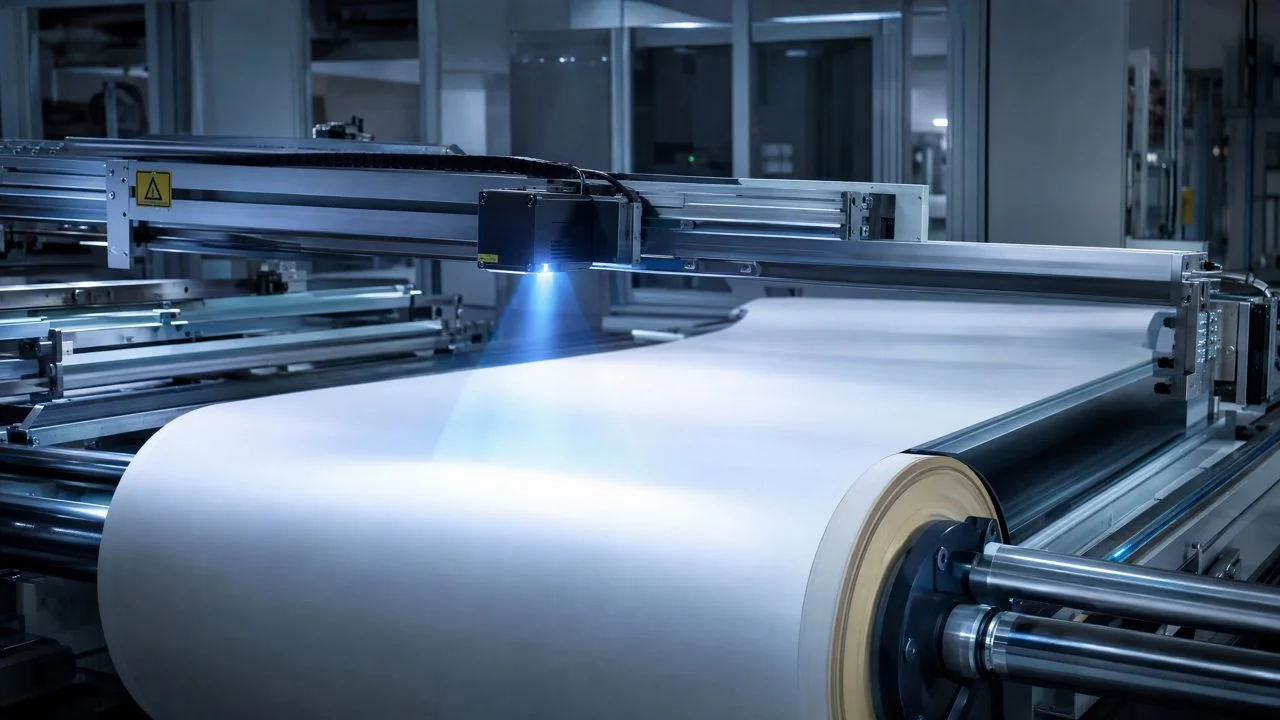
DaoAI 2D ACI equipment (high-resolution 2D imaging + deep learning secondary judgment, for surface/print/character OCR/assembly omissions and other planar defects, high-speed online full inspection, micron-level, semantic false alarm filtering) effectively controls operational expenses driven by labor costs in traditional schemes by replacing the highly manual visual inspection step in paper sheeting, significantly improving inspection efficiency and quality stability.
ACI in this article stands for Auto Cognitive Inspection — the next-generation term for AI AOI: keep the A and the I, and replace the O (optical) with C (cognitive), because the decision basis is cognition rather than the imaging method. The full argument is set out in From AI AOI to ACI.
In the chemical and materials industry, particularly in pulp and paper production, paper quality inspection is a critical step to ensure product compliance and maintain brand reputation. As market demands for product quality continue to rise, and labor costs steadily increase, the traditional reliance on manual visual inspection can no longer meet the needs of modern industrial production. Especially in high-speed processes like paper sheeting and rewinding, the precision, speed, and consistency required for identifying micron-level surface defects pose severe challenges. DaoAI 2D ACI equipment is designed to address these core pain points. It utilizes high-resolution imaging and deep learning technology to enable high-speed online full inspection of paper surface defects, effectively replacing laborious and subjective manual inspections, thereby reducing labor costs and improving overall production efficiency and quality control.
Pain Points: Why This Hurdle Is Difficult to Overcome
In the post-processing stages of paper production, especially in sheeting and rewinding, traditional manual visual inspection faces multi-dimensional challenges. Firstly, **high labor costs and low efficiency**. A large pulp and paper manufacturer reported that their paper sheeting lines required a large number of visual inspectors. Due to the high-speed movement of paper, manual inspection led to high fatigue, fluctuating detection rates, and persistently high manual re-inspection hours. Secondly, **inspection accuracy and consistency are difficult to guarantee**. Tiny surface defects on paper, such as fiber clumps, subtle color variations, uneven coating, indentations, or minor damage, are often between tens to hundreds of micrometers. On high-speed production lines, the human eye struggles to consistently identify them. Discrepancies in standards among different inspectors also lead to subjective and inconsistent quality judgments, increasing false alarm and missed detection rates. Finally, **poor generalization ability for small-sample defects**. Many sporadic or rare paper defects lack sufficient historical data for training samples, making it difficult for traditional rule-based machine vision systems to effectively identify them, and manual inspection is also prone to omissions due to insufficient experience. These factors collectively lead to fluctuations in product qualification rates, increasing rework costs and customer complaint risks.
The root cause of these difficulties lies in the extremely fast production rhythm of paper, with sheeting speeds reaching hundreds of meters per minute, leaving a very short time window for manual visual inspection. At the same time, paper surface characteristics are complex, with natural textures, varying gloss, and subtle fiber structures. These “normal” background noises are easily confused with actual defects. Traditional AOI systems based on thresholds or simple feature extraction struggle to establish a universal rule model when faced with such diverse background noise and minute defects, leading to high false alarm or missed detection rates. Industrial AI large models can improve generalization ability in small-sample defect detection by learning vast general image features and then fine-tuning with a small number of specific defect samples, but they require complex deployment and significant computational resources. DaoAI 2D ACI equipment, building on this foundation, combines deep learning models optimized for industrial scenarios to solve the complexity of paper inspection in a more lightweight and easily deployable manner.
Technical Principles
The core technology of DaoAI 2D ACI equipment lies in the tight integration of its high-resolution 2D imaging system and deep learning secondary judgment engine. The equipment uses customized high-speed industrial cameras and precise optical modules, capable of capturing micron-level resolution surface images while the paper is moving at high speed. These images undergo initial feature extraction by the visual foundation model embedded in the DaoAI ACI OS operating system. Unlike traditional rule-based AOI that relies on engineers manually setting numerous thresholds, DaoAI 2D ACI's deep learning model can autonomously learn the complex textures and appearance features of normal products from a small number of good samples, achieving “positive sample learning” or even “few-shot learning” (requiring only 1–20 good sample images), significantly shortening the modeling cycle. For paper surface defects, such as fiber clumps, tiny holes, ink spots, color differences, etc., the system can accurately distinguish abnormal areas from the background.
At the defect recognition level, DaoAI 2D ACI equipment utilizes deep learning secondary judgment technology to achieve precise classification of complex defects and semantic false alarm filtering. This means the system can not only identify “there is an anomaly here” but also understand “this is a fiber clump, not a normal paper texture,” or “this is an ink spot, not dust.” This semantic-understanding-based judgment capability significantly reduces false alarms common in traditional AOI caused by background noise, environmental light changes, or normal product variations. Compared to manual visual inspection, DaoAI 2D ACI offers 100% full inspection capability, with highly consistent detection standards, unaffected by subjective factors like fatigue or emotions. Compared to traditional rule-based AOI, its adaptability to new types of defects is stronger, requiring no frequent parameter adjustments. Through the APDT few-shot self-training function of DaoAI ACI OS, it can continuously learn from production line feedback, improving the model's generalization ability and accuracy. DaoAI ACI achieves a cold start detection accuracy of 98%, which can reach 99.99% after online iteration, with a single judgment latency of 12 milliseconds, ensuring real-time detection requirements for high-speed production lines.
Typical Application Scenarios
- **Paper Surface Fiber Clump and Foreign Matter Detection**: Real-time detection of fiber clumps and tiny foreign matters (e.g., dust, debris) on the paper surface before sheeting or rewinding. The challenge lies in the similarity of these defects to the paper's own fiber texture and their minute size, making traditional methods prone to false alarms or missed detections. DaoAI 2D ACI uses deep learning to identify their morphological features and differentiate them from the background for precise distinction.
- **Uneven Coating and Color Difference Detection**: On special paper or coated paper production lines, detecting defects such as uneven coating thickness, inconsistent color shades, or spots. These defects are often gradual, making quantitative judgment difficult for the human eye. DaoAI 2D ACI equipment can capture subtle grayscale or color differences, identifying abnormal coating areas through image analysis.
- **Indentation, Scratch, and Damage Detection**: Paper may incur indentations, scratches, or edge damage during production and sheeting. These defects are irregular in shape and highly affected by lighting angles. DaoAI 2D ACI utilizes high-resolution imaging to capture these subtle deformations and combines them with deep learning models for recognition.
- **Print Character and Pattern Defects**: For paper products with printed content, such as label paper or packaging paper, detecting print misalignment, ink shortage, ghosting, smudges, or OCR character recognition errors. The challenges include the complexity of characters and patterns and background interference. DaoAI 2D ACI, combined with its OCR capabilities, can comprehensively inspect print quality.
- **Paper Edge Burrs and Delamination Detection**: After high-speed sheeting, paper edges may exhibit burrs or delamination, affecting subsequent processing and product appearance. DaoAI 2D ACI can perform high-precision scanning of paper edges, identifying tiny edge defects.
Case Study
A large pulp and paper manufacturer's paper sheeting workshop had long relied on experienced quality inspectors for product sampling and full inspection of some critical processes. However, with increasing production line speeds and rising labor costs, the drawbacks of traditional manual inspection became increasingly prominent: the high intensity of work for quality inspectors led to fatigue, making it difficult to maintain consistent accuracy in visual inspection, and detection standards varied between shifts and personnel, increasing the risk of misjudgment and missed detections. Particularly for minute fiber clumps and color differences, manual identification was extremely challenging. To address this pain point, the manufacturer introduced DaoAI 2D ACI equipment, deploying it at the output end of a high-speed paper sheeting machine, replacing the original manual visual inspection function.
After deployment, the DaoAI 2D ACI system achieved 100% online full inspection of paper surface defects. Production line data from this manufacturer shows that the system can stably identify fiber clumps, fine indentations, and uneven coating larger than 50 micrometers in diameter, and its detection accuracy significantly surpasses the average level of manual visual inspection. The most notable change is the optimization of the manufacturer's labor structure; the previously burdensome manual visual inspection work was replaced by system automation. Quality inspection personnel were freed from a large amount of repetitive, low-value visual inspection tasks, transitioning to roles involving supervising system operation, handling a small number of complex difficult cases, and conducting data analysis. This not only effectively reduced labor costs but also enhanced the overall value of the quality inspection team. Simultaneously, due to the consistency of system detection standards, product quality stability significantly improved, reducing customer complaints and returns caused by quality issues, and providing more reliable quality data support for subsequent processes.
The figures above are a typically achievable range in anonymized industry scenarios — a different line or a different batch of parts will move the result either way; on-site measurement governs.
DaoAI 2D ACI equipment transforms paper defect detection from relying on experienced 'human eyes' to intelligent and precise 'machine vision,' ushering in a new chapter of labor cost optimization and quality control upgrades.
DaoAI Solutions and Products
The core solution provided by DaoAI to this pulp and paper manufacturer is based on its 2D ACI equipment. This system integrates high-performance image acquisition hardware and the DaoAI ACI OS intelligent operating system. During the modeling phase, customers only need to provide a small number of good sample images. Utilizing DaoAI ACI OS's APDT positive sample/few-shot learning function, automatic programming and model cold start for a good sample image can be completed within 5 minutes. For complex paper textures and diverse defects, DaoAI 2D ACI employs a combination of multispectral light sources and high-resolution cameras, ensuring clear capture of defect features under various lighting and backgrounds. The system is deployed with 100% on-premise privatization, ensuring that sample and inspection images do not leave the factory, strictly adhering to data security regulations. Through flexible deployment methods such as SDK/API/Docker, DaoAI 2D ACI can be integrated into existing production line control systems, enabling data interaction and remote monitoring.
In terms of quantifiable results, DaoAI 2D ACI equipment in this case transformed the highly manual paper surface defect inspection process into an efficient, stable automated detection. After the large pulp and paper manufacturer went live, production line data shows that its cold start detection accuracy reached 98%, and after online iteration, it could reach 99.99%, significantly reducing the workload of manual re-inspection. The single judgment latency is only 12 milliseconds, fully meeting the cycle time requirements of high-speed production lines. Through continuous semantic false alarm filtering, the system effectively distinguishes normal textures from real defects, greatly reducing the false alarm rate, allowing quality inspection personnel to focus their energy on analyzing and handling abnormal situations rather than unnecessary re-inspection, thereby achieving optimization of labor costs. DaoAI 2D ACI, with its automated, high-precision, and high-stability features, brings tangible business value to paper production in the chemical and materials industry.
FAQ
How does DaoAI 2D ACI equipment effectively reduce labor costs in paper defect detection?
DaoAI 2D ACI equipment replaces traditional manual visual inspection by achieving 100% online full inspection of paper surface defects. The system's automated, high-precision, and highly consistent detection capabilities significantly reduce the need for a large number of manual quality inspectors, freeing personnel from repetitive labor and transforming them into supervisory and analytical roles, thereby directly reducing labor costs and optimizing human resource allocation.
How does DaoAI 2D ACI's few-shot learning capability handle rare defects in paper production?
DaoAI 2D ACI, equipped with the DaoAI ACI OS operating system, features APDT few-shot self-training, allowing model cold start with just 1–20 good sample images. For rare defects, the system can quickly learn and generalize from a small number of defect samples, and continuously iterate and optimize the model based on production line feedback, effectively improving the detection capability for small-sample defects and reducing the risk of missed detections.
What is the budget and timeline for deploying DaoAI 2D ACI equipment?
The budget for deploying DaoAI 2D ACI equipment depends on the production line scale, detection requirements, and integration complexity, typically including hardware, software licenses, installation and commissioning, and technical service fees. Specific deployment times vary by project, but our 'one good sample, 5-minute, 0-code automatic programming' capability significantly shortens the modeling cycle. We recommend booking a free consultation with a DaoAI expert, who will provide a customized solution and detailed quote based on your specific situation.
Full solution for this scenario: 2D ACI Equipment industry solutions
This article is an original publication by WeLinkirt (DaoAI). Under customer confidentiality, cases are anonymized industry scenarios and figures are illustrative; see product pages for official benchmarks.