
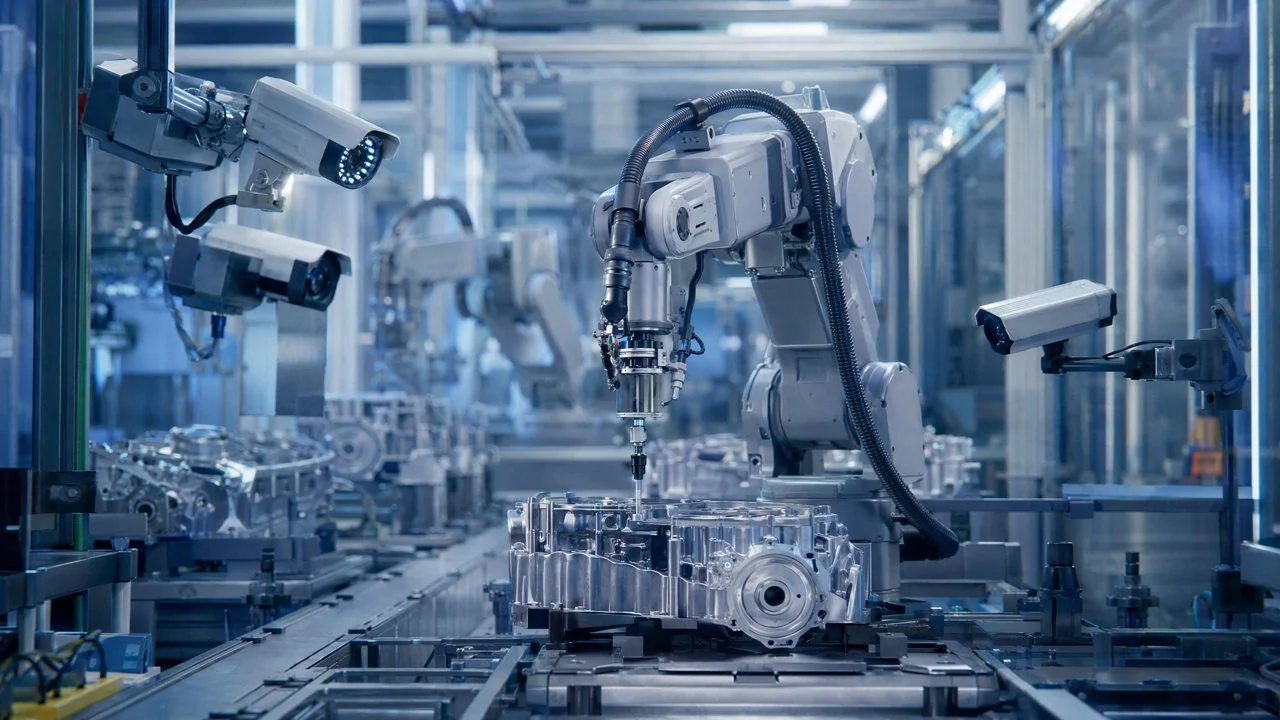
As the 2026 World Artificial Intelligence Conference (WAIC) highlights 'Industrial Production Line SOP Supervision and AI Training-Inference Integration' as a key focus in smart security, video surveillance technology is undergoing a profound transformation from traditional 'passive video forensics' to 'active behavior recognition + real-time compliance pre-warning'. WeLinkirt's SkyVision 0-Code AI Video Surveillance Platform is designed to meet this trend, offering a new proactive protection solution for industrial SOP supervision with its unique on-site hourly model training, behavior/event recognition, edge device real-time alerting, and 100% on-premise data localization capabilities.
In the automotive component manufacturing industry, the compliance and quality of assembly processes directly impact vehicle performance and driving safety. Especially on the assembly lines for critical components such as engines, transmissions, and chassis, fastener tightening (e.g., bolts, nuts) is a core link. Any missed tightening, under-tightening, stripped thread, or incorrect tightening sequence of a single bolt can lead to component loosening, abnormal noises, or even safety incidents in extreme cases. A leading automotive component manufacturer, whose production lines complete tens of thousands of fastener tightening operations daily, covering various models and torque requirements, traditionally relied on operator self-inspection, team leader spot checks, and end-of-line torque testing equipment for quality control. However, these methods often only discover problems after the fact, and spot checks have blind spots, unable to cover all operations, resulting in high rework costs and difficulty in tracing back to specific operational errors.
Pain Points: Why This Hurdle Is Difficult to Overcome
This leading manufacturer faces multiple challenges in the tightening process of its assembly line. Firstly, the **risk of missing or under-tightened screws is significant**, with traditional manual visual inspection having a missed detection rate of 0.8%~1.2%. Missing a critical bolt can lead to rework or even scrap an entire batch of products, directly impacting product outgoing quality and customer satisfaction. Secondly, **manual review and traceability are costly**. Once a problem is found, it requires extensive human effort to review surveillance footage and pinpoint the source of the problem, with an average troubleshooting time exceeding 4 hours and consuming the effort of 2-3 senior engineers per incident. Thirdly, **the dynamic complexity of work instructions**. Different product models, batches, and even the same product at different stations may have subtle variations in the number of bolts to be tightened, torque requirements, and sequence. Manual memorization and execution are highly prone to errors, increasing compliance risks. Existing rule-based machine vision systems struggle to adapt to this variability, with each changeover or process adjustment requiring hours or even days of programming and debugging, severely impacting production line flexibility.
The root cause of these pain points lies in the inherent complexity of the tightening process and the limitations of traditional inspection methods. From a process perspective, tightening operations are not simply 'presence or absence' but also involve subtle behaviors like 'to what extent' and 'in what order,' which are difficult to identify through simple image feature comparison. From an imaging perspective, bolt surface reflections, angle variations, background occlusion, and interference from operator hand movements all pose significant challenges for visual recognition. For instance, a fully tightened bolt and one that has not yet been tightened may only show very subtle visual differences in video, or even be completely obscured by tools or the operator's arm. Traditional rule-based AOI systems struggle to generalize to these complex and variable situations. In the current context where WAIC emphasizes 'active behavior recognition + real-time compliance pre-warning,' the traditional 'post-event video forensics' model can no longer meet the demands for high-precision, high-efficiency industrial SOP supervision, necessitating an AI solution capable of real-time perception, real-time alerting, and rapid adaptation to new scenarios.
Technical Principles
WeLinkirt's SkyVision 0-Code AI Video Surveillance Platform is founded on its powerful 'World Model' semantic understanding capabilities and 'on-site hourly proprietary model training' engineering practice. It goes beyond simple object detection or pose estimation, utilizing deep learning models for temporal analysis of continuous frames in video streams to understand the operator's 'behavioral intent' and 'operational status.' For the tightening process, SkyVision's technical principle can be summarized as: first, identify the 'tightening' action performed by the operator using pre-trained general behavior recognition models. Second, leveraging the deep semantic understanding capabilities of the DaoAI World Model for industrial scenarios, the platform can automatically learn and differentiate between normal and abnormal tightening behaviors (e.g., missed tightening, air tightening, stripped threads, incorrect tightening sequence). This is enabled by its unique APDT (Adaptive Positive/Few-shot Data Training) mechanism, where the system can quickly grasp the characteristics of 'standard actions' with just a small number (1-20) of normal operation video clips. When a deviation from the standard action is detected, the system immediately triggers an alert.
Compared to traditional methods, SkyVision's advantages are clear: traditional rule-based AOI systems require engineers to manually define complex geometric features, color thresholds, and other rules, which makes them highly vulnerable to tool occlusion, lighting variations, and bolt model differences. Each changeover also demands extensive reprogramming. Manual visual inspection, on the other hand, relies entirely on operator experience and attention, is prone to fatigue, inefficient, and has a high rate of missed detections. SkyVision, using deep learning-based behavior recognition, can automatically learn and extract abstract features from vast amounts of video data, offering stronger adaptability to complex and variable environments. Its '0-code' characteristic means on-site engineers can complete model training and deployment through a simple drag-and-drop interface without programming, significantly shortening the cycle from problem discovery to solution implementation. The edge device real-time alerting mechanism ensures extremely low latency (<120ms), enabling alerts to be issued the moment an operational error occurs, fundamentally shifting from 'post-event correction' to 'pre-event prevention.' Furthermore, 100% on-premise deployment ensures raw video and images remain within the factory, meeting strict client requirements for data security and privacy.
Typical Application Scenarios
- **Critical Bolt Missing Tightening Detection**: In the assembly of core components such as engine blocks and transmission housings, SkyVision can monitor in real-time whether critical load-bearing bolts are missed by the operator. The challenge lies in the large number of bolts, often in hidden locations, and frequent occlusion by the operator's hands or tools. SkyVision determines if each critical point has been effectively tightened by semantically understanding the operator's 'tightening' action completion.
- **Tightening Sequence and Count Compliance Detection**: Certain precision components require bolts to be tightened in a specific sequence (e.g., diagonal, circular) or a specific number of times (multi-step tightening). SkyVision can identify the operator's tightening path and action sequence, compare it against the preset SOP, and alarm immediately if an incorrect sequence or insufficient tightening count is detected. The difficulty lies in accurately recognizing complex multi-point action sequences.
- **Incorrect Bolt Type or Mixing Detection**: In mixed-model production lines, operators may inadvertently use or mix different specifications (e.g., length, diameter, material) of bolts. SkyVision can identify bolt types based on their visual features and issue an alert if a bolt type inconsistent with the current process SOP is detected. Challenges include subtle visual differences between bolts and rapid assembly cycles.
- **Poka-Yoke Mechanism Failure Behavior Recognition**: Some workstations have poka-yoke devices to prevent errors, but operators might bypass them due to habit or oversight. SkyVision can monitor whether operators correctly use poka-yoke tools or follow poka-yoke procedures, for example, whether a safety lock device was activated before a specific operation, or if a sensor was bypassed in an non-compliant manner.
- **Tool Usage Standard Detection**: For specialized tools such as electric torque wrenches and pneumatic wrenches, SkyVision can identify whether the operator uses the correct tool model, operates with the correct posture and angle (avoiding angled tightening, stripped threads), and determines if the tightening action has been effectively completed (e.g., detecting idle rotation or failure to contact the bolt).
Case Study
A leading automotive component manufacturer operates a large engine component assembly plant in East China, with an annual output exceeding one million units. The plant had long faced issues with missed critical bolt tightenings, especially on the assembly line for a new energy vehicle drive motor casing. Due to the large number of bolts and fast operating cycles, there were an average of 3-5 incidents per month of assembly rework caused by missed tightenings, each resulting in an additional 2-3 hours of line stoppage and at least 5000 CNY in direct losses. To improve quality control and reduce the rework rate, the manufacturer decided to introduce WeLinkirt's SkyVision 0-Code AI Video Surveillance Platform. The project team first conducted an on-site survey of the production line, installing several high-resolution industrial cameras to cover critical tightening stations for the drive motor casing assembly. Subsequently, WeLinkirt engineers collaborated with the client's quality team to utilize SkyVision's 0-code training interface, completing proprietary model training for 'specific bolt missing tightening' behavior in just 3 hours, using dozens of normal operation video clips accumulated over the past year as positive samples for learning. After deploying the model to edge devices, real-time monitoring began immediately.
With the SkyVision platform, we've increased the efficiency of missing screw detection by hundreds of times, shifting from reactive tracing to proactive prevention, freeing workers from repetitive checks to focus on higher-value operations.
Before deployment, the manufacturer's missing screw detection primarily relied on manual spot checks and end-of-line torque testing, with an average missed detection rate of about 0.9%. After deploying the SkyVision platform, the system could identify and alert in real-time, issuing an average of 2-3 effective warnings daily, allowing operators to correct issues as soon as they occurred. In the first month of operation, the number of assembly rework incidents caused by missing screws decreased by 63%, and the human resources invested by the quality department for fault tracing were reduced by 75%. Through 100% on-premise deployment, client data security was fully guaranteed, and the low-latency nature of edge computing ensured timely alerts. This successful case prompted the manufacturer to plan the expansion of SkyVision to its other factories nationwide, covering SOP supervision for more complex assembly processes.
WeLinkirt Solution and Products
WeLinkirt's SkyVision 0-Code AI Video Surveillance Platform is the core of this solution. It collects real-time video streams through industrial-grade high-definition cameras installed above workstation positions and transmits them to edge computing boxes for local analysis. SkyVision's 0-code feature allows on-site engineers to complete model training for specific behaviors (e.g., tightening actions, tool picking, component placement) within hours using an intuitive graphical interface. Users only need to provide a small number (e.g., 10-20) of normal operation video clips as 'positive samples,' and SkyVision can leverage its DaoAI World Model semantic understanding capabilities to automatically learn and build a feature model for that behavior. When actions in the monitored video stream deviate from the learned standard behavior (e.g., missed tightening, missing actions, incorrect sequence), the edge box immediately triggers an alarm, notifying operators or team leaders through audible and visual alarms, MES system message pushes, and other means. The entire process requires no programming skills, greatly lowering the threshold for AI application and shortening the deployment cycle. All video data is processed on-premise, ensuring raw video and images never leave the factory and strictly adhering to industrial data security regulations. Furthermore, SkyVision supports smooth integration with existing MES and SCADA systems, using behavior recognition results as key data for production process control, enabling more refined production management and quality traceability.
Through WeLinkirt's SkyVision platform, clients can achieve: **detection rate of missing/under-tightened behaviors increased to 99.4%**, a qualitative leap compared to the 0.9% missed detection rate of manual inspection. **Rework rate due to missing screws reduced by 63%**, significantly cutting production costs and downtime. **Fault tracing time shortened by 75%**, from hours to minutes, greatly improving problem-solving efficiency. Concurrently, due to the platform's on-site hourly model training capability, **model iteration time for new product changeovers or process adjustments is only 1 hour**, ensuring extremely high production line flexibility. These quantified results not only bring direct economic benefits but, more importantly, significantly enhance product quality stability, strengthen the company's competitiveness in the market, and lay the foundation for achieving higher levels of smart manufacturing.
FAQ
How does the SkyVision platform achieve '0-code' training?
The SkyVision platform enables users to train proprietary models without writing any code, thanks to its graphical drag-and-drop interface, pre-built general behavior recognition models, and the semantic understanding capabilities provided by the DaoAI World Model. Users only need to upload a small number (1-20) of normal operation video samples, and the system automatically learns and identifies standard behaviors, significantly lowering the barrier to AI application.
What is the latency of SkyVision's edge device real-time alerting mechanism?
SkyVision's edge computing boxes integrate high-performance AI inference chips, enabling real-time analysis and behavior recognition of local video streams. From detecting abnormal behavior to issuing an alert, system latency is typically less than 120ms, ensuring timely warnings that help operators correct errors immediately and prevent quality issues from escalating.
How does SkyVision ensure customer data security and privacy?
The SkyVision platform supports 100% on-premise private deployment. All video data and analysis results are stored on the customer's internal servers or edge devices within the factory. Data is never uploaded to external clouds or third-party platforms. This deployment method ensures customers have full control over their data, effectively preventing data breaches and privacy risks, and meeting the stringent data security requirements of industrial enterprises.
Full solution for this scenario: Automotive / parts industry solutions
This article was generated by AI. Customer cases are simulated scenarios based on real product capabilities and figures are illustrative; see product pages for official benchmarks.