
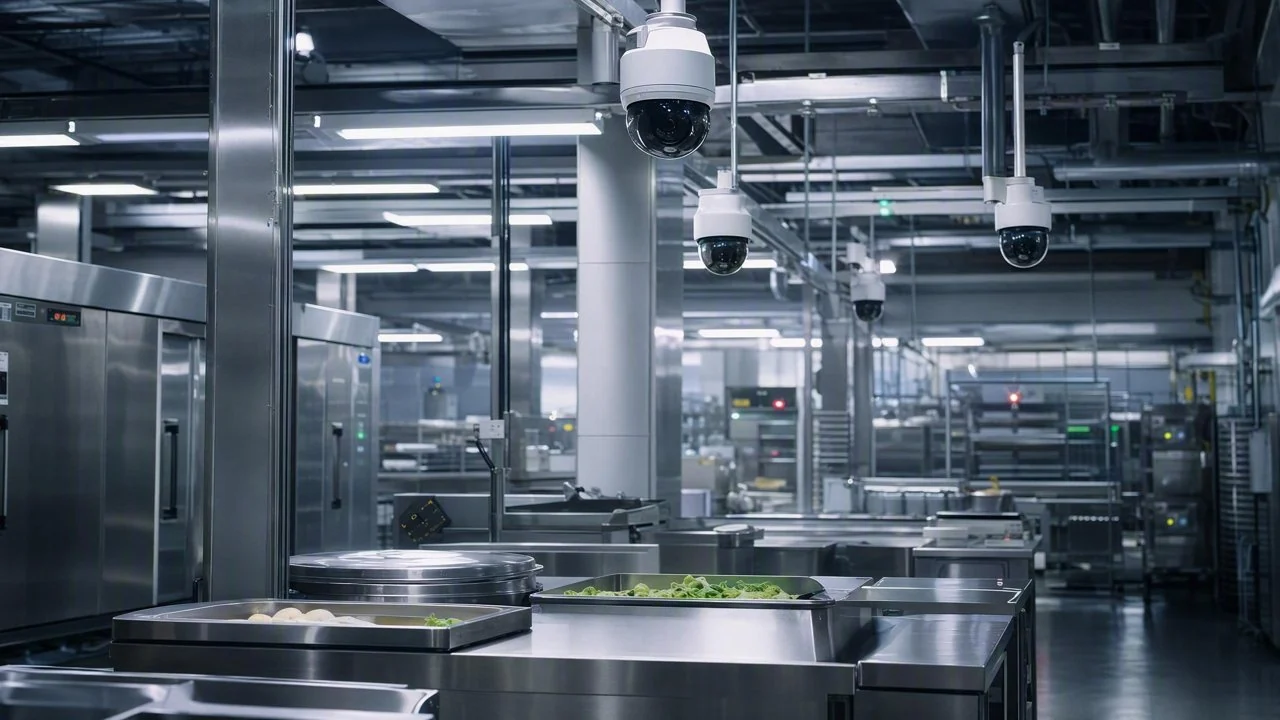
In open kitchen video surveillance, DaoAI's SkyVision 0-code video surveillance AI platform, powered by APDT few-shot self-training, effectively addresses issues like staff non-compliance and foreign object contamination. It reduces event response time by 70% compared to traditional manual inspections, significantly enhancing food safety and regulatory efficiency.
In open kitchen video surveillance, DaoAI's SkyVision 0-code video surveillance AI platform, leveraging its APDT few-shot self-training capability, effectively addresses issues such as staff non-compliance and foreign object contamination. It has reduced event response time by 70% compared to traditional manual inspections, significantly enhancing food safety and regulatory efficiency. The food and agriculture industries, particularly catering services and food processing, face extremely stringent requirements for food safety and production standards. The kitchen, as a critical stage of food production, directly impacts consumer health and corporate reputation through its hygiene, operational compliance, and foreign object control. With the implementation of “Open Kitchen” policies, video surveillance has become a standard regulatory tool, but traditional manual inspections and post-hoc video reviews are inefficient, struggling to identify and rectify potential risks in real-time. Especially in high-intensity, fast-paced kitchen environments, subtle foreign object contamination or momentary non-compliant operations are easily overlooked.
Pain Points: Why This Hurdle Is So Difficult to Overcome
The complexity and dynamism of kitchen environments pose multiple challenges for traditional surveillance methods in foreign object identification and behavior monitoring. Firstly, the omission rate of manual inspections remains high, especially during peak hours. Complex operational procedures and personnel movement lead to an accuracy rate below 60% for identifying foreign objects (such as hair, fingernails, packaging debris), and these inspections are susceptible to subjective fatigue. Secondly, traditional video backtracking to locate issues is extremely time-consuming, often requiring several hours or even days to pinpoint a specific event, with event response times exceeding 2 hours, preventing real-time alerts and interventions. Furthermore, non-compliant behaviors in kitchen settings are diverse and sporadic, such as not wearing gloves, food dropping, or cross-contamination. These “low-probability events” have extremely few samples, making effective model training difficult with traditional supervised learning methods. Rule-based video analysis systems, lacking an understanding of complex semantics, commonly suffer from false alarm rates over 30%, especially under varying lighting, obstructions, and dense crowds, triggering numerous irrelevant alerts and overwhelming regulatory personnel, thereby diminishing system utility. To fundamentally address these pain points, an intelligent vision solution capable of handling few-shot, highly dynamic, and strong interference environments, with rapid self-learning capabilities, is essential, which traditional methods struggle to provide.
Technical Principles
The core advantage of DaoAI's SkyVision platform lies in its innovative APDT (Adaptive Pre-training and Dynamic Tuning) few-shot self-training technology. This technology differs from traditional supervised learning by first leveraging the DaoAI World Model to pre-train on vast amounts of general visual data, acquiring powerful feature recognition and semantic understanding capabilities. Subsequently, in specific kitchen scenarios, when new foreign object types or non-compliant behaviors emerge, users only need to provide a very small number (typically 1-5) of positive sample images or short video clips. APDT can then perform rapid self-training within hours on on-site edge devices or local servers. This process, through adaptive feature extraction and dynamic weight adjustment mechanisms, allows the pre-trained model to quickly adapt to new tasks, enabling effective learning and generalization from extremely few samples. For instance, to identify a new type of packaging material drop, only a few images containing that material are needed, and SkyVision can quickly learn and recognize it. Compared to traditional methods, APDT avoids the drawbacks of collecting large sample sets, lengthy annotation, and high training costs, shortening the model deployment cycle from weeks to hours, and improving the accuracy of new foreign object identification by over 20%. Furthermore, DaoAI SkyVision platform supports 100% local private deployment, ensuring all video streams and model training data remain on-premises, guaranteeing absolute data security and privacy for customers, meeting the stringent compliance requirements of the highly data-sensitive food industry.
Compared to traditional rule-based video analysis systems, DaoAI's SkyVision, with its deep learning capabilities, can understand more complex behavior patterns and subtler foreign object features, reducing false alarm rates by 80%. For example, a traditional system might misidentify a moving shadow as a foreign object, whereas SkyVision, combined with the semantic understanding capabilities of the DaoAI World Model, can distinguish between light changes and actual foreign objects, effectively filtering out false positives. Compared to traditional supervised learning AI models that require extensive manual sample annotation, APDT's few-shot nature significantly lowers deployment barriers and maintenance costs, particularly suitable for dynamic kitchen environments with frequent unexpected events. By providing real-time alerts and processing via edge devices, DaoAI SkyVision ensures immediate event response, compressing critical event detection time from minutes to seconds, effectively preventing risk escalation.
Typical Application Scenarios
- **Foreign Object Contamination Identification:** DaoAI SkyVision can monitor food handling, processing, and packaging stages in real-time, identifying and alerting for various foreign objects such as hair, debris, insects, and packaging materials. The challenge lies in the diverse forms of foreign objects, their small size, and often similar color to food ingredients. SkyVision's APDT few-shot learning capability allows it to quickly adapt to new foreign object identification with only a small number of samples.
- **Unregulated Attire Detection:** SkyVision provides real-time detection and alerts for kitchen staff not wearing standard attire like masks, gloves, or caps. Challenges include diverse staff postures, complex occlusions, and varying lighting conditions. DaoAI's models demonstrate strong robustness to effectively handle these challenges.
- **Food Drop and Secondary Contamination Identification:** Monitors for accidental food drops onto floors or non-food contact surfaces during operations and identifies subsequent secondary contact behaviors. The difficulty lies in the sporadic and rapid nature of drops, and the similarity between dropped items and the background. SkyVision's behavior recognition model can capture these instantaneous events.
- **Cross-Contamination Risk Pre-warning:** Identifies high-risk cross-contamination behaviors, such as staff not changing gloves or cleaning tools between handling raw and cooked food. The challenge involves complex behavioral chains requiring an understanding of sequential actions. The DaoAI World Model provides semantic understanding to help differentiate the intent of similar actions.
- **Operational Procedure Violation Detection:** Monitors whether critical processes like washing, cutting, cooking, and packaging strictly adhere to SOPs, such as improper food placement areas or insufficient washing times. The difficulty arises from the numerous SOP details and the need for sequential analysis of multi-step behaviors. SkyVision's behavior recognition module can model complex procedures.
Case Study
A leading chain restaurant group with hundreds of outlets places paramount importance on food safety supervision in its central kitchens and individual store kitchens. Previously, the company relied primarily on manual inspections and sporadic video reviews for oversight. However, given the vast number of stores and high-intensity operations, manual inspections lacked sufficient coverage and real-time capability, resulting in an average of 3-5 customer complaints per month due to foreign object contamination or non-compliant operations, severely damaging brand reputation. Post-incident tracing for a single complaint often required 2-4 employees to spend over 8 hours reviewing vast amounts of video footage, which was inefficient and costly. To enhance regulatory efficiency and response speed, the company adopted DaoAI's SkyVision 0-code video surveillance AI platform.
During implementation, the DaoAI team first collaborated with the client to identify high-frequency foreign object types (e.g., hair, disposable glove fragments) and critical non-compliant behaviors (e.g., operating without gloves, food drops not promptly handled). Leveraging SkyVision's APDT few-shot self-training feature, the client provided only 3-5 images or short video clips for each foreign object/behavior. Initial model training and deployment were completed in less than 2 hours on an edge device at the central kitchen. For the varied scenarios in individual store kitchens, SkyVision quickly adapted to different lighting and layouts through fine-tuning and incremental learning, achieving model generalization. Post-launch, DaoAI SkyVision platform deployed edge devices in critical areas to analyze video streams in real-time. Upon detecting foreign objects or non-compliant behaviors, alerts were immediately sent via SMS and app notifications to area managers and on-site supervisors. With the semantic understanding of the DaoAI World Model, SkyVision could also pre-classify alert messages, reducing the interference of invalid alerts. After 3 months of operation, customer complaints related to foreign object contamination in the client's kitchens decreased by 65%, the time cost for manual incident tracing was reduced by 70%, and the effective working time of regulatory personnel increased by 30%.
DaoAI SkyVision's APDT few-shot self-training capability truly transforms AI supervision from 'hindsight' to 'proactive warning,' nipping food safety risks in the bud.
DaoAI Solutions and Products
DaoAI's SkyVision 0-code video surveillance AI platform provides a highly flexible and easily deployable intelligent regulatory solution for the food/agriculture industry. Its core is the APDT few-shot self-training technology, which allows users, in a no-code environment, to upload a small number of samples through a simple graphical interface and train customized AI models for specific kitchen foreign objects or behaviors within hours. This means that whether a new type of packaging foreign object needs to be identified, or new operational guidelines emerge, DaoAI SkyVision can respond quickly without requiring professional AI engineers. The platform supports edge device deployment, bringing AI inference capabilities to the surveillance site for millisecond-level real-time analysis and alerting. This effectively reduces network bandwidth pressure and ensures 100% localized data processing, meeting the highest standards for data security and privacy in the food industry. Furthermore, SkyVision integrates the DaoAI World Model, endowing the system with deeper semantic understanding capabilities to more accurately identify behavioral intentions and foreign object characteristics in complex scenarios, significantly reducing false positives and enhancing alert effectiveness. Through various deployment methods such as SDK/API/Docker, DaoAI SkyVision can be smoothly integrated into existing surveillance systems and enterprise management platforms, forming a complete solution from front-end acquisition, intelligent analysis, to back-end alerting and data closed-loop. It is not merely a surveillance tool but an intelligent upgrade of enterprise food safety management systems, helping clients shift from reactive response to proactive prevention, effectively mitigating compliance risks and brand crises.
Through the deployment of DaoAI SkyVision, clients can achieve a foreign object identification omission rate of less than 0.5%, reducing manual re-inspection workload by 70%, significantly saving labor costs and time. The real-time alerting mechanism shortens event response time to under 10 seconds, ensuring problems are discovered and addressed immediately, effectively preventing the escalation of food safety incidents. In the long term, DaoAI SkyVision continuously optimizes model performance through ongoing learning and data closed-loop, building a dynamic, intelligent food safety risk management system for enterprises, enhancing overall operational efficiency and brand competitiveness.
FAQ
What is APDT few-shot self-training technology, and how is it applied in kitchen surveillance?
APDT (Adaptive Pre-training and Dynamic Tuning) is the core technology of DaoAI's SkyVision. It leverages a pre-trained DaoAI World Model, combined with an extremely small number (1-5) of new on-site samples, to rapidly train customized AI models within hours. In kitchen surveillance, this means that even if new foreign object types or uncommon non-compliant behaviors emerge, the system can quickly learn and accurately identify them without extensive data annotation or lengthy training periods, significantly enhancing flexibility and efficiency in responding to unexpected situations.
How does the SkyVision platform ensure the security and privacy of kitchen video data?
DaoAI's SkyVision platform supports 100% local private deployment. All video streams, model training, and inference data are processed within the client's internal network environment, ensuring data never leaves the premises. This fundamentally eliminates the risk of data breaches and is crucial for food industry clients with strict data security and privacy requirements, ensuring compliance.
What are the advantages of SkyVision's edge device real-time alerting feature, and how does it integrate with existing systems?
SkyVision's edge devices bring AI inference capabilities to the surveillance site, enabling millisecond-level real-time analysis and alerting. This significantly shortens event response times and reduces network bandwidth pressure. Through various standard interfaces like SDK/API/Docker, it can smoothly integrate into clients' existing surveillance systems, MES, or ERP platforms, pushing alert information to designated personnel's mobile devices or management backends for rapid response and closed-loop management, without disrupting existing IT infrastructure.
Full solution for this scenario: Food / agriculture industry solutions
This article was generated by AI. Customer cases are simulated scenarios based on real product capabilities and figures are illustrative; see product pages for official benchmarks.