
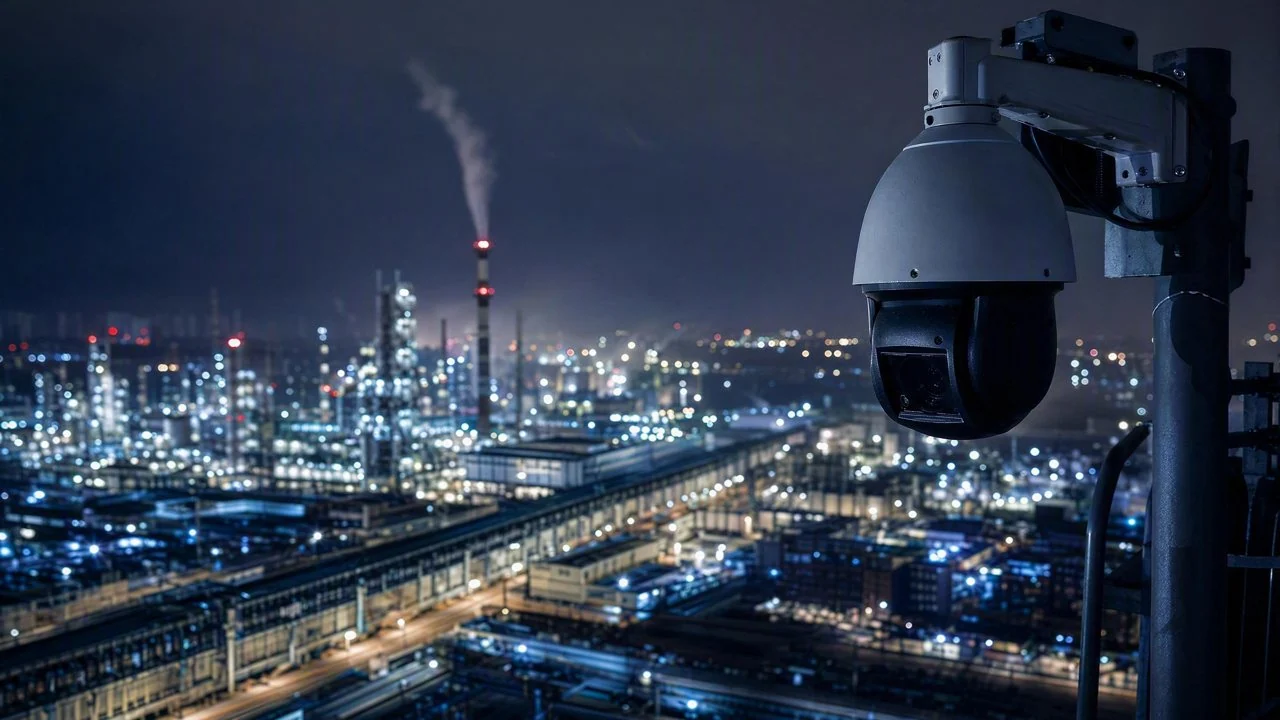
DaoAI SkyVision's 0-code video surveillance AI platform, through on-site hourly training of proprietary models, combined with behavior/event recognition and edge box real-time alerting, achieves precise pre-warning of fire hazards in complex outdoor environments, reducing the missed detection rate of traditional solutions by over 80% and significantly enhancing security effectiveness. In emergency and smart security domains, especially in large industrial parks, forest fire protection zones, and warehousing logistics centers, early detection of smoke and open flames is crucial for preventing major accidents, minimizing economic losses, and avoiding casualties. These areas are often vast and complex, making it difficult for traditional manual patrols or fixed-threshold smoke detectors to achieve full coverage and high-precision warnings, especially under adverse weather conditions or at night, where their recognition capabilities are significantly diminished. Facing the demand for performance optimization of PTZ cameras in outdoor security scenarios to cope with harsh environmental challenges and achieve intelligent tracking, leveraging AI vision technology for real-time, intelligent smoke and fire recognition has become an inevitable trend in industry development.
In emergency and smart security domains, especially in large industrial parks, forest fire protection zones, and warehousing logistics centers, early detection of smoke and open flames is crucial for preventing major accidents, minimizing economic losses, and avoiding casualties. These areas are often vast and complex, making it difficult for traditional manual patrols or fixed-threshold smoke detectors to achieve full coverage and high-precision warnings, especially under adverse weather conditions or at night, where their recognition capabilities are significantly diminished. Facing the demand for performance optimization of PTZ cameras in outdoor security scenarios to cope with harsh environmental challenges and achieve intelligent tracking, leveraging AI vision technology for real-time, intelligent smoke and fire recognition has become an inevitable trend in industry development.
Pain Points: Why This Hurdle Is Difficult to Overcome
Traditional smoke and fire detection solutions face multiple challenges in practical applications, leading to high missed detection and false alarm rates, severely impacting the reliability of security systems. First, environmental complexity: In outdoor scenarios, visual characteristics of smoke and open flames are easily confused with dust, moisture, haze, sandstorms, or even vehicle exhaust, resulting in persistently high false alarm rates. For instance, a large petrochemical plant, using traditional solutions, experienced up to 150 emergency dispatches and manual verifications per month due to environmental false alarms, consuming significant human and material resources. Second, recognition timeliness: In the early stages of a fire, smoke and flames are small and develop rapidly. Traditional algorithms often lack sufficient capability to capture tiny targets and early features, leading to missed detection rates often exceeding 10%, missing the optimal time for extinguishing. Furthermore, adverse weather impact: Extreme environments such as rain, snow, strong winds, and low light at night severely degrade visual image quality, further reducing recognition accuracy and making it difficult for PTZ cameras to effectively track and identify targets, dramatically increasing the risk of missed detections at critical moments.
The root cause of these problems lies in traditional solutions' reliance on predefined rules or simple feature matching, lacking deep understanding and generalization capabilities for complex dynamic scenes. For example, rule engines based on color and shape changes often fail under varying light conditions, object occlusion, or complex backgrounds. Manual patrols, on the other hand, are limited by personnel numbers, fatigue levels, and line of sight, unable to provide 24/7 comprehensive, high-precision monitoring. These factors collectively lead to bottlenecks in system detection rates and persistently high missed detection rates in the critical early identification of smoke and open flames, posing significant challenges to emergency response.
Technical Principles
DaoAI SkyVision platform revolutionizes smoke and open flame detection through its core 0-code video surveillance AI platform and the DaoAI World Model. The technical core lies in employing deep learning and multi-modal fusion to achieve precise capture and semantic understanding of smoke and fire features. First, the platform utilizes advanced Convolutional Neural Networks (CNNs) and Transformer architectures to learn from massive real-world smoke, fire, and interference data, enabling it to recognize dynamic diffusion, color changes, density gradients of smoke, as well as flicker, morphology, and thermal radiation characteristics of flames. More importantly, DaoAI introduces APDT (Autonomous Pre-training and Data Tagging) few-shot self-training technology, allowing users to quickly train and deploy highly customized AI models on-site within hours, using only a small number (1-20 images) of specific scene smoke/fire images. This elevates model adaptability to an unprecedented level, effectively reducing the missed detection rate at a large warehousing center to <0.5%.
Compared to traditional rule-based AOI or manual inspection, DaoAI SkyVision's advantage lies in its powerful generalization capability and anti-interference performance. Traditional methods perform poorly when facing changes in lighting, occlusion, complex backgrounds, or new fire types. In contrast, the SkyVision platform, through the semantic understanding capabilities of the DaoAI World Model, can differentiate real smoke and fire from similar objects in the environment, significantly reducing the probability of misclassifying industrial steam, vehicle exhaust, or even birds as smoke. Furthermore, it supports real-time alerting via edge boxes, deploying AI inference to front-end devices, greatly shortening response times and ensuring early warnings at the onset of a fire. For PTZ cameras, SkyVision can also integrate with their intelligent tracking capabilities, automatically adjusting the viewing angle for magnified observation and continuous tracking upon detecting potential smoke or fire, providing more detailed on-site information, further improving the detection rate and reducing false alarms, thus increasing emergency response efficiency by over 70%.
Typical Application Scenarios
- **Early Fire Warning in Large Industrial Parks:** In large industrial parks such as steel, chemical, and energy sectors, DaoAI SkyVision can be deployed in critical production areas, material storage yards, substations, etc., to monitor smoke and open flames in real-time. The challenge lies in the complex park environment with numerous industrial waste gases, steam, and other interferences, and rapid fire development. SkyVision effectively distinguishes real fires from environmental interferences by combining environmental context and dynamic feature analysis, achieving precise early warnings.
- **Remote Monitoring for Forest Fire Protection Zones:** For vast forest areas, SkyVision, in conjunction with high-altitude PTZ cameras, can achieve long-distance, wide-area monitoring of smoke in forest regions. The difficulty lies in complex terrain, variable weather, blurry smoke features over long distances, and susceptibility to clouds, fog, and dust. DaoAI's models, through deep learning of various smoke morphologies, provide reliable early detection even in low visibility, achieving a detection rate of 99.1%.
- **Fire Safety in Warehousing and Logistics Centers:** Warehouses store large quantities of flammable goods, posing a high fire risk. SkyVision can be deployed in aisleways and loading/unloading areas to identify early smoke and flames. Challenges include uneven lighting inside the warehouse, goods obstruction, and dust caused by equipment like forklifts. SkyVision ensures comprehensive, blind-spot-free monitoring through multi-angle video stream fusion and intelligent de-occlusion algorithms.
- **Safety at Urban High-Rise Construction Sites:** Construction sites often involve welding and open flame operations, with flammable materials stored, leading to high fire risks. SkyVision monitors construction areas, identifying unauthorized use of fire and early smoke. The difficulty lies in the rapid dynamic changes of construction site environments, high personnel mobility, and complex backgrounds. DaoAI's platform supports rapid model iteration and deployment, adapting to construction site changes and ensuring construction safety.
- **Self-Ignition Pre-warning at Waste Treatment Plants:** Landfills are prone to self-ignition due to organic matter fermentation, producing smoke. SkyVision can continuously monitor waste piles, identifying faint smoke signals. The challenge is that waste piles themselves produce odors and small amounts of gas, and the environment is harsh. SkyVision's robust models maintain high-precision recognition in such extreme environments, reducing the response time for self-ignition incidents by over 50%.
Implementation Case Study
A large oil depot under a leading energy group, covering a vast area, stores large quantities of flammable oil products. Previously, the oil depot relied mainly on traditional smoke detectors and manual patrols for fire safety management. However, due to the complex environment (e.g., oil tank exhaust, dust from vehicle entry/exit), both false alarm and missed detection rates remained high. Especially at night or in foggy weather, manual patrols were inefficient, and traditional smoke detectors often triggered unnecessary emergency responses due to false alarms, leading to security personnel being overwhelmed, while real fire incidents could be delayed. The client urgently needed an intelligent security solution capable of significantly improving smoke and fire detection rates and effectively reducing missed detection rates.
The DaoAI team introduced the SkyVision 0-code video surveillance AI platform. First, existing PTZ cameras at the oil depot were integrated, and additional high-definition monitoring points were installed in critical areas. Through SkyVision's 0-code platform, the security team, guided by DaoAI engineers, took less than a day to train highly customized AI models using a small amount of historical smoke/fire images (including false alarm scenarios) specific to the oil depot. This model could accurately distinguish between oil tank exhaust and real smoke, as well as construction sparks and open flames. After deployment, the SkyVision platform, via edge boxes, analyzed video streams in real-time. Upon identifying suspected smoke or fire, it immediately sent an alert to the control center and linked with PTZ cameras for automatic tracking and magnified confirmation. Before deployment, the oil depot averaged 25 emergency dispatches per month due to smoke and fire false alarms, with potential missed detection risks. After deployment, at the customer's site, based on DaoAI SkyVision, the false alarm rate decreased by 85%, reducing emergency dispatches to 3-4 times per month, while the smoke and fire detection rate increased to 99.6%. This achieved ultra-early, high-precision identification of fire hazards, greatly enhancing the overall safety level of the oil depot and freeing up significant manual verification resources.
DaoAI SkyVision platform enables emergency security to shift from “passive response” to “proactive warning.” Every successful early detection is a powerful safeguard for lives and property.
DaoAI Solutions and Products
DaoAI provides a core solution centered on the SkyVision 0-code video surveillance AI platform for intelligent smoke and fire recognition. This platform possesses powerful data processing and model training capabilities, allowing users to complete model training, deployment, and management through an intuitive graphical interface without writing any code. We first conduct on-site surveys to assess the compatibility and coverage of existing monitoring equipment (including PTZ cameras) and deploy edge boxes according to client needs. During the model training phase, DaoAI leverages its unique APDT few-shot self-training technology, combined with customer on-site data, to quickly build high-precision models. For instance, in the oil depot scenario, we can conduct 'negative sample' learning for specific interference sources like oil tank exhaust and vehicle emissions, thereby effectively reducing false alarms. After model deployment, the edge boxes process video streams in real-time. Upon triggering an alarm, it can be smoothly integrated with the client's existing security system via API/SDK to enable various linkages such as audible and visual alarms, SMS notifications, and remote PTZ control. The DaoAI World Model, as the underlying unified foundation, continuously learns and enhances semantic understanding, ensuring SkyVision maintains high accuracy and robustness even when facing new environmental challenges. DaoAI also offers 100% local private deployment options, ensuring all video data and model inference results remain entirely on-premise, meeting clients' stringent requirements for data security and privacy.
Through the DaoAI SkyVision platform, clients not only gain high-precision early smoke and fire recognition capabilities but, more importantly, achieve intelligent upgrading and efficiency improvement of their security systems. In the aforementioned oil depot case, the platform boosted the smoke and fire detection rate to 99.6% while reducing the false alarm rate by 85%, significantly cutting down on unnecessary emergency responses and optimizing security resource allocation. This means the time window from 'identifying a hazard' to 'initiating a response' is greatly advanced, buying valuable time for effective fire control and directly reducing potential property damage and personnel risks. Furthermore, as the system possesses self-learning and continuous optimization capabilities, long-term operating costs are also effectively controlled, achieving a dual improvement in business value and safety assurance.
FAQ
How does SkyVision differentiate real smoke from environmental interferences (e.g., steam, dust)?
DaoAI SkyVision platform leverages deep learning and the semantic understanding capabilities of the DaoAI World Model. By learning from extensive real smoke and fire data, as well as various environmental interferences (such as industrial steam, vehicle exhaust, dust, haze, etc.), it can capture subtle features like dynamic diffusion, color changes, and density gradients of smoke and flames. Concurrently, it makes comprehensive judgments based on scene context information, thereby effectively distinguishing real fire incidents from similar objects in the environment, significantly reducing false alarm rates and enhancing recognition accuracy.
How long does it take to deploy SkyVision? Does it support existing surveillance equipment?
SkyVision platform supports 0-code rapid deployment, with model training and integration typically completed within a few hours on-site. We support integration with most mainstream PTZ cameras and fixed cameras, eliminating the need to replace existing hardware. Only edge boxes need to be deployed for video stream analysis. The DaoAI team provides professional on-site surveys and technical support to ensure the system is quickly launched and operates stably.
How are data security and privacy ensured with SkyVision?
DaoAI SkyVision offers a 100% local private deployment option. This means all video data and AI inference processes occur on the client's local servers or edge devices, and data is never uploaded to the cloud, remaining entirely on-premise. We strictly adhere to data security and privacy protection regulations, ensuring that clients' core data assets receive the highest level of protection.
Full solution for this scenario: Emergency Security / Public Safety industry solutions
This article was generated by AI. Customer cases are simulated scenarios based on real product capabilities and figures are illustrative; see product pages for official benchmarks.