
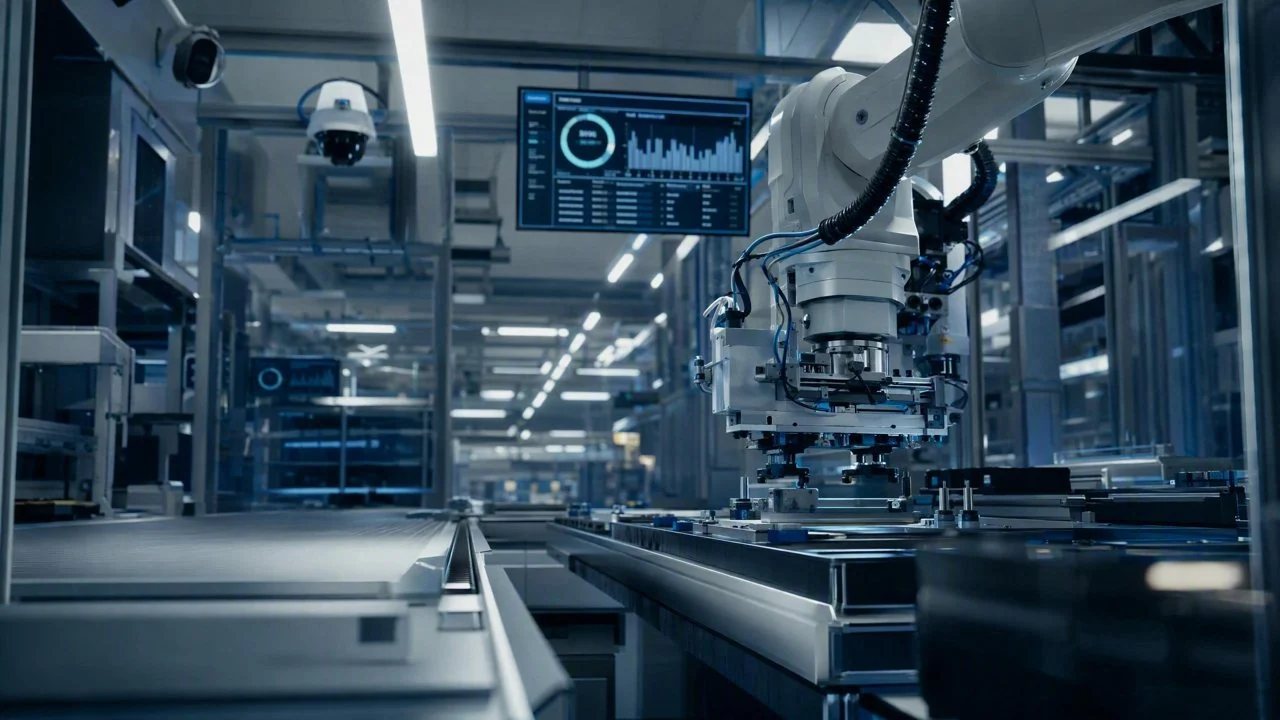
DaoAI SkyVision 0-code AI Video Surveillance Platform (on-site hourly training of proprietary models, behavior/event recognition, edge device real-time alerts, 100% on-premise data security, DaoAI World semantic understanding) precisely compares two-handed operation standards and identifies abnormal behaviors on industrial production lines, reducing traditional manual re-inspection workload by 70% while ensuring compliance and product quality in critical processes.
In lean manufacturing, compliance with industrial SOPs (Standard Operating Procedures) directly impacts product quality, production efficiency, and employee safety. Particularly in high-precision or high-risk assembly and inspection processes, the standardization of two-handed operations is crucial. For instance, on an assembly line for a consumer electronics product, a series of two-handed actions such as picking, placing, fastening, and connecting miniature components are involved. Any deviation can lead to product functional failure. Traditionally, comparing these operational standards relied on supervisors or quality inspectors' on-site patrols, which was inefficient and had limited coverage, often leading to missed detections. DaoAI SkyVision 0-code AI Video Surveillance Platform precisely compares two-handed operation standards and identifies abnormal behaviors on industrial production lines, reducing traditional manual re-inspection workload by 70% while ensuring compliance and product quality in critical processes.
Pain Points: Why is this Hurdle so Difficult to Overcome?
For scenarios involving two-handed operation standard comparison, traditional solutions face multiple challenges. Firstly, the average coverage rate of manual inspection is typically below 30%, leading to numerous non-compliant operations going undetected, posing high potential compliance risks. Secondly, traditional rule-based video analysis systems exhibit persistently high false alarm rates, generally between 15% and 25%, when identifying complex and varied two-handed movements. This not only consumes significant human resources for re-inspection but also occupies valuable production resources, leading to a surge in manual review hours. In a medium-sized electronics manufacturing enterprise, daily re-inspection hours due to false alarms amounted to 40 hours, severely hindering the production pace. Furthermore, due to differences in operational procedures for various product models, each changeover required re-setting rules, resulting in long changeover downtime, averaging 2–4 hours per changeover, affecting production flexibility.
The root cause of these difficulties lies in the complexity of industrial production environments. Factors such as lighting, occlusion, and diverse human postures make two-handed motion recognition extremely challenging. Traditional rule engines struggle to cope with subtle posture variations and environmental interferences, leading to a large number of 'ambiguous' false alarms. For example, a brief pause by a worker or a slight arm sway could be misidentified as a non-compliant operation. Simultaneously, individual differences in workers' operating habits limit the generalization capability of universal rules. In the current ubiquitous market for video surveillance, leveraging AI technology to accurately extract effective information from vast video streams while effectively suppressing false alarms is a critical challenge facing the industry. DaoAI, with its advanced AI technology, effectively addresses these challenges.
Technical Principles
DaoAI SkyVision 0-code AI Video Surveillance Platform fundamentally resolves the issue of high false alarm rates through its core DaoAI World semantic understanding capabilities and APDT (Adaptive Pre-training and Domain Transfer) few-shot learning technology. The platform first uses the unified DaoAI World foundation to semantically understand the scene, building a deep cognitive model of the operational environment that distinguishes background interference from core actions. Subsequently, by training proprietary models on-site within hours, the platform can quickly learn and adapt to specific production line operational standards. For two-handed operation comparison, DaoAI SkyVision employs a combination of pose estimation algorithms and temporal behavior analysis. It not only identifies hand positions but also analyzes the relative positions, movement trajectories, and interaction states of both hands within a specific time window to determine compliance with preset SOPs. For instance, if the SOP requires both hands to pick up material simultaneously, the platform verifies if both hands touch the designated material area in the same frame and checks their subsequent movement trajectories.
Compared to traditional rule-based AOI or manual inspection methods that rely on thresholds and regional determinations, DaoAI SkyVision's advantage lies in its powerful generalization capability and adaptability. Traditional methods require precise definition of pixel-level regions and time sequences for each action, making them sensitive to environmental changes; even slight variations in lighting or worker standing positions can render them ineffective. In contrast, DaoAI SkyVision, based on deep learning models, can learn the essential features of operational standards from a small number of samples, maintaining high accuracy even in complex and variable environments. Its real-time alerting capability via edge devices ensures second-level response to abnormal behaviors, avoiding the latency of traditional solutions. Furthermore, 100% on-premise data deployment completely eliminates customer concerns about data security and privacy.
Typical Application Scenarios
- **Precision Electronic Component Assembly:** On assembly lines for consumer electronics like mobile phones and tablets, workers need to coordinate both hands to pick, insert, and pre-position miniature components before soldering. For example, simultaneously inserting a flexible circuit board into a connector, ensuring correct orientation. The challenge lies in the tiny components, confined operating space, and significant variations in workers' operating styles. DaoAI SkyVision ensures simultaneous and correct two-handed operation through precise pose recognition.
- **Automotive Parts Assembly:** In automotive harness or interior trim assembly, workers need to use both hands to bundle harnesses, press clips, and tighten bolts. For instance, both hands simultaneously securing a component to prevent shaking or falling. The difficulty lies in complex movements and potential partial occlusions. DaoAI SkyVision accurately determines compliance through real-time tracking of key joint points and analysis of behavior sequences.
- **Medical Device Cleanroom Operations:** In cleanroom environments, medical professionals or technicians assemble or package medical devices, where both hands must strictly adhere to aseptic operating procedures. For example, both hands simultaneously retrieving sterile consumables from a designated area, or both hands performing package sealing. The challenge lies in the special environment and subtle operating movements. DaoAI SkyVision can distinguish between normal retrieval and non-compliant contact, ensuring a sterile environment.
- **Food Processing Line Packaging:** On food packaging lines, workers may need to coordinate both hands to complete product loading into boxes, sealing, and labeling, to ensure packaging efficiency and quality. For example, both hands simultaneously placing two products into one package. The challenge lies in the fast pace, high repeatability of movements but occasional deviations. DaoAI SkyVision captures and analyzes two-handed movements at a high frame rate, ensuring packaging compliance.
Case Study
A tier-1 supplier in the consumer electronics industry, operating multiple high-precision assembly lines, faced challenges with numerous two-handed collaborative operations. Previously, they relied on supervisors' on-site patrols and sample video reviews to monitor operational standards, but still struggled with high false alarm rates and immense re-inspection pressure. Their monthly rework rate due to non-compliant operations was approximately 1.2%, and the quality inspection department spent about 200 hours per week on video re-inspection. To address this pain point, the manufacturer implemented DaoAI SkyVision 0-code AI Video Surveillance Platform. In the initial phase, the DaoAI team collected a small number of video samples of compliant and non-compliant operations on-site, completing model training and deployment for the first workstation in just 3 hours. Through DaoAI World's understanding of the scene, the platform intelligently identified critical two-handed actions such as picking, placing, and tightening in specific areas.
DaoAI SkyVision has reduced our false alarm rate for two-handed operation standard comparison by 85%, significantly alleviating the re-inspection burden on our quality control personnel. Now they can focus more on valuable quality improvement initiatives.
After deployment, DaoAI SkyVision platform quickly demonstrated significant results. The false alarm rate for two-handed operation standard comparison at this manufacturer decreased from the original 18% to <3%, a reduction of 85%. This directly led to a substantial reduction in manual re-inspection workload, saving approximately 170 hours of re-inspection time per week, equivalent to freeing up the productivity of 4 full-time quality inspectors. Concurrently, because non-compliant operations were promptly detected and corrected, the product rework rate also decreased by 60%, from 1.2% to <0.5%. DaoAI SkyVision's hourly training capability and edge device real-time alerting mechanism allowed production managers to respond quickly, ensuring continuous improvement in production efficiency and product quality. The 100% on-premise deployment also fully met the manufacturer's stringent data security requirements.
DaoAI Solution and Products
DaoAI SkyVision 0-code AI Video Surveillance Platform is an ideal solution for industrial SOP scenarios. Its core capabilities lie in '0-code' and 'hourly training,' meaning customers do not need professional AI engineers. They can quickly build, train, and deploy exclusive models through a simple drag-and-drop interface and a small number of samples. For two-handed operation standard comparison, DaoAI provides pre-built pose recognition and behavior analysis modules. Users only need to upload a few videos of standard operations and a few abnormal operations, and the system will automatically learn and generate high-precision models. The platform supports various deployment methods, including edge boxes, SDK/API, or Docker containers, ensuring flexibility and integration with existing systems. All video data and model inference are performed locally, ensuring data never leaves the premises through the DaoAI SkyVision platform, meeting enterprises' strict requirements for data privacy and security. Furthermore, DaoAI World as a unified foundation continuously learns and enhances generalization capabilities, allowing models to adapt and deploy more quickly when facing new processes or products.
DaoAI is committed to providing customers with user-friendly, efficient, and secure AI vision solutions. Through the DaoAI SkyVision platform, enterprises can not only significantly reduce false alarm rates and alleviate the burden of manual re-inspection but also substantially improve the compliance of operational standards, thereby reducing production costs and enhancing product quality. This capability of deeply integrating AI into production processes is a core trend in current intelligent manufacturing development and brings tangible business value to enterprises.
FAQ
How does DaoAI SkyVision platform achieve "0-code" training and deployment?
DaoAI SkyVision platform enables non-AI engineers to quickly build, train, and deploy models through an intuitive graphical user interface and pre-built algorithm modules, using simple drag-and-drop operations and minimal sample data. Users only need to annotate a small number of image or video frames, and the platform automatically learns features, significantly lowering the barrier and time cost for AI applications.
In industrial SOP comparison, what types of false alarms does SkyVision significantly reduce?
The SkyVision platform significantly reduces false alarms caused by factors such as environmental light changes, subtle differences in human posture, and momentary occlusions. By leveraging the DaoAI World model for semantic understanding and combining it with temporal behavior analysis, the platform can distinguish between incidental fluctuations in normal operations and genuine non-compliant behaviors, thereby avoiding a large number of 'false positive' alerts that traditional rule engines cannot handle.
What is the initial investment and estimated payback period for deploying DaoAI SkyVision platform?
The initial investment for DaoAI SkyVision platform varies depending on specific customer requirements (e.g., number of cameras, edge computing device configuration, customized model needs, etc.). However, due to its '0-code' and 'hourly training' features, the deployment cycle is short, and it can significantly reduce false alarm rates, cut manual re-inspection costs, and improve production efficiency, typically leading to a return on investment within a few months. For specific quotes and payback period analysis, please contact our sales team for a customized solution.
Full solution for this scenario: Industrial SOP Compliance industry solutions
This article was generated by AI. Customer cases are simulated scenarios based on real product capabilities and figures are illustrative; see product pages for official benchmarks.