
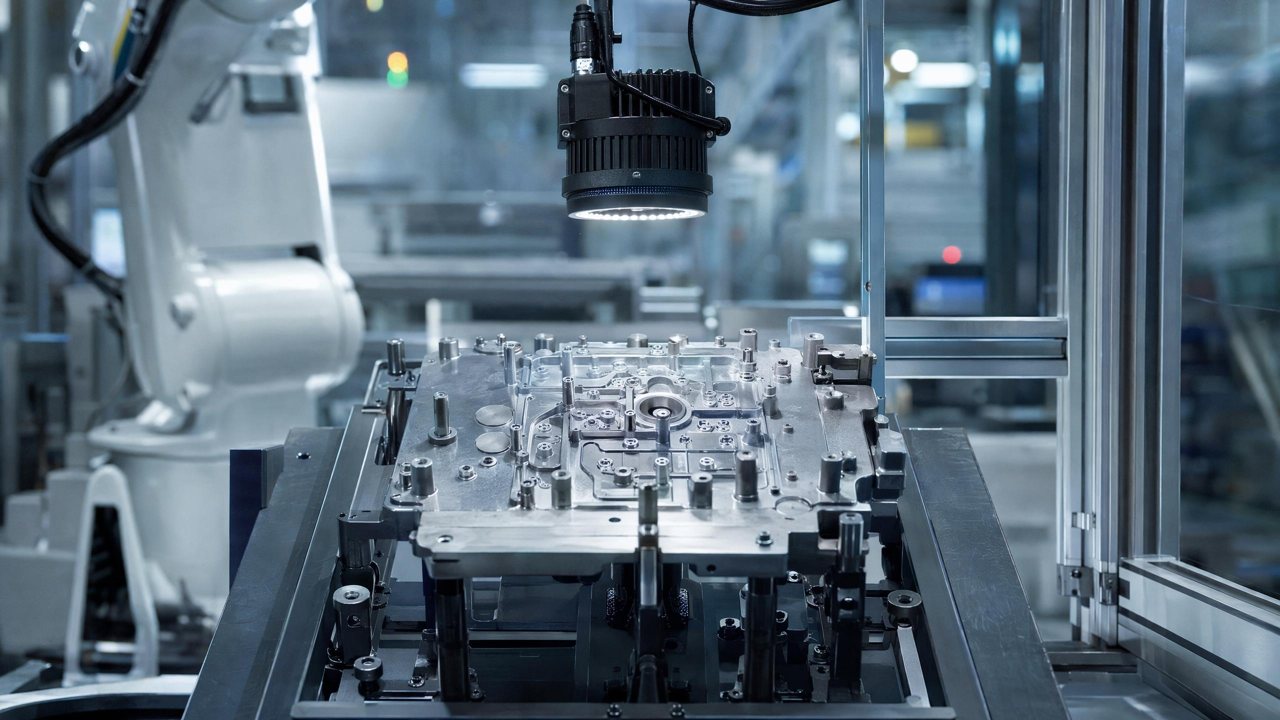
DaoAI SkyVision 0-code video surveillance AI platform (on-site hourly custom model training, behavior/event recognition, edge box real-time alerts, 100% on-premise data, DaoAI World semantic understanding) analyzes critical assembly station video streams in real-time to precisely identify and instantly alert for missing bolts of various specifications in complex products, reducing rework rates due to missing bolts from 4.5% to <0.2%. In the current wave of manufacturing's intelligent and lean transformation, strict adherence to SOP (Standard Operating Procedures) is the cornerstone of product quality and production efficiency. However, in the assembly of complex products, especially operations involving a large number of irregular, multi-specification fasteners, manual visual inspection is highly prone to fatigue and oversight, leading to defects such as missing or incorrect installations flowing downstream. This not only increases rework costs but can also impact product reliability and user safety. Just as AIoT full-domain parking solutions leverage vision and sensing technologies to optimize urban traffic flow, industrial SOP monitoring urgently needs similar intelligent methods to transform traditional passive quality control into active early warning, thereby solving the 'missing step' problem and improving overall operational efficiency.
In the current wave of intelligent and lean transformation in manufacturing, strict adherence to SOP (Standard Operating Procedures) is the cornerstone of product quality and production efficiency. However, in the assembly of complex products, especially operations involving a large number of irregular, multi-specification fasteners, manual visual inspection is highly prone to fatigue and oversight, leading to defects such as missing or incorrect installations flowing downstream. This not only increases rework costs but can also impact product reliability and user safety. Just as AIoT full-domain parking solutions leverage vision and sensing technologies to optimize urban traffic flow, industrial SOP monitoring urgently needs similar intelligent methods to transform traditional passive quality control into active early warning, thereby solving the 'missing step' problem and improving overall operational efficiency. Taking a leading high-tech manufacturer as an example, one of its core product assembly lines produces complex products, including circuit boards, precision sensors, and heat dissipation modules across multiple layers. The main board alone requires dozens of bolts of different models, lengths, and head types for fastening. These bolts are distributed in holes of varying depths, some even partially obscured by other components. Ensuring every bolt is correctly installed according to SOP at a high production pace has become a severe challenge for this manufacturer.
Pain Points: Why is this hurdle so difficult to overcome?
This leading manufacturer faces multiple pain points in the assembly of complex products. Firstly, the missing bolt rate reached 4.5%, meaning that for every 1000 products manufactured, 45 required rework due to missing bolts, severely impacting production efficiency and delivery cycles. Secondly, the labor cost for manual re-inspection and correction was enormous; each reworked product required an average of an additional 15-20 minutes for disassembly, re-installation, and re-testing. The resulting extra labor costs and downtime losses could amount to hundreds of thousands of yuan per month. Thirdly, during production line changeovers, due to the wide variety of product models, the types, quantities, and locations of bolts varied significantly. Each changeover required at least 30 minutes to retrain workers to identify the SOP for bolts in new products, leading to long changeover downtime and insufficient production flexibility. Finally, a deeper risk lies in the possibility that if a missing bolt is not detected in time and enters the market, it could lead to product failure under extreme conditions, triggering customer complaints or even recalls, severely damaging brand reputation.
The difficulty in addressing these pain points stems from the inherent challenges of complex product assembly. From a process perspective, there's a wide variety of bolts (e.g., M2, M2.5, M3; flat head, countersunk head, pan head), and hole depths vary. Some bolt holes are adjacent to other components, causing severe visual obstruction. From an imaging perspective, traditional fixed cameras or rule-based vision algorithms struggle to adapt to the subtle morphological differences, reflective properties, and complex background interference of various bolts. Especially under high production speeds, operators work quickly, relying solely on visual inspection to determine if a bolt is in place, making them highly susceptible to missed detections due to visual fatigue. Furthermore, traditional rule-based vision systems require significant time for rule adjustment and parameter optimization when new products or bolt specifications change, lacking flexibility and unable to meet the demands of multi-variety, small-batch production. This parallels the complexity of identifying different vehicle types and parking spaces in urban parking management, where manual management is inefficient and error-prone, urgently requiring intelligent, adaptive solutions.
Technical Principles
DaoAI SkyVision 0-code video surveillance AI platform fundamentally solves the problem of missing step detection in complex assembly SOPs through its core deep learning algorithms and DaoAI World model's semantic understanding capabilities. The platform employs advanced Convolutional Neural Network (CNN) architectures, combined with attention mechanisms like Transformer, to extract fine-grained features of bolt areas from high-definition video streams in real-time. Unlike traditional rule-based algorithms relying on thresholds or edge detection, SkyVision's model learns from a large number of actual bolt images (including correctly installed, missing, and incorrectly installed cases) to form a deep semantic understanding of bolt 'presence' and 'absence'. Even when bolts are partially obscured, lighting conditions change, or bolt types vary, the model can robustly perform identification. Its core lies in 'on-site hourly custom model training,' meaning users don't need programming or complex machine learning knowledge. They only need to collect a small number of good samples (typically 1-20 images) and a few defect samples (e.g., images of missing bolts) on the production line. SkyVision can then automatically train a highly accurate customized AI model within a short period (typically 1-3 hours). This process leverages transfer learning and few-shot learning techniques, transferring pre-trained general visual knowledge from the DaoAI World model to the specific bolt detection task, significantly shortening the model development cycle and lowering the barrier to entry.
Compared to traditional manual visual inspection, SkyVision offers 24/7 continuous operation, eliminating missed detections due to fatigue, and its detection consistency far surpasses human capabilities. Compared to traditional rule-based AOI systems, SkyVision's AI model possesses powerful generalization and adaptability. Rule-based AOI often requires manually setting complex detection parameters and tolerances for each bolt type and position. If product or bolt specifications change, it takes significant time to rewrite rules, and it's sensitive to environmental factors like lighting and background. In contrast, SkyVision's deep learning model automatically learns features from data, exhibiting stronger robustness to environmental changes, and supports 0-code rapid changeover. It can quickly iterate the model with a small number of new samples to adapt to new detection requirements. Furthermore, SkyVision is deployed on edge boxes, enabling real-time alerts with millisecond-level response times for detection results, ensuring defects are discovered and corrected as soon as they occur, preventing them from flowing to downstream processes, and meeting the security requirement of 100% on-premise data without leaving the factory.
Typical Application Scenarios
- **Detection of Missing Multi-Spec Bolts**: In the fastening of components like motherboards and power modules in complex electronic products, various bolt sizes (e.g., M2, M2.5, M3) and head types (flat head/countersunk head/pan head) are involved. SkyVision can simultaneously identify and determine the presence of all specified bolts, even when bolt colors are similar to the background or partially obscured by cables. The challenges lie in the tiny size, large number, dense distribution, and varying reflective properties of different bolts.
- **Detection of Missing Irregular Fasteners (e.g., clips, rivets)**: In addition to standard bolts, many products use custom-shaped clips or rivets for fastening. These components have irregular shapes and often blend into the surrounding structure, making it difficult for humans to quickly determine if they are in place. SkyVision effectively detects if they are installed according to SOP by learning their unique shape features.
- **Detection of Missing Nuts and Washers**: In some products with strict requirements for structural strength and electrical insulation, nuts and washers are indispensable components. They are usually small in volume and thin in thickness, easily overlooked during assembly. SkyVision can identify whether corresponding nuts or washers are present under the bolts, ensuring the integrity of fasteners.
- **Detection of Incorrect Bolt Installation**: In certain critical positions, specific types or lengths of bolts must be used. If the wrong type of bolt is used, it may lead to insufficient strength or interference with other components. SkyVision, combined with DaoAI World's semantic understanding capabilities, can not only determine if a bolt is present but also identify if its type meets SOP requirements, preventing incorrect installations.
Case Study
A tier-1 automotive electronics supplier, producing a smart driving domain controller, features an extremely precise internal structure, including multiple PCB boards and heat dissipation modules, requiring the installation of over 80 bolts and washers of different specifications. Previously, this production line relied entirely on manual visual inspection, leading to a persistently high missing bolt rate, with an average rework rate of 4.5% per batch of products. To address this challenge, the supplier introduced the DaoAI SkyVision platform. We first deployed multiple industrial cameras at critical assembly stations to capture high-resolution video streams after product assembly was completed. Subsequently, engineers used SkyVision's 0-code training interface, collecting only 15 images of correctly installed bolts and 5 images of defects with missing bolts, and trained a highly customized AI model within 1.5 hours. After deployment to the edge computing box, the model began real-time monitoring of the assembly process. Before deployment, the missing bolt rate hovered around 4.5%, with significant time spent on manual re-inspection and rework. After implementing SkyVision, the platform could instantly identify any missing bolts and notify the operator within 120ms via audible and visual alarms and a line stop signal, immediately intercepting defective products. After one month of trial operation, the missing bolt rate was significantly reduced to <0.2%, manual re-inspection volume decreased by 63%, and downtime due to rework was greatly shortened. The customer highly recognized this, planning to extend SkyVision to other complex assembly lines.
"SkyVision's 0-code training capability allowed us to have our dedicated AI quality inspector within hours, greatly enhancing the flexibility and efficiency of our production line."
DaoAI Solution and Products
The core solution provided by DaoAI to this leading manufacturer is based on the SkyVision 0-code video surveillance AI platform. The platform's core capability lies in its 'on-site hourly custom model training' feature, which enables rapid deployment and updating of AI models with extremely low cost and high efficiency when facing multi-variety, small-batch, and rapidly iterating production demands. In specific implementation, industrial-grade high-definition cameras are first installed above or to the side of assembly stations, covering critical bolt areas. Then, through SkyVision's intuitive user interface, engineers, without writing any code, simply upload a small number (e.g., 10-20) of 'good product' images that comply with SOP, and a few 'defect' images (e.g., images of missing bolts) according to the wizard. The platform automatically utilizes the DaoAI World model for feature extraction and model training, quickly generating a dedicated AI model for detecting missing bolts in that specific product. This model is deployed in a local edge computing box, ensuring 100% on-premise data without leaving the factory, guaranteeing data security and privacy. Once a missing bolt is detected, the edge box immediately triggers audible and visual alarms and, through integration with the production line control system (e.g., PLC), sends a line stop signal, ensuring defective products do not flow to the next process. SkyVision's 'behavior/event recognition' capability also plays a role here; it's not just about recognizing whether a bolt is present but also further determining whether the operator has completed the bolt installation action, thereby achieving more comprehensive SOP compliance monitoring. Furthermore, the platform supports multi-camera collaboration, covering large areas or multiple angles of assembly. Combined with the semantic understanding capabilities of the DaoAI World model, SkyVision can continuously learn from production line feedback, constantly optimizing model performance to achieve self-adaptive evolution, becoming 'better with use'.
By introducing the SkyVision platform, the manufacturer achieved a dual improvement in production efficiency and product quality. The missing bolt rate was significantly reduced from 4.5% to <0.2%, virtually eliminating rework due to missing bolts. Manual re-inspection volume decreased by 63%, greatly freeing up human resources. Meanwhile, because model training and changeover time were shortened from days to just 1-3 hours, production line changeover downtime was drastically reduced, and production flexibility was significantly enhanced, enabling quicker responses to market changes. This not only reduced operating costs and improved customer satisfaction but, more importantly, through proactive quality control, effectively mitigated potential product quality risks and brand reputation loss, building a more robust quality defense line for the enterprise.
FAQ
How does SkyVision ensure accurate identification of bolts with different specifications?
SkyVision utilizes deep learning algorithms and the DaoAI World model. By training with a small number of images (1-20) of various bolt specifications collected on-site, the model automatically learns and identifies features such as bolt shape, size, and position. It maintains high accuracy even with lighting changes or partial obstructions, offering greater generalization and robustness than traditional rule-based vision.
What deployment options does the platform support, and how is data security ensured?
SkyVision supports various deployment methods including SDK / API / Docker. Its core models and data processing are performed entirely on local edge boxes, ensuring 100% on-premise private deployment, with all production data remaining within the factory. This maximizes client data security and privacy, complying with stringent industrial data compliance requirements.
What specific benefits can be achieved through on-site hourly custom model training?
On-site hourly custom model training allows clients to quickly tailor AI models for specific defects or processes without relying on external experts or lengthy development cycles. This significantly shortens the preparation time for new product launches or production line changeovers, typically enabling model training and deployment within 1-3 hours. This dramatically enhances production line flexibility and responsiveness, while reducing the cost of AI implementation and maintenance.
This article was generated by AI. Customer cases are simulated scenarios based on real product capabilities and figures are illustrative; see product pages for official benchmarks.