
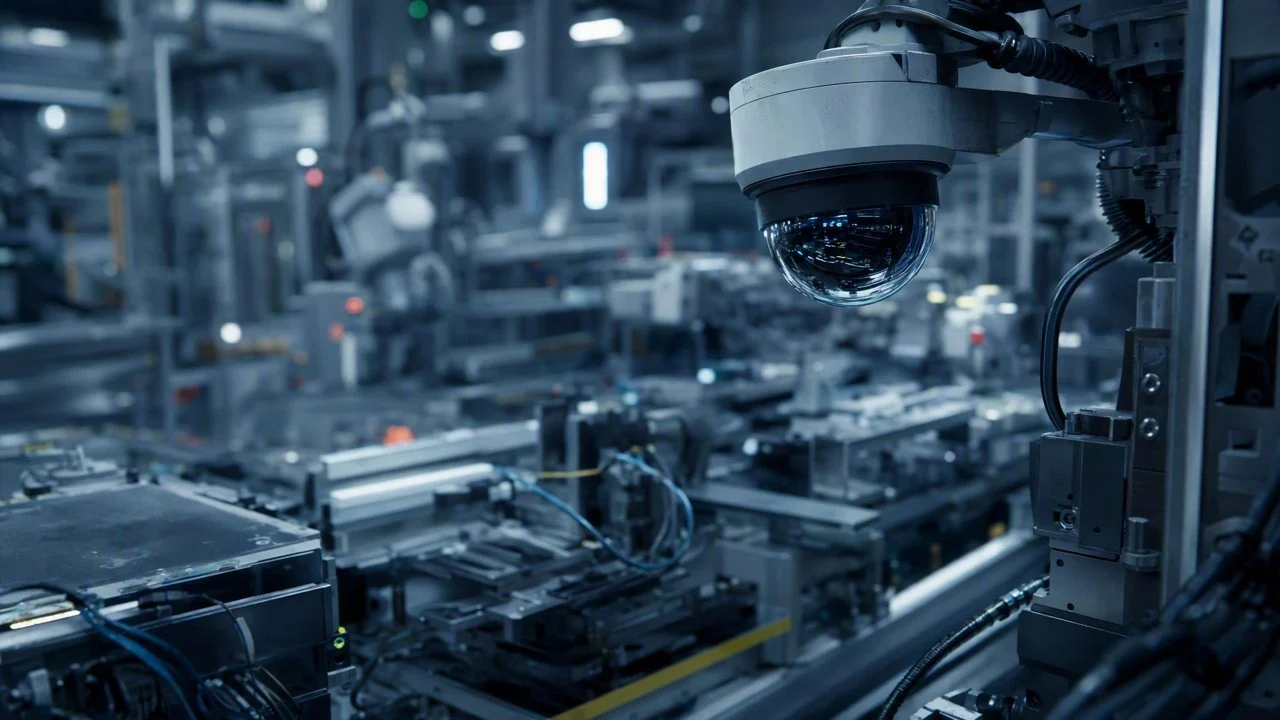
DaoAI's SkyVision 0-code video surveillance AI platform (featuring on-site hourly custom model training, behavior/event recognition, edge box real-time alerting, 100% on-premise data security, and DaoAI World semantic understanding) significantly enhances safety by reducing the early smoke and fire detection response time on high-speed production lines by 75% through precise behavior and event recognition.
In the field of emergency and smart security, especially in industrial sites such as chemical, electronics manufacturing, and warehousing logistics, where fire safety requirements are extremely high, early detection of smoke and open flames is critical for ensuring production continuity and the safety of personnel and property. Traditional fire monitoring systems often rely on point or linear sensors, with response speeds limited by the physical process of smoke or heat diffusion, making it difficult to meet the stringent demands for 'second-level response, full-area coverage' in high-speed production line environments. With the deepening of Industry 4.0, production line cycles are continuously accelerating. Any minor fire hazard, if not detected immediately, can escalate into a major accident in a very short time, causing immeasurable losses to enterprises. DaoAI's SkyVision platform addresses this pain point by introducing advanced AI vision technology into emergency security, aiming to achieve millisecond-level early warning for smoke and open flames, ensuring safe production under 100% full inspection capacity.
Pain Points: Why This Hurdle Is Difficult to Overcome
Achieving early smoke and open flame detection in high-speed production lines presents multiple challenges. First is the conflict between **response speed and accuracy**: traditional smoke or temperature sensors require smoke or temperature to reach a certain concentration/threshold to trigger, with response times typically ranging from tens of seconds to several minutes, far exceeding the production line's expectation for accident containment. Second is the **false alarm rate and environmental adaptability**: common phenomena in industrial environments such as dust, water vapor, lighting changes, welding sparks, and steam emissions are easily misidentified as fire hazards by traditional vision systems, leading to frequent false alarms that reduce security personnel's trust and response efficiency, with false alarm rates previously exceeding 30%. Third is **deployment and maintenance costs**: traditional rule-based vision systems or manual inspections require significant human investment, and model updates and iterations are slow, making it difficult to adapt to constantly changing production scenarios and new fire characteristics, resulting in high maintenance costs and low efficiency. Especially on 24/7 uninterrupted production lines, any downtime for adjustments means huge economic losses, while manual inspections cannot achieve 100% full-time, full-area coverage, leaving blind spots and missed detection risks.
The root cause of these dilemmas is that traditional methods cannot effectively distinguish between 'normal industrial activities producing smoke/flame-like phenomena' and 'real catastrophic smoke/open flames.' For example, arc light and smoke from welding share some similarities with early fire characteristics, but their behavior patterns and diffusion paths are completely different. Furthermore, factors such as equipment obstruction, light reflection, and viewing angle limitations on the production line make detecting tiny, initial smoke or fire points extremely difficult. The lack of semantic understanding capabilities for complex scenes is an insurmountable barrier for traditional solutions, making 100% full inspection while maintaining production line cycle an extravagant hope.
Technical Principles
DaoAI's SkyVision platform achieves ultra-early, high-precision detection of smoke and open flames by integrating advanced deep learning algorithms and edge computing technology. Its core lies in the semantic understanding capability built upon the DaoAI World foundation model, which can extract and analyze complex spatio-temporal features from video streams. The platform employs a multi-stage recognition architecture: first, it uses Convolutional Neural Networks (CNNs) for pixel-level feature extraction on video frames to identify potential smoke or flame regions; second, it incorporates Recurrent Neural Networks (RNNs) or Transformer architectures to model the dynamic changes of these regions over time, such as smoke diffusion speed, shape changes, flame flicker frequency, and color variations, thereby effectively distinguishing real fires from interfering factors (e.g., steam, dust, welding sparks). Through this method, DaoAI's SkyVision platform has reduced the false alarm rate by over 80%, significantly enhancing the reliability of early warnings. Furthermore, its '0-code' feature allows users to quickly train and deploy custom models for specific scenarios on-site within hours, without the need for professional AI engineers, greatly shortening the time from problem identification to resolution.
Compared to traditional rule-based vision systems or manual inspection, DaoAI's SkyVision platform offers significant advantages. Traditional rule-based systems rely on preset thresholds for color, shape, and motion trajectories, exhibiting poor robustness to environmental changes and difficulty in identifying atypical smoke or flame forms. Manual inspection is limited by fatigue, attention span, blind spots, etc., making 24/7 uninterrupted, comprehensive monitoring impossible, especially on high-cycle production lines where catching initial fire points with the naked eye is nearly impossible. DaoAI's SkyVision platform, however, learns and generalizes the ability to recognize smoke and open flames in various complex scenarios by training on vast amounts of real and simulated data. It also performs real-time analysis using edge boxes, ensuring low-latency alerts. This deep learning-based semantic understanding allows the system not only to 'see' smoke or flames but also to 'understand' their behavior patterns, leading to more accurate judgments.
Typical Application Scenarios
- **Smoke/Open Flame Detection in Chemical Raw Material Storage Areas**: In highly flammable and explosive chemical raw material warehouses, SkyVision monitors storage areas in real-time. By highly sensitively detecting initial smoke (e.g., light color, slow diffusion) and tiny flames, it immediately alerts upon abnormality, nipping potential explosion risks in the bud. The challenge lies in distinguishing environmental dust and water vapor from real smoke.
- **Overheating/Short Circuit Pre-warning on Electronic Product Assembly Lines**: During high-density electronic product assembly, localized overheating or short circuits of components can lead to smoking or even fire. DaoAI's SkyVision platform analyzes video streams from critical points on the production line in real-time, identifying trace smoke or component discoloration caused by abnormal heat sources, providing early warnings to prevent large-scale product scrap and fire accidents. The challenge involves detecting small targets on high-speed moving production lines and complex background interference.
- **Fire Pre-warning in Automated Storage and Retrieval Systems (AS/RS)**: The internal space of AS/RS is complex, with dense shelving, making traditional fire fighting methods difficult to cover. SkyVision is deployed at key monitoring points within the warehouse, utilizing its behavior/event recognition capabilities to effectively detect initial smoke or fire points in areas like shelf gaps and conveyor belts. It links with fire suppression systems to guide extinguishing robots for precise localization, minimizing the risk of fire spread. The challenge lies in robust detection in large spaces with multiple obstructions and uneven lighting.
- **Abnormal Behavior and Fire Linkage in Hazardous Material Processing Areas**: In hazardous material processing or waste incineration areas, SkyVision not only identifies smoke and open flames but also leverages DaoAI World's semantic understanding capabilities to recognize abnormal personnel behavior (e.g., unauthorized operations, approaching dangerous areas). It links this with fire detection, triggering the highest level of alert if fire hazards and abnormal behavior occur simultaneously, achieving multi-dimensional safety protection.
Case Study
A leading domestic electronics manufacturing enterprise, with hundreds of SMT (Surface Mount Technology) production lines operating 24 hours a day, had extremely high demands for fire safety. Previously, the company primarily relied on traditional smoke and temperature sensors and manual inspections, but faced numerous challenges in actual operation: frequent false alarms (e.g., caused by welding smoke, equipment heat dissipation) led to security personnel being overwhelmed, and real fire response times were slow; some areas had monitoring blind spots, making 100% full coverage impossible; the production line cycle was fast, and initial fires often escalated rapidly, making traditional methods ineffective in containment. To address these issues, the enterprise introduced DaoAI's SkyVision 0-code video surveillance AI platform. Before deployment, the average initial fire response time was over 120 seconds, and there were over 30 false alarms per month. After deployment, by installing edge boxes and high-definition cameras in critical areas of the production line and utilizing SkyVision for hourly model training, the system could issue an alert within 30 seconds of smoke or open flames appearing, reducing response time by 75%. Simultaneously, thanks to the semantic understanding capabilities of the DaoAI World foundation model, the platform effectively distinguished between normal production activities and real fires, reducing the false alarm rate to <1.5%. This significantly alleviated the burden on security personnel and ensured safe operation and 100% full inspection capacity on the high-speed production line.
DaoAI's SkyVision platform dramatically reduced initial fire response time from an average of over 120 seconds to under 30 seconds, and lowered the false alarm rate to <1.5%, truly achieving second-level early warning and a closed-loop safety system for high-speed production lines, ensuring production continuity and personnel safety.
DaoAI Solutions and Products
DaoAI's core solution for this client was based on the SkyVision 0-code video surveillance AI platform. The primary advantage of this platform is its '0-code' characteristic, allowing on-site client engineers, without specialized AI development skills, to complete the training and deployment of custom smoke/open flame recognition models within hours using simple drag-and-drop operations and a small amount of sample data. To meet the demands for production line cycle and 100% full inspection capacity, DaoAI's SkyVision adopted an edge box deployment model, bringing AI inference capabilities down to the production site. This ensures real-time processing and analysis of video data locally, with data remaining on-premise, meeting the client's stringent requirements for data security and privacy. The edge box is equipped with high-performance AI chips, capable of processing multiple high-definition video streams with millisecond-level latency, and immediately triggering audio-visual alarms or linking with fire suppression systems upon detecting anomalies. Furthermore, the DaoAI World foundation model, as SkyVision's underlying intelligent engine, provides powerful semantic understanding and cross-scenario generalization capabilities, enabling the system to continuously learn from production line feedback, constantly optimizing model performance, and improving recognition accuracy in complex industrial environments. Through APDT few-shot self-training technology, clients only need to provide a small number of good/abnormal samples to quickly adjust and optimize the model, achieving rapid changeover and scenario adaptability.
The implementation of this solution involved: first, evaluating and upgrading the existing monitoring system, deploying high-definition industrial cameras and DaoAI edge boxes; second, on-site client engineers used the SkyVision platform for model training, importing a small number of normal and abnormal (simulated smoke/flame) video clips for learning, with the platform automatically generating and optimizing recognition models based on this data; finally, the models were deployed to the edge boxes and integrated with the client's existing alarm and fire linkage systems. Through the SkyVision platform, the client achieved early and precise detection of smoke and open flames on the production line, reducing initial fire response time from an average of over 120 seconds to under 30 seconds, and lowering the false alarm rate by over 80%. This significantly improved the overall emergency security level, ensuring continuous production and personnel safety under the production line cycle. This solution not only optimized labor costs but also, through intelligent means, minimized potential safety risks, bringing significant business value and economic benefits to the enterprise.
FAQ
What exactly does SkyVision's '0-code' feature mean?
DaoAI SkyVision's '0-code' feature means users can complete AI model training, deployment, and management through a graphical interface and simple operations, without writing any code. This significantly lowers the barrier to using AI technology, allowing non-AI engineers to quickly build and optimize visual inspection solutions, especially suitable for the rapid iteration needs of production lines.
How does SkyVision achieve real-time alerts at the edge, and how is data security ensured?
The SkyVision platform deploys AI inference models in high-performance edge boxes, enabling localized real-time processing of video streams. This means video data does not need to be uploaded to the cloud; analysis and alarm triggering are completed directly on-site, greatly shortening response times. Concurrently, 100% on-premise private deployment ensures all data remains within the factory, meeting enterprises' strict compliance requirements for data security and privacy.
What are the core advantages of the SkyVision platform compared to traditional fire monitoring systems?
Compared to traditional fire systems relying on physical sensors or rule-based algorithms, DaoAI SkyVision's core advantage lies in its deep learning-based semantic understanding and behavior/event recognition capabilities. It not only detects the presence of smoke and flames but also understands their dynamic change patterns, thereby significantly reducing false alarm rates (e.g., distinguishing steam from real smoke). Additionally, its 0-code, hourly on-site training capability allows the system to quickly adapt to complex and changing industrial environments, achieving earlier, more precise warnings, and supporting smooth linkage with existing fire systems.
This article was generated by AI. Customer cases are simulated scenarios based on real product capabilities and figures are illustrative; see product pages for official benchmarks.