
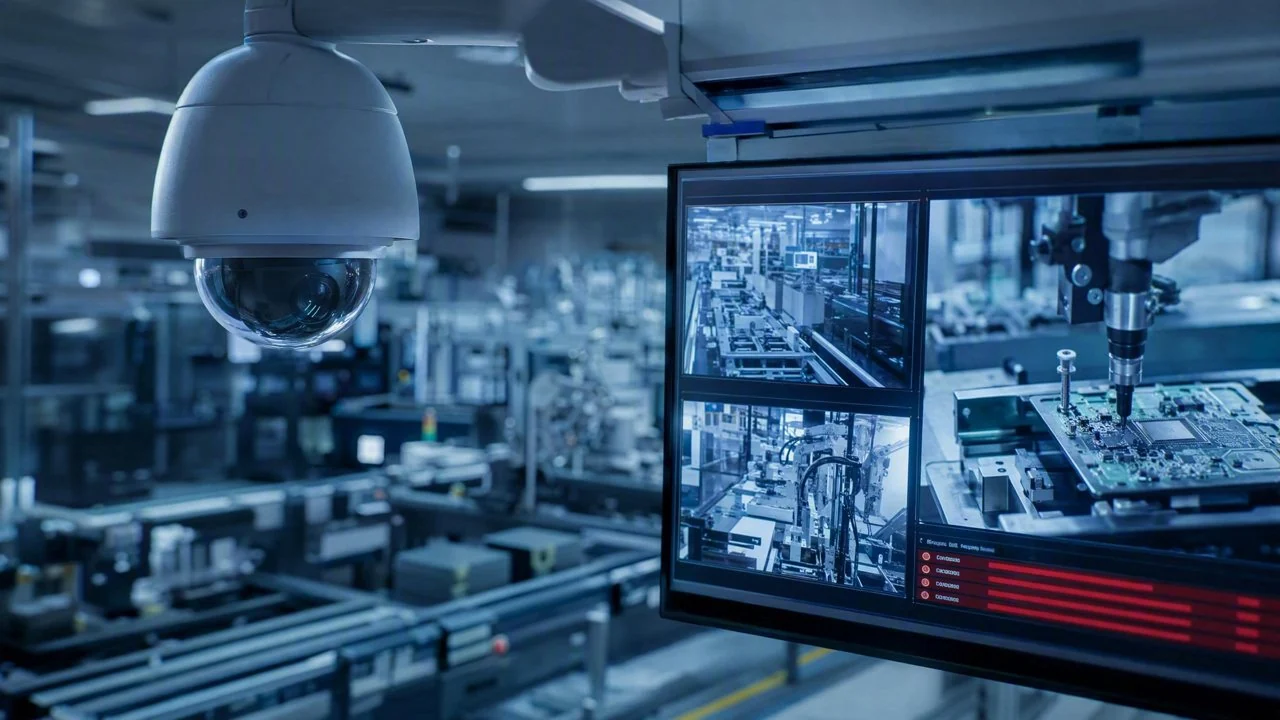
DaoAI SkyVision 0-code video surveillance AI platform, through 100% local deployment and hour-level model training, has reduced the non-compliance detection rate for screw tightening operations from 3% with traditional manual inspections to <0.3%, significantly enhancing production quality and data security. In manufacturing processes, ensuring the standardization and compliance of critical operations like screw tightening is paramount. Especially in industries such as aerospace, automotive manufacturing, and precision machinery, an under-tightened or over-tightened screw can lead to degraded product performance, safety hazards, or even batch recalls. Traditionally, compliance with such operations primarily relied on on-site inspections by team leaders or quality inspectors. This method is not only inefficient but also prone to missed detections or misjudgments due to human fatigue and subjective differences, making full coverage almost impossible on multi-station, high-beat production lines. With the advancement of Industry 4.0, there is an increasing demand for refined management of production processes and data security, highlighting the limitations of traditional solutions.
Pain Points: Why is Screw Tightening Compliance Monitoring So Difficult?
Traditional solutions for compliance monitoring of detailed operations like screw tightening face multiple challenges. First, manual inspection coverage is limited, especially during peak production periods, making it difficult for a single team leader to monitor multiple workstations simultaneously. This often results in a missed detection rate of critical actions around 3%. Second, due to subtle variations in operator movements and lighting conditions, the accuracy and consistency of manual judgment are difficult to guarantee, leading to high false alarm rates and increased re-inspection costs. Third, data security is paramount. Industrial production processes and operational procedures are core trade secrets, and any data leakage can cause immeasurable losses. Traditional cloud-based AI solutions pose potential risks during data transmission and storage, deterring many manufacturers with stringent data security requirements. Furthermore, manual record-keeping and traceability are difficult; once a quality issue arises, it's challenging to quickly pinpoint the specific operational step and responsible party, leading to lengthy quality tracing cycles, averaging 2-3 days for initial investigation, severely impacting problem resolution efficiency. These factors collectively constitute the 'hard nut to crack' in screw tightening compliance monitoring.
Current industry trends, such as Hikvision's large model application for traffic checkpoint capture in precise law enforcement, while different from industrial scenarios, share the common need for 'precise recognition' and 'real-time alerting' capabilities. Traffic checkpoints require millisecond-level responses to vehicle and human behavior in complex and dynamic environments, ensuring data integrity. Industrial screw tightening similarly demands precise capture of subtle deviations in worker movements and immediate feedback, with even higher demands for the privacy of industrial data. Traditional solutions struggle to meet these dual high requirements – precise recognition of subtle actions while ensuring all data remains within the enterprise, never uploaded to external servers. This is precisely where DaoAI SkyVision's core advantage lies.
Technical Principles: How Does SkyVision Achieve Localization and Precision?
The core strength of DaoAI SkyVision platform lies in its 0-code, on-site, hour-level training capability for proprietary models, coupled with a 100% local deployment architecture. This effectively addresses data security and model adaptability challenges. The platform leverages the DaoAI World Model to provide a unified underlying semantic understanding, enabling it to learn and generalize from vast amounts of industrial video data. In specific applications, it employs advanced skeleton point detection and behavior recognition algorithms, combined with temporal feature analysis, to precisely capture whether an operator's tightening action is compliant (e.g., using the correct tool, tightening angle, duration, etc.). Compared to traditional rule-based machine vision or manual inspection, SkyVision's AI model boasts superior robustness and generalization capabilities. Rule-based AOI struggles with complex conditions like lighting variations and operator posture differences, while manual inspection is limited by human fatigue and subjectivity. DaoAI SkyVision, through deep learning, can quickly adapt to production line environmental changes after training with a small number of samples on-site, and identify subtle non-compliant actions never seen before, reducing false alarm rates by over 90%.
Furthermore, DaoAI SkyVision's real-time alerting mechanism via edge devices is crucial for local deployment and rapid response. Video streams are processed directly on the edge device, eliminating the need to upload to the cloud, fundamentally preventing data leakage risks. The edge device features built-in high-performance computing units and optimized inference engines, ensuring video analysis and alert generation within milliseconds. This 'edge intelligence' not only guarantees data security but also significantly reduces network bandwidth requirements while ensuring real-time response on the production floor, shortening the time from non-compliance occurrence to alert notification to within 200ms, far surpassing human reaction speed. The DaoAI World Model, as its intelligent foundation, continuously learns from production line feedback, constantly optimizing model performance to ensure the system's high accuracy and long-term stability.
Typical Application Scenarios
- **Screw Tightening Tool Usage Compliance Detection:** Monitors whether operators use specified models of electric screwdrivers or torque wrenches, rather than alternative tools, to ensure torque meets requirements. Challenges lie in tool model recognition and action sequence judgment.
- **Tightening Angle and Turns Compliance Detection:** Identifies the rotation angle and approximate number of turns during screw tightening to determine if preset standards are met, preventing under-tightening or stripping. Challenges lie in quantitative analysis of fine movements.
- **Two-Handed Operation Monitoring:** In some precision assembly tasks, two hands are required to operate simultaneously for stability and safety. Monitors whether operators use one hand or if two-handed actions are uncoordinated. Challenges lie in coordinated analysis of multiple human skeleton points.
- **Jig and Fixture Usage Compliance:** Monitors whether operators correctly place products in jigs and fixtures and tighten them as required, preventing product displacement during tightening. Challenges lie in complex backgrounds and fixture state determination.
- **Poka-Yoke Bypass Detection:** Identifies whether operators attempt to bypass poka-yoke devices or safety interlock mechanisms on the production line, which are often hidden causes of quality incidents. Challenges lie in recognizing unusual, low-frequency non-compliant action patterns.
Case Study: Compliance Upgrade at a Precision Machinery Manufacturer
A Tier-1 supplier specializing in high-end precision equipment manufacturing faced a critical and high-risk screw tightening process on its engine core component assembly line. Previously, the factory relied primarily on spot checks by team leaders, supplemented by manual video playback checks. This method resulted in a non-compliance detection rate of 2.8% for screw tightening actions, with an average of 5-8 rework and quality complaint incidents per month due to non-compliant tightening. More importantly, the client had strict data security requirements, prohibiting any production video data from being uploaded to external cloud platforms. After implementing DaoAI SkyVision platform, the factory deployed it locally, processing and analyzing all video data in real-time on edge devices. The SkyVision engineering team conducted model training on-site in less than 2 hours, successfully establishing recognition models for specific tightening actions. After going live, the system could monitor screw tightening actions at all workstations 100% around the clock, identifying non-compliant operations in real-time and sending audio-visual alerts and notifications to team leaders. After one month of trial operation, the non-compliance detection rate for screw tightening actions significantly reduced to <0.2%, and rework incidents due to non-compliant tightening decreased by 80%, while ensuring all core production data remained entirely on-premise. This not only significantly improved product quality but also effectively mitigated data security risks, earning the full trust of the client.
DaoAI SkyVision platform, with its excellent local processing capability and precise recognition technology, successfully reduced the non-compliance detection rate for screw tightening operations to below 0.2%, while ensuring 100% of sensitive production data remains on-premise.
DaoAI Solutions and Products
The core solution provided by DaoAI revolves around the SkyVision 0-code video surveillance AI platform, whose key capabilities lie in intelligent behavior recognition and compliance monitoring in industrial settings, while strictly adhering to the principle of local private deployment. In the screw tightening compliance monitoring scenario, DaoAI SkyVision deploys industrial-grade high-definition cameras to capture video streams of the work area and uses edge computing boxes for real-time analysis. Users do not need to write any code; simply by using simple 'selection' and 'tagging' operations on the platform interface, they can complete sample annotation for 'compliant tightening actions' and 'non-compliant tightening actions' within tens of minutes. The platform leverages its APDT few-shot learning capability, enabling it to train high-precision proprietary recognition models within hours, even with only 1-20 good samples (or a few non-compliant actions). This rapid modeling and iteration capability allows DaoAI SkyVision to quickly adapt to production line process adjustments and new product changeovers, with changeover times controllable within 5min. All model training and inference are completed on local servers or edge devices, with data remaining on-premise, ensuring the security and compliance of enterprise data assets. The system supports various deployment methods such as SDK / API / Docker, allowing flexible integration into existing MES/WMS systems to achieve data closed-loop and quality traceability. The DaoAI World Model, as the underlying support, continuously optimizes the model's generalization capabilities and semantic understanding, providing more intelligent solutions for complex industrial scenarios.
Through the DaoAI SkyVision platform, customers can achieve 100% full inspection of critical operations like screw tightening, completely eliminating the limitations of manual spot checks. This not only significantly reduces quality incidents and rework costs caused by human error but also improves product consistency and reliability. For this precision machinery manufacturer, the local deployment of SkyVision effectively reduced the compliance non-detection rate by 92% (from 2.8% to <0.2%), saving over ¥50,000 per month in rework costs and quality complaint handling fees. Furthermore, the real-time alerting mechanism ensures that issues are discovered and corrected at the earliest opportunity, reducing the risk of batch quality problems and enhancing the company's competitiveness in the market. This solution, balancing efficiency, accuracy, and data security, sets a new benchmark for industrial SOP compliance monitoring.
FAQ
How does DaoAI SkyVision platform ensure local private data security for industrial production?
DaoAI SkyVision platform ensures data security through 100% local private deployment. All video streams, model training, and inference computations are completed on the customer's local servers or edge devices, and data is never uploaded to external clouds. This architecture fundamentally eliminates security risks that may arise from data transmission and storage on third-party platforms, ensuring that production process and operation data never leaves the factory, strictly complying with internal enterprise data security and compliance requirements.
What are the core advantages of SkyVision for screw tightening compliance monitoring compared to traditional manual inspections or rule-based vision systems?
SkyVision's core advantages lie in its AI-driven precise recognition, few-shot self-training capability, and real-time alerting mechanism. Compared to manual inspections, it achieves 100% round-the-clock coverage, avoiding human fatigue and subjective judgment biases, significantly reducing missed detection rates. Compared to rule-based vision systems, SkyVision, based on deep learning, adapts better to complex variations like lighting and posture. With APDT few-shot learning, models can be trained and quickly changed over in tens of minutes, whereas traditional systems require tedious rule configuration and debugging, making them far less efficient and robust than SkyVision.
What is the budget required to deploy DaoAI SkyVision platform? What factors influence the quotation?
The deployment budget for DaoAI SkyVision platform depends on several factors, including the number of monitoring points, the performance of required edge computing devices, the complexity of integration, and whether custom development is needed. We offer flexible licensing models and hardware configuration options to suit customers of different scales and needs. To get an accurate quote, we recommend contacting our sales team, who will provide a detailed solution and quotation based on your specific production line conditions and monitoring requirements.
Full solution for this scenario: the full inspection solution for Industrial SOP Compliance
This article was generated by AI. Customer cases are simulated scenarios based on real product capabilities and figures are illustrative; see product pages for official benchmarks.