
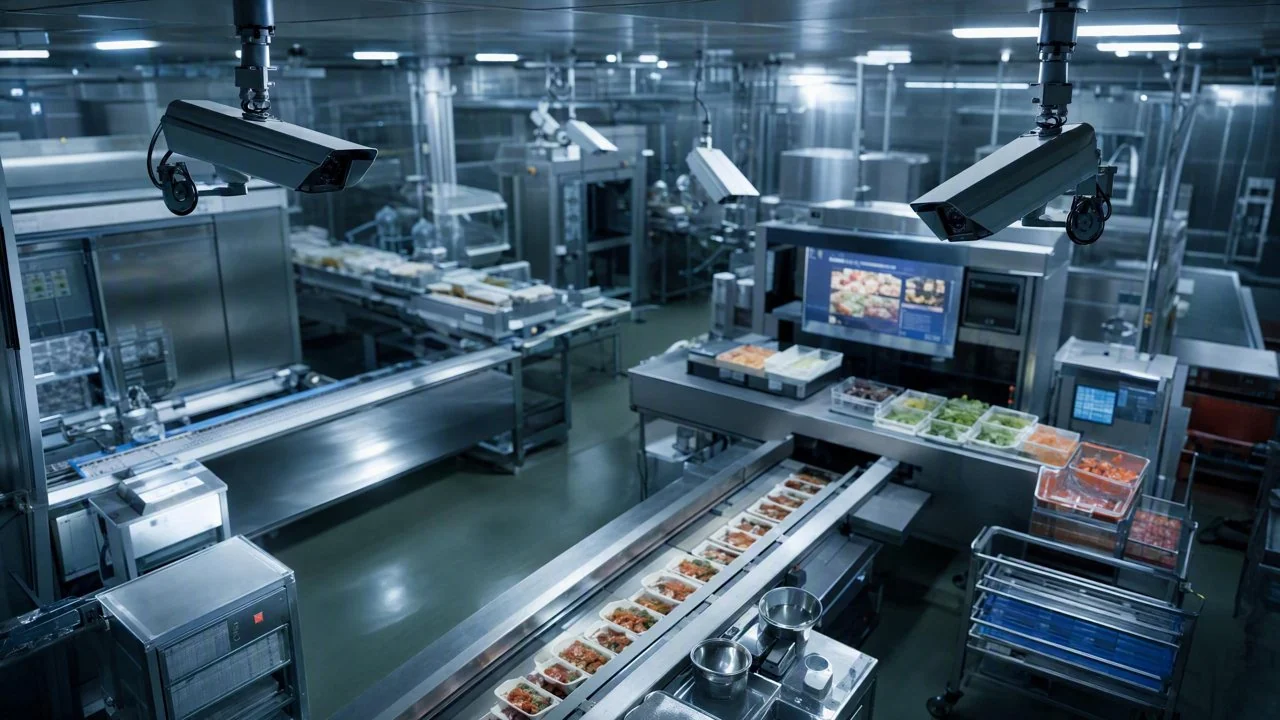
DaoAI SkyVision 0-code video surveillance AI platform, enabled by its APDT few-shot self-training capability, precisely identifies non-compliant employee behaviors in open kitchen environments, reducing the non-compliance detection rate of traditional manual inspections by 85%, significantly improving food safety compliance and management efficiency. The food and agriculture industry, especially catering services, has an increasing demand for regulating kitchen operation compliance. With the implementation of “Open Kitchen” policies, video surveillance has become a standard management tool. However, efficiently and accurately identifying potential risks from vast video data poses a universal challenge for the industry.
Traditional manual inspections and post-hoc sampling are not only time-consuming and labor-intensive but also suffer from strong subjectivity, limited coverage, and poor real-time performance, making it difficult to meet increasingly stringent food safety standards. This case focuses on the central kitchens and store kitchens of medium to large chain catering enterprises, utilizing the DaoAI SkyVision platform to achieve automated monitoring of critical operational norms such as employee handwashing, mask-wearing, and cross-contamination in cutting areas, ensuring transparency and safety throughout the food production and processing chain.
Pain Points: Why This Hurdle Is Difficult to Overcome
In video surveillance for open kitchens, traditional solutions face multiple challenges. Firstly, there's a “high false negative rate”: manual inspections often cover only limited time periods and areas, leading to a false negative rate of over 70% for high-frequency, transient non-compliant behaviors (e.g., briefly not wearing a mask, not washing hands as required). Secondly, “false alarms and re-inspection burden”: traditional rule-based video analysis systems, due to complex factors like environmental light changes, personnel obstruction, and object movement, are prone to generating a large number of false alarms. This forces managers to invest significant effort in video re-inspection, potentially spending 4-6 hours daily, severely impacting other management tasks. Thirdly, “poor model update and adaptability”: catering businesses have subtle operational differences across seasons, dishes, and stores. Traditional AI models require extensive labeled data for retraining, which is time-consuming and costly, making it difficult to adapt quickly to new regulatory demands. This often leads to ineffective implementation of surveillance systems in practice, failing to provide effective early warning and intervention for potential food safety risks.
Delving into the root causes, the complexity of the catering kitchen environment is the primary challenge. For instance, employees vary in clothing, skin color, height, and operating habits; ingredients are diverse, and utensils come in various shapes. Coupled with factors like oil fumes, steam, and light reflections, visual recognition becomes extremely difficult. Traditional feature engineering or deep learning solutions often require large-scale, high-quality labeled datasets to achieve usable performance, and acquiring such data in real-world scenarios is prohibitively expensive. Furthermore, drawing insights from recent breakthroughs in visual foundation models for multi-label perception in vehicle surveillance videos, we find that kitchen scenarios also require fine-grained, multi-dimensional understanding of “people, objects, behaviors, and environment.” However, vehicle scenarios are relatively more structured, whereas the unstructured and highly dynamic nature of kitchens places higher demands on the model's generalization and few-shot learning capabilities. DaoAI deeply understands these challenges and offers targeted solutions.
Technical Principles
The core technology of the DaoAI SkyVision platform lies in its innovative APDT (Adaptive Pre-trained Detector Transfer) few-shot self-training mechanism. This mechanism allows users to quickly train highly accurate customized AI models on-site within hours, by providing only a very small number (1-20) of positive sample images of non-compliant behaviors. This is attributed to the DaoAI World foundation model, which serves as a unified base, incorporating powerful visual foundation model feature recognition and semantic understanding capabilities. When users upload a small number of samples, DaoAI World leverages its pre-trained visual knowledge, covering vast general scenarios, to quickly understand the semantic features of new samples. Through adaptive transfer learning, it efficiently transfers this general knowledge to specific scenario recognition tasks. This approach significantly reduces reliance on large-scale labeled data, solving the generalization problem of traditional deep learning models in data-scarce scenarios.
Compared to traditional methods, the advantages of DaoAI SkyVision are significant. Traditional rule-based AOI systems require manual coding of complex rule sets, exhibiting poor robustness to changes in lighting and posture, and are difficult to adapt to new types of violations; manual visual inspection is inefficient and highly subjective. While traditional deep learning solutions offer higher accuracy, their long training cycles, high costs, and dependence on large amounts of labeled data make them difficult to iterate quickly in dynamic, diverse environments like the catering industry. DaoAI SkyVision's APDT few-shot self-training technology, by leveraging the powerful generalization capabilities of the DaoAI World model, achieves a “learn from a few, apply to many” effect. Even in extreme cases with only 1-5 samples, model training and deployment can be completed within 1 hour, reducing the model training cycle from weeks to hours, significantly improving responsiveness and deployment efficiency. Furthermore, the platform supports 100% on-premise private deployment, with all data processed locally on edge boxes, ensuring data security and preventing data from leaving the premises, meeting stringent enterprise requirements for data security and privacy protection.
Typical Application Scenarios
- **Employee Handwashing Compliance Monitoring:** At critical junctures such as entering the operating area or switching between raw and cooked food, monitor whether employees complete handwashing according to the “seven-step handwashing method” and whether the duration meets standards. The challenge lies in action decomposition recognition and temporal sequence judgment, which DaoAI SkyVision precisely captures through behavior recognition algorithms.
- **Mask Wearing Compliance Detection:** Real-time monitoring of all on-duty employees to ensure correct mask-wearing (covering mouth and nose). Challenges include personnel obstruction, recognition under different angles and lighting, and distinguishing masks from other facial coverings. SkyVision enhances robustness through multi-angle feature extraction and semantic understanding.
- **Cross-Contamination Warning in Cutting Areas:** Identify whether raw and cooked food knives, cutting boards, and containers are mixed or improperly placed. The difficulty lies in complex judgment of item categories and spatial relationships, where the DaoAI World model performs fine-grained object recognition and scene semantic analysis.
- **Ground Foreign Object and Cleanliness Monitoring:** Identify whether fallen ingredients, trash, or accumulated water exist on the operating area floor, prompting timely cleaning. Challenges include complex backgrounds, small foreign object sizes, and light changes. SkyVision's anomaly detection capabilities effectively identify these.
- **Kitchen Waste Sorting Compliance:** Monitor whether kitchen waste is sorted and disposed of according to regulations to avoid mixing. The difficulty lies in identifying different trash bins and judging disposal actions. DaoAI SkyVision can be trained to recognize various waste types and disposal behaviors.
Case Study
A leading chain catering enterprise, with hundreds of stores and several central kitchens, has long struggled with the difficulty of uniformly supervising kitchen operations. Traditionally, they relied on regional managers for regular store visits and store managers for daily spot checks. However, due to limited manpower, there were significant blind spots in monitoring critical aspects such as employee handwashing, mask-wearing, and raw/cooked food separation, leading to persistently high compliance risks. Especially during peak hours, the false negative rate of manual inspections could exceed 80%. The enterprise introduced the DaoAI SkyVision platform, first deploying it in a central kitchen as a pilot. For non-compliant behaviors such as improper handwashing and mask-wearing, only 5-10 example images were provided for each type of violation. Using SkyVision's APDT few-shot self-training feature, initial model training and deployment were completed within 2 hours. After deployment, the platform analyzes video streams in real-time via edge boxes. Upon detecting a non-compliant behavior, it immediately pushes an alert message via WeChat or SMS to the duty manager, complete with violation screenshots and video clips.
The DaoAI SkyVision platform reduced the false negative rate of non-compliant kitchen operations to below 10%, while decreasing manual re-inspection time by 75%, significantly enhancing food safety management efficiency.
Before deployment, the enterprise averaged 15-20 internal incident reports per week due to operational non-compliance, with most being discovered post-facto through customer complaints or superior inspections. After deploying DaoAI SkyVision, the platform increased the detection rate of non-compliant behaviors by 600%, allowing intervention at the first instance of a violation. During a one-month trial, the platform identified and alerted over 300 non-compliant behaviors, with approximately 90% of alerts being addressed within 5 minutes of occurrence. This reduced the number of internal incident reports by 70%, and employees' awareness of compliant operations significantly improved. Concurrently, due to the accuracy of the alerts, the time managers spent on video re-inspection decreased from 4 hours to 1 hour per day, an efficiency improvement of 75%, freeing up valuable human resources for other management tasks. DaoAI SkyVision's 100% on-premise deployment also fully met the enterprise's stringent requirements for data security and privacy protection.
DaoAI Solutions and Products
DaoAI provides an integrated solution for the food/agriculture industry's open kitchen monitoring, centered around the SkyVision platform. The SkyVision platform supports integration with various mainstream cameras and deploys locally via edge boxes, enabling real-time video stream analysis and alerting. Its core advantages are “0-code” and “APDT few-shot self-training”: users do not need programming expertise and can configure monitoring tasks through an intuitive graphical interface, quickly training customized models with very few samples. For example, for new operational norms or new risk points brought by seasonal dishes, users only need to upload a few images, and SkyVision can complete model updates within 1 hour and immediately put them into use. All data processing is done locally, ensuring data security and preventing data from leaving the premises, fully complying with the food industry's strict requirements for data privacy. Furthermore, the SkyVision platform integrates the semantic understanding capabilities of the DaoAI World model, enabling a deeper understanding of the relationships between “people, objects, and behaviors” in the scene, effectively filtering false alarms and improving alert accuracy. Through open SDK/API interfaces, SkyVision can be integrated with existing enterprise ERP, MES, or other management systems to achieve unified alert management and data closed-loop.
Through the deployment of DaoAI SkyVision, clients can achieve 24/7, comprehensive intelligent surveillance of kitchen operations, reducing the false negative rate of manual inspections by 85% and decreasing manual re-inspection hours by 75%. This not only significantly enhances food safety compliance, reducing food safety risks and brand reputation loss due to non-compliant operations, but also effectively saves labor costs and improves overall operational efficiency through automated, intelligent management methods. The SkyVision platform provides enterprises with a rapidly iterative, highly flexible intelligent surveillance tool, enabling them to calmly respond to constantly changing regulatory requirements and market challenges, truly achieving intelligent and refined management of “open kitchens.”
FAQ
How exactly does DaoAI SkyVision's APDT few-shot self-training feature work?
DaoAI SkyVision's APDT (Adaptive Pre-trained Detector Transfer) few-shot self-training feature leverages the powerful pre-trained visual foundation model of DaoAI World. Users only need to upload 1-20 example images of non-compliant behaviors. The platform then quickly performs adaptive transfer learning based on this small set of samples, customizing the specific scene model within 1 hour. This eliminates the need for extensive data labeling, significantly lowering the barrier to model deployment and updates.
What are the cost and deployment cycle advantages of SkyVision compared to traditional video surveillance systems?
Traditional video surveillance systems typically rely on manual inspections or rule-based analysis; the former is costly and inefficient, while the latter generates many false alarms and is complex to maintain. SkyVision, through APDT few-shot self-training, reduces the model training cycle from weeks to hours, significantly shortening deployment time. Its high accuracy and low false alarm rate also reduce manual re-inspection costs. Specific pricing depends on factors such as camera count, deployment scale, and feature customization. We recommend contacting the DaoAI sales team for a customized solution and detailed quote.
How does SkyVision ensure the security and privacy of kitchen monitoring data?
DaoAI SkyVision platform supports 100% on-premise private deployment. All video stream analysis, AI model inference, and data storage are completed on the client's local edge boxes or servers, ensuring that data never leaves the premises. This fundamentally eliminates the risk of data leakage and privacy infringement, fully complying with the food industry's strict regulatory requirements for data security and privacy protection.
Full solution for this scenario: Food / agriculture industry solutions
This article was generated by AI. Customer cases are simulated scenarios based on real product capabilities and figures are illustrative; see product pages for official benchmarks.