
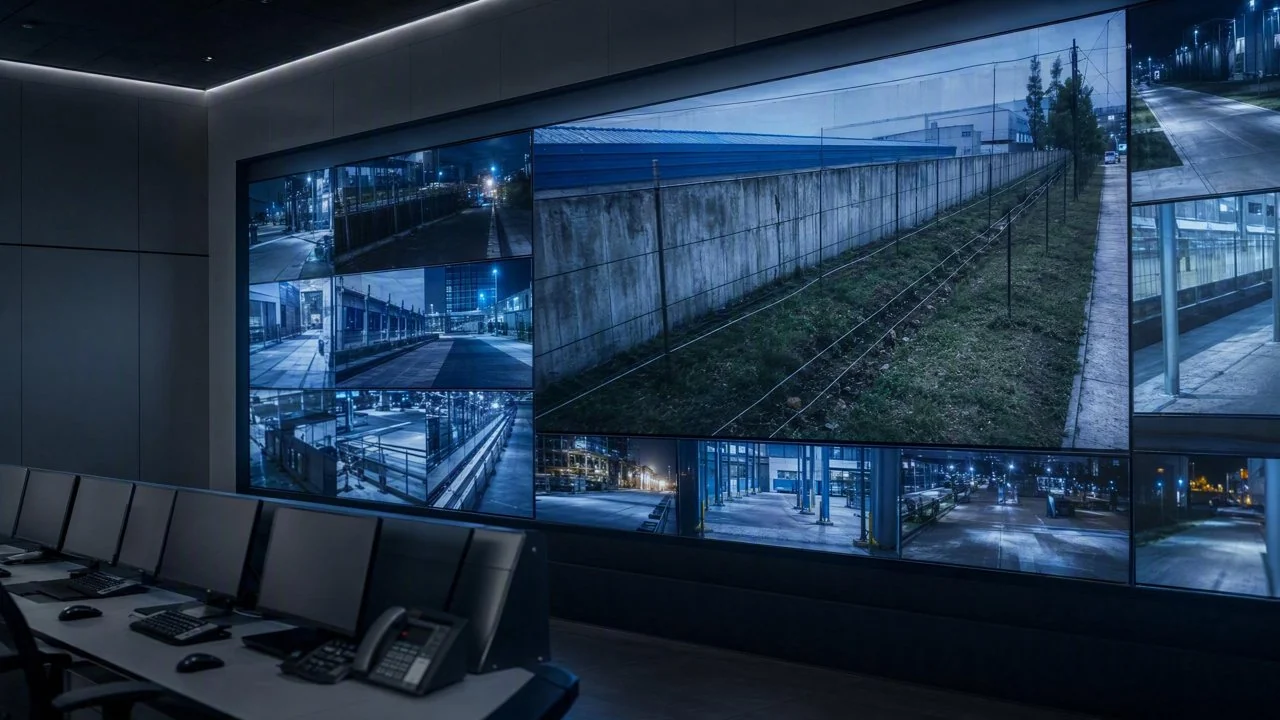
WeLinkirt's SkyVision 0-code video surveillance AI platform (featuring on-site hourly custom model training, behavior/event recognition, real-time edge box alerts, 100% on-premise data security, and DaoAI World model semantic understanding) significantly reduces false alarm rates in cross-border/tripwire detection by 85% through intelligent recognition and semantic understanding. This dramatically cuts down re-inspection workloads for security personnel, allowing limited human resources to respond more efficiently to genuine threats.
Video surveillance in industrial parks, warehousing and logistics centers, and critical infrastructure is a core component of ensuring safe operations. In these scenarios, cross-border/tripwire detection serves as a fundamental and crucial early warning mechanism, designed to identify unauthorized personnel or objects entering specific areas. However, traditional cross-border detection systems, based on pixel changes or simple geometric rules, often face severe challenges in real-world deployments. For instance, swaying foliage, moving shadows, small animals, changes in lighting, or even rain and snow can be misidentified as “crossing the boundary,” triggering a large number of false alarms. These false alarms not only consume significant time for security personnel to verify but can also lead to a “cry wolf” effect, causing genuine threats to be overlooked and severely impacting the reliability and response efficiency of the security system.
Pain Points: Why This Hurdle Is Hard to Clear
In large industrial parks and warehousing logistics centers, the false alarm rate for traditional cross-border/tripwire detection solutions typically exceeds 70%, leading to security personnel having to process hundreds of invalid alerts daily, creating an enormous re-inspection workload. This high false alarm rate is not accidental; its root causes are: firstly, high environmental complexity, as outdoor surveillance scenarios are heavily influenced by natural factors (wind, rain, snow, lighting changes, vegetation movement), making it difficult for traditional algorithms to distinguish between real intrusions and environmental interference; secondly, a lack of deep semantic understanding, where most existing systems only identify motion at the pixel level, unable to comprehend specific targets like “people,” “vehicles,” and their behavioral intentions; finally, poor model generalization, meaning that even minor changes in the deployment environment, such as new obstacles or camera angle adjustments, require extensive manual reconfiguration or calibration, leading to low efficiency. These factors combined leave security personnel constantly overwhelmed, not only affecting job satisfaction but also significantly increasing operational costs and potential security risks.
Considering the current trend of large model technologies serving video surveillance, the biggest shortcoming of traditional solutions lies in the limitations of their “knowledge.” They cannot judge the nature of an event through “understanding” the scene as humans do. For example, a swaying branch and a person crossing may both appear as “changes” at the pixel level, but the human brain can easily distinguish between them. Traditional algorithms lack this semantic understanding based on “world knowledge,” leading to numerous misjudgments. WeLinkirt's SkyVision aims to bridge this gap by introducing more advanced AI models, fundamentally solving the false alarm problem.
Technical Principles
WeLinkirt's SkyVision 0-code video surveillance AI platform overcomes the limitations of traditional cross-border detection through its core DaoAI World model semantic understanding capability. This platform does not simply rely on pixel changes but employs deep learning technology, deploying lightweight yet high-accuracy AI models at the edge. Its technical core lies in the “on-site hourly custom model training” capability, allowing users to quickly collect a small amount of data (e.g., a few false alarm samples) in real-world scenarios, train the model iteratively through the platform, and specifically optimize it to accurately identify genuine intrusion behaviors in specific environments, while effectively filtering out non-threat factors like swaying foliage or small animals. This rapid iterative optimization mechanism enables the model to quickly adapt to on-site environmental changes, maintaining high recognition accuracy. Concurrently, the DaoAI World model endows SkyVision with stronger generalization and semantic understanding capabilities, allowing it to comprehend high-level semantic concepts like “people” and “vehicles” and determine whether their actions truly constitute a “cross-border” event, rather than simple area intrusion.
Compared to traditional cross-border detection based on rules (such as background subtraction, frame differencing) or simple machine learning methods, WeLinkirt's SkyVision's advantage lies in its self-learning and semantic understanding capabilities. Traditional methods often require manual setting of complex rule thresholds, have poor robustness to the environment, and are prone to failure with slight changes in lighting, weather, or background, leading to consistently high false alarm rates. In contrast, the SkyVision platform uses deep neural networks to autonomously learn target features and behavior patterns, extracting deeper-level features from vast video data to distinguish between real threats and environmental noise. For example, in a deployment at a large logistics park, WeLinkirt's SkyVision successfully reduced the false alarm rate for cross-border detection by 85%, significantly outperforming traditional solutions. Furthermore, its “edge box real-time alert” capability ensures immediate alerts upon event occurrence, without requiring data upload to the cloud, greatly shortening response times and ensuring the security and privacy of “100% on-premise data security.”
Typical Application Scenarios
- **Industrial Park Perimeter Security:** Setting virtual tripwires in critical areas such as fences and entrances of large industrial parks, WeLinkirt's SkyVision platform can accurately identify unauthorized personnel or vehicle intrusions. The challenge lies in the complex park environment with frequent vegetation, vehicle movements, etc., which cause severe false alarms in traditional solutions, whereas SkyVision can distinguish real intrusions from environmental interference through training.
- **Restricted Area Management in Warehousing & Logistics:** Defining electronic fences in high-value goods storage areas or hazardous materials storage areas to monitor for unauthorized personnel entry. The difficulty is the frequent movement of personnel in logistics areas, requiring precise differentiation between normal staff work and unauthorized intrusion. SkyVision can improve recognition accuracy through learning behavioral patterns.
- **Construction Site Safety Management:** Implementing cross-border detection in dangerous areas like construction site entrances and under cranes during nighttime or non-working hours to prevent theft or accidents. The challenge is the variable construction site environment and poor lighting conditions, where traditional solutions' performance degrades sharply in low light, while SkyVision offers stronger robustness.
- **Critical Infrastructure (e.g., Substations, Water Plants) Protection:** 24/7 monitoring of substation fences and critical equipment areas, triggering immediate alarms if suspicious individuals approach or climb over. The difficulty is that these areas have relatively fixed environments but extremely low tolerance for false alarms, where any false alert can lead to wasted resources. SkyVision's ultra-low false alarm rate is key.
- **Airport/Port Restricted Area Surveillance:** Defining no-entry zones at runway edges, aprons, and dock operation areas to prevent accidental entry by unauthorized personnel. The challenge is that these areas have open views but frequent weather changes, making traditional solutions susceptible to weather effects, while SkyVision can effectively handle complex weather challenges.
Case Study
A power generation base under a large state-owned energy group faced significant challenges in perimeter security. The base covered a vast area, with a perimeter several kilometers long, and was equipped with traditional video surveillance systems and rule-based cross-border detection functions. However, due to dense vegetation around the base, swaying trees, passing small animals, and even seasonal fallen leaves frequently triggered cross-border alarms. The base's security department had to dispatch at least 3 security personnel to review these alarms 24/7, processing an average of over 200 alerts daily, more than 90% of which were false alarms. This not only consumed a large amount of human resources but also desensitized security personnel to alarms, potentially delaying truly urgent incidents. In an internal assessment, the base found that its security personnel spent over 500 hours per month on ineffective work due to reviewing false alarms, severely impacting the efficiency and morale of the security team.
After the deployment of WeLinkirt's SkyVision 0-code video surveillance AI platform, the false alarm rate for cross-border detection at the power generation base significantly dropped from over 90% to below 5%, reducing the re-inspection workload for security personnel by 85%, achieving a qualitative leap in security efficiency.
Following the introduction of WeLinkirt's SkyVision 0-code video surveillance AI platform, the project team first conducted a pilot deployment in several typical areas along the base's perimeter. Utilizing SkyVision's “on-site hourly custom model training” capability, on-site security personnel provided a small number of real intrusion video clips and a large number of false alarm video clips as training samples. WeLinkirt engineers collaborated closely with the base team to conduct rapid iterative training through the platform, completing the initial model optimization and deployment in just 2 days. After going live, the SkyVision platform, through its advanced AI algorithms and DaoAI World model semantic understanding, accurately identified real cross-border behaviors such as personnel climbing over fences and vehicle intrusions, while effectively filtering out interferences like swaying leaves and small animal activities. After one month of trial operation, the false alarm rate for cross-border detection at the base decreased from over 90% to less than 5%, and the number of effective alerts requiring daily review by security personnel dropped from over 200 to less than 30. This allowed the security team to dedicate more effort to core tasks such as patrols and emergency responses, reducing ineffective work hours due to false alarms by 85% per month, significantly enhancing overall security effectiveness and management level.
WeLinkirt Solutions and Products
WeLinkirt's SkyVision 0-code video surveillance AI platform provides an end-to-end intelligent solution for cross-border/tripwire detection. Its core advantage lies in the “0-code” usability, allowing non-AI professionals to quickly set up and optimize AI models through an intuitive interface. During deployment, users simply need to define cross-border areas or tripwires on the monitoring screen with simple drag-and-drop operations and upload a small number of scene-specific video samples. The SkyVision platform utilizes its built-in DaoAI World model for pre-training and feature extraction, and through the “on-site hourly custom model training” function, it specifically learns real intrusion patterns and interference factors in specific scenarios. For example, to address high false alarm rates, users can collect a small number of false alarm video clips as negative samples for incremental training, rapidly improving the model's anti-interference capability and reducing the false alarm rate to below 85%. The entire modeling process requires no coding, significantly shortening deployment cycles and lowering technical barriers. Deployment is flexible, supporting various integration methods such as SDK/API/Docker, allowing integration with existing security systems, and supporting 100% on-premise private deployment to ensure all video data and alert information are processed locally, fully complying with data security requirements.
Through WeLinkirt's SkyVision platform, customers not only achieve a significant reduction in cross-border/tripwire detection false alarm rates but, more importantly, effectively alleviate the re-inspection pressure on security personnel, improving the overall response efficiency of the security system. The edge box real-time alert mechanism ensures a sub-second response after an event, gaining valuable time for security personnel to handle incidents. This intelligent upgrade transforms traditional “manpower tactics” into “intelligent decision-making,” leading to more rational allocation of security resources, optimized operational costs, and ultimately building a more reliable and efficient intelligent security system. The DaoAI World model continuously learns from production line feedback, ensuring SkyVision's recognition capabilities are constantly iterated and optimized, providing customers with a continuously evolving intelligent security solution.
FAQ
What exactly does SkyVision's “0-code” feature refer to?
SkyVision's “0-code” means users can complete model training, configuration, and deployment through an intuitive graphical user interface without writing any programming code. It uses drag-and-drop operations, preset templates, and automated processes, allowing non-AI security or operations personnel to easily get started, quickly build and optimize video surveillance AI models, significantly reducing the threshold and time cost of applying AI technology.
How does the SkyVision platform achieve a significant reduction in false alarm rates?
WeLinkirt's SkyVision platform primarily achieves false alarm reduction through two core mechanisms: first, its “on-site hourly custom model training” capability allows users to quickly collect on-site false alarm samples for incremental training, enabling the model to precisely learn and filter out non-threat factors in specific environments; second, the deep semantic understanding capability provided by the DaoAI World model can distinguish between real human and vehicle behaviors and environmental interference, fundamentally reducing misjudgments. Combined with real-time processing by edge boxes, it ensures the accuracy and timeliness of alerts.
What is the approximate budget required to deploy WeLinkirt's SkyVision platform?
The budget for WeLinkirt's SkyVision platform depends on several factors, including the number of surveillance points, required AI functional modules (such as cross-border detection, behavior recognition, etc.), the scale of edge box deployment, and whether customized development or deep integration with existing systems is needed. We offer flexible subscription and deployment plans. We recommend contacting our sales team for a detailed assessment based on your specific requirements and scenarios to receive a customized quote, ensuring maximum return on investment.
Full solution for this scenario: Video Surveillance industry solutions
This article was generated by AI. Customer cases are simulated scenarios based on real product capabilities and figures are illustrative; see product pages for official benchmarks.