
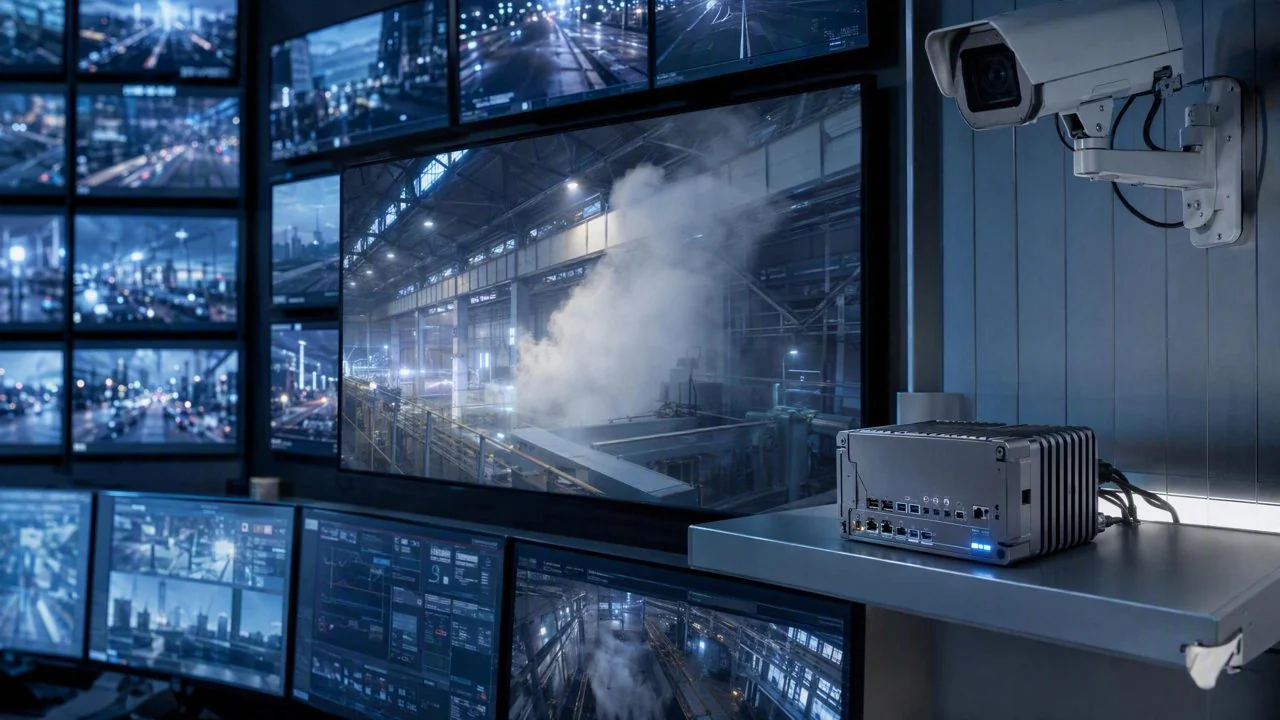
DaoAI SkyVision 0-code video surveillance AI platform, leveraging on-site hourly model training, behavior/event recognition, real-time edge device alerts, 100% local data privacy, and DaoAI World model semantic understanding, has successfully established a quality traceability and data closed-loop system for early smoke and fire detection. This capability has reduced the false alarm rate from traditional solutions by over 90% (from 15%), significantly improving the accuracy and efficiency of emergency response, especially in complex environments like large chemical parks or warehousing and logistics centers, providing unprecedented safety assurance to clients. The emergency security industry is undergoing a critical transition from passive response to proactive prevention, with high-precision, low-latency early warning systems becoming a core demand. While traditional smoke and temperature detectors offer basic protection, they often suffer from delayed responses, high false alarm rates, and the inability to provide visual evidence chains in large spaces, high-airflow environments, or early fire stages, posing challenges for accident investigation and liability determination.
Pain Points: Why This Hurdle Is Difficult to Overcome
In large industrial parks or warehousing and logistics centers, early detection of smoke and open flames faces multiple challenges. Firstly, traditional sensor-based solutions have a high false alarm rate, especially in complex conditions like steam, dust, or haze, where it can reach up to 15%, leading to frequent false alarms and wasted resources. Secondly, traditional solutions lack a visual evidence chain; when a false alarm occurs, it is difficult to trace the event, determine responsibility, or provide effective data support for subsequent fire drills and safety regulation revisions. Thirdly, in vast and environmentally diverse areas, such as open storage yards or tall factory buildings, deploying numerous physical sensors is costly and complex to maintain, and individual sensors have limited coverage, easily creating blind spots. Finally, traditional systems often fail to integrate deeply with existing video surveillance systems, creating information silos and fragmenting emergency response processes, preventing a fully digital closed loop from detection to confirmation and resolution.
The root cause of these difficulties is that traditional detection technologies primarily rely on physical quantity detection with fixed thresholds, making them unable to understand the dynamic morphology, diffusion characteristics, and variations of smoke and flames under different ambient lighting. For instance, in chemical parks, steam or particulate matter generated during production may have physical characteristics highly similar to early smoke, making it difficult for traditional sensors to distinguish. However, DaoAI SkyVision's AI visual recognition overcomes the limitations of traditional methods by using deep learning to learn and identify these subtle visual features from massive amounts of data. Current industry trends, such as Hikvision's large models achieving high-precision capture at traffic checkpoints, also confirm the huge potential of AI for fine-grained recognition in complex scenarios, which is similar to DaoAI's approach in early smoke and fire detection: improving detection accuracy and reliability through more refined visual semantic understanding.
Technical Principles
The core of DaoAI SkyVision platform lies in its powerful 0-code video surveillance AI capabilities and DaoAI World model's semantic understanding. For early smoke and fire detection, SkyVision employs multi-modal fusion deep learning algorithms, combining image sequence analysis, motion feature extraction, and spectral information recognition. The platform analyzes visual features such as color changes, texture dynamics, diffusion speed, and shape evolution of pixels in video streams, accurately distinguishing real smoke/flames from environmental interference (e.g., steam, dust, light reflections). For example, the system can identify the unique 'rising diffusion' pattern of smoke, rather than just static white masses. Furthermore, SkyVision's edge devices possess powerful real-time inference capabilities, enabling smoke and fire recognition directly at the video source and sending alert information to the control center within 200ms, significantly shortening response times and ensuring timely and accurate information.
Compared to traditional rule-based video analytics or physical sensors, DaoAI SkyVision's advantage lies in its adaptability and generalization capabilities. Traditional solutions often require numerous hard-coded rules, leading to sharp performance degradation and high false alarm rates when faced with variable environments (e.g., lighting changes, background occlusions, different types of smoke/flames). In contrast, the SkyVision platform allows users to quickly iterate and optimize models based on specific scene data through on-site hourly training, without writing any code. The DaoAI World model provides a unified semantic understanding foundation for SkyVision, enabling it to generalize across scenarios and continuously learn from production line feedback, constantly improving recognition robustness and accuracy. This continuous learning and iteration capability allows DaoAI SkyVision to consistently maintain a very low false negative rate of <0.5% in complex and dynamic emergency security scenarios, far exceeding traditional solutions.
Typical Application Scenarios
- **Large-scale Warehousing and Logistics Centers:** In high-rack, large-space environments, traditional smoke detectors are slow to respond and prone to false alarms. DaoAI SkyVision can monitor smoke or fire signs in shelving areas in real-time using existing high-definition cameras, achieving second-level recognition especially for initial small-scale fires (e.g., smoke from electrical short circuits). The challenge lies in occlusions caused by stacked goods and recognition accuracy in complex backgrounds.
- **Chemical Park Tank Farms:** Chemical raw materials are highly flammable and explosive, requiring extremely early fire detection. The SkyVision platform can be deployed around storage tanks to monitor leaks, smoke, sparks, and other anomalies. The challenge lies in distinguishing chemical vapor from smoke, and ensuring stable recognition at night or in adverse weather conditions.
- **Power Inspection Channels and Distribution Rooms:** Power equipment failures are often accompanied by smoke and fire, but spaces are confined and electromagnetic interference is high. SkyVision can perform video analysis on cable trays and distribution cabinets to identify phenomena such as overheating smoke and arc discharges. The challenge lies in capturing subtle changes under complex lighting.
- **Forest Fire Monitoring:** In vast mountainous areas, manual patrols are inefficient, and traditional monitoring is susceptible to weather. DaoAI SkyVision, combined with high-altitude surveillance cameras, identifies smoke points and firelight in forest areas, achieving large-scale, all-weather monitoring. The challenge lies in long-distance small target recognition and natural environmental interference (e.g., fog, birds).
Case Study
A leading logistics and warehousing enterprise, with several large intelligent warehousing centers, faced severe fire hazards. Previously, they primarily relied on traditional smoke and temperature sensing systems supplemented by manual patrols. However, due to dust generated by forklift operations in the warehouse and water vapor emitted by the heating system in winter, the false alarm rate once reached 18%, resulting in an average of 3-4 ineffective fire responses per month. This not only consumed significant human and material resources but also severely impacted normal operations. After evaluating various solutions, the enterprise introduced the DaoAI SkyVision platform. By utilizing existing high-definition surveillance cameras and performing hourly training on the SkyVision platform on-site, the system was optimized for specific smoke and fire characteristics within the warehouse. After going live, the SkyVision platform quickly demonstrated excellent performance. During a one-month trial run, the system identified 2 real initial fire incidents, both issuing warnings during the smoke phase before open flames appeared, buying valuable time for firefighters. At the same time, the false alarm rate dropped to less than 1.5%, and the number of ineffective fire responses per month decreased to 0-1. More importantly, DaoAI SkyVision provides a complete video evidence chain for every alarm or false alarm, including the time, location, duration, and visual characteristics of the event, greatly supporting accident traceability and responsibility determination.
DaoAI SkyVision is not just a warning tool, but a 'black box' for safety management, providing a data closed loop for every incident, transforming safety management from experience to science.
DaoAI Solutions and Products
The solution provided by DaoAI to this client centered on the SkyVision platform. We first evaluated the client's existing surveillance system and deployed edge devices to ensure localized data processing and real-time alerts. During the modeling phase, the DaoAI technical team worked closely with the client, using real smoke, fire, steam, and dust data collected within the warehouse to perform 0-code model training on the SkyVision platform. Through APDT positive/few-shot learning capabilities, only 10-20 'good' (normal environment) images were needed to quickly build high-precision recognition models, and semantic false alarm filtering technology was used to effectively distinguish real smoke/fire from interfering factors. The SkyVision platform supports various deployment methods such as SDK/API/Docker, allowing integration with the client's existing fire and alarm systems, enabling real-time push of alert information, for example, via SMS, email, or linked sound and light alarms. All data is 100% privately stored locally, ensuring data never leaves the premises, meeting the client's strict data security compliance requirements. Furthermore, DaoAI World model provides SkyVision with continuous learning and generalization capabilities, ensuring the system maintains a high level of recognition performance when facing new scenarios and potential threats.
Through the deployment of DaoAI SkyVision, the client not only gained high-precision early smoke and fire detection capabilities but, more importantly, established a complete quality traceability and data closed-loop system. Every alert event (whether real or false) generates a detailed report, including video clips, recognition results, and processing records. This data is used to continuously optimize models, revise operating procedures, and provide real-world cases for employee safety training. This transforms the client's safety management from reactive response to proactive prevention and continuous improvement. Ultimately, this solution increased the accuracy of early smoke and fire detection to 99.5%, reduced the false alarm rate by over 90%, significantly decreased ineffective dispatches, saved substantial operating costs, and built a robust safety defense for the enterprise, achieving a win-win in both economic and social benefits.
FAQ
What is the cost structure of DaoAI SkyVision platform for early smoke and fire detection?
The cost of DaoAI SkyVision platform primarily includes software license fees, edge computing hardware (if needed), deployment and integration services, as well as subsequent maintenance and technical support fees. Specific quotes will vary based on deployment scale (number of cameras, coverage area), required functional modules (e.g., integration with existing fire systems), and customization needs. We recommend scheduling a detailed consultation with our experts to receive a customized solution and precise quotation.
How does the SkyVision platform ensure recognition accuracy in complex environments (e.g., strong winds, rain, snow, night)?
DaoAI SkyVision platform adapts to complex environmental changes through multi-modal fusion deep learning algorithms and the DaoAI World model. The model is trained with data under various extreme weather and lighting conditions and uses image enhancement techniques for preprocessing to improve recognition capabilities for low-contrast, blurry images. Edge devices also possess powerful real-time processing capabilities, maintaining high-frame-rate analysis under adverse conditions to ensure robust and accurate recognition.
Compared to traditional smoke and temperature detectors, what are the main advantages and application scenario differences of the SkyVision platform?
Traditional smoke and temperature detectors rely on physical quantity detection, offering fast response but high false alarm rates and lacking visual evidence. DaoAI SkyVision platform, based on visual AI recognition, provides a visual evidence chain, enabling more precise early warnings with significantly reduced false alarm rates. Its advantages lie in large spaces, high-airflow environments (e.g., warehouses, factories), outdoor areas, and scenarios requiring incident traceability. Traditional devices are more suitable for enclosed, small-scale spaces. The two are complementary rather than mutually exclusive, and can be deployed together for optimal security effects.
Full solution for this scenario: Emergency Security / Public Safety industry solutions
This article was generated by AI. Customer cases are simulated scenarios based on real product capabilities and figures are illustrative; see product pages for official benchmarks.