
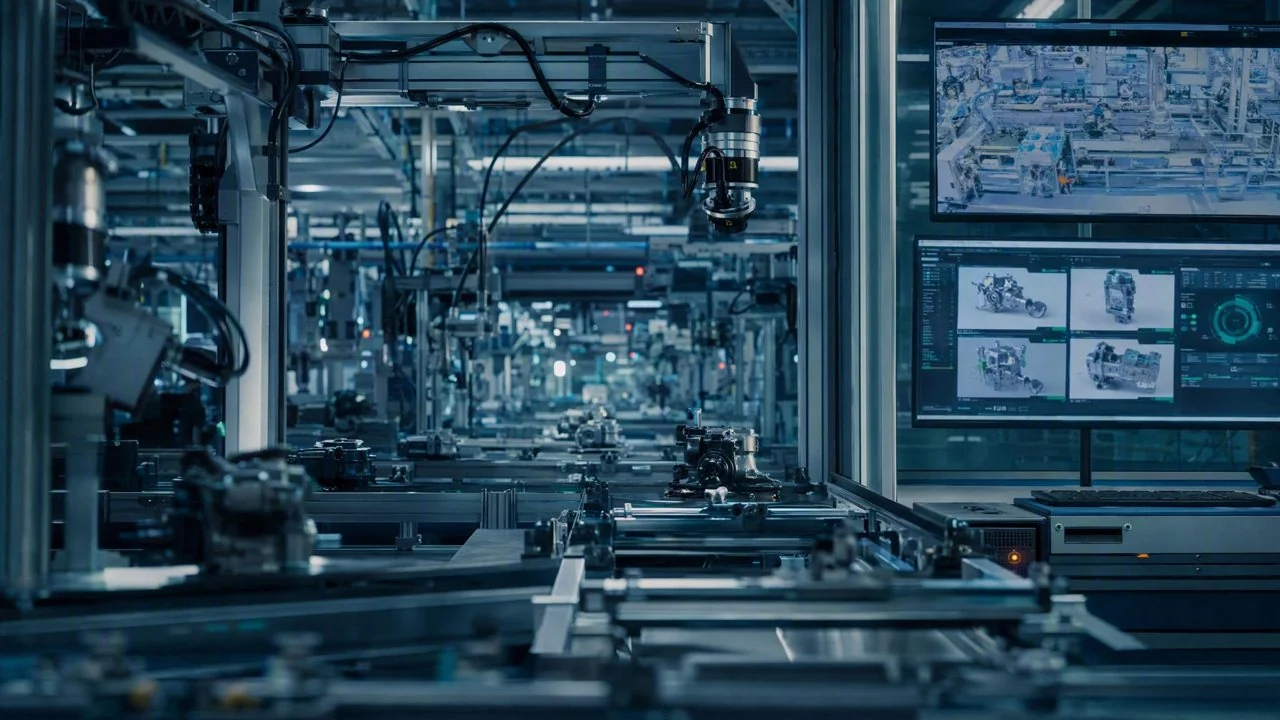
DaoAI SkyVision 0-code video surveillance AI platform (on-site hour-level custom model training, behavior/event recognition, edge box real-time alerting, 100% local data processing, DaoAI World world model semantic understanding) reduces the missed detection rate of bolt tightening omissions on automotive component assembly lines from a traditional 3.5% to <0.5% through real-time monitoring and intelligent identification, ensuring product quality and compliance. In the field of industrial SOP/operation specifications, especially in industries with extremely high assembly quality requirements such as automotive components and precision instrument manufacturing, any minor assembly oversight can lead to degraded product performance or even safety incidents. Traditional assembly lines primarily rely on manual visual inspection, sampling, or simple sensor triggers. These methods, when faced with increasingly complex and high-speed assembly processes, increasingly expose shortcomings such as high missed detection rates, low inspection efficiency, and high labor costs. Many manufacturers are still struggling with difficult-to-detect step omissions in assembly processes, which not only affects product quality but also increases rework costs and customer complaint risks.
DaoAI SkyVision 0-code video surveillance AI platform, through real-time monitoring and intelligent identification of bolt tightening omissions on automotive component assembly lines, reduces the missed detection rate of this critical process from a traditional 3.5% to <0.5%, ensuring product quality and compliance. In the field of industrial SOP/operation specifications, especially in industries with extremely high assembly quality requirements such as automotive components and precision instrument manufacturing, any minor assembly oversight can lead to degraded product performance or even safety incidents. Traditional assembly lines primarily rely on manual visual inspection, sampling, or simple sensor triggers. These methods, when faced with increasingly complex and high-speed assembly processes, increasingly expose shortcomings such as high missed detection rates, low inspection efficiency, and high labor costs. Many manufacturers are still struggling with difficult-to-detect step omissions in assembly processes, which not only affects product quality but also increases rework costs and customer complaint risks.
Pain Points: Why This Hurdle Is Difficult to Overcome
In automotive component assembly, such as engine or gearbox housing connections, hundreds of bolts are involved. The probability of missing a single bolt is low, but the consequences are severe if it occurs. The challenges of traditional solutions primarily manifest in several dimensions: Firstly, **high missed detection rates**. Manual visual inspection is limited by fatigue, distraction, and hidden bolt locations, typically resulting in an average missed detection rate between 1.5% and 3.5%. Even with sampling, it's difficult to cover all potential risks. Secondly, **high false alarm rates and re-inspection burden**. Rule-based traditional vision systems lack robustness to changes in ambient light, product model variations, and diverse worker postures, leading to a large number of false alarms, with an average false alarm rate exceeding 10%. This increases manual re-inspection hours, wastes human resources, and impacts production line takt time. Furthermore, **data exfiltration risk**. Faced with highly sensitive production data, especially video streams involving core processes and product designs, customers have extremely high demands for data security and local deployment. Any cloud-based solution may face compliance challenges. This aligns with the current focus on local data processing and privacy protection in retail parking lot security system construction, both emphasizing the importance of data staying on-premises.
The root cause of these pain points lies in the complexity and dynamic nature of assembly processes. For example, when tightening bolts, slight variations in bolt sizes for different models, tool obstructions, and hand or body obstructions during worker operations all pose significant challenges to visual recognition. Additionally, fast production line takt times leave very short time windows for inspection, making it difficult for traditional solutions to achieve high-precision judgments within such limited time. DaoAI deeply understands these engineering challenges and is committed to providing practical solutions through innovative technology.
Technical Principles
The core of DaoAI SkyVision platform lies in its powerful 0-code video surveillance AI platform, which combines advanced deep learning algorithms and the DaoAI World world model. For assembly step omission detection, SkyVision employs multi-modal sensing and behavior recognition technology. It captures real-time video streams of worker operations through industrial-grade cameras deployed at critical workstations on the production line. The platform's built-in visual foundation models automatically learn and understand the semantics of assembly actions, such as “picking up a bolt,” “aligning with a hole,” and “tightening tool contacting the bolt,” which are key steps. Unlike traditional rule-based AOI that relies on preset geometric features and thresholds, SkyVision, through its APDT (Auto-Programming & Data-Driven Training) few-shot self-training mechanism, requires only a small number of positive samples (1-20 good samples or compliant operation video clips) to quickly train a high-precision model on-site within hours, identifying whether a bolt has been correctly tightened or a critical component has been omitted.
Compared to traditional methods, DaoAI SkyVision's advantages include: Firstly, **high detection rate and significant reduction in missed detections**. Behavior recognition based on deep learning can effectively handle complex conditions such as lighting changes, occlusions, and diverse postures, increasing the detection rate of bolt tightening omissions to over 99.5% and reducing the missed detection rate by 85%. Secondly, **extremely low false alarm rate**. With the powerful semantic understanding and cross-scenario generalization capabilities of the DaoAI World world model, SkyVision can distinguish between actual omissions and misoperations, momentary occlusions, and other non-defect events, reducing the false alarm rate to below 0.2%, significantly easing the burden of manual re-inspection. Furthermore, **100% local deployment**. All data processing and model inference are completed on edge boxes, with video streams and sensitive data not uploaded to the cloud, meeting stringent customer requirements for data security and privacy. This local capability allows SkyVision to provide millisecond-level real-time alert responses while ensuring data security, far exceeding the response speed of traditional manual visual inspection.
Typical Application Scenarios
- **Automotive Component Assembly Bolt Omission Detection**: On assembly lines for critical components like engine blocks and gearbox housings, detecting whether all bolts are tightened according to specifications and if any are missed. The challenge lies in the large number of bolts, scattered locations, and potential obstruction of some bolts by tools or surrounding structures, making it difficult for traditional methods to cover comprehensively.
- **Electronic Product Line Connector Omission Detection**: During the assembly of PCBAs (Printed Circuit Board Assemblies) or wire harnesses, identifying whether all cables and connectors are correctly inserted into their corresponding interfaces. The challenge involves a wide variety of connectors, tiny sizes, and potential visual challenges such as similar colors or awkward angles.
- **Precision Instrument Component Installation Omission Detection**: For example, in the assembly of medical devices, aerospace components, ensuring that all tiny washers, springs, and clips are correctly installed. The challenge lies in extremely small component sizes, hidden installation locations, reflective or transparent materials, demanding extremely high imaging and recognition precision.
- **Home Appliance Product Line Component Misassembly/Omission**: Detecting whether internal wiring, piping, fans, and other critical components of large home appliances like washing machines and refrigerators are installed according to SOPs, preventing functional failures due to misassembly or omission. The challenge involves a complex variety of components, intricate assembly spaces, and potential co-production of multiple models on the same line.
Case Study
A leading Tier-1 automotive supplier had long faced challenges with missed bolt tightening on its engine assembly line. This production line produces thousands of engines daily, with hundreds of bolts involved in each engine. Traditionally, they relied on manual patrols combined with spot checks, but still experienced several rework incidents or customer complaints each month due to missed bolts, leading to high rework costs and damage to brand reputation. The average missed detection rate was around 2.8%, and manual re-inspection consumed significant man-hours. After introducing the DaoAI SkyVision platform, we first conducted a two-week on-site model training and deployment on a critical sub-assembly line. By collecting a small number of video clips of normal tightening and simulated omissions, the SkyVision platform completed custom model training and deployment in less than one workday. In the initial phase, SkyVision operated in parallel with manual inspection for validation.
"The SkyVision platform not only reduced our missed detection rate to an unprecedented level but, more importantly, it freed up significant manual re-inspection resources, allowing us to focus our efforts on more valuable quality improvement activities."
After deployment, the supplier's bolt tightening omission detection rate quickly rose to over 99.6%, with the missed detection rate consistently below <0.4%, representing an 85% reduction compared to traditional solutions. Simultaneously, due to a 90% reduction in false alarm rates, the workload for manual re-inspection was significantly reduced, saving an average of 3-4 hours of manual re-inspection time daily. The SkyVision platform's edge box real-time alerting function ensured that any omission was detected and corrected at the first instance, preventing defective products from flowing to the next process, effectively reducing rework costs and quality risks. Furthermore, 100% local deployment completely alleviated the customer's data security concerns, ensuring the privacy of core production data.
DaoAI Solutions and Products
DaoAI's core solution for assembly step omission detection revolves around the **SkyVision 0-code video surveillance AI platform**. This platform, based on the DaoAI World world model, possesses powerful semantic understanding and scenario generalization capabilities, enabling it to quickly adapt to assembly specifications of different production lines and product models. In practical implementation, we first capture production line video streams using high-resolution industrial cameras and connect them to SkyVision edge boxes. Customers do not need specialized AI knowledge; they can use SkyVision's 0-code visual interface to train models on-site within hours, using a small number (1-20) of video clips of normal operations or defective samples. The platform automatically learns and builds assembly action models to identify critical events such as whether bolts are in place or components are missing.
The SkyVision platform supports 100% local private deployment, with all data processing, model inference, and alerts completed on local edge boxes, ensuring data remains on-premises and meeting stringent customer requirements for data security and compliance. When the system detects any omission, it immediately sends a real-time alert via the edge box to the production line control system and can link with audible and visual alarms to notify on-site operators for timely correction. This rapid response mechanism ensures that defects are contained within the smallest possible scope, greatly reducing the cost and complexity of subsequent rework. DaoAI also provides flexible SDK/API interfaces, allowing customers to integrate SkyVision's intelligent detection capabilities into existing MES/SCADA systems, achieving data closed-loop management and intelligent production processes. Through the SkyVision platform, customers have achieved an **assembly step omission detection rate increase to 99.6%**, a **missed detection rate reduction to <0.4%**, and a **false alarm rate reduction of 90%**, significantly improving product quality and production efficiency.
FAQ
How does DaoAI SkyVision platform achieve “0-code” training?
SkyVision platform utilizes an intuitive visual interface and the APDT few-shot self-training mechanism, allowing users to upload a small number (1-20) of video clips of normal operations or defects. The platform's built-in visual foundation models automatically learn and understand these samples, enabling high-precision model training and deployment on-site within hours, without writing any code, significantly lowering the barrier to using AI technology.
What are the deployment and integration features of the SkyVision platform?
The SkyVision platform supports 100% local private deployment, with all data processing and model inference completed on edge boxes, ensuring data remains on-premises to meet strict data security and privacy requirements. Additionally, we provide flexible SDK/API interfaces, allowing customers to integrate SkyVision's intelligent detection capabilities into existing MES, SCADA, or other production management systems, achieving data closed-loop and intelligent production management.
What are the cost components for deploying DaoAI SkyVision platform?
The cost of the SkyVision platform primarily includes software licensing fees, edge computing hardware (such as edge boxes) costs, and potential professional services (e.g., on-site deployment, customized model training support). Specific pricing will vary based on factors such as your production line scale, number of monitoring points, detection complexity, and required functional modules. We encourage you to contact our sales team to receive a detailed proposal and quote tailored to your specific needs.
Full solution for this scenario: Video Surveillance industry solutions
This article was generated by AI. Customer cases are simulated scenarios based on real product capabilities and figures are illustrative; see product pages for official benchmarks.