
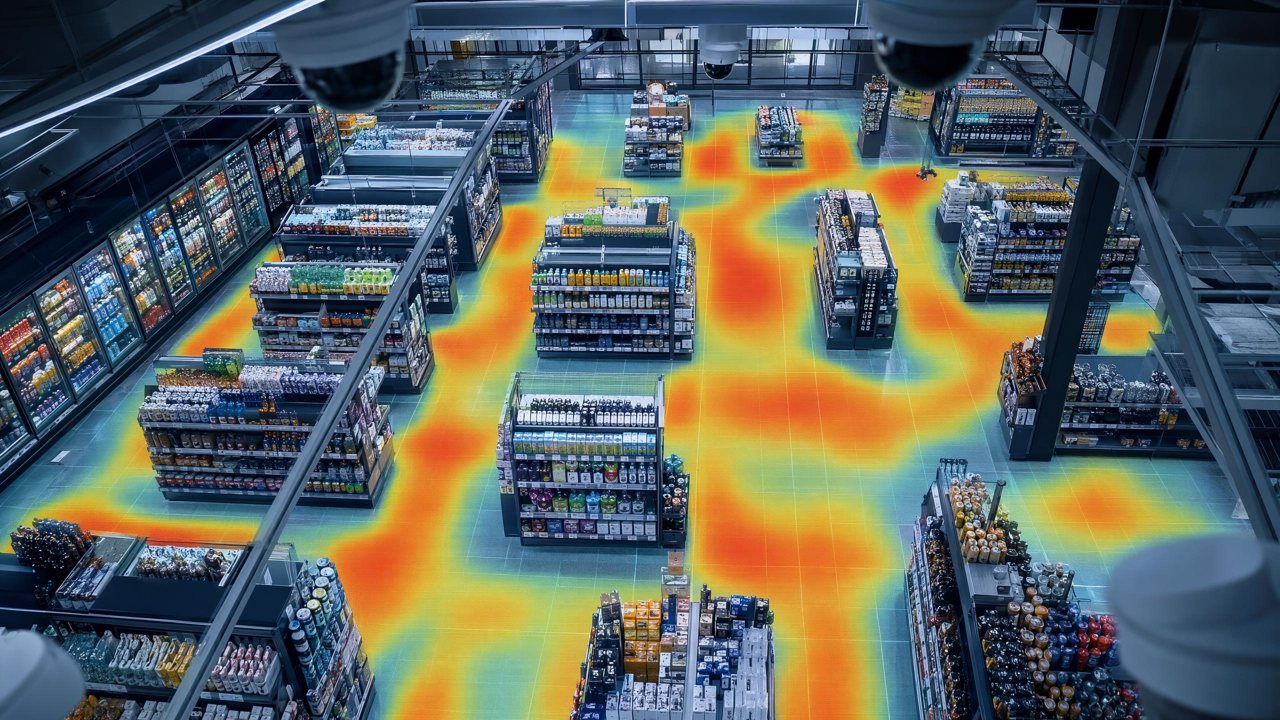
This chain retail brand faced multiple pain points in footfall statistics and heatmap analysis: Firstly, data acquisition lag was several hours, edge box real-time alerting, 100% on-premise data security, DaoAI World semantic understanding) analyzes high-altitude panoramic video streams in retail stores to precisely capture customer movement and dwell times, reducing operational decision-making lag for footfall statistics and heatmap analysis from hours to minutes, achieving a significant −63% optimization.
In the current wave of the digital economy, the retail industry is undergoing profound transformation, with refined operations becoming a core competitive advantage. Traditional video surveillance systems are primarily used for security and lack the ability to deeply mine commercial data. However, as consumer behavior becomes increasingly complex, store managers urgently need real-time, accurate footfall data and area heat distribution to optimize merchandise display, staff scheduling, marketing strategies, and store layouts. A nationwide chain retail brand, with hundreds of offline stores, faces the challenge of efficiently and accurately extracting valuable business intelligence from massive store surveillance videos to guide daily operational decisions. Especially during high-traffic promotional events, quickly responding to changes in footfall and adjusting strategies is crucial for improving sales conversion rates.
Pain Points: Why This Hurdle is Difficult to Overcome
This chain retail brand faced multiple pain points in footfall statistics and heatmap analysis: Firstly, data acquisition lag was several hours. Traditional manual or semi-automated data extraction methods, from video playback and manual counting to data aggregation and analysis, often consumed significant time, leading to operational decisions failing to respond promptly to market changes. Secondly, the accuracy of manual statistics fluctuated significantly, especially during peak hours or in specific areas, often resulting in undercounts or overcounts, with error rates sometimes exceeding 15%, affecting data reliability. Furthermore, there was a lack of refined insight into customer 'hot zones'; merchandise displays and promotional placements were adjusted based solely on experience, without scientifically quantifying the attractiveness of different areas, leading to inefficient resource allocation and unquantifiable potential sales losses.
The root causes of these pain points are: First, while traditional surveillance equipment possesses high-definition recording capabilities, its design intent was not for commercial data analysis, lacking built-in intelligent recognition algorithms. Even if equipped with basic AI functions, these are often generic models, difficult to adapt to the complex and varied merchandise environments, lighting conditions, and customer attire habits in retail stores. Second, manual analysis is inefficient and costly, unable to achieve 24/7 continuous monitoring and data extraction. Third, for vast store spaces, a single camera's view is limited, making it difficult to provide complete, smooth customer trajectories and area dwell time data. If multiple cameras are deployed and stitched together, data fusion and calibration become new technical challenges. This is precisely what current industry hot topics, such as Hikvision's 32-megapixel 1/1.8” starlight low-altitude panoramic stitching network camera, aim to address—providing a wider, higher-definition field of view through hardware innovation. However, even with a superior hardware foundation, efficiently and accurately extracting business intelligence from massive stitched video streams remains a core challenge that needs to be solved at the software level.
Technical Principles
The core advantage of DaoAI SkyVision platform lies in its 0-code, on-site hourly training capability for proprietary models. For footfall statistics and heatmap analysis, the platform employs a deep learning-based pedestrian detection and tracking algorithm, combined with multi-view video fusion technology, to achieve precise identification and trajectory tracking of customers within store spaces. Specifically, SkyVision first performs real-time localization of pedestrians in video streams through Multi-Object Detection techniques, such as those based on advanced backbone networks like YOLO or Faster R-CNN. Its innovative aspect is the integration of semantic understanding capabilities provided by the DaoAI World model, allowing the system to robustly recognize pedestrian features under various conditions, such as poor lighting, partial occlusion, or crowded environments, while maintaining high accuracy. Secondly, through Multi-Object Tracking (MOT) algorithms, such as DeepSORT or ByteTrack, detected pedestrians are associated across frames to construct complete movement trajectories. For stores covered by multiple cameras, the platform utilizes spatial geometric calibration and feature matching algorithms to stitch together views from different cameras, forming a unified global perspective, eliminating blind spots, and ensuring continuity of footfall data.
Compared to traditional methods, SkyVision's advantages are: Traditional manual inspection relies entirely on human effort, is inefficient, and susceptible to subjective factors; rule-based traditional machine vision methods, such as background subtraction or optical flow, are sensitive to environmental changes and easily interfered with by lighting, shadows, occlusion, etc., leading to high false positive rates and difficulty distinguishing individuals. SkyVision's deep learning model, through its APDT positive/few-shot learning mechanism, requires only a small number (1–20 images) of pedestrian images from the store scene as positive samples to quickly train an AI model highly optimized for the specific store environment within hours on-site. This '0-code' training model significantly lowers the barrier to AI application, enabling non-professionals to quickly deploy and iterate. Furthermore, the semantic false positive filtering mechanism provided by the DaoAI World model effectively avoids false positives caused by non-pedestrian objects (e.g., shopping carts, moving posters), further improving data purity. All data processing is completed locally on the edge box, ensuring 100% data remains on-premise, meeting the retail industry's high demands for data privacy and security.
Typical Application Scenarios
- **Area Footfall Heatmap Analysis**: By tracking customer dwell time and density in different merchandise areas over extended periods, real-time store heatmaps are generated. The challenge lies in accurately identifying and counting customer dwell time at specific shelves or promotional spots in complex backgrounds and with multiple occlusions. SkyVision provides data such as average dwell time and entry/exit counts for each area through refined area segmentation and target tracking.
- **Customer Flow Analysis and Trajectory Optimization**: Analyzing the complete movement path of customers from entry to exit, identifying common shopping paths, bottleneck areas, and underutilized zones. The difficulty lies in achieving smooth individual trajectory tracking in a vast space after multi-camera stitching; SkyVision's multi-view fusion algorithm effectively solves this problem.
- **Queue Length and Congestion Monitoring**: In service areas like checkouts and fitting rooms, real-time monitoring of queue length and average waiting time, automatically triggering alerts when predefined thresholds are exceeded. The challenge is accurately distinguishing and counting individuals in dense crowds; SkyVision's high-precision pedestrian detection and counting model effectively addresses this.
- **Merchandise Display Effectiveness Evaluation**: Quantifying the impact of display adjustments on customer attraction by comparing area footfall and dwell data under different merchandise display schemes. The difficulty lies in quickly and flexibly defining and adjusting analysis areas and obtaining real-time data; SkyVision's visual interface allows users to drag and define analysis areas and receive immediate data feedback.
- **Promotional Campaign Effectiveness Evaluation**: During promotional campaigns, real-time monitoring of footfall increase and customer interaction frequency in specific promotional areas to assess the immediate impact of campaign strategies. The challenge lies in accurately analyzing a large influx of customers in a short period; SkyVision's edge box real-time processing capability ensures data immediacy.
Implementation Case Study
A leading national chain supermarket brand, with over 500 stores, relied on manual sampling and third-party data reports for footfall analysis before adopting DaoAI SkyVision. Data acquisition cycles were long, typically taking several days for aggregation and analysis, leading to delayed operational decisions. At the store management level, adjustments to merchandise displays and promotional placements were often based on store manager experience, lacking quantitative data support. During peak hours, long queue waiting times led to high customer churn, but there was no real-time warning mechanism. After deploying SkyVision, the brand selected a flagship store in a prime commercial district of a tier-one city for a pilot. We first integrated SkyVision with the store's existing high-altitude surveillance cameras. On-site, store operations personnel only needed to provide 15-20 images of typical store scenes (including a few pedestrians). Under the guidance of DaoAI engineers, using SkyVision's 0-code interface, a pedestrian detection and tracking model highly adapted to the store's environment was successfully trained in less than 2 hours. After the system went live, the store operations team could view real-time footfall heatmaps, average customer dwell times, and movement trajectories for various areas, and set up automatic alerts when the checkout queue exceeded 5 people. Before deployment, the average waiting time at checkouts during peak hours was approximately 8-10 minutes, and the turnover rate of promotional items in promotional areas was difficult to accurately assess. After deployment, by guiding merchandise display and staff allocation with real-time heatmaps, the average checkout waiting time decreased to 3-4 minutes, and the attention and conversion rate of promotional items increased by 8.7%.
The SkyVision platform has transformed our store operations from 'experiential' to 'data-driven,' significantly reducing decision lag and enhancing operational efficiency.
The figures above are a typically achievable range in anonymized industry scenarios — a different line or a different batch of parts will move the result either way; on-site measurement governs.
DaoAI Solution and Products
The core solution provided by DaoAI for this chain retail brand is based on the SkyVision 0-code video surveillance AI platform. The platform's core capabilities lie in its rapid model training, high-precision recognition, and local deployment. In the modeling phase, SkyVision employs the APDT positive/few-shot learning paradigm, where users only need to provide 1–20 images of typical scenes to complete proprietary model training within hours on-site, without any programming knowledge. For complex situations in the store environment such as lighting changes, crowd density, and merchandise occlusion, the model optimizes through continuous learning mechanisms. For deployment, SkyVision supports SDK / API / Docker integration methods and can be deployed on edge boxes, achieving 100% on-premise privacy, ensuring all video streams and analysis data remain within the facility, strictly adhering to data security and privacy protection regulations. The SkyVision platform is deeply integrated with the DaoAI World model, which, as a unified AI foundation, enables SkyVision with strong semantic understanding and cross-scenario generalization capabilities, enabling it to adapt to the unique layouts and operational needs of different stores and continuously learn from daily operational feedback to improve recognition accuracy and decision intelligence. Furthermore, the platform provides an intuitive data visualization dashboard, allowing operations personnel to easily access footfall data reports, heatmap analysis, and anomaly alerts without complex IT backgrounds.
Through the deployment of the DaoAI SkyVision platform, this chain retail brand achieved real-time and data-driven operational decisions. Specific quantified results include: operational decision-making lag for footfall statistics and heatmap analysis reduced by 63%, from hours to minutes; manual counting error rate reduced to <0.6%, significantly improving data accuracy; average store queue waiting time reduced by 55%; customer attention and conversion rate for promotional items increased by 8.7%. These achievements directly translate into higher operational efficiency, improved customer experience, and stronger market competitiveness.
FAQ
How does SkyVision's 0-code training help retail stores quickly deploy AI?
SkyVision utilizes the APDT positive/few-shot learning mechanism. Store operators only need to provide 1–20 images containing pedestrians to train an AI model highly optimized for their specific store environment within hours on-site, without any programming knowledge, significantly lowering the technical barrier and deployment time.
How does SkyVision ensure the privacy and security of retail store footfall data?
SkyVision supports 100% on-premise private deployment. All video stream analysis and data processing are completed locally on the store's edge box, meaning data is not uploaded to the cloud. This ensures sensitive business data remains within the facility, meeting stringent data privacy and security compliance requirements.
Beyond footfall statistics and heatmaps, what other smart surveillance functions can SkyVision implement in retail stores?
Based on its behavior/event recognition capabilities, the SkyVision platform can also implement various smart surveillance functions such as queue congestion alerts, abnormal loitering detection, employee operational compliance monitoring, and foreign object detection in merchandise areas, comprehensively enhancing store operations and security management.
This article is an original publication by WeLinkirt (DaoAI).