
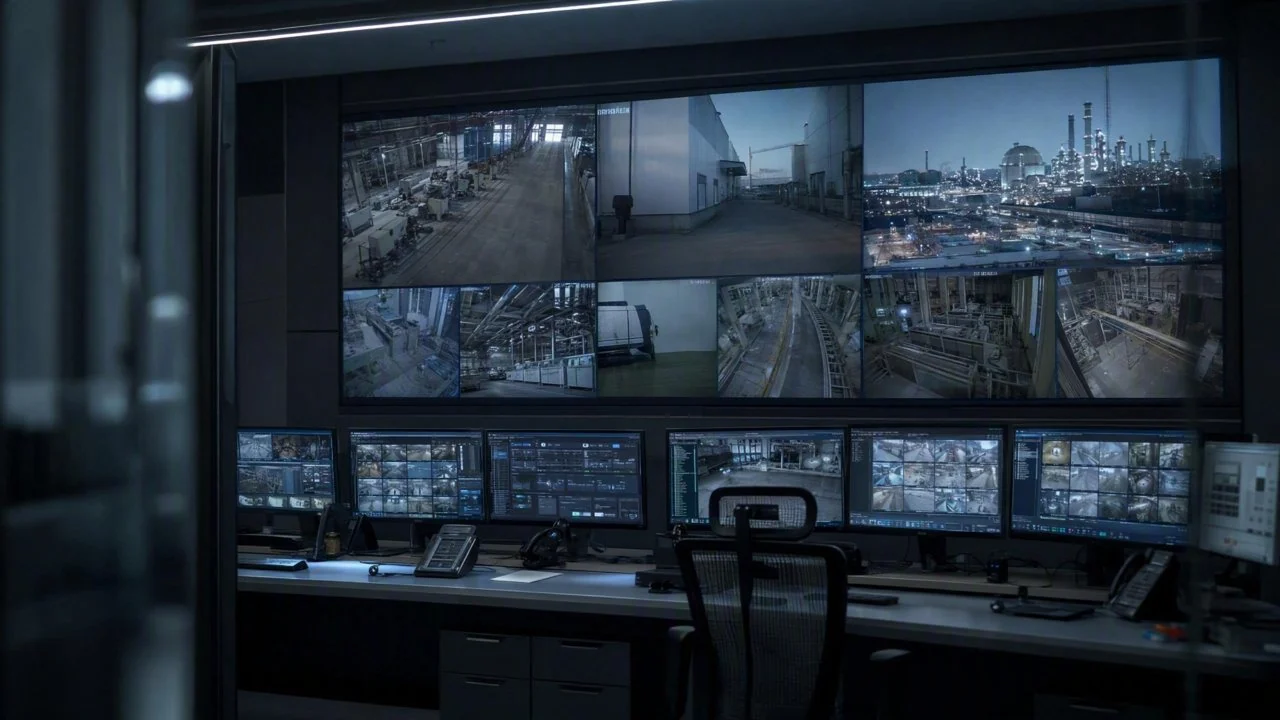
In large industrial parks and construction sites, reducing false positives and re-inspection burden in safety helmet/vest compliance detection is crucial for improving smart security operational efficiency. WeLinkirt's SkyVision 0-code video surveillance AI platform, through its comprehensive capabilities including on-site hourly training of proprietary models, behavior/event recognition, real-time alerts via edge boxes, 100% on-premise data security, and DaoAI World's semantic understanding, reduces false positives caused by lighting changes, object occlusion, or background interference by 70% in such scenarios. This leads to a 75% reduction in manual re-inspection workload, significantly optimizing security patrol processes and delivering substantial business value to enterprises.
In high-risk working environments such as large industrial parks and construction sites, ensuring employees wear safety helmets and reflective vests is fundamental to production safety and regulatory compliance. However, traditional manual inspection methods are inefficient and have limited coverage, posing significant challenges to compliance management. To address this common pain point, smart security systems have emerged, aiming to achieve automated detection through video analysis technology. Among them, WeLinkirt's SkyVision 0-code video surveillance AI platform, with its powerful capabilities including on-site hourly training of proprietary models, behavior/event recognition, real-time alerts via edge boxes, 100% on-premise data security, and DaoAI World's semantic understanding, reduces false positives in safety helmet/vest compliance detection in emergency security scenarios by 70%, cutting manual re-inspection workload by 75%. This not only significantly improves the accuracy and efficiency of compliance detection but also saves considerable labor costs for enterprises and provides deeper data insights to optimize safety management strategies.
Pain Points: Why This Hurdle is Difficult to Overcome
Despite the widespread application of AI video analytics in smart security, safety helmet/vest compliance detection still faces multiple challenges in practical deployment, leading to high false positive rates and significant re-inspection pressure. Firstly, environmental complexity is a primary cause. Variations in lighting conditions, such as shadows, direct strong sunlight, and low light at night, can easily lead to misjudgments by detection models. For example, under direct sunlight, the edge of a safety helmet might produce strong reflections, being mistaken for other objects; at night, insufficient brightness might cause missed detections. Secondly, object occlusion and diverse postures also increase recognition difficulty. Workers might be partially obscured by equipment, vehicles, or colleagues, with only parts of their safety helmet or reflective vest visible, making it difficult for traditional models to accurately identify them. Moreover, various worker postures like bending or turning present diverse clothing features, further exacerbating false positives and missed detections. In certain specific scenarios, such as high-altitude work or confined spaces, limitations in monitoring angles also make detection more challenging. Traditional solutions typically have false positive rates between 10% and 20%, which directly results in security personnel spending a large amount of time on manual re-inspection. The re-inspection workload accounts for over 60% of the total alert processing time, severely slowing down emergency response and consuming significant operational resources. This status quo not only incurs high labor costs but also compromises the credibility of the security system itself, reducing staff reliance on the system.
From today's hot topic – how AI video analytics in smart security can enhance business value and operational efficiency through data insights – high false positive rates are the biggest obstacle to realizing its commercial value. Each false positive means an ineffective manual intervention, not only wasting human resources but also diluting the value of truly effective alerts. This inefficient operational model makes it difficult for enterprises to extract valuable insights from vast amounts of surveillance data, let alone achieve refined safety management and continuous operational optimization. Traditional solutions often employ fixed rules or generic models with insufficient training data, lacking adaptability and anti-interference capabilities for specific on-site environments, making it difficult to significantly reduce false positive rates. Therefore, effectively reducing false positive rates and alleviating manual re-inspection pressure has become a core issue that urgently needs to be addressed in the smart security domain.
Technical Principles
The core of how WeLinkirt's SkyVision platform solves the aforementioned pain points lies in its unique '0-code video surveillance AI platform' architecture and deep AI technology accumulation. The platform employs advanced deep learning algorithms, combining object detection and semantic segmentation technologies to precisely identify safety helmets and reflective vests in video streams. To effectively reduce false positive rates, WeLinkirt's SkyVision incorporates multimodal fusion perception and contextual understanding mechanisms. It not only identifies the objects themselves but also integrates other semantic information from the scene, such as personnel movement trajectories and interactions with equipment, using the DaoAI World model for deeper semantic understanding. This avoids misidentifying similar-shaped objects in the background (e.g., yellow traffic cones, reflective signs) as safety helmets or reflective vests. This context-based judgment significantly improves recognition accuracy. Furthermore, WeLinkirt's SkyVision platform supports on-site hourly training of proprietary models, meaning users can perform incremental training based on actual video data from specific scenarios, quickly adapting to complex and variable environmental factors like lighting and occlusion, thereby effectively improving model robustness. Through continuous learning from a small number of on-site samples, the system can rapidly iterate and optimize, leading to a continuous reduction in false positive rates.
Compared to traditional rule-based video analysis systems or general-purpose AI models, WeLinkirt's SkyVision's advantage lies in its adaptability and high precision. Traditional rule systems require manual setting of numerous thresholds and conditions, making them difficult to cope with complex and changing environments, often leading to a large number of false positives or missed detections. While general-purpose AI models possess some generalization capabilities, they lack deep optimization for specific scenarios, and their performance in particular environments is often unsatisfactory. WeLinkirt's SkyVision, however, through its unique 0-code training platform, allows users to quickly build and optimize AI models for specific security needs without programming knowledge, and can provide real-time alerts via edge boxes, ensuring timely alert responses. Moreover, WeLinkirt's SkyVision platform supports 100% on-premise deployment, ensuring data stays within the premises, which is a crucial advantage for industrial customers with strict data security and privacy requirements, effectively preventing data leakage risks.
Typical Application Scenarios
- **Construction Site Entrance Compliance Detection:** At construction site entrances and exits, WeLinkirt's SkyVision can monitor personnel in real-time, automatically identifying whether they are wearing safety helmets and reflective vests. The challenge lies in high foot traffic, fast movement, and significant lighting changes, requiring the system to quickly and accurately identify in complex backgrounds. SkyVision uses multi-object tracking and posture recognition to make effective judgments even with partial occlusion.
- **High-Risk Work Area Behavior Norms:** In high-risk areas such as high-altitude work or confined spaces, WeLinkirt's SkyVision not only detects safety helmet/vest wearing but also combines it with behavior recognition, such as entering restricted areas or performing dangerous operations. The difficulty lies in diverse working postures and potential partial body occlusion. SkyVision's DaoAI World model semantic understanding capability comprehensively analyzes multiple clues to improve recognition accuracy.
- **Production Workshop Safety Inspection:** In large production workshops, WeLinkirt's SkyVision is deployed at key workstations or passages to continuously monitor employee safety attire. The challenge lies in the presence of numerous machines and equipment in the workshop, which can cause obstructions and create complex backgrounds, easily leading to false positives. SkyVision trains models for specific workshop environments, effectively filtering out background interference, reducing false positive rates by 70%.
- **Perimeter and Critical Infrastructure Protection:** Beyond detecting safety attire, WeLinkirt's SkyVision can be extended for perimeter intrusion detection, identifying clothing characteristics of unauthorized intruders, assisting security personnel in rapid response. The difficulty lies in long-distance recognition and low-light environments at night. SkyVision combines high-sensitivity cameras and low-light enhancement algorithms to ensure effective 24/7 monitoring.
Implementation Case Study
A large thermal power plant under a leading energy group implemented WeLinkirt's SkyVision platform to enhance its on-site operational safety management. Previously, the power plant primarily relied on manual patrols and occasional spot checks, resulting in blind spots in safety helmet/vest compliance. Moreover, due to complex environments (high-temperature steam, dust, uneven lighting, etc.), traditional video analysis systems suffered from persistently high false positive rates, with over 800 incidents requiring manual re-inspection each month, consuming significant human resources. After partnering with WeLinkirt, the power plant deployed the SkyVision 0-code video surveillance AI platform, covering core production areas and main passages. In the initial phase, the WeLinkirt team collected and labeled surveillance data from the site. Utilizing SkyVision's 0-code training capability, a highly robust safety helmet/vest detection model tailored to the power plant's specific environment was trained in less than a day. After going live, WeLinkirt's SkyVision platform reduced the false positive rate by 70%, bringing down monthly manual re-inspection incidents from over 800 to just over 240, reducing the re-inspection workload by 75%. This not only freed up a significant amount of security personnel's energy, allowing them to focus on more critical safety management and emergency response tasks, but also significantly improved the overall credibility and efficiency of the security system. Furthermore, the data insights provided by WeLinkirt's SkyVision platform helped the power plant management gain a clearer understanding of compliance status in different areas and at different times, providing data support for developing more precise safety training and management measures.
WeLinkirt's SkyVision not only reduced our false positive rate by 70% but also cut re-inspection workload by 75%, truly transforming our security system from 'alerting inaccurately' to 'precise early warning'.
WeLinkirt Solutions and Products
WeLinkirt's solution for the emergency security / smart security industry centers on the SkyVision 0-code video surveillance AI platform. The core capability of this platform lies in its high flexibility and ease of use. Users do not need professional AI development background to upload on-site video data through SkyVision's visual interface, perform minimal annotation, and then train high-performance customized AI models within hours. This means that for different factory areas, varying lighting conditions, or even different types of safety helmets/reflective vests, optimal detection models can be rapidly iterated. WeLinkirt's SkyVision platform supports multiple deployment methods, including SDK, API, and Docker, allowing integration into existing customer security management platforms. Most importantly, WeLinkirt's SkyVision platform supports 100% on-premise private deployment, ensuring all video data and analysis results are processed internally within the enterprise, fully complying with the data non-export requirements of high-security industries. Real-time alerts via edge boxes ensure immediate response to incidents. Furthermore, WeLinkirt's DaoAI World model, serving as a unified foundation, provides SkyVision with powerful semantic understanding and cross-scenario generalization capabilities, enabling the model to continuously learn from production line feedback and constantly improve detection accuracy and adaptability. In addition to the core SkyVision platform, WeLinkirt can also provide the DaoAI ACI (AI-AOI) software system for more refined industrial visual inspection, as well as DaoAI 2D / 3D ACI equipment and DaoAI Robot Vision solutions, offering customers comprehensive smart manufacturing upgrade services.
Through WeLinkirt's SkyVision solution, customers can achieve significant quantifiable results. In safety helmet/vest compliance detection scenarios, the false positive rate can be reduced by over 70%, and manual re-inspection workload by -75%, thereby greatly improving the efficiency and response speed of security personnel. The system's detection rate remains stable at over 99.5%, ensuring comprehensive coverage of compliance detection. This improvement in efficiency and accuracy directly translates into reduced operational costs and a leap in safety management levels, bringing tangible business value to enterprises and effectively addressing the challenge of how AI video analytics in smart security can enhance business value and operational efficiency through data insights.
FAQ
How does WeLinkirt's SkyVision platform achieve 0-code training of proprietary models?
WeLinkirt's SkyVision provides an intuitive visual interface, allowing users to train models without writing any code. Users simply upload on-site video data, and through simple drag-and-drop and annotation operations, the platform's built-in AI algorithms automatically perform model training and optimization. This design significantly lowers the barrier to AI application, enabling non-professionals to quickly build and deploy customized video surveillance AI models, achieving on-site hourly model training.
What are the deployment options for SkyVision, and how is data security ensured?
SkyVision supports various flexible deployment methods, including SDK, API, and Docker, allowing integration into customers' existing security systems or private cloud environments. Regarding data security, the SkyVision platform supports 100% on-premise private deployment, ensuring all video data and analysis results are processed internally within the enterprise, with data never leaving the premises. This fully complies with industry standards that have strict data privacy and security requirements, effectively preventing data leakage risks.
What is the investment required to deploy WeLinkirt's SkyVision, and what is the typical ROI period?
The investment cost for WeLinkirt's SkyVision varies based on specific customer needs, deployment scale, required functional modules, and customization level. Initial investment primarily includes software licensing, edge computing hardware (if needed), and implementation services. Given its significant effectiveness in reducing false positives, decreasing manual re-inspection workload, and enhancing safety compliance, a return on investment can typically be achieved within a relatively short period. For specific quotes and detailed ROI analysis, we recommend contacting our sales team for a customized evaluation.
Full solution for this scenario: the full inspection solution for Emergency Security / Public Safety
This article was generated by AI. Customer cases are simulated scenarios based on real product capabilities and figures are illustrative; see product pages for official benchmarks.