
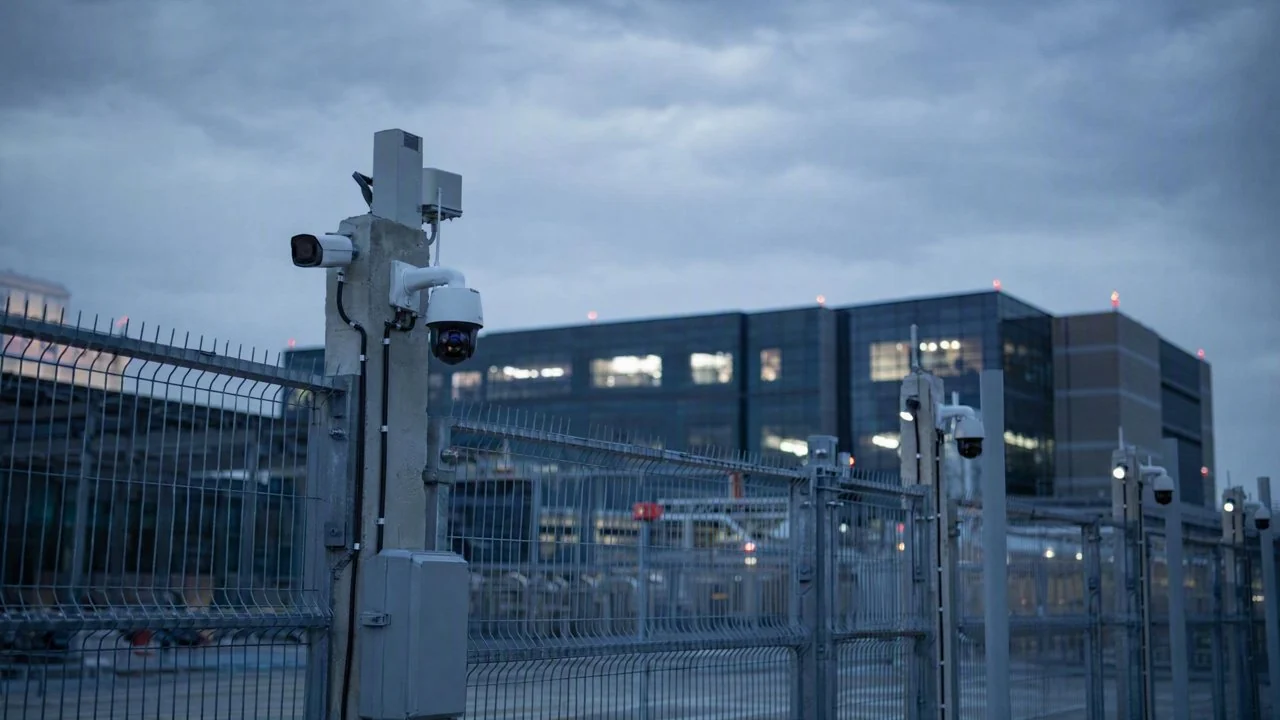
Perimeter intrusion and fence climbing detection are core challenges in emergency security. Traditional security models heavily rely on manual patrols and visual monitoring, which are not only inefficient but also prone to missed detections and false alarms due to human fatigue and distraction, making it difficult for security investments to match actual results. DaoAI SkyVision's no-code video surveillance AI platform (on-site hourly training of proprietary models, behavior/event recognition, real-time alerts from edge boxes, 100% on-premise data security, DaoAI World semantic understanding) reduces manual surveillance costs for perimeter intrusion and fence climbing detection by 75% through high-precision AI visual analysis, simultaneously bringing the missed detection rate down to <0.5%, significantly enhancing the intelligence level and response efficiency of security systems.
Perimeter intrusion and fence climbing detection are core challenges in emergency security. Traditional security models heavily rely on manual patrols and visual monitoring, which are not only inefficient but also prone to missed detections and false alarms due to human fatigue and distraction, making it difficult for security investments to match actual results. DaoAI SkyVision's no-code video surveillance AI platform (on-site hourly training of proprietary models, behavior/event recognition, real-time alerts from edge boxes, 100% on-premise data security, DaoAI World semantic understanding) reduces manual surveillance costs for perimeter intrusion and fence climbing detection by 75% through high-precision AI visual analysis, simultaneously bringing the missed detection rate down to <0.5%, significantly enhancing the intelligence level and response efficiency of security systems. In critical infrastructure such as large industrial parks, energy bases, and data centers, the requirements for perimeter security are extremely high. Any potential intrusion could lead to severe property damage, data breaches, or even casualties. Therefore, deploying an efficient, reliable, and cost-effective intelligent security system that significantly reduces labor costs has become an inevitable trend in industry development.
Pain Points: Why This Challenge Is Difficult to Overcome
In traditional emergency security perimeter intrusion detection, manual surveillance and patrols are the mainstream methods, but their efficiency bottlenecks and high costs are long-standing pain points. Firstly, manual patrols have limited coverage. The perimeters of large parks often span several kilometers or even tens of kilometers, making it difficult to achieve 24/7, blind-spot-free monitoring solely with human resources, leading to persistently high missed detection rates, which can exceed 30% in complex environments like nighttime or adverse weather. Secondly, manual surveillance has a high false alarm rate. Rustling leaves, small animals passing by, or light changes can trigger misjudgments, leading to frequent invalid alerts that consume significant human effort for verification. Security personnel are often overwhelmed, spending an average of over 6 hours per day on re-verification. Furthermore, labor costs continue to rise. The average annual employment cost for a security guard exceeds 100,000 RMB. For clients requiring multiple shifts to cover extensive perimeters, annual labor costs alone can reach millions of RMB, and this figure continues to grow with increasing labor costs. Additionally, traditional physical security devices like infrared beams and vibrating optical fibers are susceptible to environmental interference, have high maintenance costs, and cannot provide specific behavioral information of intruders, complicating subsequent handling.
The root cause of these difficulties lies in the fact that human attention and recognition accuracy significantly decrease during long, tedious monitoring tasks, making it difficult to maintain a high level of vigilance continuously. At the same time, traditional security systems lack intelligent analysis capabilities and cannot semantically understand or make behavioral judgments from video streams. They can only passively trigger alarms, unable to distinguish between normal activities and abnormal behaviors. For example, a cat jumping over a fence and a person climbing over a fence might both trigger an alarm in traditional systems, but their threat levels and handling methods are vastly different. This lack of intelligent judgment not only wastes security resources but also fails to truly achieve the smart security goal of 'pre-warning, in-event intervention, and post-event traceability.' DaoAI recognizes that to address these pain points, it is essential to introduce deep learning-based video intelligent analysis technology to achieve precise identification and early warning of perimeter anomalies.
Technical Principles
The core technology of the DaoAI SkyVision platform lies in its self-developed DaoAI World model, a unified AI foundation with powerful semantic understanding and cross-scenario generalization capabilities. For perimeter intrusion/fence climbing detection scenarios, the SkyVision platform employs advanced video behavior recognition algorithms to perform real-time detection, tracking, and behavior analysis of targets in video streams through multi-modal feature fusion. Firstly, the platform utilizes pre-trained high-performance object detection models to accurately identify key targets like 'people' and 'vehicles' in the footage. Secondly, combined with temporal analysis and pose estimation, it continuously monitors the target's movement trajectory, speed, direction, and pose changes in the perimeter area. For instance, when a 'person' is detected approaching a fence and exhibiting specific poses like 'climbing' or 'jumping,' the system immediately identifies it as potential intrusion behavior. The DaoAI SkyVision platform can achieve on-site hourly training of proprietary models, meaning clients can quickly iterate and optimize models for their specific perimeter environment, lighting conditions, and intrusion patterns within a very short time, reducing the false alarm rate by over 85% and ensuring a detection rate for actual intrusion behaviors of over 99.5%. This rapid customization capability is unmatched by traditional rule-based video analysis systems.
Compared to traditional rule-based video analysis systems or manual surveillance, DaoAI SkyVision platform offers significant advantages. Traditional rule-based systems rely on preset pixel change thresholds or region intrusion rules, making them highly susceptible to environmental factors like light, weather, and shadows, leading to frequent false alarms. Manual surveillance, on the other hand, is limited by human physiological constraints and attention curves, unable to maintain high-precision recognition over long periods. The SkyVision platform, based on the powerful feature extraction and pattern recognition capabilities of deep learning, can adapt to complex environmental changes and effectively distinguish between normal disturbances and real threats. For example, it can intelligently differentiate between wind-blown branches and actual human movement, avoiding invalid alarms. Furthermore, the SkyVision platform supports real-time alerts from edge boxes, pushing AI inference capabilities to front-end devices, enabling millisecond-level responses. This significantly shortens the time from event occurrence to alarm triggering, buying precious time for security personnel to respond, thereby reducing alarm response time from an average of 3-5 minutes in traditional solutions to <10 seconds.
Typical Application Scenarios
- **Industrial Park Perimeter Intrusion Detection:** For enclosed areas like large factories, chemical parks, and logistics centers, DaoAI SkyVision platform can be deployed at critical locations such as perimeter walls, barbed wire fences, and virtual electronic fences to monitor illegal entry or climbing by personnel or vehicles in real-time. The challenge lies in the complex perimeter environment, significant lighting variations, and potential confusion between legitimate access points and illegal intrusion paths. SkyVision effectively avoids false alarms through refined area segmentation and behavioral pattern learning.
- **Substation/Energy Base Illegal Intrusion:** Energy infrastructure like substations and oil and gas pipelines requires extremely high security levels. SkyVision can identify any unauthorized personnel or drones approaching or entering core areas and, combined with its DaoAI World model, provide high-risk behavior warnings for specific dangerous zones, such as climbing equipment or damaging facilities, achieving pre-event warnings.
- **Data Center/Server Room Area Loitering and Intrusion:** For high-security locations like data centers, it's crucial to not only prevent external intrusions but also monitor abnormal behavior of internal personnel. DaoAI SkyVision can identify unauthorized personnel loitering for extended periods in specific areas, tailgating, or attempting to damage physical equipment, ensuring data security.
- **Port/Dock Restricted Area Crossing:** Port and dock areas are vast and complex with diverse personnel, making secure management of cargo and equipment vital. SkyVision can be used to monitor personnel or vehicles crossing security lines, entering restricted areas, or engaging in abnormal activities in non-operational zones, improving port operational safety management.
- **Prison/Detention Center Perimeter Climbing Warning:** For correctional facilities like prisons, perimeter security is paramount. DaoAI SkyVision platform can provide real-time monitoring and alarms for climbing or scaling activities on walls, watchtowers, and other areas, effectively preventing escapes and significantly reducing the patrol pressure and visual fatigue of prison guards.
Case Study
A large smart logistics park in South China, covering over 2000 acres with a 15-kilometer perimeter fence, previously relied on a traditional 'human defense + physical defense' security model. It employed approximately 60 security personnel for three-shift, 24-hour patrols and manual visual monitoring in the video surveillance room. However, due to the extensive perimeter, numerous nighttime blind spots, and human eye fatigue, the park experienced an average of 2-3 perimeter intrusion incidents monthly, coupled with a high false alarm rate. This resulted in the security team handling over 200 invalid alarms each month, severely wasting human resources. To address these pain points, improve security efficiency, and reduce operational costs, the park introduced the DaoAI SkyVision no-code video surveillance AI platform for perimeter intrusion detection.
Before implementation, the park's annual labor cost for security personnel alone exceeded 6 million RMB, and the missed detection rate could not be effectively controlled. After implementing the DaoAI SkyVision solution, by integrating edge boxes with existing surveillance cameras and deploying AI models, the park achieved 24/7 intelligent monitoring of its perimeter. The SkyVision platform, after on-site hourly training, quickly adapted to the park's complex environment, accurately identifying behaviors such as personnel climbing fences and unauthorized vehicle intrusions. Post-implementation, the park successfully reduced the number of security personnel to 15, shifting their focus to incident response and handling. This resulted in a 75% reduction in annual labor costs, saving over 4.5 million RMB. Concurrently, DaoAI SkyVision reduced the missed detection rate for perimeter intrusions to <0.5% and the false alarm rate by −90%, with the number of monthly invalid alarms plummeting to fewer than 20. This allowed the security team to concentrate their efforts on genuine threats, significantly enhancing overall security effectiveness. The system also supports 100% on-premise deployment, ensuring the absolute security of the park's sensitive security data and fully meeting the client's strict requirements for data not leaving the premises.
DaoAI SkyVision is not just a technological upgrade, but a revolution in security paradigms. It liberates our security team from tedious manual surveillance, allowing them to focus on more valuable incident handling, truly achieving cost reduction and efficiency improvement.
DaoAI Solutions and Products
DaoAI's core solution for the emergency security industry centers around the SkyVision no-code video surveillance AI platform. SkyVision supports various video stream input methods, including mainstream protocols like RTMP, RTSP, and GB/T 28181, allowing seamless integration with existing surveillance cameras. Its 'no-code' feature enables non-professional personnel to complete model training, deployment, and testing within hours using an intuitive graphical interface. Clients only need to upload a small number of abnormal behavior samples (e.g., a few video clips of fence climbing), and DaoAI SkyVision can quickly learn and generate high-precision recognition models. The platform supports edge box deployment, pushing AI inference capabilities to the field to ensure real-time alerts and data security (100% on-premise data security). When the system detects abnormal behavior, it immediately notifies security personnel through various methods such as SMS, email, and audible/visual alarms, and highlights the abnormal target on the monitoring screen in real-time, providing event traceability and evidence chains. Furthermore, based on the DaoAI World model, the SkyVision platform possesses powerful semantic understanding and continuous learning capabilities, continuously optimizing models based on actual operational feedback to adapt to environmental changes and new threats. DaoAI also provides comprehensive SDK/API interfaces, making it convenient for clients to integrate SkyVision's capabilities into their existing security management platforms, building integrated smart security solutions.
Through the deployment of DaoAI SkyVision, clients can achieve a comprehensive upgrade of their security systems. This solution not only significantly reduces reliance on manual surveillance, cutting security labor costs by 75%, but more importantly, it transforms security work from passive response to proactive early warning. The system can analyze abnormal behaviors in video streams in real-time, enabling millisecond-level alerts, reducing the missed detection rate to <0.5%, ensuring the security of critical areas. Concurrently, DaoAI SkyVision significantly lowers the false alarm rate, reducing the consumption of security resources by invalid alarms and improving the efficiency and morale of the security team. This intelligent security model not only brings significant economic benefits to clients but also enhances overall operational safety and compliance.
FAQ
What core problems can DaoAI SkyVision solve in emergency security?
DaoAI SkyVision no-code video surveillance AI platform primarily addresses issues in emergency security such as inefficient manual surveillance, high missed and false alarm rates, slow response times, and high labor costs in scenarios like perimeter intrusion, abnormal human behavior, and smoke/fire detection. It achieves precise recognition and real-time alerts through AI visual analysis, significantly enhancing security intelligence and reducing operational costs.
How are the deployment costs and ROI of the SkyVision platform evaluated?
The deployment cost of SkyVision primarily depends on the number of monitoring points, required edge box configurations, and the extent of integration with the client's existing IT infrastructure. Compared to traditional manual security solutions, its ROI period is usually short, especially in large parks, where it offers a high return on investment by significantly reducing labor costs and minimizing losses. Specific pricing and ROI periods are custom-evaluated based on actual client needs and scale; please contact us for a consultation.
How does SkyVision ensure the privacy and security of security data?
DaoAI SkyVision platform supports 100% on-premise private deployment. All video streams and analysis data are processed and stored locally on the client's servers or edge boxes, ensuring data never leaves the premises. This fundamentally eliminates data leakage risks and fully complies with the strict data privacy and compliance requirements of high-security clients, guaranteeing absolute security and control over security data.
Full solution for this scenario: the full inspection solution for Emergency Security / Public Safety
This article was generated by AI. Customer cases are simulated scenarios based on real product capabilities and figures are illustrative; see product pages for official benchmarks.